 Yorimichi Games
How to play Spite and Malice
Spite and Malice is a turn-based contest between two players. The aim is to empty your pay-off pile before your opponent does. It is often called Cat and Mouse. Both players put cards onto the same center stacks. Each has a separate pay-off pile: emptying that pile is the winning objective. This is a planning game rather than a race to tap the screen. You can play against a CPU or pass one device between two people. Before making a move, look at your visible pay-off card. Playing many hand cards can be useful, but those cards are tools for reaching your objective, not the objective itself.
The cards and the layout
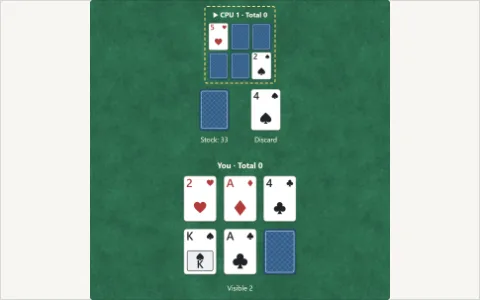
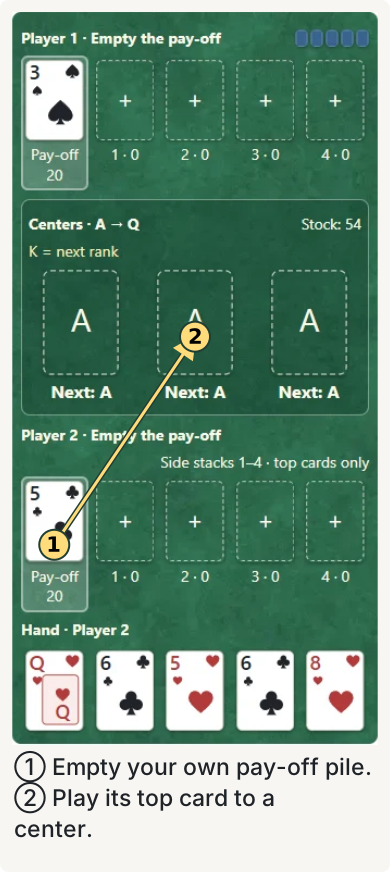
The standard setting uses two ordinary packs without jokers, shuffled together. Each player receives twenty pay-off cards and a five-card hand. The remaining cards form the draw stock. Only the top pay-off card is exposed. Neither player may examine the covered cards in either pay-off pile. The higher exposed rank opens the game, with K treated as highest for this comparison. Equal ranks lead to reshuffling both pay-off piles and comparing again. Four personal side stacks and three shared center spaces start empty. Your hand belongs to you; the other player sees its size but not its contents.
Spite and Malice rules for the center stacks
Build a center from A upward through Q. Suit and color do not affect whether a card fits. A red six and a black six are both legal on a five. You cannot skip a rank, move a center elsewhere, or take cards back from it. A completed twelve-card center is shuffled into the draw stock immediately, leaving an empty space. Starting a second center may create another route for a card that does not fit the first. However, spreading your useful cards across several centers can also leave you without the consecutive ranks needed to reach your pay-off card.
Kings are wild cards
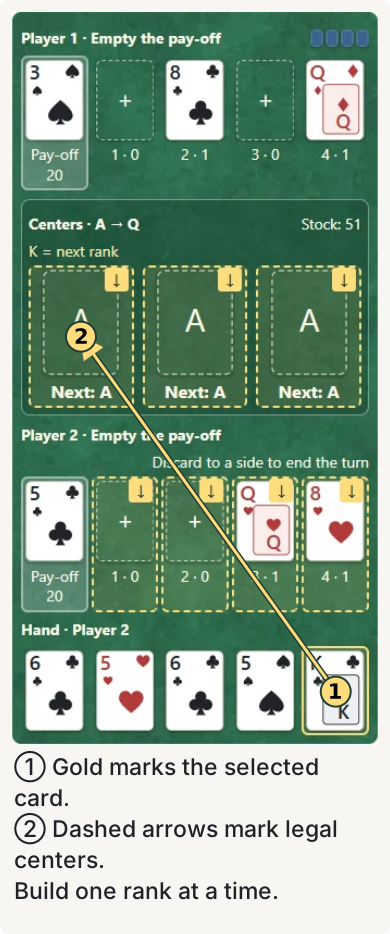
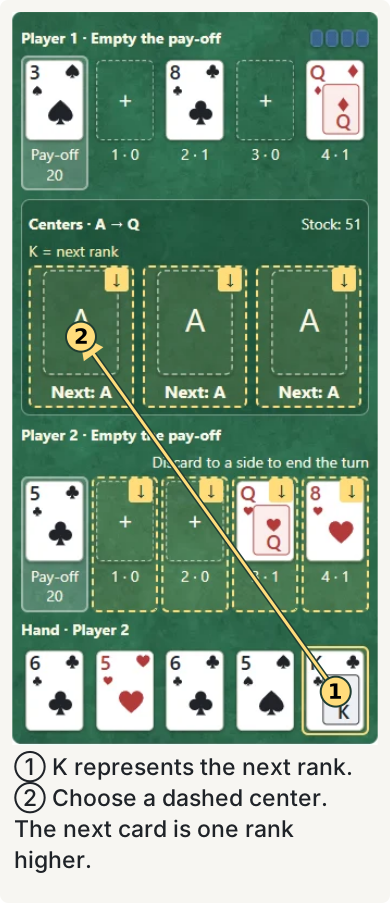
K represents the next required rank on a center. On a five, it represents six; the following card must be seven. In the standard setting, K may also represent A to start an empty center. The No wild ace setting removes that particular use. A K sitting in a side stack has no assigned rank yet. Its value is fixed by the center position when you play it. You do not choose an arbitrary higher number, and the next player does not change its value. A wild used as Q completes the center just as a natural Q does.
Selecting and placing a card
Tap or click a card in your hand, the top of your pay-off pile, or the top of a side stack. Then tap a center to place it. A dashed border marks legal destinations for the selected card. An unsuitable destination leaves the card where it was and explains the restriction. Tap the same card again, tap the empty felt, or press Clear selection to cancel your choice. You can also use Tab to reach a button and Enter to activate it. Escape clears the card selection. There is no requirement to drag a small card onto a precise target. This makes the same controls usable on a phone, tablet, or desktop computer.
Ending a turn with a side-stack discard
Place one hand card onto one of your four side stacks to end your turn. You may discard even when a center play remains available. This can be a useful decision when an otherwise harmless move would open a route for the opponent. Side stacks may contain ranks in any order, but only their top cards are available later. You cannot move a covered card, transfer a side card to another side stack, or put it back into your hand. Pay-off cards cannot be discarded. Keep track of which useful card you would cover before choosing a destination.

Hand refills and continuing a turn
At the start of a turn, your hand is replenished to five. If you play every hand card to the centers during the turn, you immediately receive five more and may continue. Moving a side or pay-off card does not reduce your hand. Discarding your last hand card ends the turn instead of giving you an immediate extra hand. Whenever fresh cards arrive, pause to check whether the new hand opens a route to your current pay-off card. A long sequence can change the best choice of center, especially after a completed stack leaves a new empty space.

Winning and a depleted stock
Playing the final pay-off card wins immediately, even if your hand and side stacks still contain cards. You do not wait for your opponent to finish a turn. If the draw stock cannot provide a required refill, this page ends the game as a draw. It does not award victory to the smaller remaining pay-off pile. A winning final pay-off play takes priority over any later refill. There is no move clock that makes you lose while thinking. You can pause a game, study the public side-stack history, or return to the rules without needing to make a rushed choice.
Rule variants and the settings
Standard uses twenty pay-off cards, three centers, and kings that may represent aces. Short game changes the pay-off count to ten. No wild ace keeps the standard count and spaces but requires a natural ace to begin a center. Four centers adds a shared building space. Custom lets you combine ten, twenty, or twenty-six pay-off cards with three or four centers and either wild-ace rule. These options are not the separate book version with jokers and restricted side-stack discards. Choosing twenty-six cards does not change the other rules into that book version. Some household versions also require specific low cards to be played or allow loading an opponent’s pile; those rules are outside this game.
Spite and Malice strategy: plan the bridge
First, identify the rank that will release your pay-off card. If a center shows three and your pay-off card is six, look for a four and a five among your hand and exposed side cards. Consider the whole bridge before starting it. A wild can fill a missing link, but spending it on a center with no useful continuation may leave you short next turn. Second, compare destinations when the same rank fits more than one center. One destination might expose the next card of a side stack, while another merely uses a hand card. Third, remember that emptying the hand can produce a fresh set of choices. This can justify a longer sequence even when the current pay-off card cannot be reached.

Organize reserves and watch the opponent
Arrange side stacks so that the top card can eventually lead to the cards beneath it. Repeated ranks can share a stack, while a descending series is often easier to release in order than a small card buried under a large one. Preserve an empty side space when practical, because it gives an awkward hand card somewhere to go without covering a valuable reserve. Finally, check the opponent’s visible pay-off card before handing over the turn. Advancing a center from four to five may help an opponent waiting with six. If you can continue through six yourself, that same move may instead deny the immediate opportunity. This is a reason to consider stopping, not a reason to assume you know the next hidden card.
CPU levels and local play
Easy concentrates on available hand plays and can miss a better reserve arrangement. Normal pays more attention to the pay-off card and useful side-stack combinations. Hard considers sequences of visible cards and the opponent’s exposed objective. All levels use their own hand and public information, not the opponent’s concealed cards. Press Play CPU turn when you are ready to watch its moves. Pause can interrupt that sequence. In local play, the hand is covered when the turn changes. Pass the device before selecting Reveal hand. Both players may inspect the public side-stack history. Neither has permission to inspect the draw stock or the covered part of a pay-off pile.
Undo and passing the device
Undo restores your most recent card action together with any CPU reply that followed it. It can interrupt an ongoing CPU sequence. In local play, you may undo a discard before the next player presses Reveal hand. Once that player reveals their private hand, undo is cleared. Finished games cannot be undone. A CPU game in which Undo has been used is practice and does not change the win/loss record. Open Settings, history & sound below the board for supporting controls. Against the CPU, your cards always stay at the bottom while the opponent selects and moves its own cards above.
Saving, records, and frequently asked questions
Each move saves the current game in this browser. Continue returns to the stored position, including the original rule choices. Opening settings does not overwrite the game by itself; starting a new game replaces the unfinished save. Another browser or device does not receive the save automatically. Storage restrictions or clearing browser data may remove it. CPU results are kept locally by difficulty, while local matches do not change that record. Why did an empty hand not win? Because the pay-off pile is the winning objective. Why is a side card unavailable? A card above it must be played first. Why does K seem to change the sequence? It takes the next rank required at the moment it reaches a center.
About this version
Spite and Malice belongs to the competitive-patience family and has several household and published rule traditions. There is no single universal combination of wild cards, pay-off sizes, side restrictions, and center limits. This page uses ordinary playing cards with kings as wilds, and keeps the selected rules visible below the controls. Check those settings before a local match so that both players expect the same game. The diagrams explain this page’s rules rather than the artwork or interface of a particular commercial product.
Rules at a glance
| Setting | Pay-off | Centers | K as A |
|---|---|---|---|
| Standard | 20 | 3 | Yes |
| Short | 10 | 3 | Yes |
| No wild ace | 20 | 3 | No |
| Four centers | 20 | 4 | Yes |
Rule sources: Pagat / SpiteNET / Beal family rules