 Yorimichi Games


How to play Dobon, a Japanese card game
Dobon combines matching suits and ranks with an unusual way to finish: compare the sum of your entire hand with the rank of the top discard. With a three and a five against an eight, you can claim Dobon regardless of suits. You cannot choose only part of a larger hand. Aces count as one, jacks as eleven, queens as twelve, and kings as thirteen. These arithmetic values stay the same even when a card has a special effect. A wild eight still provides a target of eight. A discard by another player can give you a winning opportunity before your ordinary turn arrives.
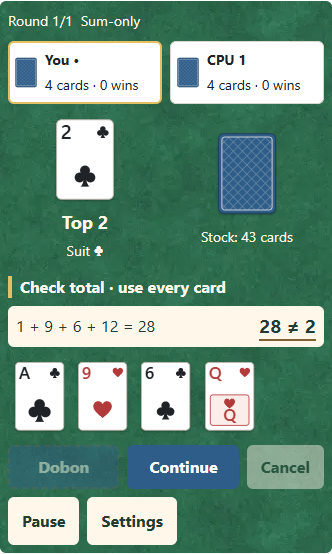

Choose Sum-only or Action cards
The Sum-only preset deals four cards and requires a Dobon claim to win. You cannot play your final card as an ordinary discard. A single card can still claim Dobon when another player’s top card has the same rank. Action cards deals five cards and also allows a player to finish by playing every card. It adds special aces, twos, eights, jacks, and bundled queens. Both presets use a standard fifty-two-card deck without jokers. Choose two, three, or four players. In CPU mode you are player one; the other seats use the selected level. Local mode lets everyone take turns on one device, with a hidden hand between players.
Matching cards and drawing
On an ordinary turn, choose a card matching the active suit or the top rank, then press Play. A dot and an outline identify a legal candidate. Drawing can also be a deliberate choice when you want to change your total. In Sum-only, drawing one card ends the ordinary turn. In Action cards, you may play the card just drawn if it fits, or end your turn while keeping it. The Draw until playable option keeps drawing until the latest card fits; you may then play that card or end the turn. You cannot use this step to play a different card already in your hand. After a draw, the drawing player gets a total check. You cannot claim against your own discard.
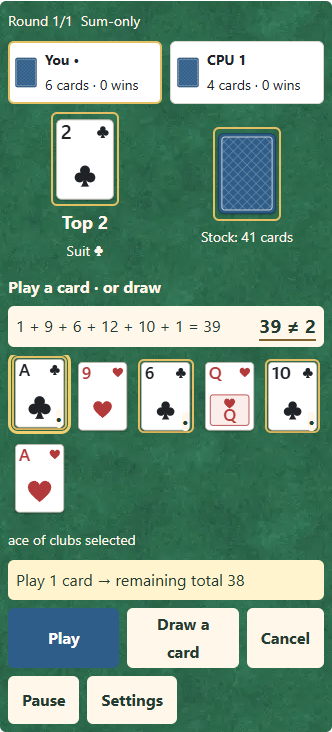

The checking step has no speed contest
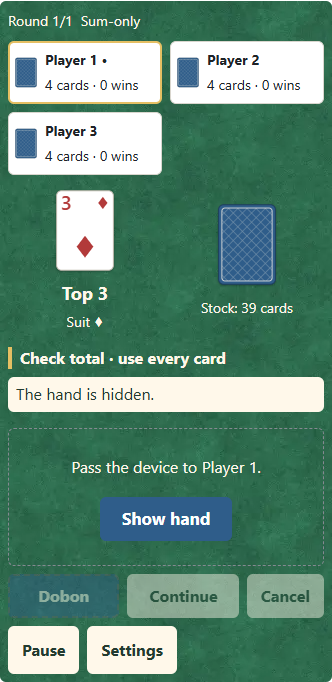
There is a checking step for the opening card, every fresh discard, and the person who has just drawn. During a check, ordinary play is paused. Claim Dobon when your whole hand matches the target, or choose Continue. If more than one person could claim, the checking order begins after the discarder and follows the current direction. The opening card starts with the first player. Nobody has to race a CPU or reach across a device. There is no countdown. Passing ends that particular opportunity; a later matching target can create a new one. Your own total is displayed, but your opponents’ cards remain hidden.
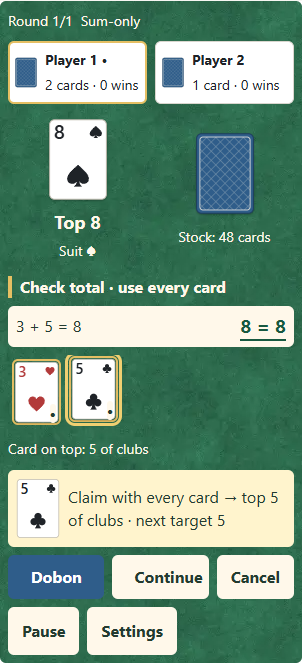

Returning Dobon changes the target
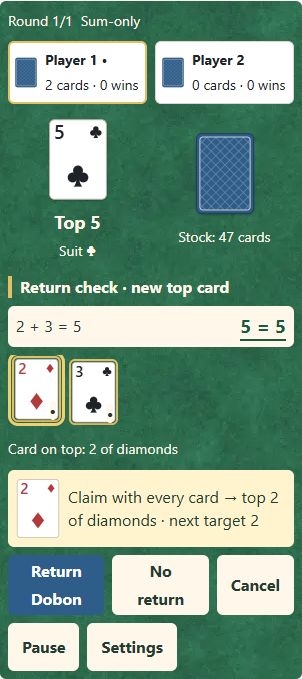
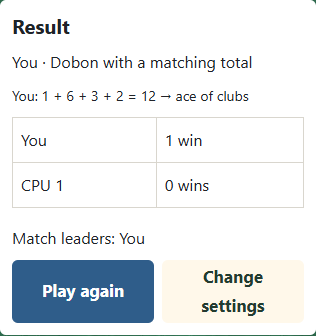
With returns enabled, a claim is not immediately final. The claimant places the whole hand on the discard pile and chooses one of those cards to go on top. Other players compare their totals with that new rank. Suppose a three and a five claim against an eight. If the five goes on top, a two and a three can return against five. The target is no longer eight. The last successful claimant wins once the remaining checks are complete. The original discarder may return, but a player who has already claimed cannot enter the same chain again. Choose a card from your hand to set the top of a claim. With returns disabled, the first successful claim ends the round.

Twos, eights, aces, and jacks
A two passes a drawing obligation to the next ordinary player. That player may play another two or take the required cards. Sum-only doubles the requirement: two, four, eight, then sixteen. After accepting it, that player still has an ordinary turn. Action cards adds two each time: two, four, six, then eight, and accepting the cards ends the turn. A total check comes before paying the obligation, so a successful Dobon claim ends the round first. An Action cards eight may be played on any suit and lets its player choose the next suit, but cannot answer a pending two. An ace skips the next player, while a jack reverses direction. With two players, skipping the opponent brings the ordinary turn back to you.
Bundled queens and the final card
In Action cards, you may play multiple queens together. The first queen must fit the existing discard, and the last queen becomes the new top. Select the queen you want on top and enable Bundle queens. A card needed as the first queen cannot also appear a second time at the end. Only available orders are accepted. There is no queen bundle in the Sum-only preset. When someone plays their last card in Action cards, the other players still complete the Dobon checking step. A successful claim takes priority over that ordinary finish. Otherwise the player who emptied the hand wins. This makes a final discard something worth checking rather than a reason to stop paying attention.
Opening cards and configurable variants
The opening card can be claimed in either preset. In Sum-only, an opening two also creates a two-card obligation. In Action cards, an opening special card has no effect. Before starting, compare the settings with the rules your group knows. You can change returns, ordinary empty-hand wins, the growth of the two penalty, eight behavior, ace and jack effects, queen bundles, drawing, and opening effects. A printed-suit eight follows its own suit rather than a suit chosen by the player. The calculation always uses addition of the entire hand. Multiplication, division, and selecting a favorable subset are not part of these options. There is also no out-of-turn matching-rank interruption, changing deal sizes after losses, or penalty for forgetting a last-card announcement.
Strategy: manage your total and your suits
A possible target never exceeds thirteen, so reducing a large total is often more useful than discarding a small card simply because it fits. High cards can bring a hand into that range quickly. However, leaving cards of unrelated suits may force more draws later. Look for a balance between a small total and several ways to match the next discard. Once your total is thirteen or less, check every opportunity. Do not watch only for your ordinary turn. If returns are enabled, think about which claimed card to put on top. A smaller rank can limit the combinations available to a multi-card opponent, but a one-card opponent may need only that exact rank. There is no guarantee because those cards remain hidden.
Strategy: use special cards deliberately
When an opponent has one card, the next target could give them a Dobon claim. An ace or a two can affect ordinary turns, but does not remove checking opportunities. An eight is useful for escaping an awkward suit and choosing a suit you still hold. Spending it immediately can leave fewer choices later. Reversing direction may change whose ordinary turn comes next, so compare the nearby hand counts before using a jack. In Sum-only, remember that an opponent cannot win by simply playing their final card; the claim condition remains important. Easy opponents can overlook matching totals and returns. Normal opponents organize their hands more carefully. Strong opponents also consider the visible discards and hand counts when choosing a risky target. None can see another player’s hidden hand.
Rounds, ties, and an empty stock
A round winner receives one win. Choose a single round, three rounds, or five rounds; the largest number of wins determines the match leaders. Equal totals share the lead. This is a simple round record, rather than a card-value transfer or a changing-handicap match. If the stock runs out, keep the top discard in place and shuffle the cards underneath it into a fresh stock. If there are no recyclable cards, the round is drawn. A round also stops as a draw after eight hundred actions. Neither kind of draw awards a win. A match does not move to the next round automatically: you can inspect the result and any return chain before choosing Next round.

Saving, privacy, controls, and rule references
Your current hand, checking order, return chain, settings, and round scores are saved on this device. Open Settings and choose Continue to resume. The Japanese and English pages share the same saved match. In local play, the outgoing hand disappears before the next person presses Show hand. Pass the device before revealing it. Select cards by touch or mouse; a keyboard can select the first nine cards, play the selection, draw, claim, or continue a check. Sound starts off and can be enabled when appropriate. Dobon has several regional and household forms, so agree on the settings before playing. The Sum-only and Action cards presets describe the rules used on this page rather than claiming to be universal rules for every group.

Frequently asked questions
Can I claim with only part of my hand?
No. Add every card in your hand.
Do face cards all count as ten?
No. J is eleven, Q twelve, and K thirteen.
Can I claim against my own discard?
No. Check another player’s discard or the opening card.
Does a return use the original target?
Use the new top card chosen by the claimant.
Does a drawn round award a win?
No. Equal win totals share the match lead.
Preset comparison
| Rule | Sum-only | Action cards |
|---|---|---|
| Deal | 4 cards | 5 cards |
| Empty hand | No | Wins |
| Returns | On | Off |
| Twos | Double; draw then act | Add two; end turn |
| Effects | Twos only | A, 2, 8, J, Q |
References: DOBON.NET / JDA · Playingcards.jp · Card-asobi.
Selecting a card prepares the action. Tap it again to deselect; Cancel, the empty table or Escape clears the preparation. Sliding a finger does not confirm. Enter on a focused card toggles its selection. Move focus to Play or Dobon and press Enter to confirm. For an ordinary play, tapping the top pile also confirms the selection. A claim always uses every card; the selected card only chooses which one goes on top.