 Yorimichi Games
How to play TriPeaks Solitaire
TriPeaks (also written Tri Peaks) is a one-player card game played with a standard 52-card deck, no jokers. Twenty-eight cards are laid out in the shape of three mountain peaks, and your goal is to clear every one of them by moving cards onto a single waste pile. The only rule you need to remember is this: you can play a card that is one higher or one lower than the top card of the waste pile. It takes a minute to learn, but deciding which card to take first, and keeping a long run going, is what keeps people coming back for “just one more deal.”
The TriPeaks layout
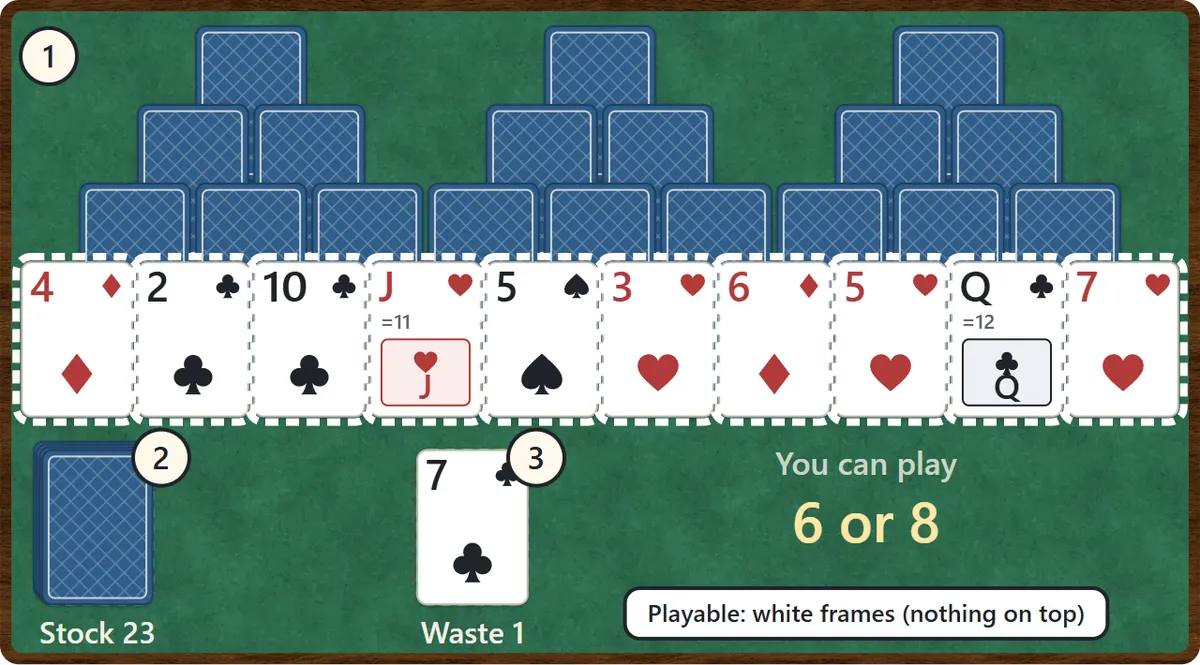
Shuffle the deck and deal 28 cards into three overlapping pyramids. The peaks have four rows: 3 cards at the top, then 6, then 9, and finally a bottom row of 10 that joins all three peaks together. The bottom 10 cards are dealt face up; the 18 cards above them are face down. Each card in an upper row is partly covered by two cards in the row below it.
The other 24 cards form the face-down stock. Turn the top card of the stock face up to start the waste pile (some players call it the foundation or the discard pile), which leaves 23 cards in the stock. From then on, every move either takes a card from the peaks and puts it on the waste pile, or turns up a new waste card from the stock.
TriPeaks rules
Play one higher or one lower
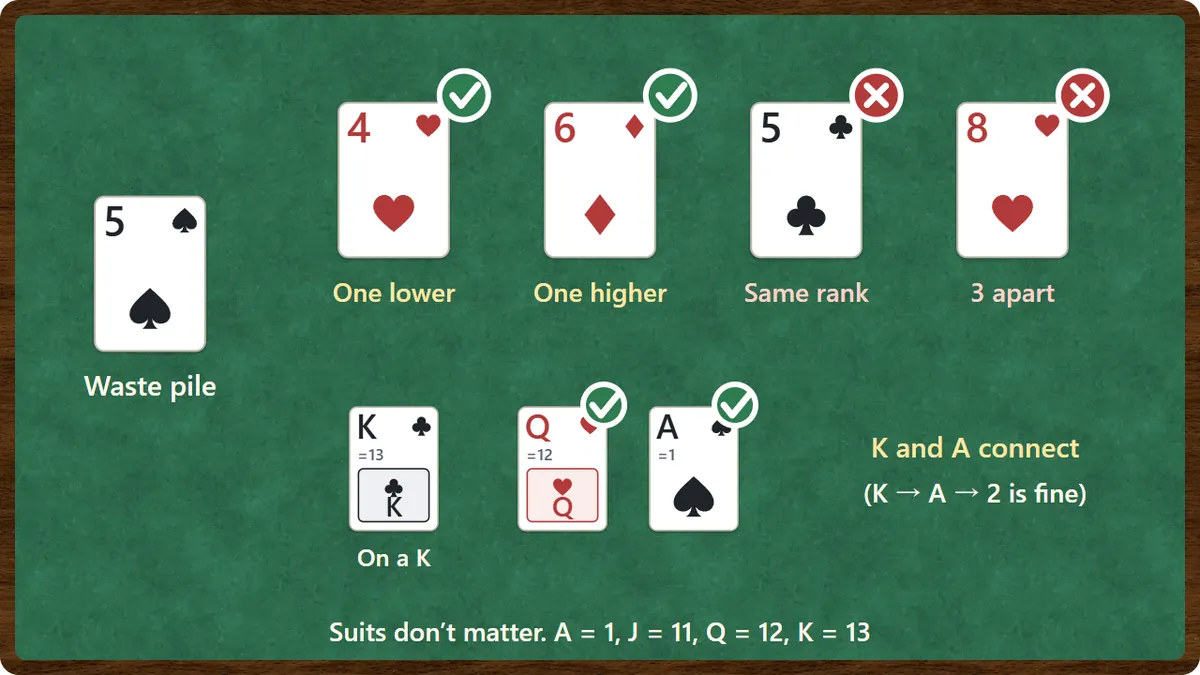
A card from the peaks can go on the waste pile only if its rank is exactly one above or one below the waste pile’s top card. On a 5 you can play a 4 or a 6; on a 10 you can play a 9 or a jack. Suits and colors don’t matter at all. You can’t play a card of the same rank, and you can’t skip a rank. For counting, an ace is 1, a jack is 11, a queen is 12 and a king is 13.
In the Standard rules, kings and aces connect, so the ranks loop around like a clock: a queen or an ace can go on a king, and a 2 or a king can go on an ace. A run such as Q, K, A, 2 is perfectly legal.
Uncover the face-down cards
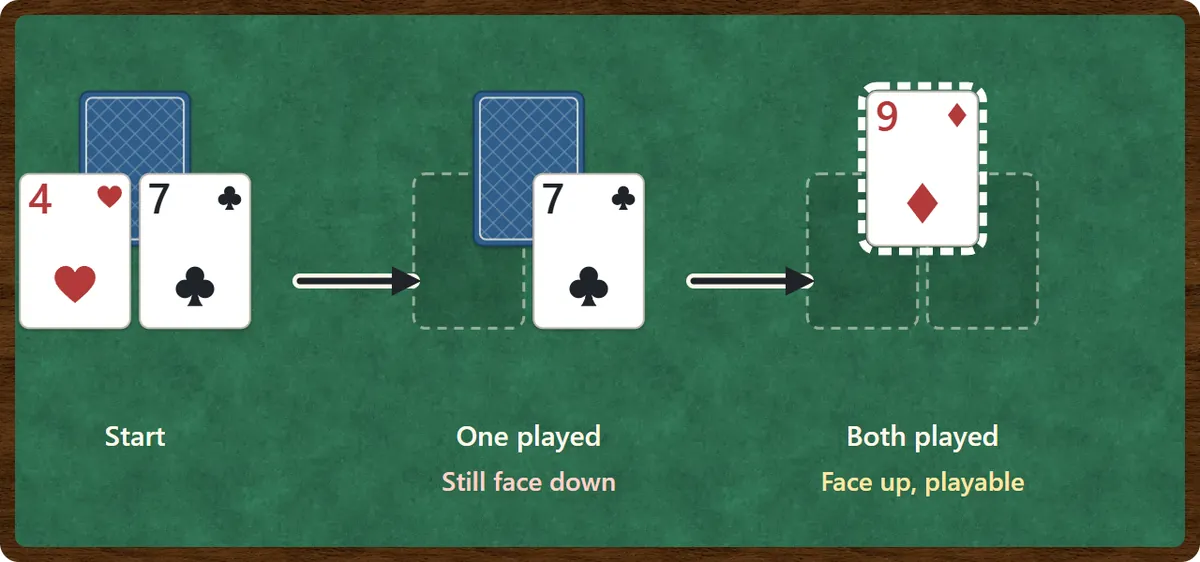
You can only play a card that is face up with nothing overlapping it. Every face-down card is held down by two cards in the row below. As soon as both of those are gone, the face-down card flips over and becomes available. You never know what it will be until it turns, and that mix of planning and surprise is the heart of TriPeaks.
Draw from the stock when you’re stuck
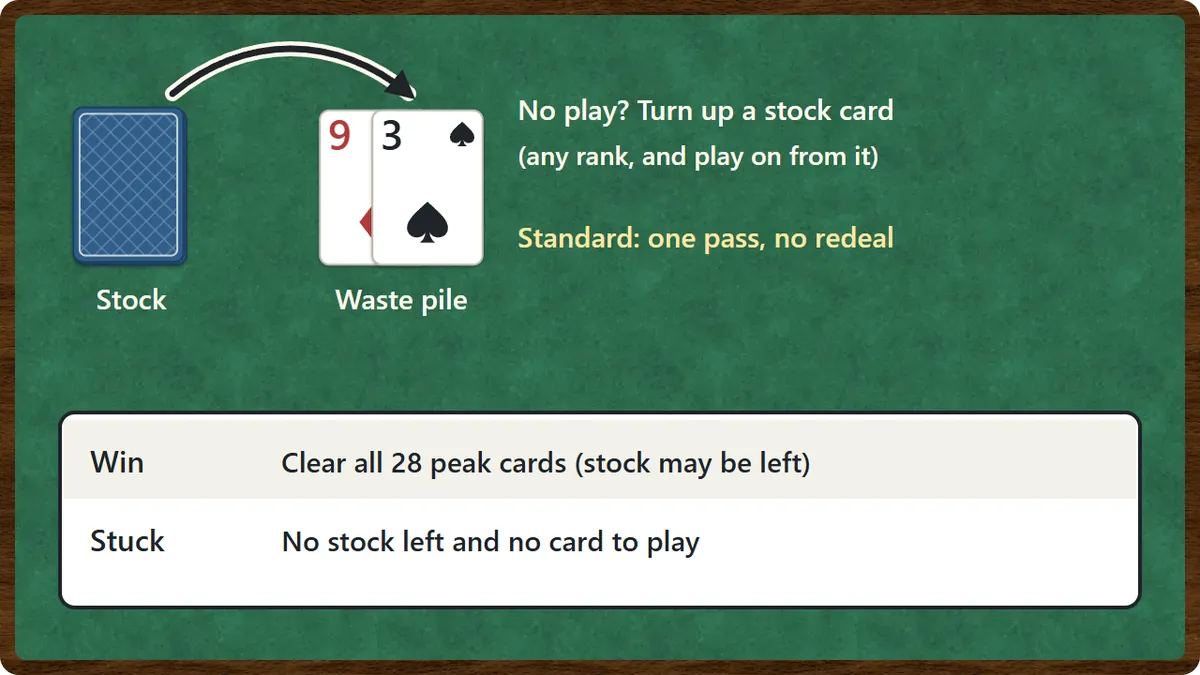
When no card in the peaks fits, turn up the next card from the stock and put it on the waste pile. It can be any rank; it simply becomes the new card to build from. You may draw at any time, even when a play is available, but drawing costs points and ends your run. In the Standard rules you go through the stock only once. When the stock is empty and nothing in the peaks can be played, you are out of moves. You win the moment all 28 peak cards are cleared, even if cards are still left in the stock.
TriPeaks scoring: runs, peaks and the stock
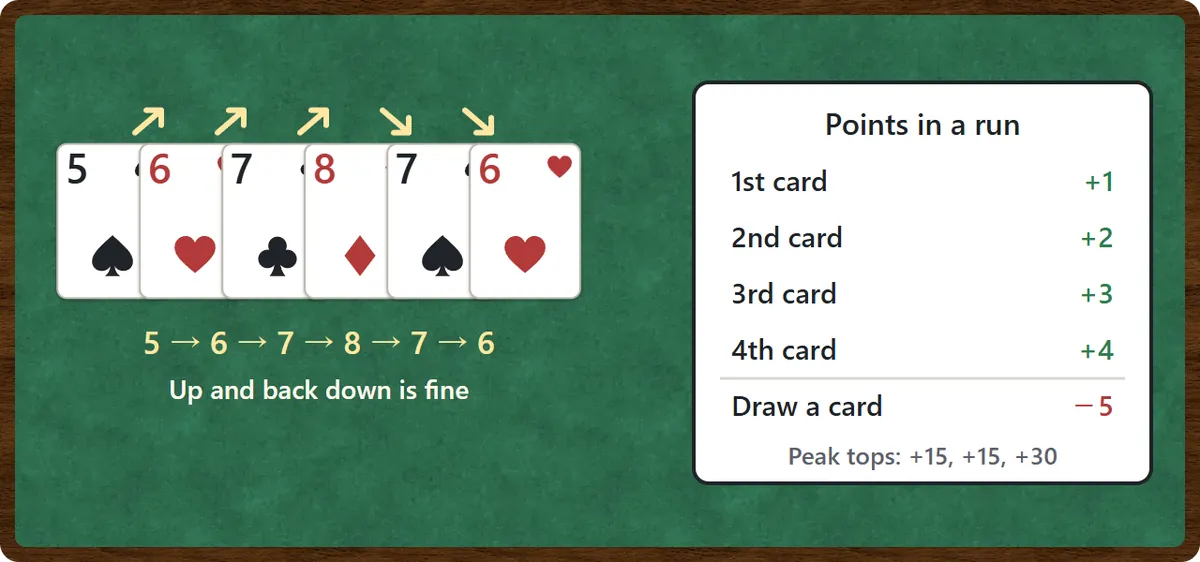
Every card you play becomes the new top of the waste pile, and you can change direction whenever you like: 5, 6, 7, 8 and then back down to 7 and 6 is a single run. This game uses a classic scoring system that rewards long runs:
| Event | Points |
|---|---|
| Each card in a run | 1 for the first, 2 for the second, 3 for the third, and so on |
| Each card drawn from the stock | −5, and the run starts again from 1 |
| Clearing a peak (its top card) | +15 for the first and second peaks, +30 for the last |
A run of 10 cards is worth 55 points, while ten single plays with draws in between barely break even. Your best score and fastest time for each rule set are saved as personal bests, as long as you win without using a hint.
The three rule sets
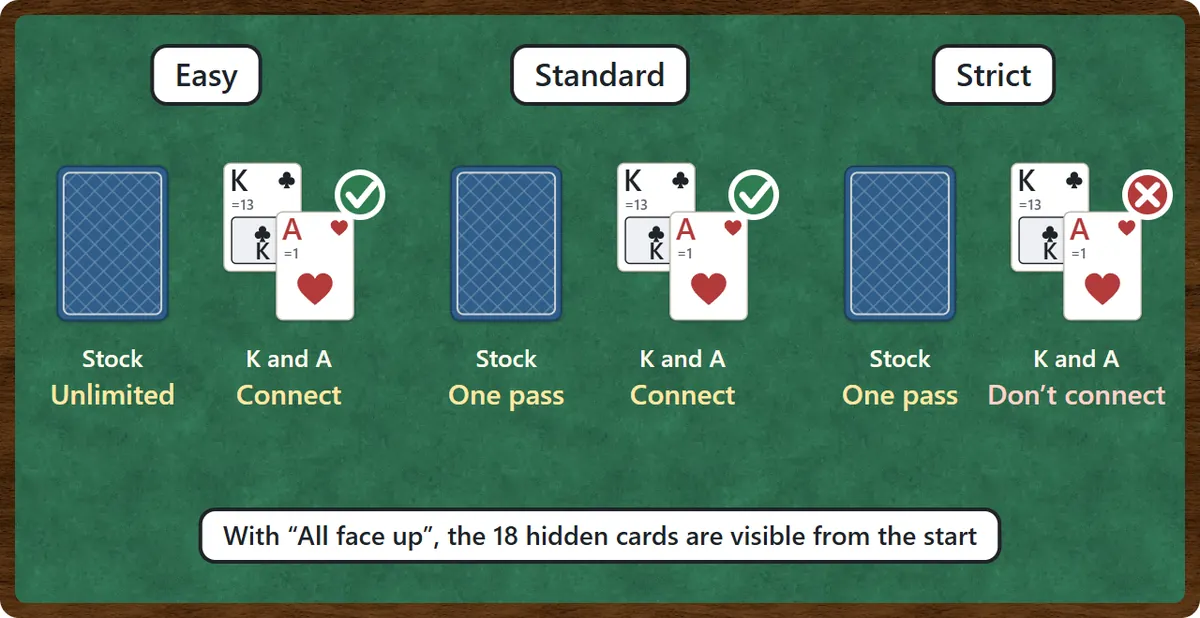
Card game books and apps don’t all play TriPeaks exactly the same way, so you can choose. The game starts on Standard, which matches the most common version.
| Rules | Stock · Kings and aces | What it feels like |
|---|---|---|
| Easy | Unlimited passes · connect | When the stock runs out, turn the waste pile over and go through it again. Nearly every deal can be cleared. Good for learning |
| Standard | One pass · connect | The classic game. Search the peaks carefully before every draw |
| Strict | One pass · don’t connect | Only a queen on a king and only a 2 on an ace, so kings and aces tend to end your runs |
Choose Custom to set the stock and the king–ace rule separately. Set “Peak cards” to “All face up” to see all 18 hidden cards from the start and plan the whole game like a puzzle. With “Winnable deals only” turned on, you only get deals that have been checked to be clearable with the rules you picked.
Playing on this site
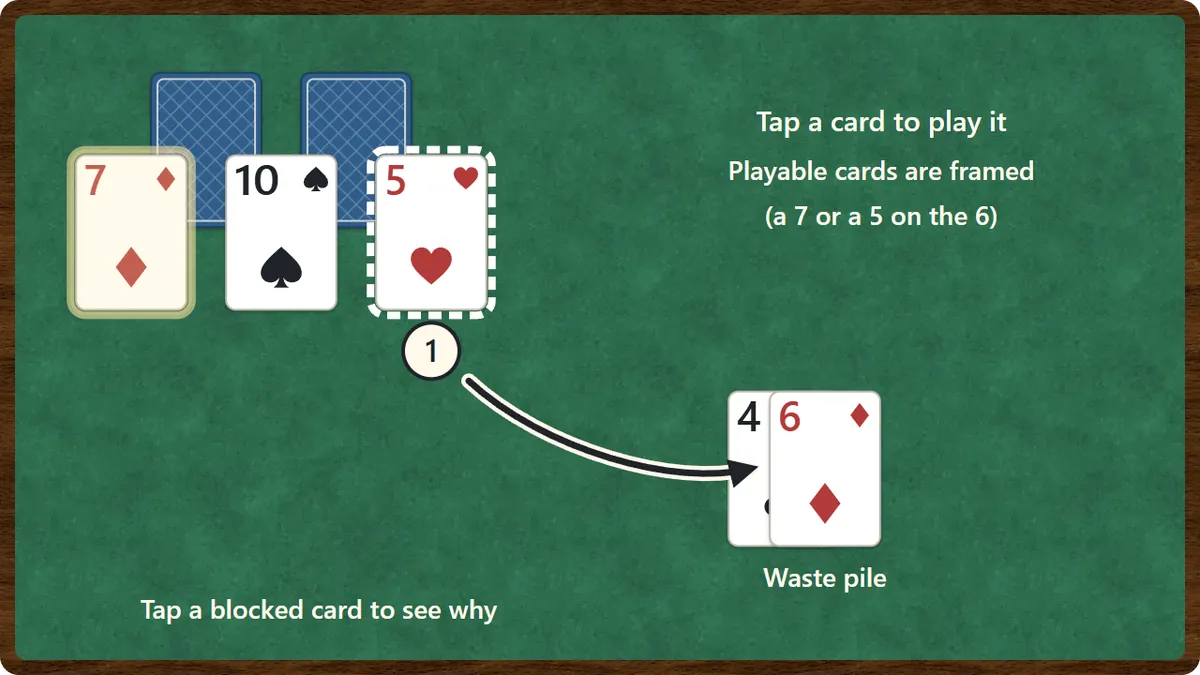
Tap or click a card in the peaks and it moves straight to the waste pile; you can also drag it there. Cards you can play right now get a soft gold frame, and the right side of the table shows which ranks you can play and how long your current run is (you can turn the frames off in the settings). If you tap a card that can’t be played, you’ll see why, for example “A 9 can’t go on a 5. You can play a 4 or a 6.” Tap the stock, or press Draw, to turn up a new card.
Undo takes back as many moves as you like, even after you run out of moves. Hint shows the next move with a white frame, and if the peaks can no longer be cleared from where you are, it tells you how many moves to go back. On a keyboard, use the arrow keys to choose a card and Enter to play it, Space or D to draw, Z to undo and H for a hint.
TriPeaks strategy: tips to clear more deals
1. Draw only when you have to
As long as a card in the peaks can be played, think twice before drawing. In the Standard rules the stock is used only once, and every draw costs 5 points and breaks your run. Before you draw, scan all three peaks, including the corners, for a card you missed.
2. Prefer plays that uncover face-down cards
When two cards are playable, take the one that turns a face-down card face up. More visible cards mean more ways to continue. A face-down card that needs just one more card removed is especially valuable: clear it early and your options open up.
3. Work on all three peaks
If you keep digging into one peak, the other two stay buried and their hidden cards stay out of reach. Taking the peaks down evenly keeps more cards available and makes it much less likely that you get stuck with the stock empty.
4. Look ahead for the longest run
With a 6 on the waste pile and both a 5 and a 7 available, the choice matters. After the 5 you need a 4 or a 6; after the 7 you need a 6 or an 8. Count the visible cards and choose the order that keeps the run alive longest. Long runs are where the big scores come from.
5. Keep a spare card of the same rank
If the waste pile shows an 8 and you have two 7s, you don’t have to use both right away. Leaving one behind gives you a way back later, such as 7, 8, 7, which can rescue you after the next draw.
6. Undo and try another order
If a deal gets away from you, step back a few moves and try a different line. Hint will tell you how far you need to go back to reach a position that can still be cleared.
TriPeaks FAQ
Can every TriPeaks deal be won?
Not every deal, but most. We checked deals 1 to 10,000 with a solver that knows where every card is: with the Standard rules, 97.3% of them can be cleared, which agrees with the game’s inventor, who is said to have calculated that over 90% of deals are winnable. With the Easy rules every one of those deals can be cleared, and with the Strict rules about three in four. In real play the face-down cards and the stock are hidden, so winning is harder than those numbers suggest. Turn on “Winnable deals only” to be sure a deal has a solution.
Is it okay to draw when I still have a play?
Yes. You can draw from the stock at any time. It costs 5 points and ends your current run, so it is usually worth it only when playing the available card would leave you stranded later.
How does the Easy stock work?
When the stock runs out, tap the empty stock space (or press Reset stock). The waste pile is turned over, in the same order, to become the new stock, and its first card is turned up. Each card you draw still costs 5 points. With unlimited passes you are out of moves only when none of the playable cards is one rank away from any card in the stock or the waste pile.
What is the difference between TriPeaks and Golf Solitaire?
Both use the same “one higher or one lower” rule. In Golf the cards sit face up in seven columns and you take them from the front of each column. In TriPeaks the cards form three peaks, most of them start face down, and scoring rewards long runs. Golf is a game of pure planning; TriPeaks adds the surprise of hidden cards.
Can I stop and continue later?
Yes. If you come back on the same device and browser, press Continue to pick up where you left off, with your undo history intact. Sound is off to begin with; press “Sound: off” to hear card sounds.
Where TriPeaks comes from
Unlike most solitaires, TriPeaks is a fairly recent invention. It is usually credited to Robert Hogue, who is said to have designed it around 1989, and it spread worldwide through computer solitaire collections. It is closely related to the much older game of Golf, which uses the same “one higher or one lower” rule; TriPeaks rearranged the cards into three overlapping pyramids and added face-down cards and run-based scoring. You may also see it called Three Peaks, Tri Towers or Triple Peaks. Hidden cards give it a dose of luck, while choosing the order of plays gives it real depth, which is why it remains one of the most popular solitaire games today.