 Yorimichi Games
Four Leaf Clover: the 15-sum game
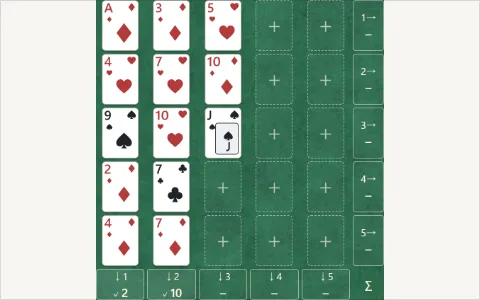
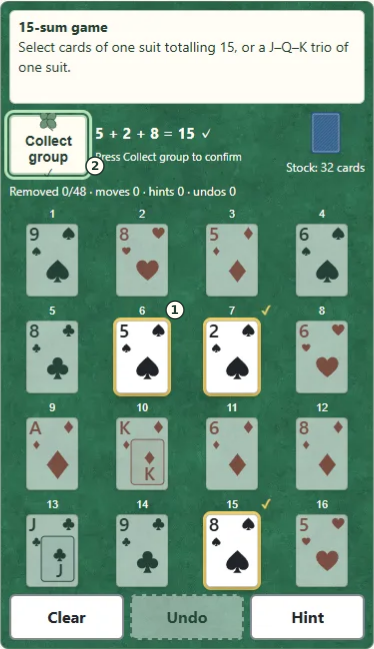
The default preset on this page is the Japanese 15-sum game called Four Leaf Clover. It is a separate game from the thirteen-pile Four Leaf Clovers found in English solitaire collections. Remove all Tens and jokers, leaving 48 cards. Deal sixteen face-up cards in a four-by-four grid and leave the other 32 cards in the stock. Select cards of a single suit whose numerical values total fifteen. Ace counts as one; Two through Nine use their printed values. Six plus Nine and Seven plus Eight are valid pairs. Four, Five and Six make a valid three-card group. One, Two, Three, Four and Five also total fifteen, so a group is not restricted to two or three cards. Matching colour alone is insufficient: every selected card must have the same suit.
Court-card exception and refill
Jack, Queen and King are not counted as eleven, twelve and thirteen. Remove them only as a same-suit Jack–Queen–King trio. Jack with Four, Queen with Three and King with Two are not numerical fifteen groups, and two court cards are not enough. Cards can be selected anywhere in the grid; they do not have to be adjacent. After you confirm a legal group, the stock automatically fills its empty cells. In this edition, refill follows ascending cell number, regardless of selection order. When the stock runs out, unfilled cells remain empty. There is no separate draw action, rearrangement between cells or mid-game redeal. Remove every one of the 48 cards to complete the game. If no legal group is available, the position is blocked even when cards remain in the stock; use Undo or Restart to explore another route.

Controls, difficulty and tips for the 15-sum game
Tap or click several cards, then confirm with the clover-shaped Collect group button. Tap a selected card again to deselect it or use Clear selection to start over. Arrow keys move between cells, Enter or Space selects cards, and F collects the selected group. H gives a hint, Z undoes, P pauses or resumes, and Escape clears your selection. Check suit symbols as well as colours before collecting. Keep numerical groups separate from court-card trios. Hints use the current visible grid and do not reveal stock identities or guarantee a winning continuation. Difficulty chooses the opening, while removal and refill rules stay the same. Verified deals have at least one legal full solution, but solutions are not promised to be unique. Numbered and random openings may be unverified. Progress, assistance records and daily deals work in both presets, but changing the rules starts a separate game rather than converting the current position.

Choose the right clover rules
Select the thirteen-pile preset for the English Four Leaf Clovers rules described below. That game uses 52 cards, no stock, single-card tableau transfers and one ascending foundation. The 15-sum game uses 48 cards, a stock and multi-card same-suit groups. These are separate rule sets sharing a clover name, not interchangeable moves within one game. Inspect the chosen preset and board before starting. Both can be played in Japanese or English without changing the underlying rules.
How to play Four Leaf Clovers solitaire
Four Leaf Clovers is an open solitaire game played with one ordinary deck of 52 cards and no jokers. Deal thirteen tableau piles of four face-up cards each. Your goal is to collect every card onto a single central foundation. There is no stock, waste pile, draw action or opponent. Because every card is visible from the beginning, you can inspect the whole layout before deciding how to expose a useful rank. Visibility does not mean availability: a card covered by another card cannot move yet. Only each pile’s exposed end card is playable. The puzzle comes from rearranging those exposed cards to reach the ones underneath, while keeping the central foundation moving in its required direction. You can play at your own pace; there is no time limit or need to chase a speed bonus.

The opening layout and playable cards
Each of the thirteen piles starts with exactly four cards. The nearer card overlaps the cards behind it. The visible corner of a covered card helps you plan, but it does not allow you to pick that card up. Remove the exposed end card first, then the next card becomes available. Every move transfers one card. You cannot lift a sequence, select a card in the middle of a pile, or collect four matching ranks as a group. Pile numbers are navigation labels only. Pile Seven has no special relationship to a Seven, and a King does not belong to a particular numbered pile. When deciding between two cards of the same rank, inspect what each one will uncover. Their suits do not change the move rule, but the different cards beneath them may change the next choice.
Foundation rules: up from Ace, then around the corner
The foundation starts empty and accepts an exposed Ace as its first card. Any suit is allowed. Then build Two, Three, Four and onward, one rank higher each time, regardless of colour or suit. An Eight of hearts or clubs can go onto a Seven of spades; a Six or another Seven cannot. Ace counts as one, Jack as eleven, Queen as twelve and King as thirteen. After a King, play another Ace and continue upwards again. Four complete passes through Ace to King collect all 52 cards. This wrapping rule does not make the foundation bidirectional: you cannot play a King onto an Ace or move backwards from Seven to Six. The Next label beside the foundation shows the exact rank currently required. Cards already on the foundation do not return to the tableau through a normal move.

Tableau rules: one rank up or down, no empty-pile refill
Between tableau piles, an exposed card may go onto another exposed card one rank higher or lower. Suits and colours are ignored. A Six can therefore go onto a Five or a Seven. The tableau connects King and Ace in both directions: an Ace can go onto a King, and a King can go onto an Ace. Remember the distinction: the tableau builds up or down, but the foundation builds up only. Move just one card, even if several cards form a neat sequence. Once a tableau pile becomes empty, it cannot be filled again. Neither a King nor an Ace can restore that space, and there is no stock to replenish it. Clearing a pile removes a possible receiving location, so consider whether that pile is still useful before emptying it. Rearrangement is a tool for uncovering cards, rather than an invitation to move the same card back and forth indefinitely.

Standard rules and similarly named games
This edition uses the thirteen-by-four layout, an Ace-start foundation, ascending foundation play, bidirectional tableau play, King–Ace wrapping and no refilling of empty tableau piles. It does not include an arbitrary starting rank, descending foundation play, joker cards or free placement into empty spaces. Similarly named clover games and other solitaire layouts may have different rules; their instructions should not be combined with this one. Undo and hints are practice features and do not change which placements are legal. Restart returns to the same initial numbered deal. New deal starts according to your chosen setup rather than redealing cards during the current game. The foundation accepts all suits into one pile, so there are no separate suit foundations to complete. If you are used to moving ordered packets in another solitaire, keep in mind that this game always moves a single exposed card.
Difficulty, daily deals and solvability
Easy, Normal and Hard choose different starting deals; all three use exactly the same standard move rules and deck size. Verified solvable selects from a finite collection of openings with a legal route to all 52 foundation cards. The existence of a route does not mean every choice succeeds. A rearrangement can bury a needed card or remove a useful receiving pile, and you may need to undo and choose another branch. Solutions are not required to be unique. Any legal route that reaches all 52 cards counts as a completion, even if it differs from another solution. Daily deal uses your device’s local date and chosen difficulty. The catalogue is finite, so different days or consecutive starts can repeat a number. Numbered and random deals are not graded by difficulty. Openings outside the verified collection are labelled Solvability not checked. That label means unknown, not proven impossible, and the game does not promise that every random opening can be won.
Touch, mouse and keyboard controls
Tap or click the pile whose exposed card you want to move. Then tap the foundation or a different tableau pile. Only the exposed end card moves; the rest remain behind. Tap the selected pile again or use Clear selection to cancel. An invalid destination displays the reason and leaves the card in its original pile. You do not have to drag anything. On a keyboard, use the arrow keys to move focus between piles and Enter or Space to select or confirm a destination. F sends the selected card to the foundation. H suggests a move, Z undoes the previous action, P pauses or resumes, and Escape clears the selection. You can also use ordinary Tab navigation to reach controls. Pause hides the cards and resumes the same position. Hints select one candidate and indicate its destination, but you confirm the move yourself. A hint is not a promise of a winning continuation.
Four Leaf Clovers strategy and practical tips
Start by checking the foundation’s Next rank. If several exposed cards match it, compare the cards each move uncovers. Uncovering the following required rank can let you advance immediately. If the needed card is covered, look for another pile that can receive the card above it. Before making that transfer, inspect the destination: avoid burying a card you will need soon. Use the King–Ace connection as a tableau rearrangement opportunity, while respecting the foundation’s one-way order. Preserve receiving locations when useful, since an emptied pile cannot return to service. Repeating a transfer between two piles without uncovering a new card does not improve the layout. If you are stuck, undo to an earlier choice and try another matching card or receiving pile. Even a small change in which equal-ranked card you remove first can uncover a different chain of available moves.
Saving, completion records and Four Leaf Clovers FAQ
Your position is saved in this browser on this device. Choose Resume after reopening the page. The Japanese and English pages share that progress, but there is no account or transfer to another device. Clearing browser storage removes the save. If saving is unavailable, you can keep playing on the current page. Sound starts off and is enabled only when you choose it. Completions using hints or undo are marked assisted; repeated completions of the same deal are not added as separate problems. Must suits match? No: rank alone determines legality. Why can I not add another Ace to an Ace? The foundation needs a Two immediately after an Ace. Why can I see a card but not move it? A covering card must leave first. What if no legal move remains? Undo or restart the same deal to explore a different branch. The name appears in several solitaire collections; this guide does not claim a particular inventor or a confirmed naming history.
Four Leaf Clovers rules at a glance
| Destination | Rule |
|---|---|
| Empty foundation | Ace only |
| Foundation | Up one rank; King → Ace |
| Tableau pile | Up or down one rank; King ↔ Ace |
| Empty tableau | Cannot be filled |
Playingcards.jp (15-sum) / SDIN (15-sum) / Cardgame-rules (comparison)
Rule references: BVS / SolSuite / PySolFC / Gem Solitaire