 Yorimichi Games
How to Play Poker Squares
Poker Squares is a solitaire card-placement puzzle. You build a five-by-five grid and score the poker hands in its five rows and five columns. A game uses the first twenty-five cards from a shuffled standard deck of fifty-two cards, without jokers. There is no opponent, betting or money. Each decision is simply where to put the card currently face up. Choose a scoring system and a target level, then press Start. Tap an empty square to place the card. The next card appears only after that placement. You may begin in any square, including a corner. Later placements do not need to touch an existing card. The grid always has room for the remaining cards, so every deal can be played to the end, even when a planned hand becomes impossible. Completing the board and reaching the target are separate achievements: all twenty-five placements finish the game, while the target gives you a score to aim for.
Five Rows and Five Columns
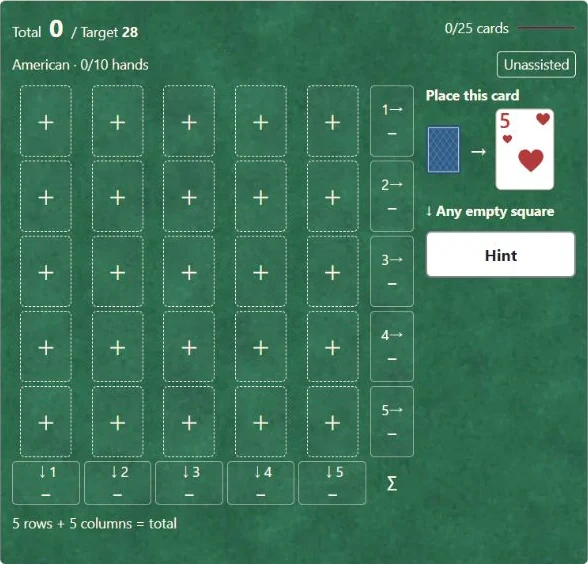
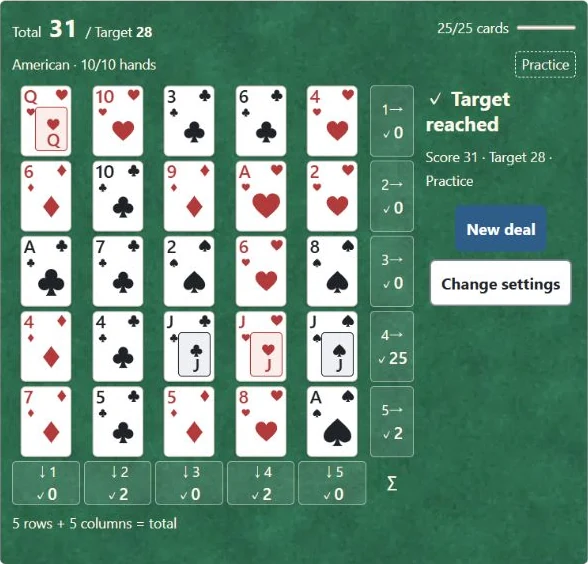
Every horizontal row of five cards is one hand. Every vertical column is another hand. Together they make ten scored hands, and each card belongs to exactly two of them. The numbers at the right of the board show row scores; the numbers underneath show column scores. A dash means the hand is still incomplete, rather than an estimated score. Diagonals do not count, and you cannot choose five cards from unrelated squares as a bonus hand. Order within a row or column makes no difference. For example, five hearts make a flush even when their ranks are scattered. Each hand receives the points for one category only. A full house does not also collect three-of-a-kind and pair points. The final score is the sum of all ten hands. At the end, the results list identifies every category so you can connect the total with the choices you made.
American and English Scoring
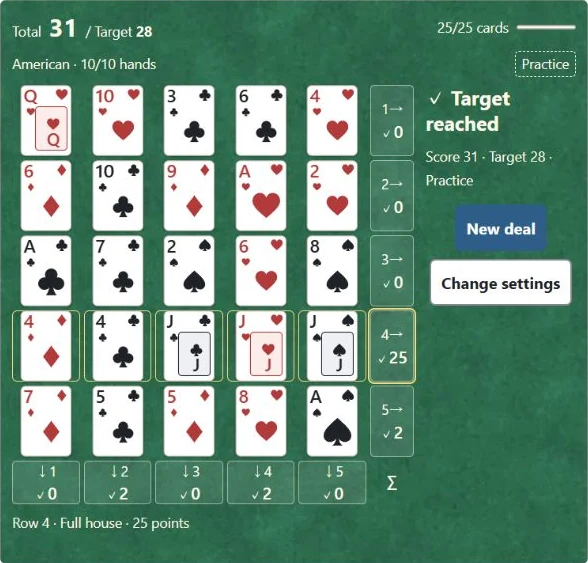
Poker Squares has more than one established scoring table. The American system gives a flush twenty points and a straight fifteen. The English system gives a flush five points and a straight twelve. This changes the value of your plans: matching suits is relatively rewarding in American scoring, while runs of ranks deserve more attention in English scoring. English scoring is a rule choice, not a language choice. You can use either table on either language page. A royal flush is ten, jack, queen, king and ace of one suit. It is worth one hundred in American scoring, but thirty in English scoring, where an ordinary straight flush is also worth thirty. The table below lists every category, including a zero-point high-card hand. Choose the table before starting. Opening Settings pauses your current game; Continue returns with the original settings, whereas Start begins a new deal using your new choices. Compare personal bests within the same table rather than treating the two totals as interchangeable.
| Hand | American | English |
|---|---|---|
| High card | 0 | 0 |
| One pair | 2 | 1 |
| Two pair | 5 | 3 |
| Three of a kind | 10 | 6 |
| Straight | 15 | 12 |
| Flush | 20 | 5 |
| Full house | 25 | 10 |
| Four of a kind | 50 | 16 |
| Straight flush | 75 | 30 |
| Royal flush | 100 | 30 |

Aces, Straights and Other Hand Rules
An ace can sit at the low end of a straight, A-2-3-4-5, or the high end, 10-J-Q-K-A. It cannot connect the two ends: Q-K-A-2-3 is not a straight. A run needs five different ranks, so repeated ranks cannot fill a missing step. A straight flush combines a valid run with a single suit. Four of a kind contains all four cards of one rank and any fifth card. A full house contains three cards of one rank and two of another. Two pair means two distinct pairs plus a fifth card. One pair means one pair and three other ranks. Five red cards are not necessarily a flush, because hearts and diamonds are different suits. Look at the suit shape as well as its color. A hand with no category scores zero, but its cards still contribute to the crossing hands. High cards have no separate rank-based points, and equal totals require no tie-break because this is a single-player score puzzle.

Targets, Difficulty and Practice Tools
The three levels change your target, not the shuffled deck or the legal moves. American targets are eighteen, twenty-eight and thirty-eight for Easy, Normal and Hard. English targets are nine, fifteen and twenty. These are this game's learning targets, not universal winning scores for every version of Poker Squares. Reaching a target early does not end the game: keep placing cards until all twenty-five squares are full. If you miss it, you still see your score and completed hands. Hint suggests one empty square from the current card and visible board. It does not guarantee the best possible final score. Using Hint marks the attempt as practice. Undo also marks practice, since you have already seen the following card when you reverse a placement. Restarting the same deal has the same practice label. Unassisted and practice bests are kept separately. You can use these tools to study a decision, then start a new shuffled deal for an unassisted attempt. No speed bonus rewards rushing your placements.
Poker Squares Strategy: Six Useful Habits
First, inspect both hands through a candidate square. A perfect match in its row may damage a stronger plan in its column, so compare at least two places before committing. Second, give different directions different jobs. You might collect matching ranks across rows and matching suits down columns. A card can then help two plans at once. Third, avoid committing every column to a flush immediately. The twenty-five cards may not contain enough of each suit, and some flexibility is valuable. Fourth, give nearly finished hands particular attention. When four cards are present, you can calculate exactly what the current card would complete instead of relying on an imagined future card. Fifth, adapt to the scoring table. English scoring makes a straight more valuable than a flush, so a rank-based plan can deserve priority over a suit-based plan. Sixth, leave somewhere for awkward cards. One low-scoring hand can protect several promising ones. Trying to force every card into a spectacular hand may close the spaces you need for ordinary pairs and completed flushes. These habits improve the quality of decisions, but the next card is still uncertain and no plan guarantees a target score.
Touch, Keyboard Controls and Local Saves
On a phone, tap an empty square. With a mouse, click it. On a keyboard, use the arrow keys to move the outline, then Enter or Space to place the card. The number keys 1 through 5 select a column in the current row. Z undoes a move as practice, H requests a practice hint and P pauses or resumes. Tab and Enter also operate the buttons. Clicking an occupied square does not swap cards, spend a turn or discard the current card. Pause prevents placements, and opening Settings preserves the current board. Progress is saved in this browser after actions. When you return, choose Continue to resume; the language pages share the same local save. Sound starts off and can be enabled with its button. If browser storage is unavailable, a message explains that you can continue on the current page. Saves do not follow you to another browser or device, and clearing browser data can remove them. When another tab saves the game, this tab stops and asks you to reload rather than silently replacing that progress. Tap a row or column score to highlight its five cards and hand category. Clear the highlight by tapping the current card or blank felt, or by pressing Escape. After a hint or keyboard selection, you can still tap any empty square directly. Clearing a highlight does not undo a placement; use Undo to return a card.
Poker Solitaire FAQ and Variants
Can I move a placed card? Standard Poker Squares fixes each placement. Undo here is a practice tool, not permission to rearrange the board freely. Can I skip a bad card? No. Place the face-up card in any empty square; there is no reserve or discard pile in this version. Does every deal guarantee the target? No, although every deal has exactly enough empty squares for all twenty-five cards. Does time reduce my score? No. Only the completed hands contribute points. Are Poker Solitaire and Poker Patience different games? Those names are also used for Poker Squares, though a particular app or book may use additional rules. Some variants let you move cards, reveal all twenty-five at once or hold cards in a reserve. Those change the information available and therefore change sensible score goals. Scoring tables also differ between publications and implementations. Before comparing results, check the table, whether placement was fixed, and whether hints or undo were used. You do not need knowledge of betting poker to enjoy this puzzle; learning the hand categories and their point values is enough to begin.