 Yorimichi Games
Seven columns and a three-card reserve
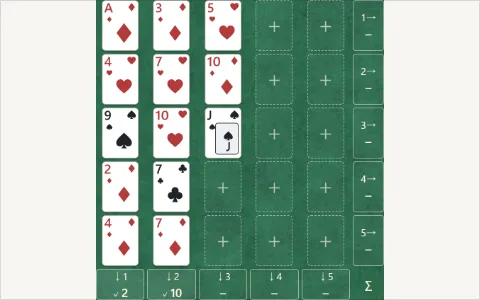
Scorpion Solitaire is a one-player card puzzle played with a standard deck of fifty-two cards. There are seven tableau columns, initially holding seven cards each. The other three cards form a reserve. No jokers are used. Your aim is to gather each suit into its own descending king-to-ace column, rather than to build alternating red and black cards or to send aces into separate foundations.
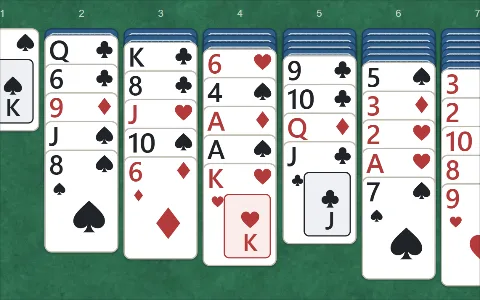
In the classic layout, the first four columns each begin with three face-down cards underneath four face-up cards. The last three columns are entirely face up. This gives twelve hidden cards. Whenever moving a group exposes a face-down card at the end of a column, that card turns over automatically. A newly revealed card can open several possibilities, so check its suit and rank before choosing your next move.
Aces are low, followed by two through ten, jack, queen and king. The card graphics use both suit symbols and color. The board also reports the number of hidden cards and the size of the reserve. There is no time limit, so you can examine the arrangement before changing it.
Moving a group from any face-up card
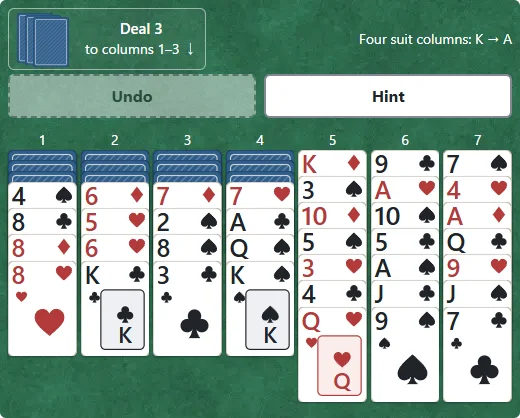
You may select any face-up card in a tableau column, including one in the middle. That card and every card covering it move together. Cards behind the selected card remain where they are. The moving group does not need to form a sequence: its ranks may be out of order and its suits may be mixed. This flexibility is an important feature of Scorpion.
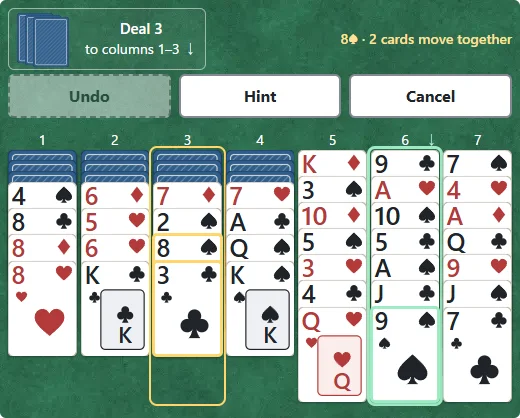
Only the first card of the selected group is compared with the exposed end card of the destination. They must have the same suit, and the moving card must be exactly one rank lower. A group beginning with the eight of spades can go onto the nine of spades. It cannot go onto the nine of hearts or the ten of spades. An ace does not accept a king; ranks never wrap around.
Before moving, look beyond the first card. The group may carry an awkward card into a useful column and bury another card that you need later. If you choose an illegal destination, nothing changes and a short explanation appears. You can keep the group selected, choose another destination or clear the selection without a penalty.
Empty columns and kings
Under the classic rule, an empty column accepts only a king or a group beginning with a king. The cards carried behind that king may be mixed or out of sequence. A king cannot be placed on another card because there is no higher rank, making empty columns its usual destination.
An empty space is useful only if you can use it to improve the position. Check whether a face-up king is accessible before clearing a column. Moving a king-led group can uncover hidden cards or release a suit you need elsewhere. Repeatedly transferring the same group between empty columns, however, does not reveal new information or improve a sequence.
Easy uses an any-card empty-column rule, often called the Wasp variation. It lets you practice separating groups with fewer restrictions. It is a different challenge from classic Scorpion, and completion records are kept separately. Normal retains the king-only empty-column rule but begins with fewer hidden cards.
Dealing the reserve
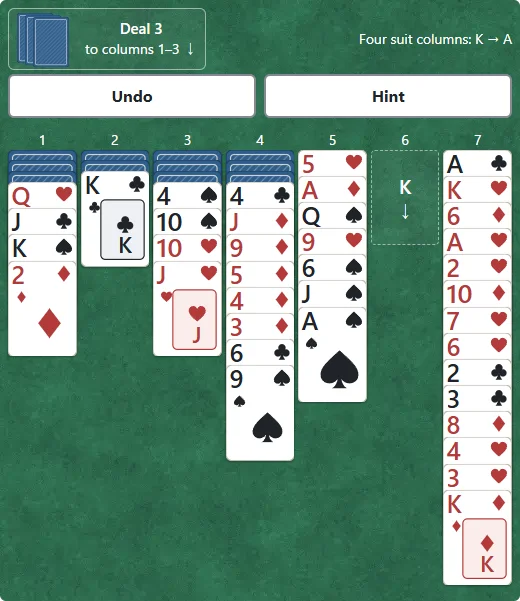
Tap the reserve packet at the top left to place one face-up card on each of the first three columns, from left to right. It does not deal to all seven columns. The three-card reserve can be used once; after that, its count is zero. There is no redeal, exchange or second packet. Empty columns do not prevent this deal. If the reserve places a non-king in an empty column, that card remains a normal tableau card.
New cards cover the previous end cards of those columns, which may hide a useful destination. Traditional instructions recommend exploring the available tableau moves before dealing. Here you may tap the reserve packet at any time while the reserve remains, so consider how it will change your current options before using it.
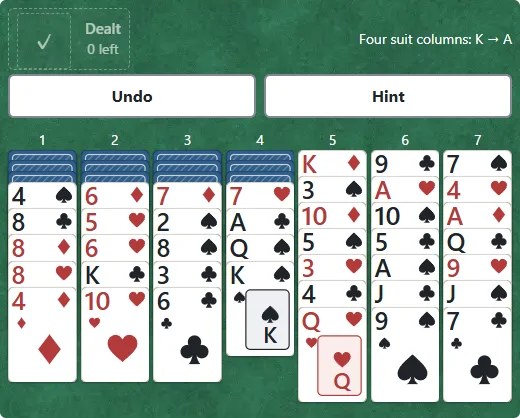
Having no tableau move while the reserve remains is not the end of the deal. The three cards may open a new chain. After the reserve is used, a position with no legal move receives a notice. You can undo or retry the same deal. A legal move is not a guarantee of eventual success: Scorpion may still require a different earlier choice.
Completing all four suits
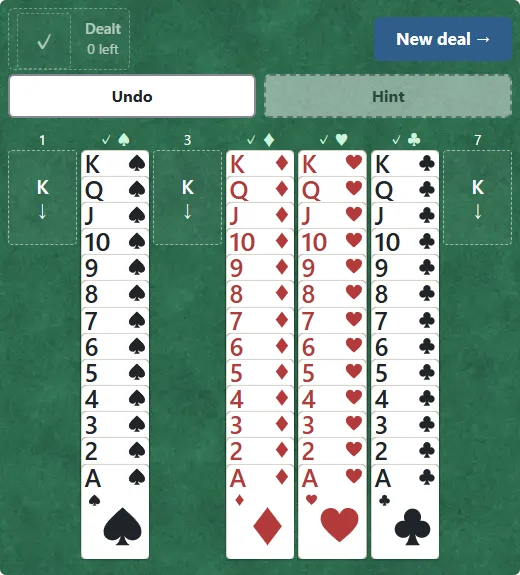
You win by forming four separate columns, each containing all thirteen cards of one suit in descending order from king to ace. The reserve must also have been used, so all fifty-two cards belong to those four columns. A king-to-ace run buried beneath an extra card is not counted as a completed column. Neither is a column containing a hidden card.
Completed columns remain on the tableau. The cards stay where you can see them. Before the whole game is won, you may still move cards out of a completed column under the normal movement rule. Doing so can reduce the completed-column count. Consider whether breaking a finished suit is needed to release another card.
A completed column receives a check mark and its suit symbol. Continue arranging the remaining cards until four columns are complete. The result panel then offers a new deal or a replay of the same deal.
Difficulty, saved progress and controls
Easy keeps twelve hidden cards but allows any face-up group into an empty column. Normal is Scorpion II: nine hidden cards and king-only empty columns. Hard is classic Scorpion with twelve hidden cards and king-only spaces. These are rule-based difficulty settings, not selected winning deals. All three are solo puzzles, with no computer opponent and no score based on playing speed.
Tap the exposed top edge of a face-up card to select it and every card below it. The group receives yellow outlines. Green outlines and down arrows mark legal destination columns. Tap a destination card or drag the group there. Tap the same leading card, blank felt, or Esc to cancel. Hint marks one legal option, but it does not promise a complete solution.
Undo reverses one move or reserve deal, including the automatic reveal of a hidden card. Retry this deal restores the original layout. New deal creates a different shuffled deck. Your position is saved in this browser and can be resumed with Continue. The Japanese and English pages share the same save. Changing devices or clearing browser storage does not transfer the position.
Start by identifying a move that reveals a hidden card, then consider whether an empty column has a useful destination. Check the first three columns before dealing the reserve. Keep an eye on cards that could become trapped below a long group. Take your time: understanding the connections between suits matters more than moving quickly.
What happens at the move limit?
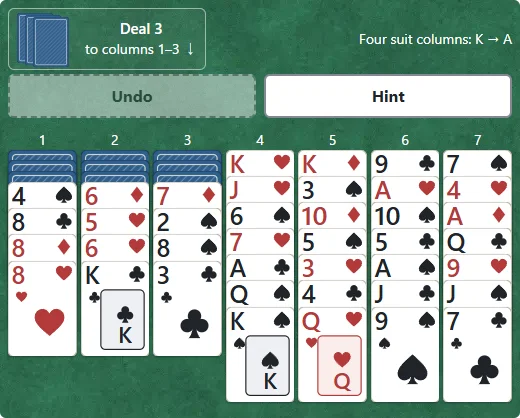
A deal allows up to 2,000 recorded moves. At the limit, undo or retry the same deal.
Frequently asked questions
Can a mixed group move?
Yes. Only the leading card is compared with the destination. All the covering cards accompany it.
Do empty columns prevent the reserve deal?
No. The reserve still places one card on each of the first three columns, even if they are empty.
Are finished columns removed?
They remain on the tableau in this rule. Continue until all four separate suit columns are complete.