 Yorimichi Games
How to play Calculation Solitaire
Calculation is a one-player card game played with a standard 52-card deck, no jokers. As the name suggests, it is a solitaire about counting: you build four foundations at once, the first going up by ones, the second by twos, the third by threes and the fourth by fours. Suits and colors never matter – only the ranks do. The rules take a minute to learn, yet the game is famous for rewarding careful thought. Where you park each card while you wait decides almost everything, and players who learn to plan ahead win far more often than beginners.
The layout
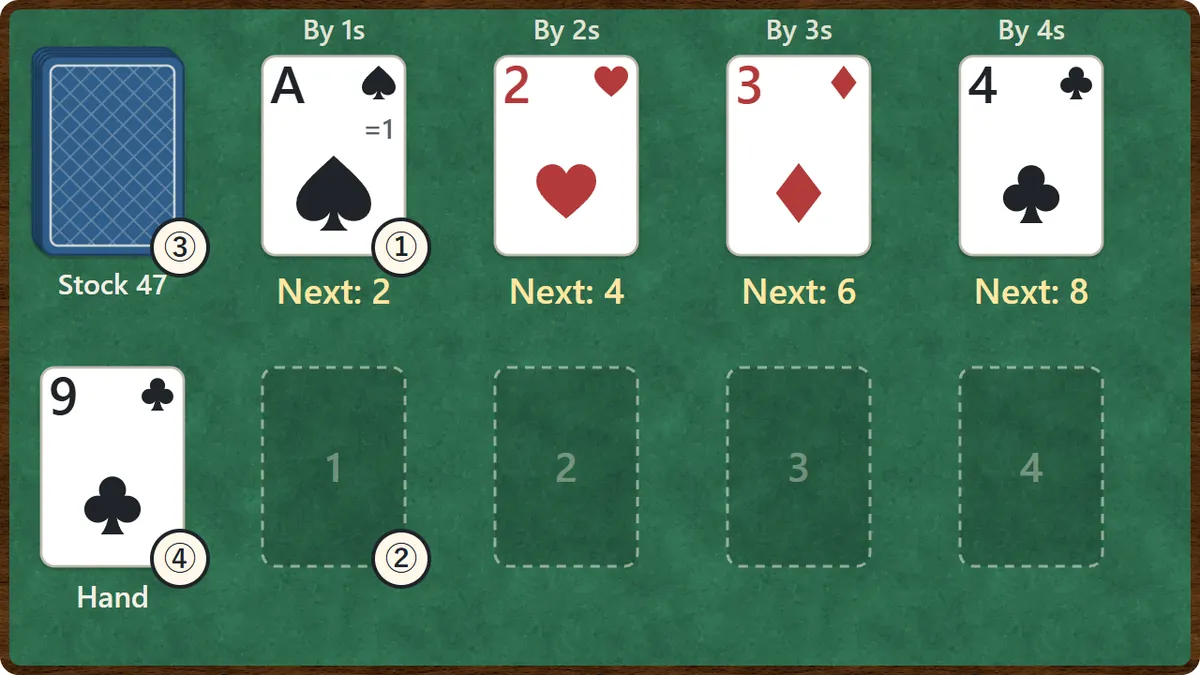
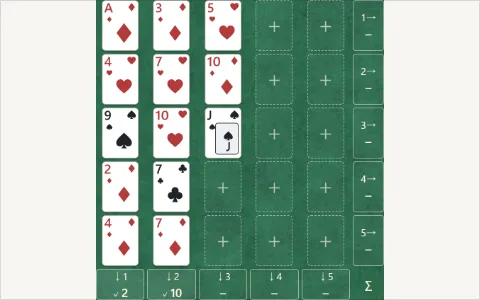
To set up, take out one ace, one 2, one 3 and one 4 of any suits and lay them in a row. These start the four foundations. Shuffle the other 48 cards into a face-down stock and turn over the top card – this is your hand card. Below the foundations are four waste piles, which start empty. You use them to hold cards that cannot go onto a foundation yet.
Calculation Solitaire rules: the four sequences
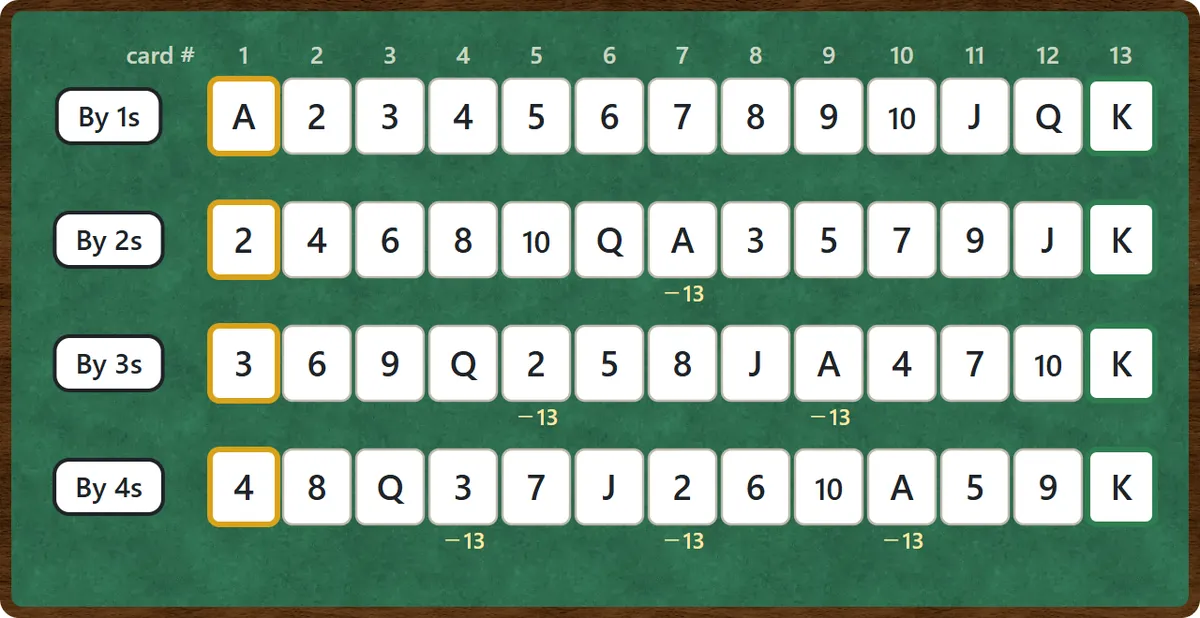
Each foundation must be built in its own fixed order. Count an ace as 1, a jack as 11, a queen as 12 and a king as 13. The first foundation simply counts A, 2, 3 … K. The second adds 2 each time: 2, 4, 6, 8, 10, Q. The third adds 3: 3, 6, 9, Q. The fourth adds 4: 4, 8, Q.
What happens after the queen? On the by-twos foundation, Q (12) plus 2 makes 14, but there is no card higher than 13. So you subtract 13 and keep going: 14 − 13 = 1, which means an ace comes next. Following that rule, the by-twos foundation continues Q, A, 3, 5, 7, 9, J, K, and the by-threes foundation goes Q, 2, 5, 8, J, A, 4, 7, 10, K. Every one of the four foundations uses each rank exactly once and finishes with a king as its 13th card.
Place the hand card on a foundation or a waste pile
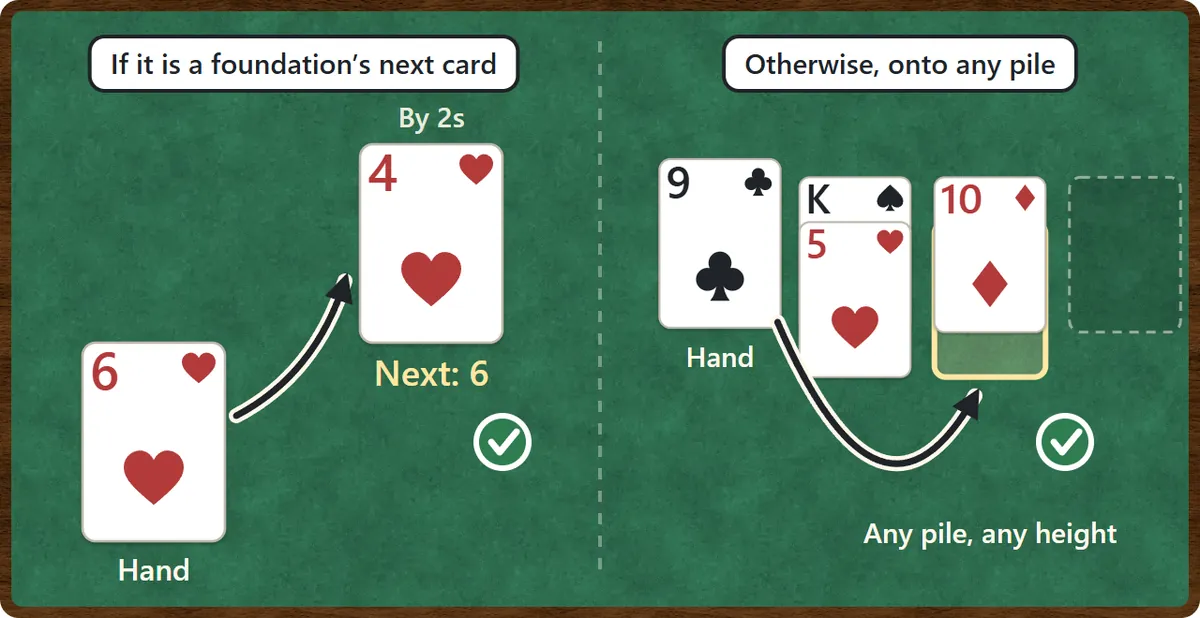
If your hand card is the next card needed by one of the foundations, you may play it there. If it isn’t, you must place it on top of one of the waste piles. There is no restriction on which pile – any pile, empty or not, can take any card, and piles can grow as tall as you like. Then you turn over the next card of the stock as your new hand card. You are also allowed to put a playable hand card on a waste pile instead of a foundation if you want to save it for later.
Only the top card of a waste pile can move
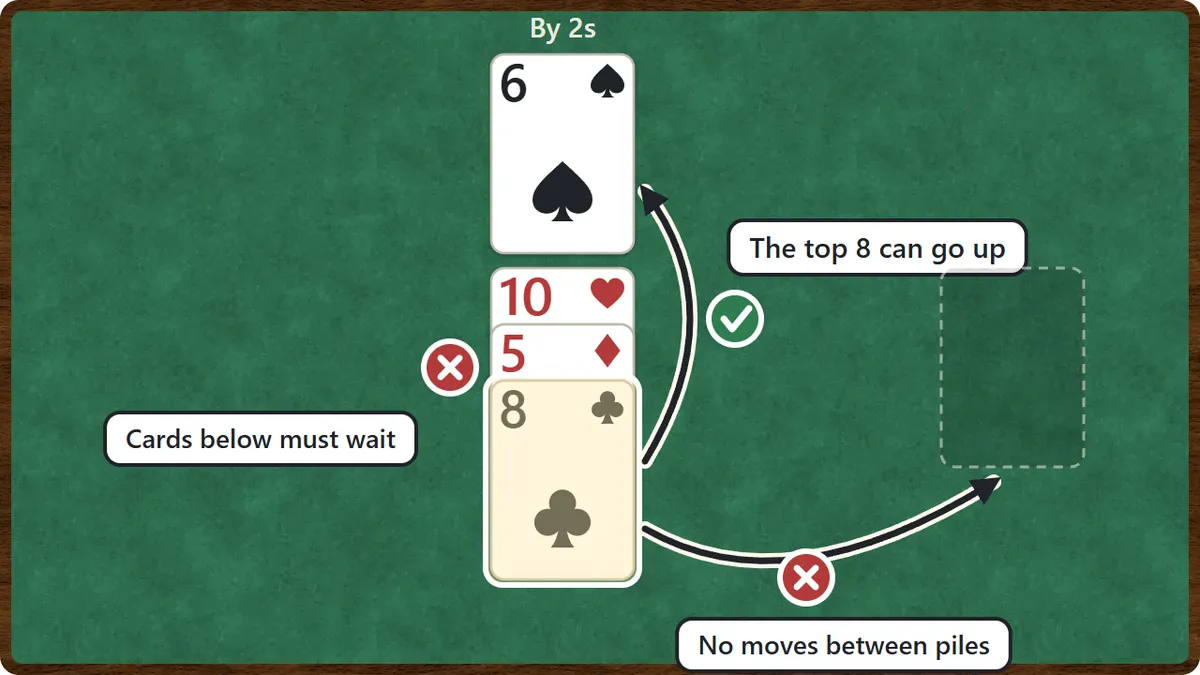
Whenever the top card of a waste pile is the next card of a foundation, you can move it up. Cards underneath are stuck until everything above them has gone. And here is the key restriction: cards in the waste piles can never be moved to another pile. Once a card is parked, its only way out is onto a foundation. That is why choosing the right pile for each card is the heart of Calculation.
Winning and losing
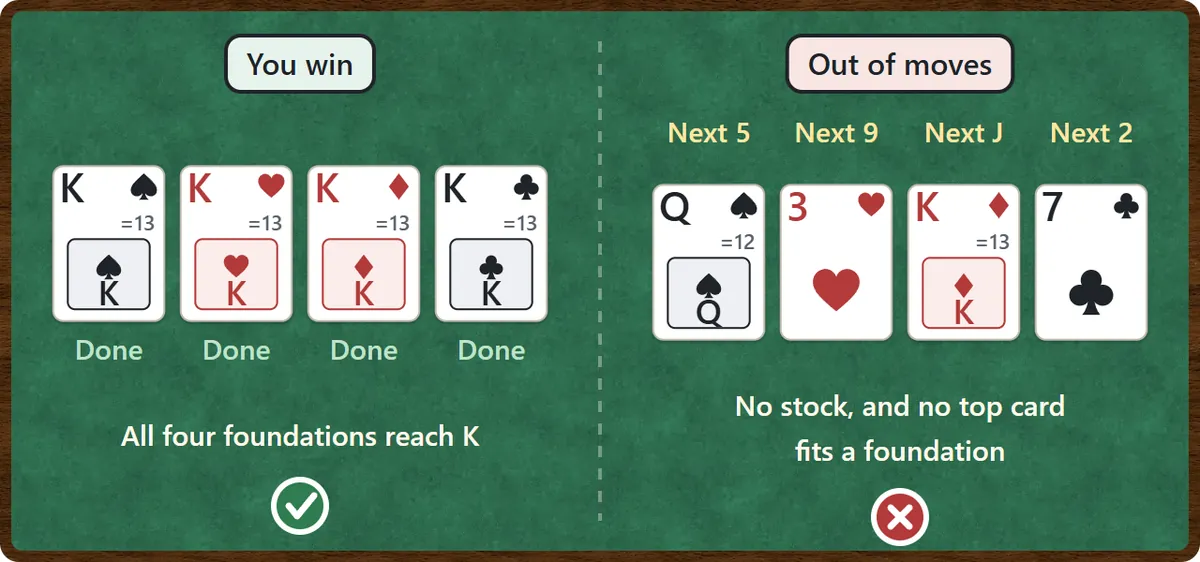
You go through the stock only once; there is no redeal. After the last stock card is placed, keep moving cards from the tops of the waste piles to the foundations. If all four foundations reach the king, you have won. If no top card fits anywhere, the game is over.
Rule variations
Most books describe the game the way it is set up here. Two harder variations are well known, and you can turn them on under “Change the rules”.
| Rule | Default | Harder option |
|---|---|---|
| Foundations | Start with A, 2, 3, 4 | Start empty; the A, 2, 3 and 4 must also come from the stock |
| Waste piles | 4 | 3 – much tighter |
| Stock | One pass | (Redeals are almost never used) |
Using this game
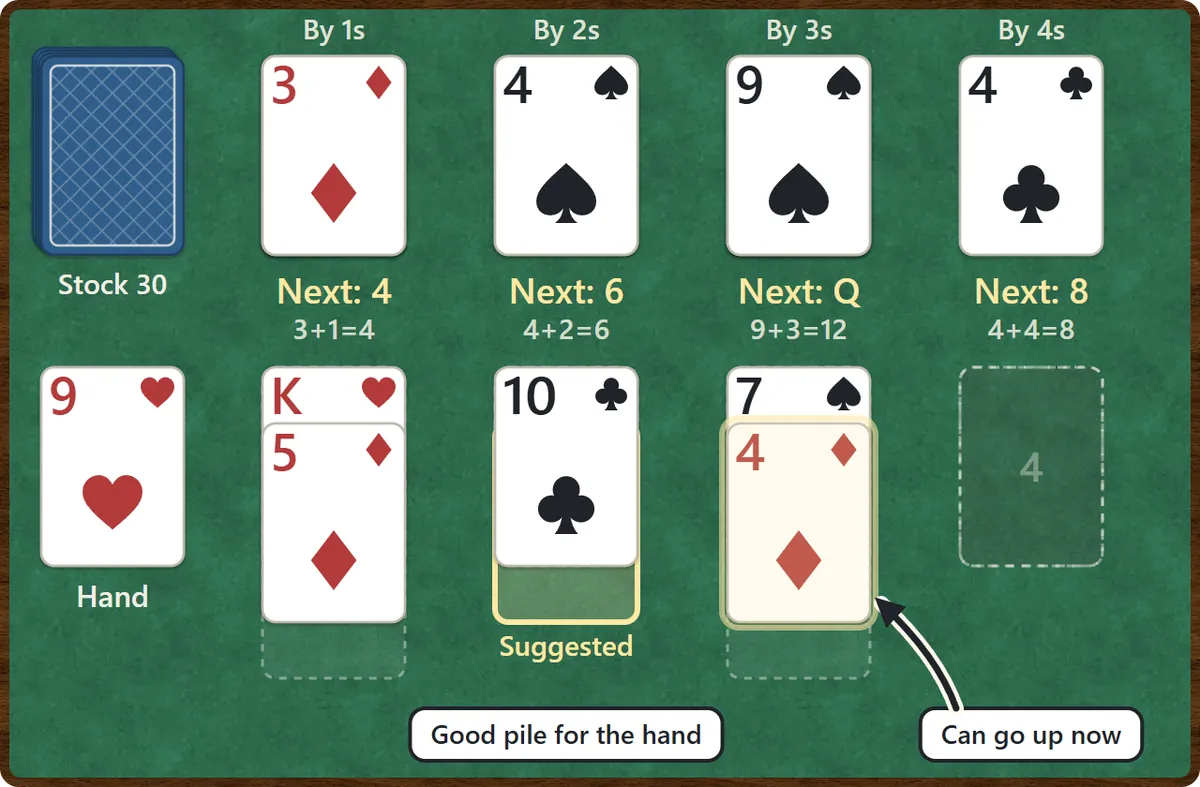
Tap the hand card (face up, on the left) to play it on a foundation. If it doesn’t fit, tap a waste pile and the hand card goes on top of it. Tap the top card of a pile to send it up to its foundation. You can also drag cards. When a card fits two foundations, the game asks you which one to use.
The Help setting decides how much the game shows you. With “Some”, each foundation shows its next card, such as “Next: 6”. With “Full”, you also see the sum behind it (“12+2−13=1”) and a suggested pile for your hand card. With “None”, you keep track of all four sequences in your head. The Sequences button opens a table of all four orders. Undo works for any number of moves, and Hint shows the next move together with the reason for it.
Calculation Solitaire and math
The four foundations are really the multiplication tables in disguise. The by-twos foundation runs through the multiples of 2 (2, 4, 6, 8, 10, 12), the by-threes foundation through the multiples of 3 (3, 6, 9, 12) and the by-fours foundation through 4, 8 and 12. Play a few games and you will be reciting times tables without noticing.
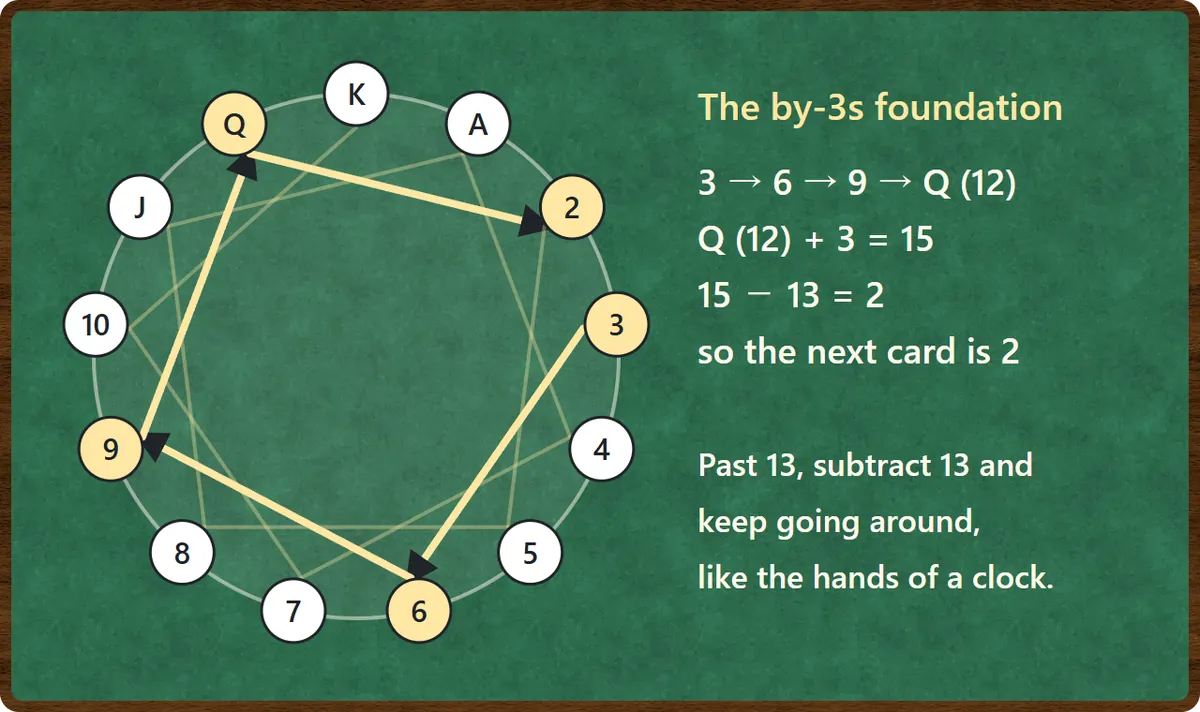
The interesting part starts after 12. “Subtract 13 when you go past 13” is modular arithmetic, the same idea as clock arithmetic: the 5th card on the by-threes foundation is 3 × 5 = 15, and 15 leaves a remainder of 2 when divided by 13, so it is a 2. The 7th card on the by-fours foundation is 4 × 7 = 28; take away 13 twice and you get 2 again.
Why does every foundation end on a king? Thirteen steps of 1, 2, 3 or 4 always add up to a multiple of 13 (13, 26, 39 or 52). And because 13 is a prime number, each sequence visits all thirteen ranks exactly once before it gets there. With Help set to Full, the game shows the sum for each foundation, so it doubles as quick mental-math practice.
Calculation Solitaire strategy and tips
1. Always know the next card of every foundation
Each time a new hand card turns up, compare it with the four “next” cards and check whether any pile top can go up. Strong players also keep the card after next in mind, because that tells them which cards are safe to bury and which are not.
2. Put cards you need sooner on top of cards you need later
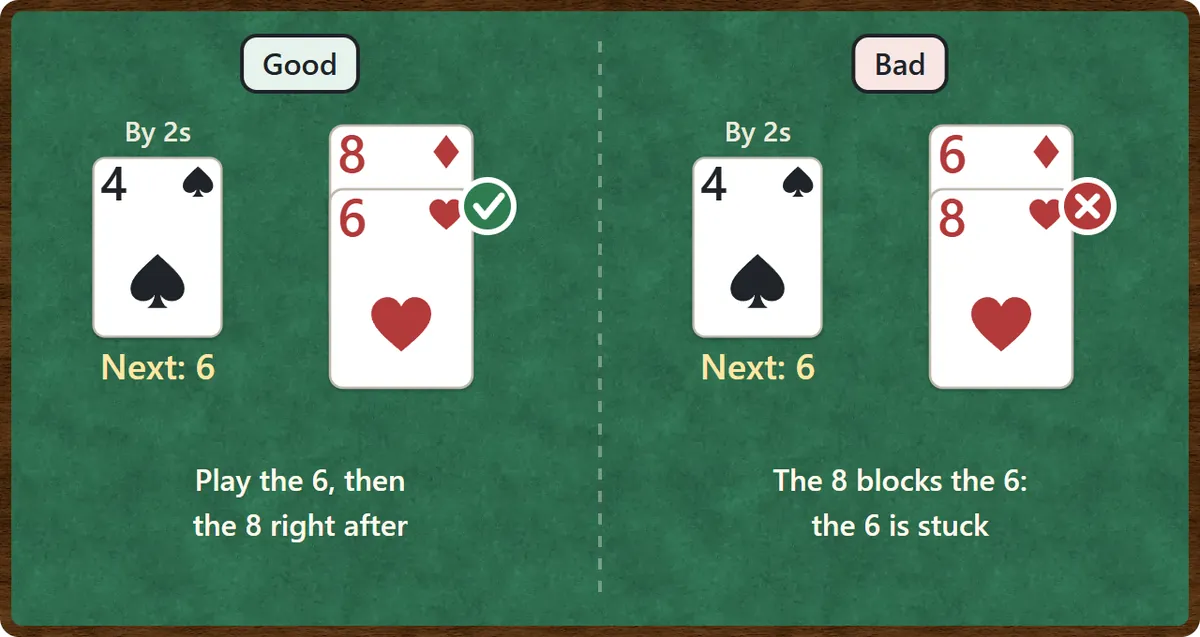
A waste pile empties from the top down, so it works best in reverse order. If the by-twos foundation is on 4, it needs 6 next and 8 after that. Putting a 6 on top of an 8 is perfect: once the 6 goes up, the 8 follows immediately. Putting an 8 on top of a 6 does the opposite – the 6 is buried under a card you can’t use yet.
3. Give the kings a pile of their own
A king is the last card on every foundation. A king dropped on top of other cards locks them in until the very end of the game. Most experienced players reserve one pile for kings. Anything can sit on top of a king without blocking it, because the king won’t be needed until last anyway.
4. Keep an empty pile as long as you can
An empty pile accepts anything, which makes it your emergency exit for an awkward card or a king. If a card can go on an existing pile without burying something important, use that pile and keep the empty one free.
5. The same rank is needed at different times
A 6 is the 6th card on the by-ones foundation, the 3rd on the by-twos, the 2nd on the by-threes and the 8th on the by-fours. Sixes, eights and queens tend to be needed early; tens, jacks and kings tend to be needed late. Ask yourself which foundation will want a card first, and how soon, before you choose its pile.
6. Learn from Undo and Hint
When a game falls apart, step back a few moves and try a different pile. The Hint button explains its choice – for example, “In the by-twos sequence 8 comes right after 6” – and reading those reasons is one of the quickest ways to pick up good habits.
Calculation Solitaire FAQ
How often can you win Calculation Solitaire?
Beginners often lose almost every game at first, and that is normal. Once you learn how to stack the waste piles, your win rate climbs quickly; experienced players are said to win well over half of their games. Luck matters, but skill matters more than in most solitaires. Playing with Help on Full and following the suggested piles is a good way to see what strong play looks like.
Do I have to play a card to a foundation when it fits?
No. You may put a playable hand card on a waste pile instead. Most of the time it is better to play it, because it keeps your piles short, but occasionally holding a card back is useful.
What if a card fits two foundations?
A 6, for example, is next on the by-ones foundation when it shows 5 and on the by-twos foundation when it shows 4. You may choose either one. In this game you tap the foundation you want. A good rule is to pick the one that lets more pile cards follow.
What is the Daily Deal?
Each day has one fixed deal, the same for everyone who plays it that day, so you can compare results with friends or family. “Replay this deal” lets you try any deal again.
Can I stop and continue later?
Yes. Open the game again in the same browser on the same device and press Continue; your undo history is kept too. Sound is off at first – press “Sound: off” to turn on the card sounds.
Where Calculation comes from
Calculation is an old patience game. It is said to come from France, where it was known as “La Plus Belle” (the most beautiful one), and in English it is also called Broken Intervals. It belongs to the same family as Sir Tommy, where cards from the stock are parked on a few waste piles until they can go up, but the four interlocking sequences make it one of the most thoughtful games in that family. It is a quiet, satisfying puzzle that gives your arithmetic a light workout along the way.