 Yorimichi Games
How to Play Make 10
Make 10 is a small arithmetic puzzle with a simple goal: take four single digits, join them with addition, subtraction, multiplication, division and brackets, and end up with exactly 10. Each puzzle takes anywhere from a few seconds to a few minutes, and you need nothing but the numbers in front of you. In Japan the game is traditionally played with the four-digit serial number printed on a train ticket, so any bus ticket, receipt, license plate or clock can turn into a puzzle while you wait.
The basic rules
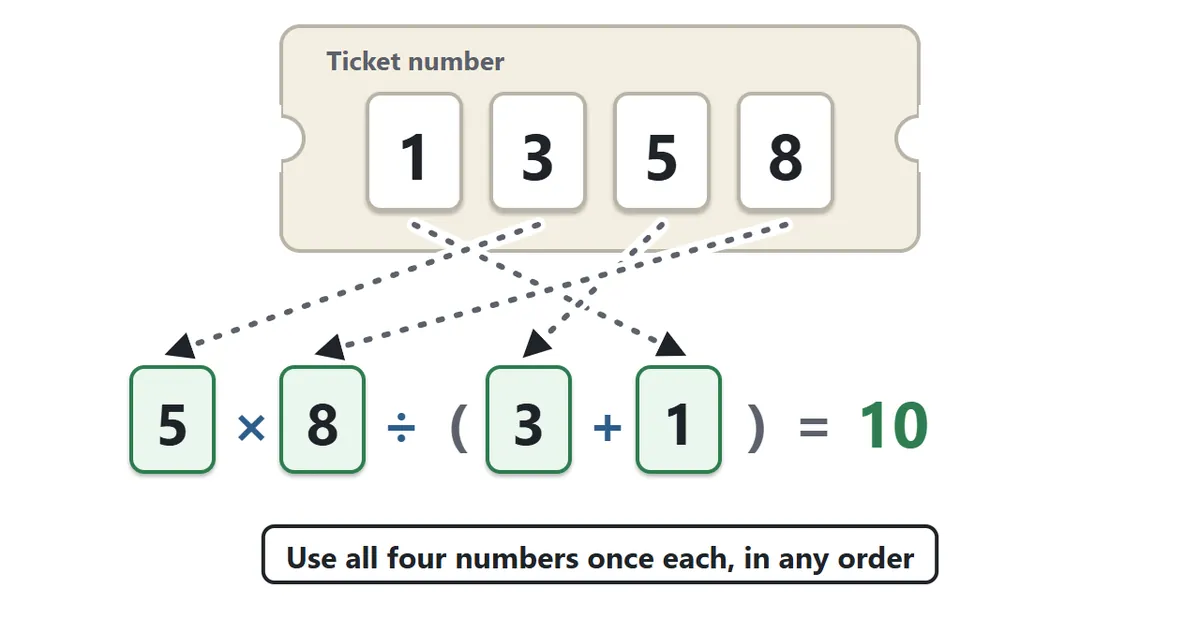
There are only three rules. Use all four numbers, each exactly once. Use only +, −, ×, ÷ and brackets. The result must be exactly 10. Under the standard rules you may rearrange the digits however you like, so 1358 and 5381 are the same puzzle. Most puzzles have more than one answer: 1358 can also be solved with 8 + (5 − 3) × 1.
What is not allowed
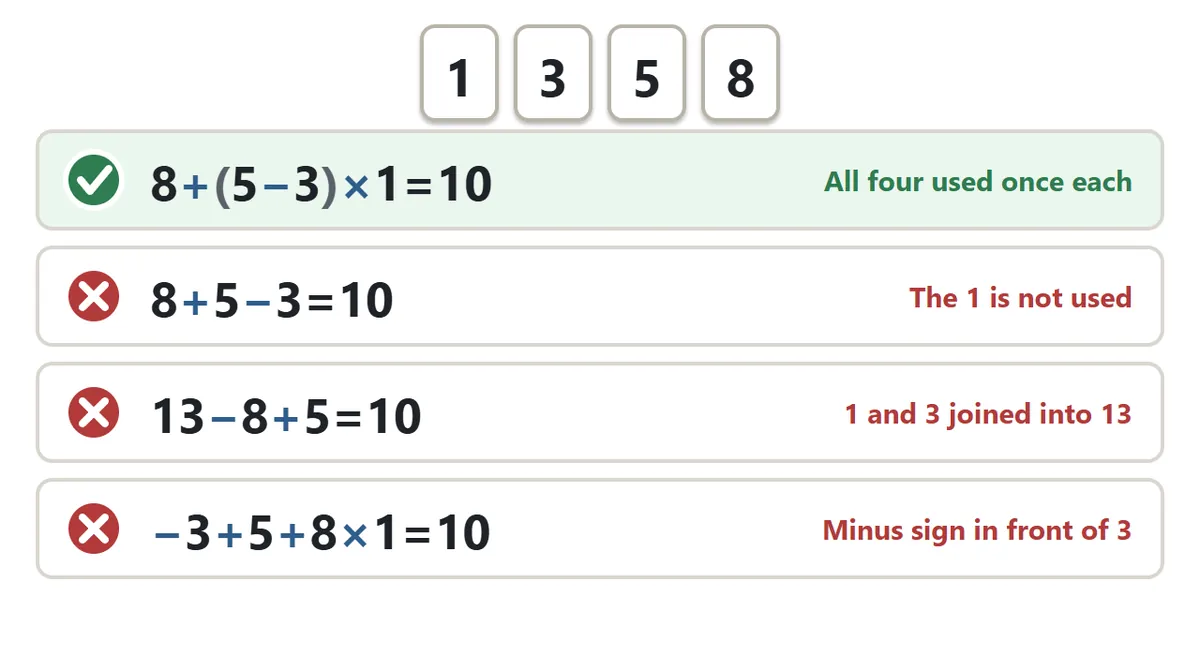
Three mistakes come up again and again. The first is leaving a number unused: 8 + 5 − 3 equals 10, but the 1 is missing, so it does not count. The second is gluing two digits together, such as turning 1 and 3 into 13. That is not allowed under the standard rules, although one of the variations below permits it. The third is writing a negative number, such as −3, by putting a minus sign in front of a digit. A negative value that appears partway through the calculation is fine, though: 5 − 8 = −3 is a perfectly good step.
Order of operations
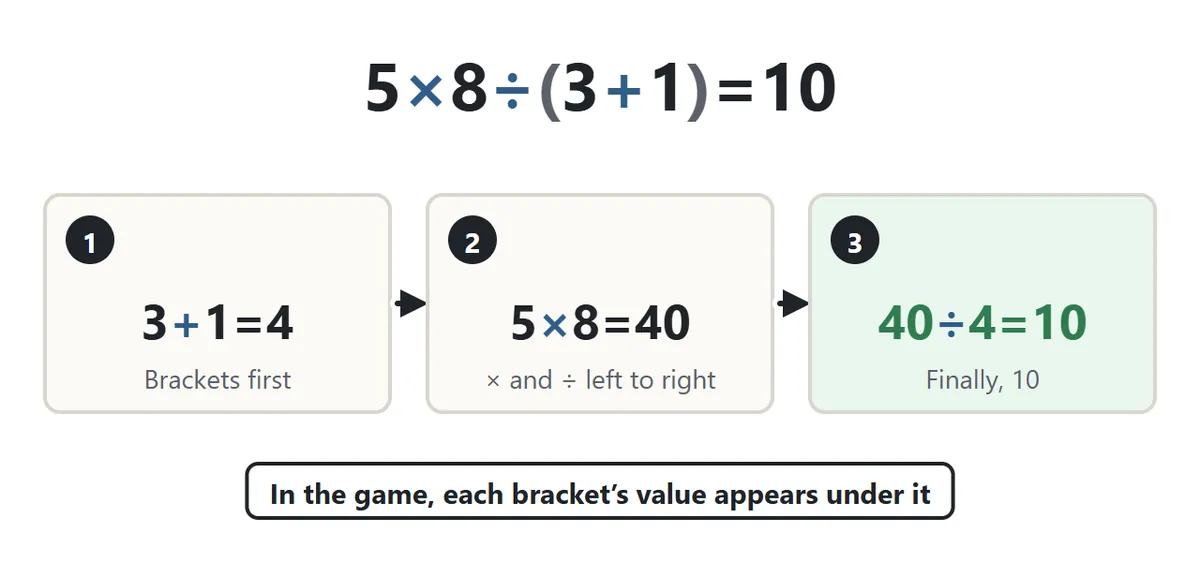
Expressions follow the usual order of operations you learned in school: anything inside brackets comes first, then multiplication and division, then addition and subtraction. Signs of the same strength are worked out from left to right. So 8 + 2 × 3 is 8 + 6 = 14, while (8 + 2) × 3 is 10 × 3 = 30. One pair of brackets can change the answer completely, which is why deciding where the brackets go is often the key to a hard puzzle.
Using the game screen
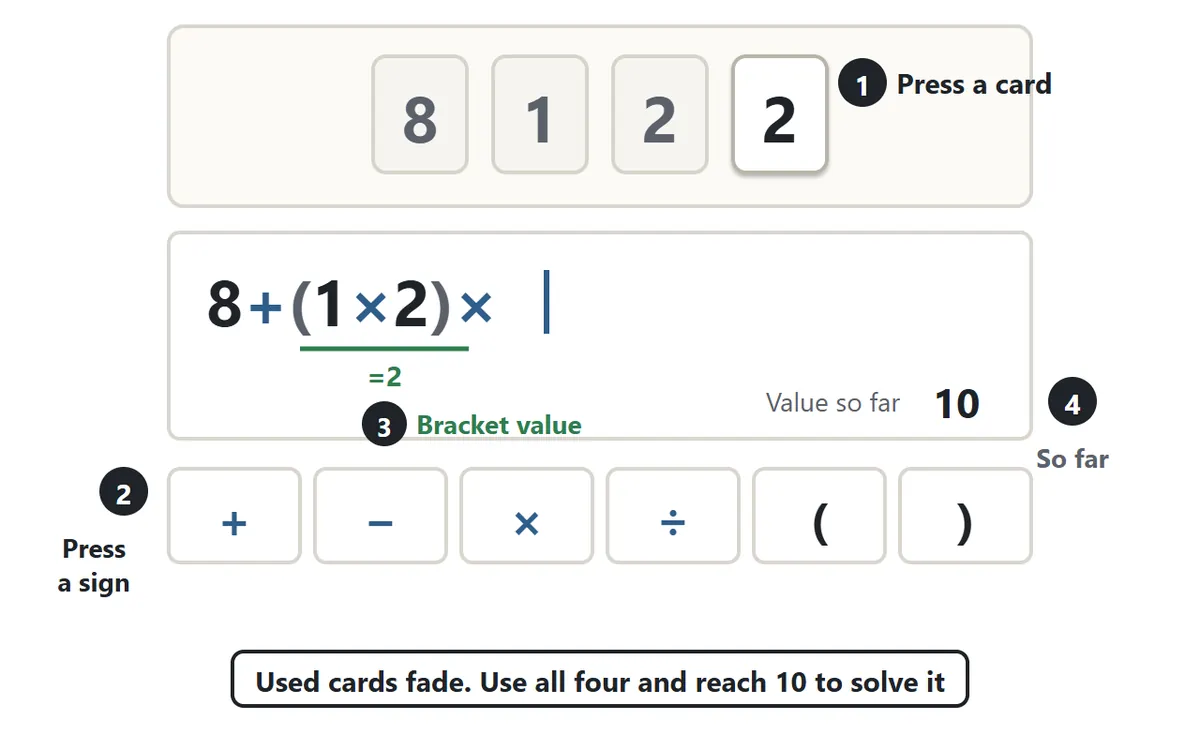
Build your expression by pressing the number cards at the top and the sign buttons below them. On a computer you can also type: digits, + − * / (or x), brackets, Enter to check and Backspace to delete the last entry. When you close a bracket, its value appears underneath it, and the “value so far” in the corner shows what everything you have entered adds up to. Seeing each step makes it much easier to experiment without doing all the arithmetic in your head. As soon as all four numbers are used and the result is 10, the puzzle is solved.
The Hint button tells you which signs you need the first time you press it, and which two numbers to combine first the second time. “Show answer” reveals a full solution, and after solving a puzzle you can open “Other solutions” to see every way it can be done.
Four ways to play
| Mode | What you do |
|---|---|
| One at a time | Pick a difficulty and solve puzzles at your own pace. Your total solved, your fastest time and your streak without hints are saved |
| Time attack | Solve as many as you can in 1 or 3 minutes. You can pass on a puzzle, but hints are off |
| Daily puzzle | Three fixed puzzles each day (easy, normal and hard). Everyone gets the same set on the same day, so you can race friends and family |
| Check numbers | Type in any four digits to see whether they can make 10 and list every solution, then play them yourself |
Make 10 Rules and Variations
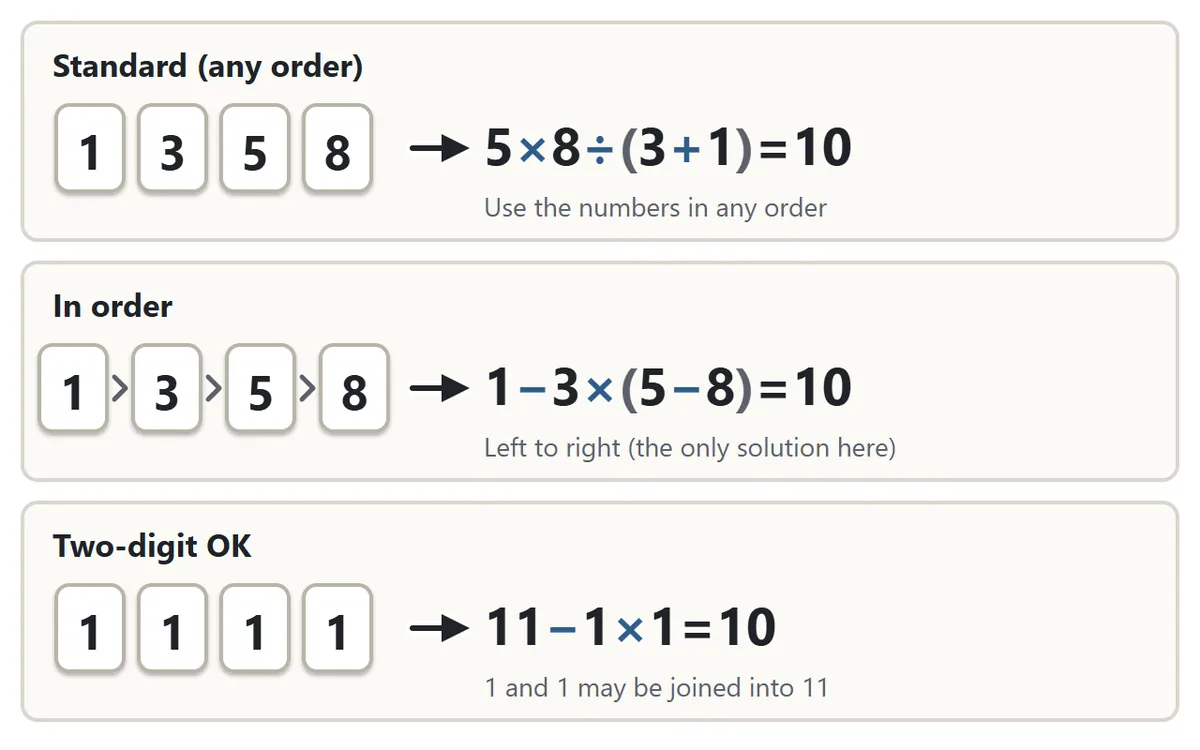
Like most folk games, Make 10 is played with small differences from group to group. The most common variations are built in as rule sets, and “Custom” lets you switch each of the three rules on or off yourself.
| Rules | What changes | How it plays |
|---|---|---|
| Standard (any order) | Use the numbers in any order. No joining digits | The usual game. About three out of four sets of digits can make 10 |
| In order | Use the numbers left to right as shown; signs and brackets are free | Much harder. Many puzzles have only one solution, and bracket placement matters |
| Two-digit OK | Neighboring digits may form a number like 12 or 90 (not starting with 0) | Easier, and sets such as 1111 or 4444 become solvable |
| Whole numbers only (custom) | No division that leaves a fraction | Almost the same as standard, but the fraction puzzles disappear |
Fractions along the way
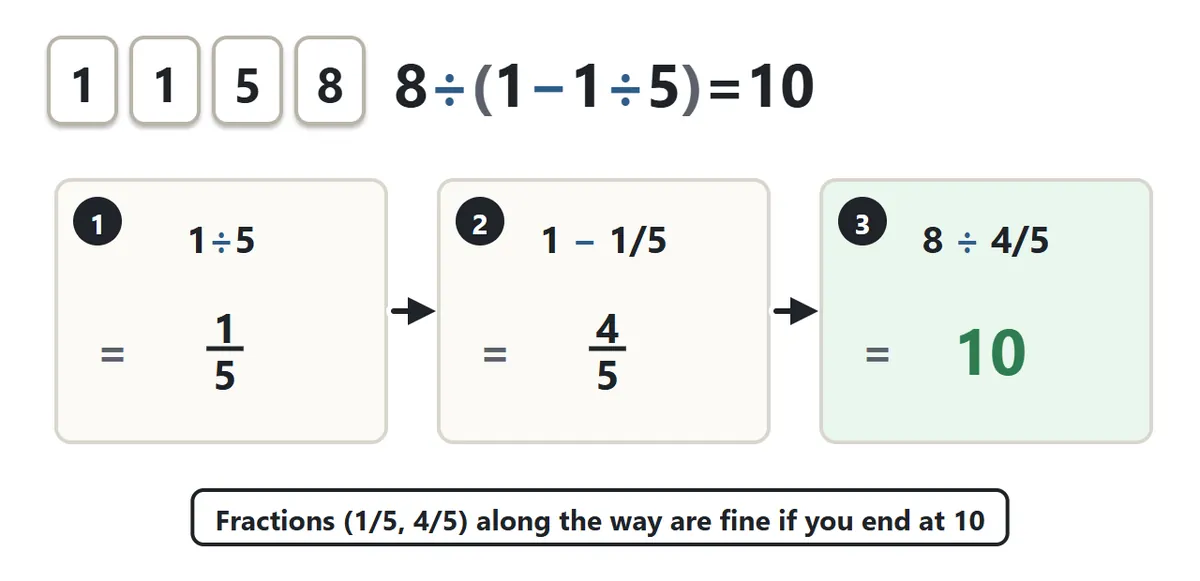
Division can produce a fraction partway through a calculation. Under the standard rules that is fine, as long as the final answer is 10. The digits 1158 are a famous example: 1 ÷ 5 is one fifth, 1 minus one fifth is four fifths, and 8 divided by four fifths is 10. There is no other way to solve that set. Puzzles like this are rare, and they are some of the toughest in the whole game. On screen, fractions are shown as fractions in the value so far, so you can follow them step by step.
The three difficulty levels
Every puzzle the game gives you can be solved. Easy puzzles need little more than addition, or a single multiplication or subtraction. Normal puzzles combine multiplication with subtraction or need a pair of brackets. Hard puzzles have only one or two solutions, or pass through a large number, a negative number or a fraction along the way. Start with Easy, and move up when the answers start to jump out at you.
How to Solve Make 10: Tips and Strategy
1. Work backward from the last step
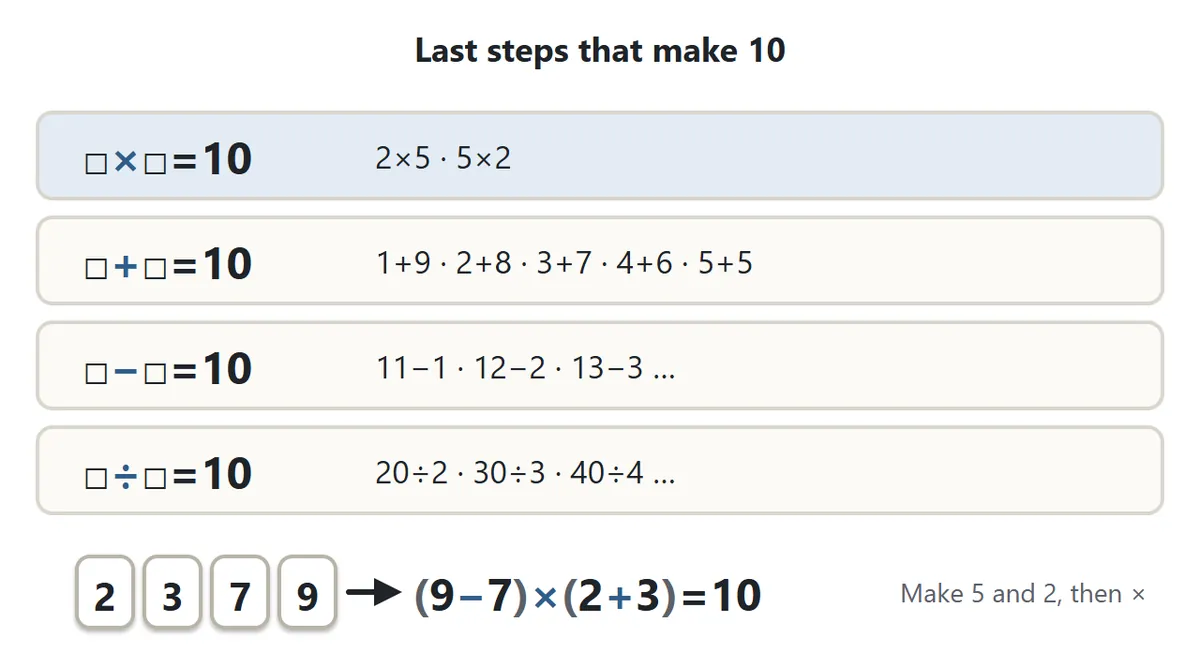
The final calculation that produces 10 has to be one of a handful of shapes: 2 × 5, a sum such as 3 + 7, a subtraction such as 12 − 2, or a division such as 20 ÷ 2. Pick one of those shapes first, then ask whether the remaining numbers can produce the two pieces you need. With 2379, for example, 9 − 7 gives 2 and 2 + 3 gives 5, so (9 − 7) × (2 + 3) = 10.
2. Look for a 5 and a 2
If one of your numbers is 5, try to make 2 from the other three. If you have a 2, try to make 5. Multiplying 2 by 5 is the most common way to reach 10, and it is often the fastest route to an answer.
3. Treat 1 and 0 as spare parts
Multiplying or dividing by 1 changes nothing, and adding or subtracting 0 changes nothing either, while multiplying by 0 wipes out whatever it touches. So if three of your numbers already make 10, you can usually tack on a leftover 1 or 0 with × 1 or + 0. When a puzzle contains a 1 or a 0, solve the other three numbers first.
4. Build a big number, then divide
When sums and differences get you nowhere, multiply to make a large number and divide it back down. 9999 looks impossible at first, but (9 × 9 + 9) ÷ 9 = 90 ÷ 9 = 10. If you can make a multiple of ten such as 20, 30 or 40, all that is left is dividing by 2, 3 or 4.
5. Try subtracting the other way round
Taking a larger number from a smaller one, as in 5 − 8, feels unnatural, which is exactly why it hides the answer to many hard puzzles. If you are stuck, allow yourself a negative number in the middle and see what opens up. 1358 in order, for instance, is solved by 1 − 3 × (5 − 8).
6. Let the value so far guide you
You do not have to work everything out in your head before you start. Enter something, look at the value so far, and adjust. Noticing that you are “2 too many” or “exactly half” is often enough to tell you which sign to change next.
Make 10 FAQ
Can every set of four numbers make 10?
No. Under the standard rules some sets, such as 0000 or 1111, can never make 10. Counting sets of four digits without regard to order, there are 715 in total, and 163 of them are impossible, so roughly one set in four cannot be solved. One neat fact, though: if the four digits are all different and none of them is 0, a solution always exists. You can test any digits with Check numbers.
Can I join two digits into a two-digit number?
Not under the standard rules. If you want to turn 1 and 2 into 12, choose the Two-digit OK rules. With that rule, 70 more sets of digits become solvable.
Is it OK if a division doesn’t come out even?
Yes. Fractions are allowed partway through, as long as the final result is 10. If you prefer whole numbers only, choose Custom and untick the fraction option.
Is Make 10 good arithmetic practice?
It is a friendly way to practice mental math. Each puzzle asks you to add, subtract, multiply and divide in your head, think about the order of operations and try several ideas before one works. Because the value so far is always visible, players who are still getting comfortable with arithmetic can check each step as they go, while experienced solvers can turn off the help and race the clock.
When does the daily puzzle change?
A new set of three appears when the date changes on your device. You can replay it as often as you like that day, but only your first completion is recorded.
Can I stop and continue later?
Yes. In One at a time and Daily puzzle modes, open the game again on the same device and browser and press “Continue”. Time attack is a race against the clock, so it cannot be resumed.
Is there sound?
The game starts muted. Press “Sound: off” below the game to turn on button and success sounds.
Where Make 10 Comes From
Make 10 is best known in Japan, where it is usually called the ten puzzle. For decades, paper train tickets carried a four-digit serial number, and passengers passed the time on the platform by trying to turn those digits into 10. People still play it with car license plates, receipts and even the time on a clock. It has no inventor, no official rulebook and no equipment, which is why the rules drift a little from one group of friends to another, and why variations such as “in order” and “two-digit OK” exist. What keeps people coming back is the moment a set of digits that looked hopeless suddenly gives way, often with a bracket or a fraction you did not expect.