 Yorimichi Games

How to play Cross Sums
Cross Sums is a number puzzle laid out like a crossword. Instead of words, you write the digits 1 to 9 into the white cells, and instead of definitions, the clues are totals. Each clue tells you what a row or column of cells has to add up to. The only arithmetic involved is adding and subtracting small numbers, yet working out which digits can make a given total turns the puzzle into a surprisingly deep game of logic. Every puzzle here has exactly one solution, so you never need to guess: with the right reasoning, you can fill it in cell by cell.
Cross Sums rules
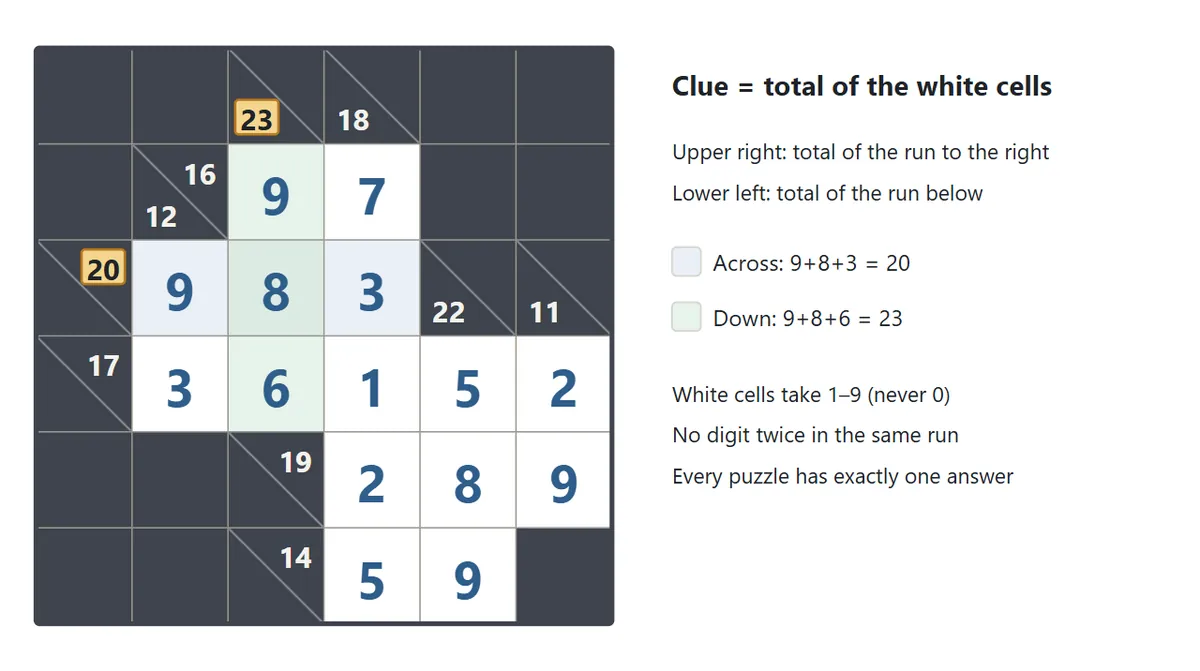
The board is made of black cells and white cells. A line of white cells running left to right or top to bottom is called a run. The black cell just before each run holds a clue, split by a diagonal line. The number in the upper right is the sum of the run to its right (an “across” clue), and the number in the lower left is the sum of the run below it (a “down” clue).
There are only three rules:
- Write one digit from 1 to 9 in every white cell. Zero is never used.
- The digits in each across run and each down run must add up to that run’s clue.
- A digit may not appear twice within the same run.
When every white cell is filled and every run matches its clue, the puzzle is solved.
Why “no repeats” matters so much
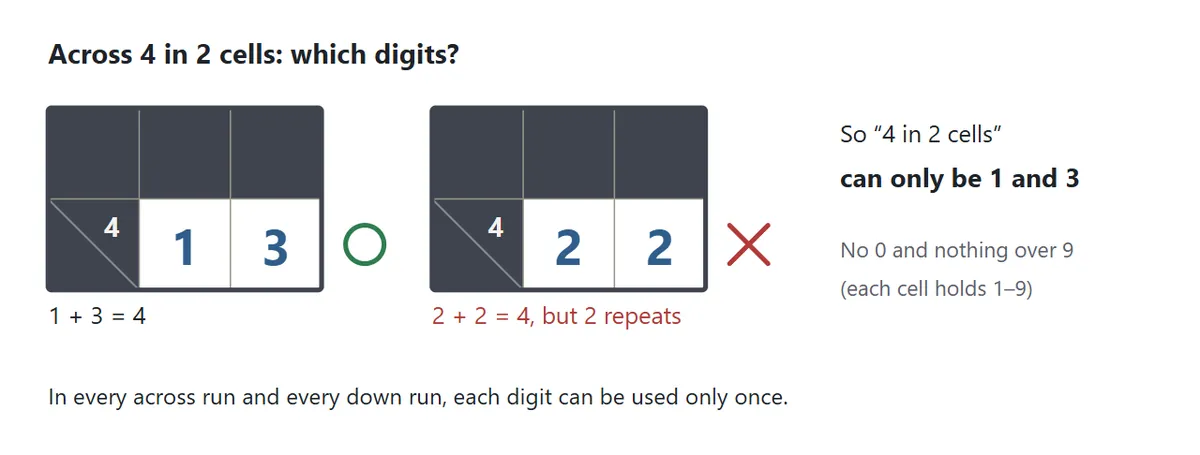
Almost every deduction in Cross Sums comes from the third rule. Take a two-cell run with a clue of 4. The pair 2 + 2 is not allowed, so the only possibility is 1 and 3. You don’t yet know which cell is 1 and which is 3, but you know from the start that those two cells hold exactly those two digits. That kind of certainty is what the whole puzzle is built on.
Using this game
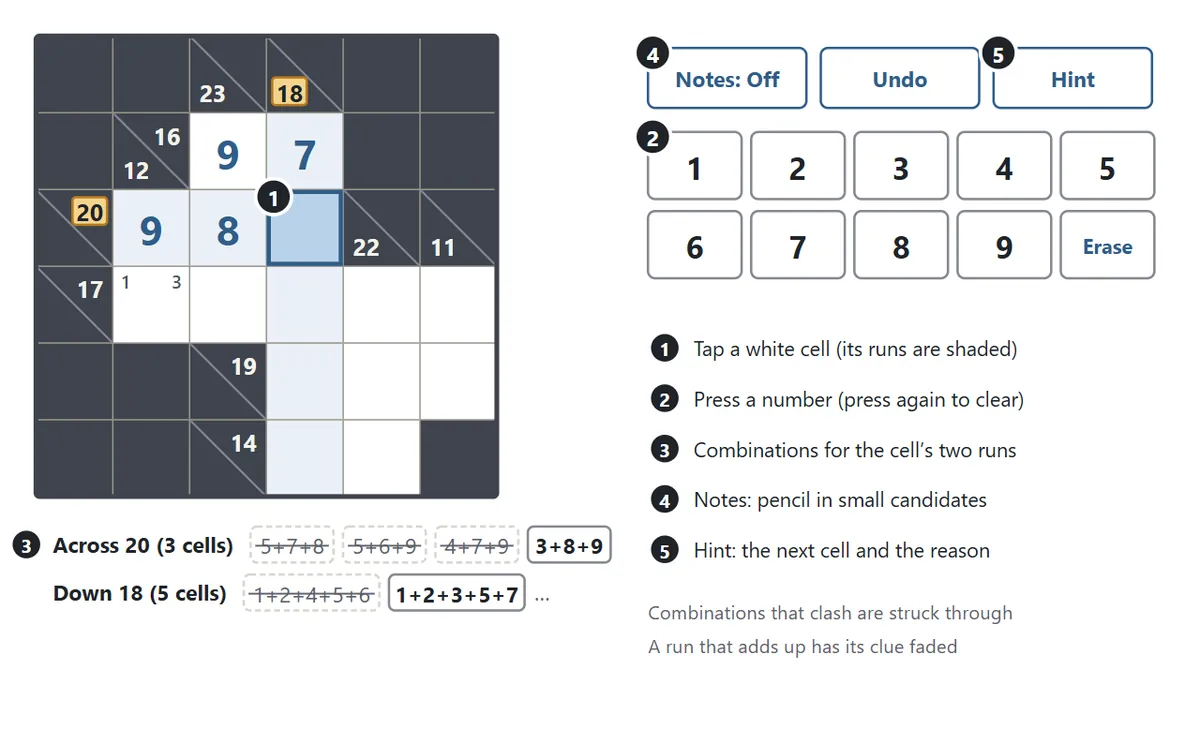
Tap or click a white cell to select it, then press a number on the pad. Press the same number again to clear it. When a cell is selected, the across and down runs through it are shaded and their clues are highlighted, so you always know which totals you are working with.
Just below the board is the combination chart. For each run through the selected cell, it lists every set of distinct digits that makes the run’s total with the right number of cells. Sets that clash with digits you have already placed are struck through, so the remaining options are easy to see. Once you know the common combinations by heart, you can switch the chart off with “Combos: off”.
Turn on Notes to pencil small candidates into a cell, such as “this is 1 or 2”. When you enter a digit, it is removed from the notes of every other cell in the same runs. “Fill in all notes” writes, in every empty cell, all the digits that fit both its across and down combinations. “Undo” steps back one entry or note at a time. You can also play with a keyboard: arrow keys to move, number keys to enter, M for notes, Z to undo, H for a hint and K to toggle the combination chart.
Hints and showing mistakes
If you get stuck, press “Hint”. The first press marks a cell that can be worked out from the current board with a dashed outline and names the technique needed. The second press explains the reasoning and highlights the runs and cells involved. The third press fills in the digit. If you would rather keep thinking for yourself, just use the first step. If any digit you entered is wrong, the hint points that out first by marking the cell in red.
With “Show mistakes” turned on, a wrong digit turns red as soon as you enter it, and a run that doesn’t add up has its clue shown in red. It is a good choice for your first few puzzles. With it off, nothing is pointed out, which suits players who want to solve on their own. Either way, once a run is complete and correct, its clue fades.
Board sizes and difficulty levels
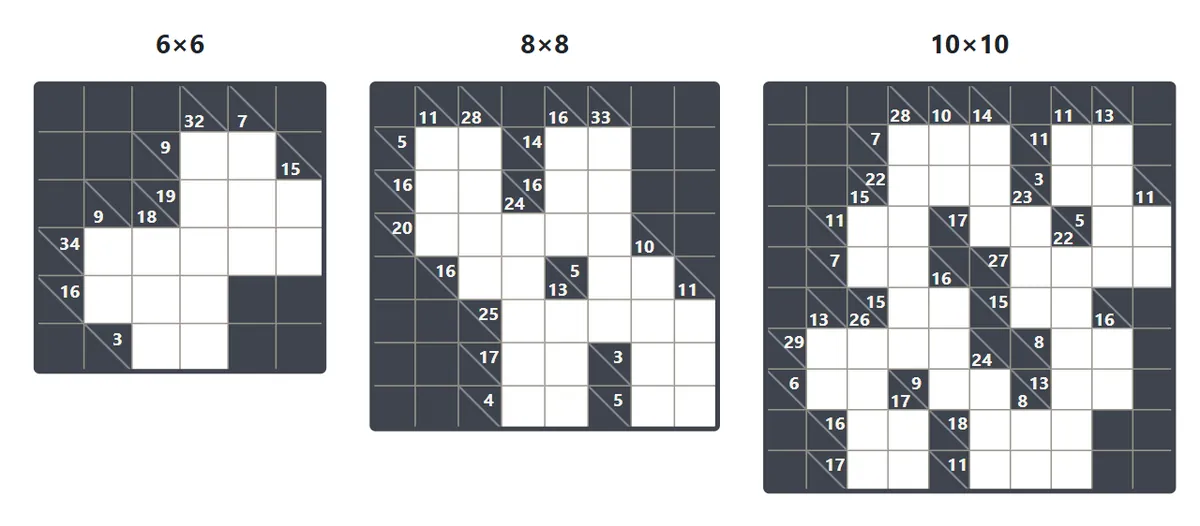
You can play on a 6×6, 8×8 or 10×10 grid (the size counts the top row and left column of clue cells). A 6×6 board has around fifteen white cells, which is just right for learning the rules; a first-time player usually finishes a Beginner 6×6 in about ten minutes.
Difficulty is not about how many cells there are but about which reasoning you need to reach the end. Every puzzle can be solved using only the techniques of its level, and cannot be solved with the techniques of the level below.
| Level | What you need |
|---|---|
| Beginner | Crossing single: only one digit fits both the across and the down combinations |
| Easy | Plus only spot in the run: a digit the run must contain has just one cell it can go in |
| Normal | Plus fitting the combinations: test each combination against the notes and discard the ones that can’t be made |
A new puzzle is generated every time you play, so you will almost never see the same one twice.
Cross Sums strategy and tips
1. Learn the combinations that have only one answer
The best place to start is a total that can only be made one way. These are the smallest and largest possible totals for a run, and the totals right next to them. Keep this cross sums combination chart handy for your first puzzles and you’ll soon remember the common ones.
| Cells | Totals with only one combination |
|---|---|
| 2 | 3 = 1+2, 4 = 1+3, 16 = 7+9, 17 = 8+9 |
| 3 | 6 = 1+2+3, 7 = 1+2+4, 23 = 6+8+9, 24 = 7+8+9 |
| 4 | 10 = 1+2+3+4, 11 = 1+2+3+5, 29 = 5+7+8+9, 30 = 6+7+8+9 |
| 5 | 15 = 1+2+3+4+5, 16 = 1+2+3+4+6, 34 = 4+6+7+8+9, 35 = 5+6+7+8+9 |
| 6 | 21, 22, 38, 39 (1–9 with three digits left out) |
| 7 | 28, 29, 41, 42 (1–9 with two digits left out) |
An eight-cell run uses every digit but one, so subtracting its clue from 45 tells you the missing digit. A nine-cell run always totals 45 and uses 1 to 9 once each.
2. Look where an across run meets a down run
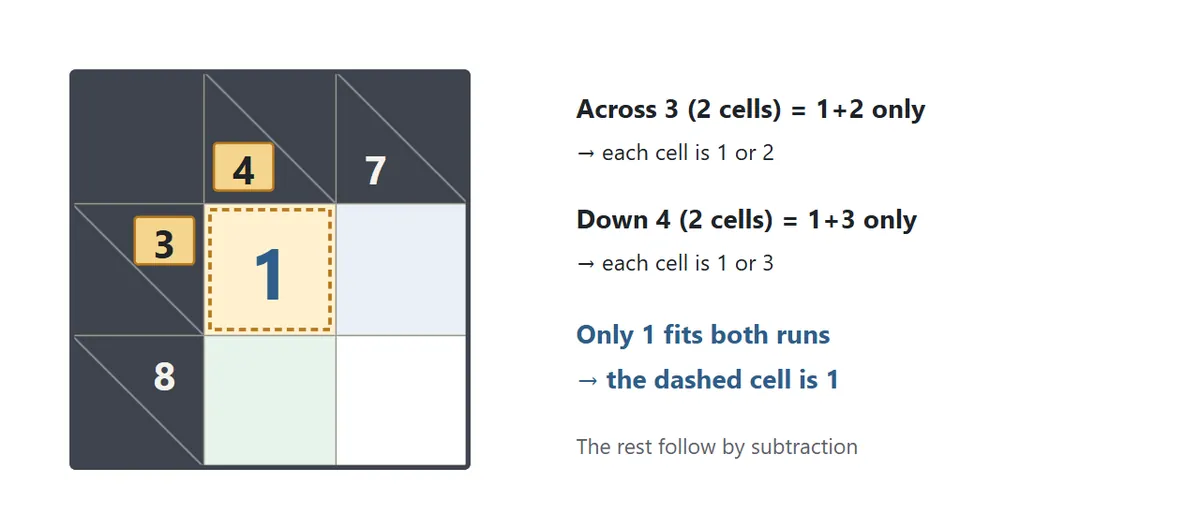
Every white cell belongs to one across run and one down run. Compare the digits allowed by the across combinations with those allowed by the down combinations. If only one digit appears in both, that is the answer for the cell. In the picture, an across 3 in two cells must be 1 and 2, and a down 4 in two cells must be 1 and 3, so the cell where they cross is 1. Once it is placed, the other cells of both runs follow by subtraction.
3. The last cell of a run is simple subtraction
When a run has only one empty cell left, its value is the clue minus the digits already in the run. It sounds obvious, but it is easy to overlook. Get into the habit of checking, after each entry, whether the across or down run you just touched now has a single cell left. It speeds up solving more than any clever trick.
4. Find digits a run must contain
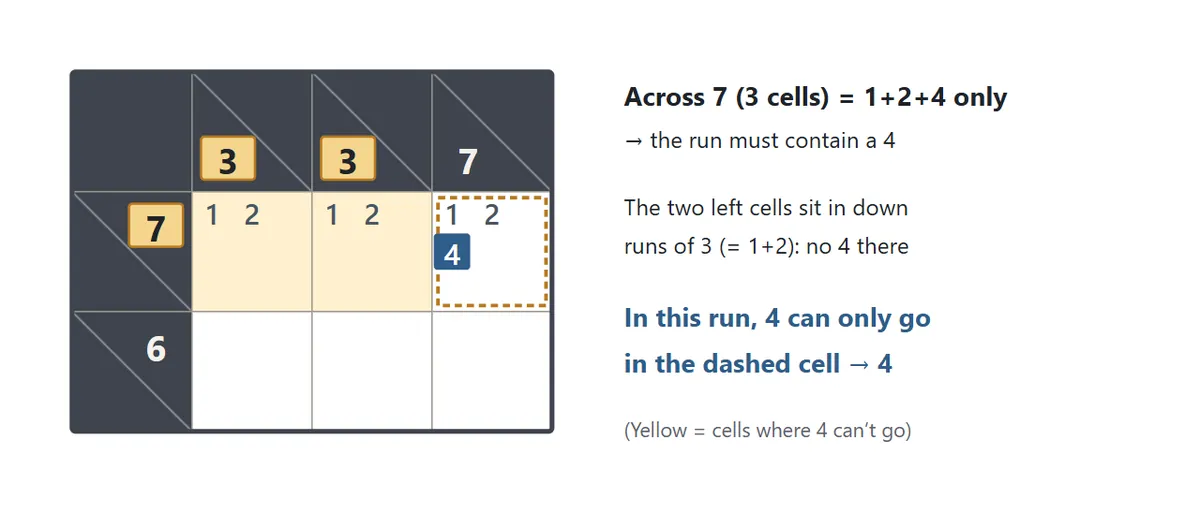
From the Easy level on, you will sometimes need to think from the run’s point of view instead of the cell’s. However many combinations a run has, any digit that appears in all of them must go somewhere in that run. Check each cell where that digit could go against its crossing run. If only one cell is possible, the digit belongs there.
5. Fit the combinations to your notes
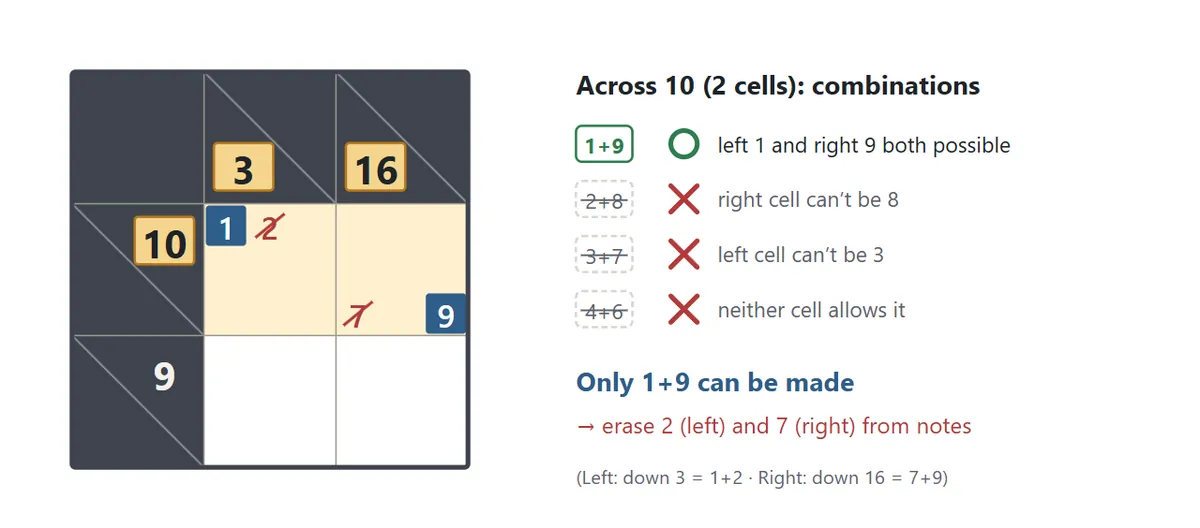
Normal puzzles ask you to take notes first. A two-cell run of 10 has four possible pairs: 1+9, 2+8, 3+7 and 4+6. But if you already know the left cell can only be 1 or 2 and the right cell only 7 or 9, then 1+9 is the only pair you can actually make. That lets you erase the 2 from the left cell and the 7 from the right cell. Removing candidates like this often opens up a new crossing single or a new only-spot deduction somewhere else.
6. Start with the smallest and largest totals
When you don’t know where to begin, scan the board for the smallest and largest clues. Small totals can only use small digits and large totals only large ones, so their candidates narrow down quickly and the first cell is easy to find. If you hit a wall, press “Fill in all notes” and look around cells that have only one or two candidates left.
Daily puzzle
The daily puzzle is one 8×8 board chosen by the date. Everyone who plays on the same day gets the same puzzle, so you can compare times with family and friends. The difficulty follows the weekday: Beginner on Monday and Tuesday, Easy on Wednesday and Thursday, and Normal from Friday to Sunday. Solve it on consecutive days to build a streak.
Cross Sums FAQ
Do I need to be good at math?
No. All you ever do is add and subtract digits from 1 to 9. With the combination chart on, the game shows you which sets of digits can make each total, so the real puzzle is deciding which digit goes in which cell. The common combinations stick in your memory after a few games.
Does every puzzle really have only one answer?
Yes. Before a puzzle is shown, it is checked to be solvable from start to finish using only the reasoning of its level. If every cell can be deduced, there is no room for a second answer. On top of that, a full search confirms that the solution is unique.
How are my times recorded?
For each combination of size and level, the game keeps the number of puzzles solved, how many you solved without hints, your fastest time and your average time. Only puzzles solved without hints or “Show answer” count for the best time. Showing mistakes or using the combination chart does not affect your record. Records are saved only in your browser on this device.
Can I stop and continue later?
Yes. Open the page again in the same browser on the same device and press “Continue” to pick up with your digits, notes and elapsed time as they were. The undo history is kept too. The clock stops while you are in another tab.
Is there sound?
The game starts muted. Press “Sound: off” to turn on the effects for entering digits and solving the puzzle.
Where Cross Sums comes from
Puzzles in which digits are fitted to totals are generally said to have appeared in American puzzle magazines around the middle of the twentieth century, where they were printed under names such as Cross Sums and Cross Addition. They were conceived as a numerical cousin of the crossword: the same interlocking grid, but with arithmetic in place of vocabulary. The format later spread to puzzle magazines in other countries, including Japan, where it became a staple of puzzle books from the 1980s. Because it needs no knowledge of any language, only a feel for how small numbers combine, it can be enjoyed by players of any age anywhere, and new puzzles are still being created every day, including the ones generated for you here.