 Yorimichi Games

How to Play Cryptarithms
A cryptarithm is an arithmetic puzzle in which some or all of the digits have been hidden, and your job is to bring them back. This page has the two classic kinds. In a missing digits puzzle, a worked calculation (column addition, subtraction, multiplication or long division) has some digits replaced by empty boxes. In an alphametic (also called verbal arithmetic or a letter sum), every digit has been replaced by a letter, and you have to work out which letter stands for which digit. The arithmetic itself is never hard. The challenge is that you have to run the calculation backwards, reasoning from what you can see to what must be hidden. Every puzzle here has been checked so that it has exactly one answer, so you never need to guess.
Missing digits rules
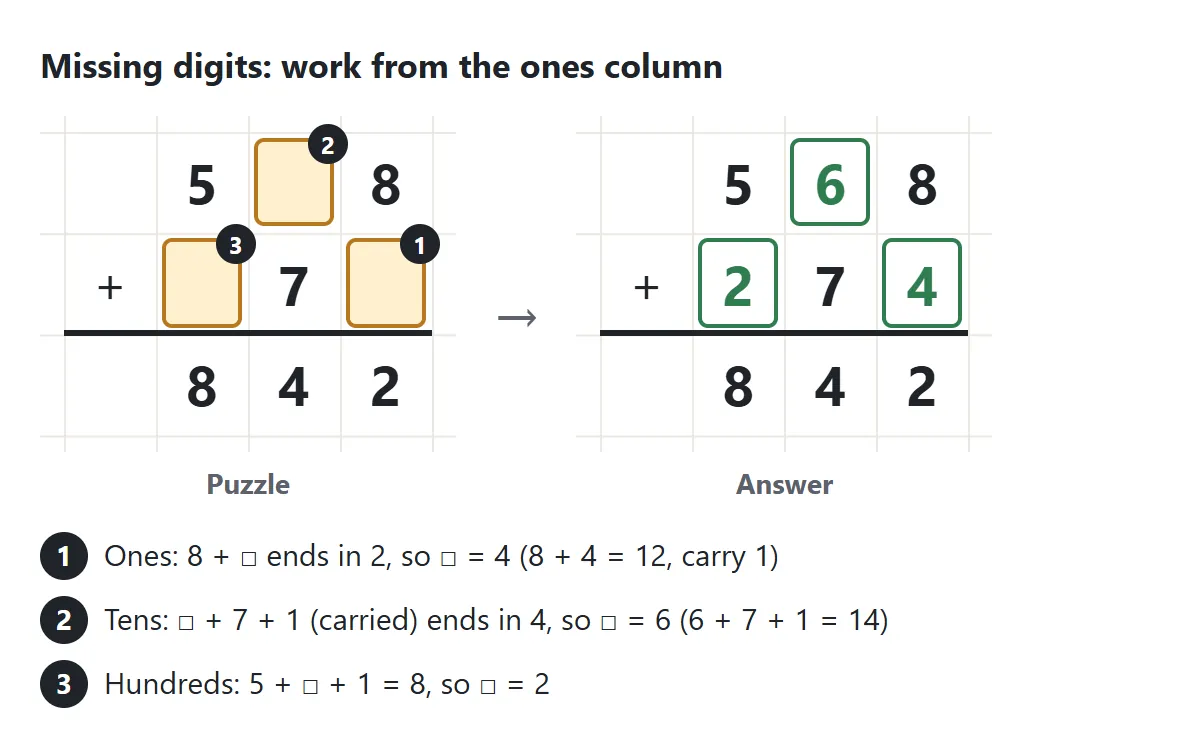
The rule is short: write one digit from 0 to 9 in each box so that the whole calculation is correct. A number with two or more digits never starts with 0. Two boxes are allowed to hold the same digit. Multiplication by a two-digit number shows both partial products, and long division shows every subtraction step, exactly the way you would write them out by hand. All of the division puzzles divide exactly, so the last row is always 0.
Alphametic rules
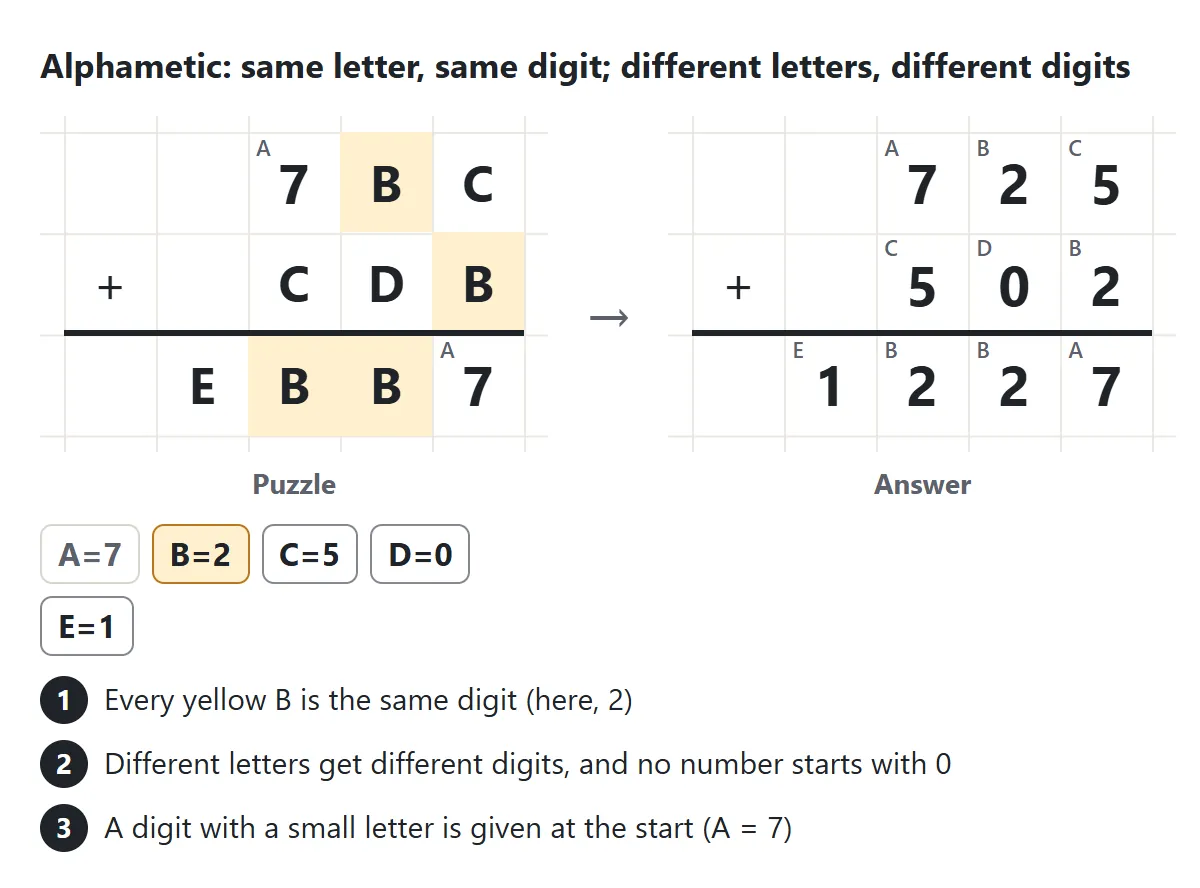
In an alphametic, each letter stands for one digit. The same letter always means the same digit, and different letters always mean different digits. As before, no number may start with 0. In the easier puzzles, one or more letters are revealed at the start; they are shown as a digit with the small letter in the corner. A revealed digit cannot be used by any other letter, which is itself a useful clue. If you prefer, you can switch the letters to simple shapes in the settings.
Using this game
Tap a box (or a letter square in an alphametic) to select it, then tap a digit on the number pad. Tap the same digit again to erase it. In an alphametic, setting a letter fills every square that shows that letter, and the table under the puzzle lets you pick letters directly. The small label on each digit key shows which letter is already using that digit. On a computer you can use the arrow keys to move, the number keys to type, Backspace to erase, Z to undo and H for a hint.
The Hint button reveals one digit (one letter in an alphametic). Revealed digits turn green and are locked. If you have already entered a wrong digit, the hint points that out first by turning it red. With mistake check switched on, any digit that does not match the answer turns red immediately; switch it off if you would rather check your own work. Giving two letters the same digit always triggers a warning, because it breaks the rules.
Puzzle Types and Difficulty
Missing digits puzzles come in eight types, from simple column addition up to expert long division where most of the digits are hidden. Alphametics come in five types. The easy ones reveal a few letters to get you started, and the expert ones give you at most one.
| Type | What it is | Hidden |
|---|---|---|
| Addition, subtraction | 3-digit column sums | 3–5 boxes |
| Multiplication | × 1 digit, or 2 × 2 digits with partial products | 4–9 boxes |
| Long division | ÷ 1 or 2 digits, exact | 5–10 boxes |
| Expert | 3 × 2 digits, or a 3-digit quotient | 60–75% of digits |
Cryptarithm Strategy: How to Solve Missing Digit Puzzles
1. Start with the ones column
Column arithmetic is done from right to left, so that is the natural order for solving, too. Once the ones digit is fixed, you know whether there is a carry (or a borrow) into the tens column, and the next box becomes much easier. In the example above, 8 plus the box ends in 2, so the box must be 4, and 1 carries over.
2. Count the digits
The length of each number is a strong clue that is easy to overlook. If two 3-digit numbers add up to a 4-digit number, the answer must start with 1. If a two-digit number times 7 gives a three-digit number, the first number must be at least 15. Before you try anything clever, look at how long every row is.
3. Use the partial products
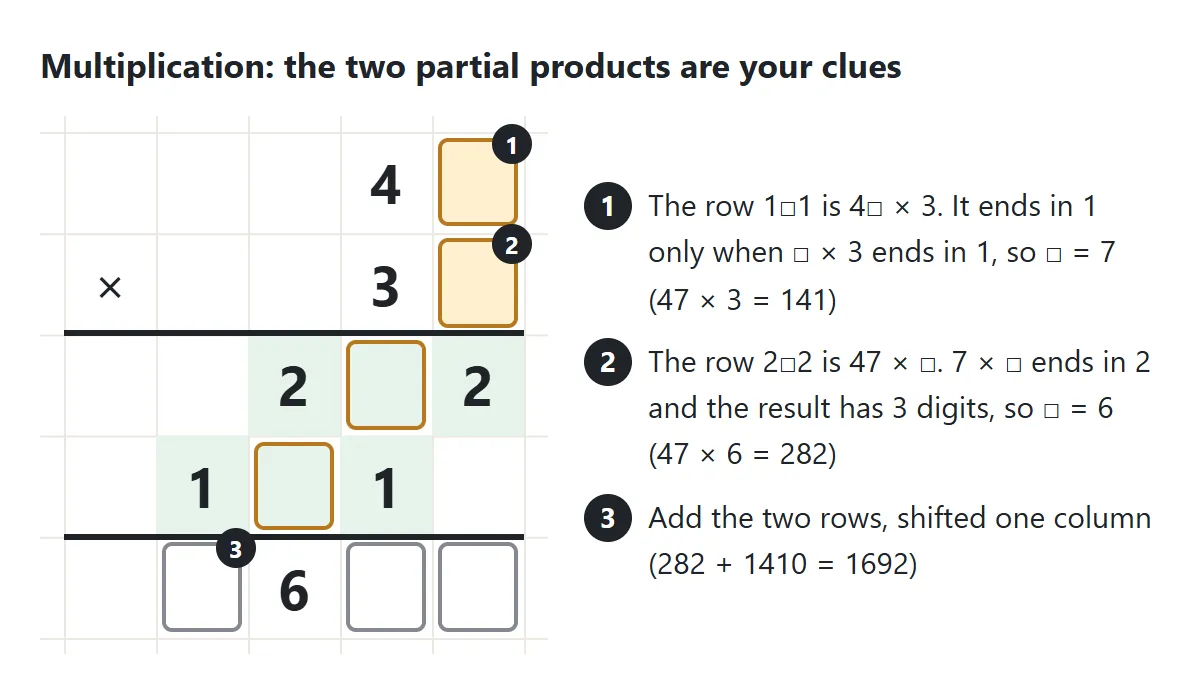
When you multiply by a two-digit number, each partial product is the top number times one digit of the multiplier. Looking only at the last digit of each partial product narrows the choices quickly. For example, if 7 times a digit ends in 2, that digit can only be 6. Knowing your times tables by their last digits pays off here.
4. Read long division row by row

Long division repeats one cycle: write the divisor times one quotient digit, subtract, and bring down the next digit. Because every puzzle divides exactly, the last two rows above the final 0 are the same number. Every row you subtract is a multiple of the divisor, so listing the divisor's multiples is often enough to pin down a whole row. The expert puzzles combine these facts several times over.
Alphametic Tips
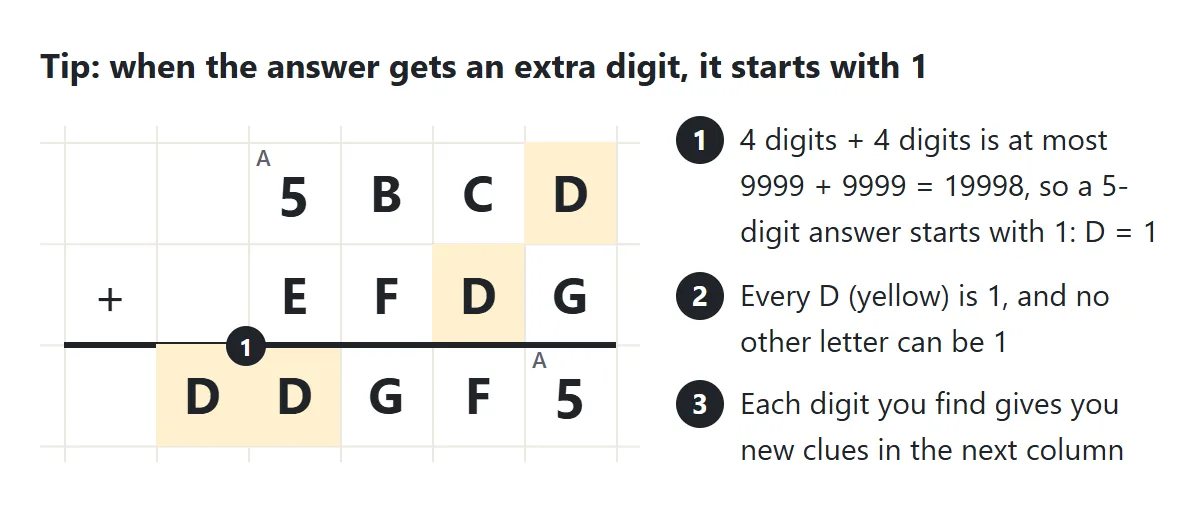
The most useful alphametic clue is that an extra digit in the answer must be 1. When you add two numbers, the carry from any column is only ever 0 or 1. Once you know a letter is 1, fill it in everywhere and remember that no other letter can be 1.
A few more patterns come up again and again. If a column reads A + B and the answer digit is A again, then B is 0, or 9 if a carry came in from the right. A letter added to itself (A + A) always gives an even ones digit. In a subtraction, the top number is the answer plus the number being taken away, so you can rewrite it as an addition. And when you are stuck, pick the letter with the fewest possibilities, list them, and test each one. The ones that lead to a contradiction drop out.
When you get stuck
Try a digit, follow it through, and use Undo if it falls apart. That is a perfectly good way to test an idea. If you are truly stuck, a single hint is often enough to unlock the rest of the puzzle.
Daily Puzzle and Printable Worksheets
The daily puzzle is the same for everyone on a given date, with one missing digits puzzle and one alphametic each day. Early in the week the puzzles are gentler; Saturday's are the hardest. Solve them on consecutive days to build a streak.
The printable page makes black-and-white worksheets with 1, 2, 4 or 6 puzzles per page and an optional answer page. Choose US Letter or A4. Alphametic worksheets include a box for each letter so you can write down your answers.
Cryptarithm FAQ
Does every puzzle really have only one answer?
Yes. Before a puzzle is shown, every possible way of filling the hidden digits is checked, and only puzzles with exactly one valid answer are used. Alphametics are checked the same way against every possible assignment of digits to letters.
Can two boxes have the same digit?
In a missing digits puzzle, yes. The only requirement is that the calculation is correct. In an alphametic, no: different letters always stand for different digits.
What is the difference between a cryptarithm and an alphametic?
Cryptarithm is the general name for any arithmetic puzzle with hidden digits. An alphametic is the kind where the digits are replaced by letters, and the term is often reserved for puzzles whose letters spell real words. Puzzles where digits are replaced by boxes or asterisks are often called missing digit puzzles or skeleton division.
How are records kept?
For each puzzle type, the game records how many you have solved, how many without hints, your best time and your average time. Only puzzles solved without hints and without showing the answer count toward your best time. Everything is stored in your own browser and never sent anywhere.
Can I stop and continue later?
Yes. Open the page again in the same browser and press Continue. Your digits and the timer are restored, and the timer pauses while the tab is in the background.
A Short History of Cryptarithms
Puzzles in which digits have to be restored are old. Similar problems appear in Japanese mathematics books from the Edo period, and in many countries they were used as arithmetic exercises. The Japanese name for the missing digits kind compares the empty boxes to the holes left when insects eat their way through an old book. Letter sums became popular in puzzle magazines in the early twentieth century, and the word alphametic was coined in the 1950s for puzzles whose letters form meaningful words. Today both kinds are favorites in recreational mathematics and in competition math practice.