 Yorimichi Games

How to Play Conway's Game of Life
Conway's Game of Life is a grid of squares called cells, each of which is either alive or dead. You decide which cells start out alive, then let the generations roll. From that moment on nothing is up to you: every cell follows the same four simple rules, and the whole board changes at once, one generation after another. It was devised by the British mathematician John Horton Conway in 1970, and it is often called a zero-player game because there is no opponent, no score and nothing to win. The fun is in the surprise. A handful of cells can explode into a busy city, settle into a quiet landscape, blink forever, or set off across the board like a tiny spaceship. It is also a favorite in science and computing classes, because it shows how complex behavior can grow out of very simple rules. (Despite the similar name, it has nothing to do with the family board game about careers and paydays.)
Conway's Game of Life rules: birth, survival and death
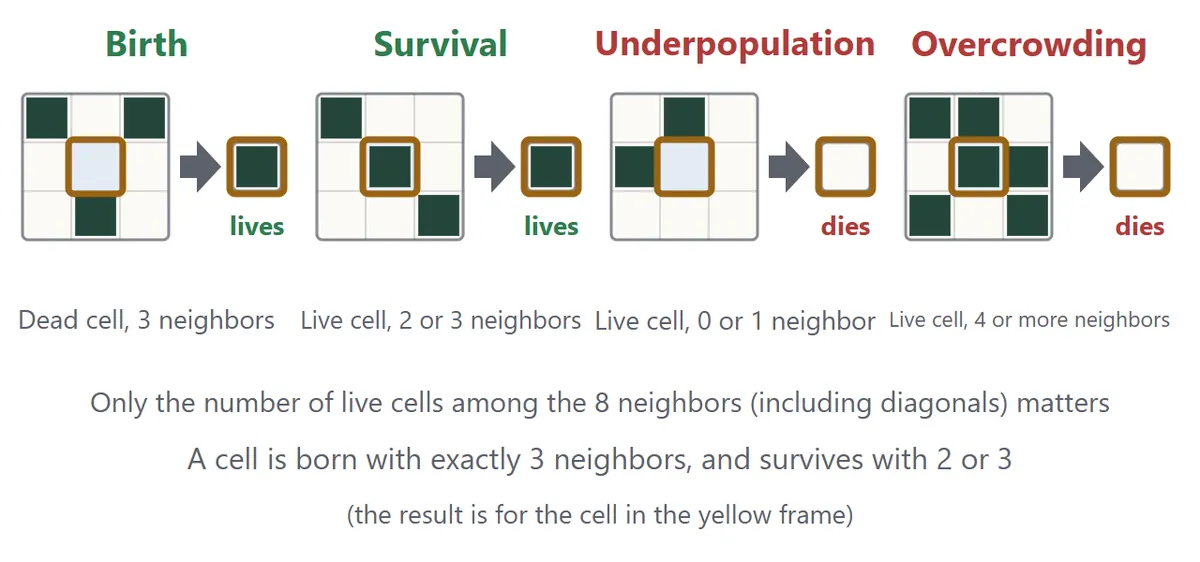
Every cell has eight neighbors: the squares above, below, left, right and on the four diagonals. To find out what happens to a cell in the next generation, count how many of those eight neighbors are alive right now.
- Birth: a dead cell with exactly 3 live neighbors becomes alive.
- Survival: a live cell with 2 or 3 live neighbors stays alive.
- Underpopulation: a live cell with 0 or 1 live neighbor dies, as if from loneliness.
- Overcrowding: a live cell with 4 or more live neighbors dies, as if from overpopulation.
Mathematicians write this rule as B3/S23: a cell is Born with 3 neighbors and Survives with 2 or 3. Many other rules of the same kind exist, but this is the one Conway picked after a long search, because it makes patterns that are hard to predict – neither dying out too quickly nor filling the whole board.
Count first, then update every cell at once

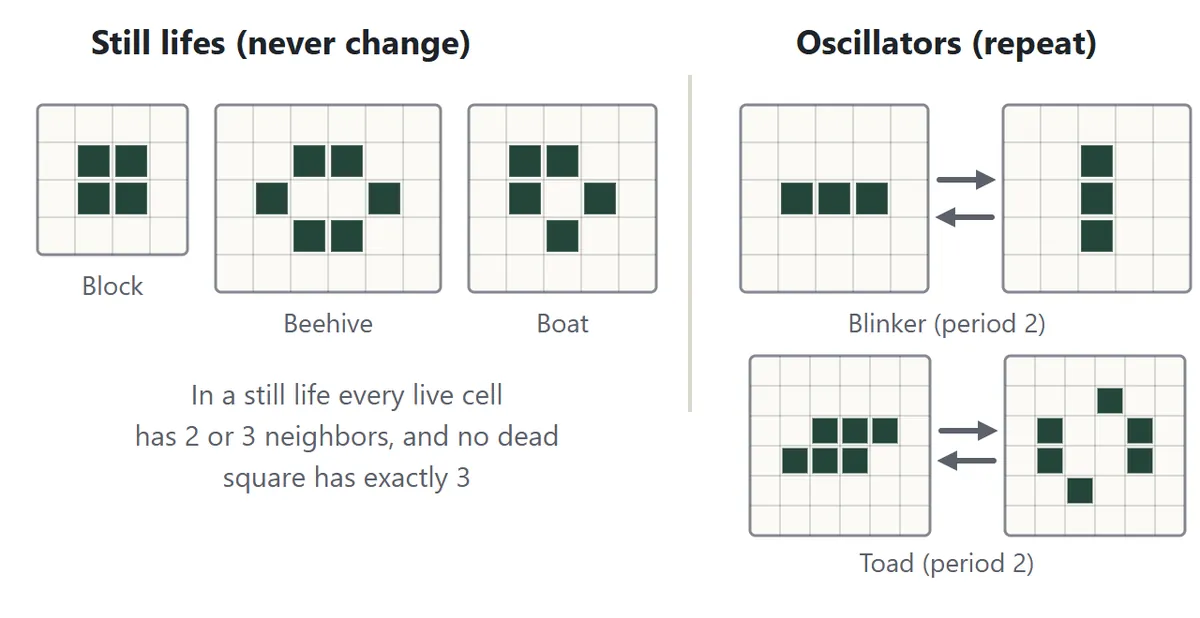
The most important detail is that all cells change at the same time. First count the neighbors of every square on the board, and only then apply the rules everywhere. If you update the cells one by one from the top left, a cell that has just been born would already be counted by its neighbors, and you would get a different – wrong – result. That is exactly why a straight row of three cells turns into a straight column of three: the two end cells die, two new cells are born above and below the middle, and the middle survives. Do it again and you are back to the row. This little pattern is called the blinker.
Using this simulator
Click or tap any square to add a live cell, and tap it again to remove it. Drag across the board to draw several cells in one stroke. When your shape is ready, press Play to run the generations and Pause to stop. Step advances exactly one generation, which is the best way to learn the rules. Speed cycles through slow, normal, fast and fastest. Whenever you change the board the generation counter goes back to 0, and Back to gen 0 restores the shape you started from. The simulator stops by itself when every cell has died or when nothing changes anymore, and when the board starts repeating it tells you the generation where the loop began and how long the loop is.

Turn on Preview next gen and, while the board is paused, every square where a cell will be born gets a green ring and every cell that is about to die gets a red cross. Try predicting the next generation yourself, then turn the preview on to check your answer.
Board size and wrap-around edges
| Setting | Options and what they're good for |
|---|---|
| Board size | 24×24 for checking small shapes square by square, 48×48 for placing library patterns, 96×96 for big random soups and patterns that spread out |
| Board edges | Wrap-around keeps moving patterns going forever; dead edges show how patterns break up against a wall |
| Starting pattern | Empty to draw your own, Random to see the game in action right away, or the Gosper glider gun |
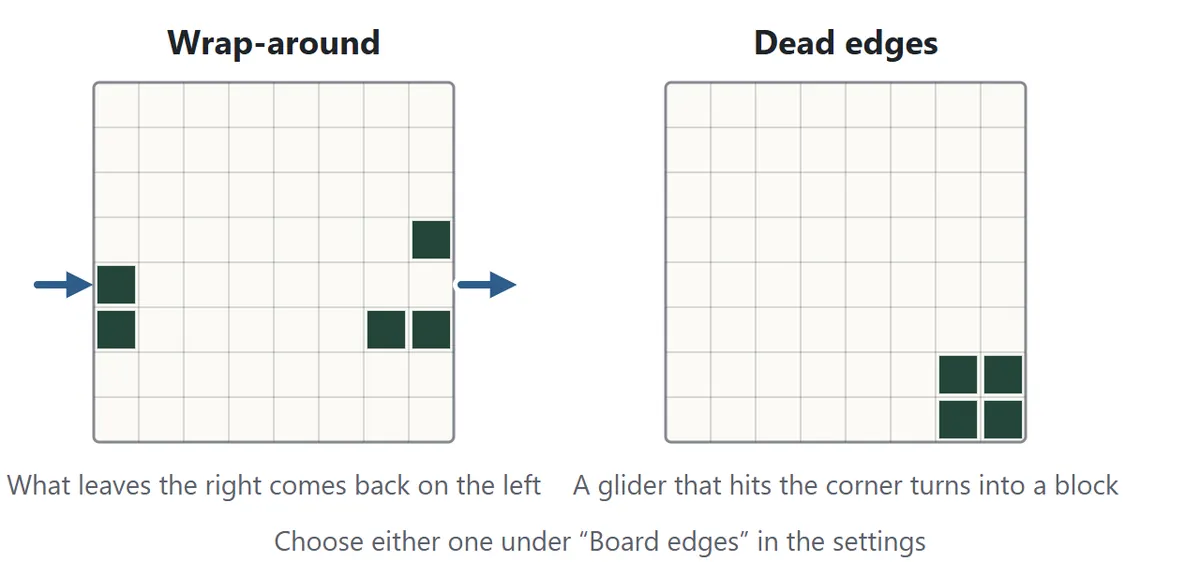
In theory Life is played on an infinite grid, but any screen has edges. With wrap-around (a torus, or doughnut shape) the right edge is joined to the left and the top to the bottom, so a glider that flies off one side comes back on the other. With dead edges, everything outside the board counts as dead, so patterns that hit the edge get squashed – a glider crashing into a corner, for example, ends up as a still block.
Conway's Game of Life patterns: the pattern library
Over the years, fans of the game have discovered and named thousands of patterns. The Pattern library button lets you drop 16 of the most famous ones onto the board. Pick a pattern and a preview appears in the middle of the board; tap where you want it, press Rotate to turn it, and press Place. The patterns fall into five families.
| Type | Patterns in the library |
|---|---|
| Still lifes – never change | Block, beehive, loaf, boat, tub |
| Oscillators – repeat after a fixed period | Blinker, toad, beacon (period 2), pulsar (period 3), pentadecathlon (period 15) |
| Spaceships – travel across the board | Glider, lightweight spaceship |
| Guns – fire spaceships forever | Gosper glider gun |
| Methuselahs – tiny seeds with long lives | R-pentomino, acorn, diehard |
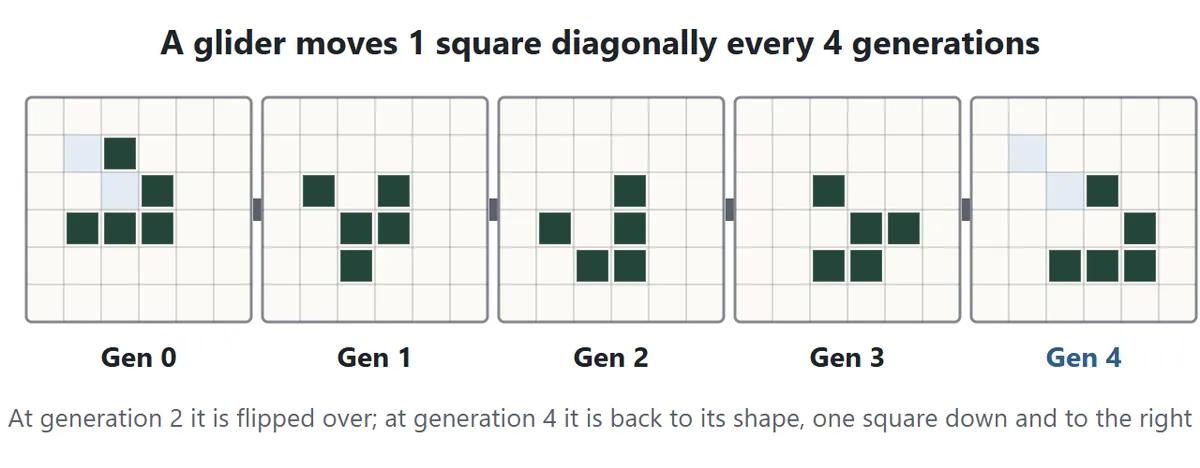
The star of the show is the glider, just five cells that crawl diagonally across the board, returning to their original shape every four generations one square further along. It was the first spaceship ever found, spotted by Richard Guy of Conway's group around 1969–70 while they were tracking the chaotic R-pentomino. The lightweight spaceship, found by Conway in 1970, travels sideways twice as fast. The pulsar cycles through 48, 56 and 72 cells, and the pentadecathlon takes 15 generations to come back – and appears all by itself if you draw a straight row of ten cells.
The Gosper glider gun
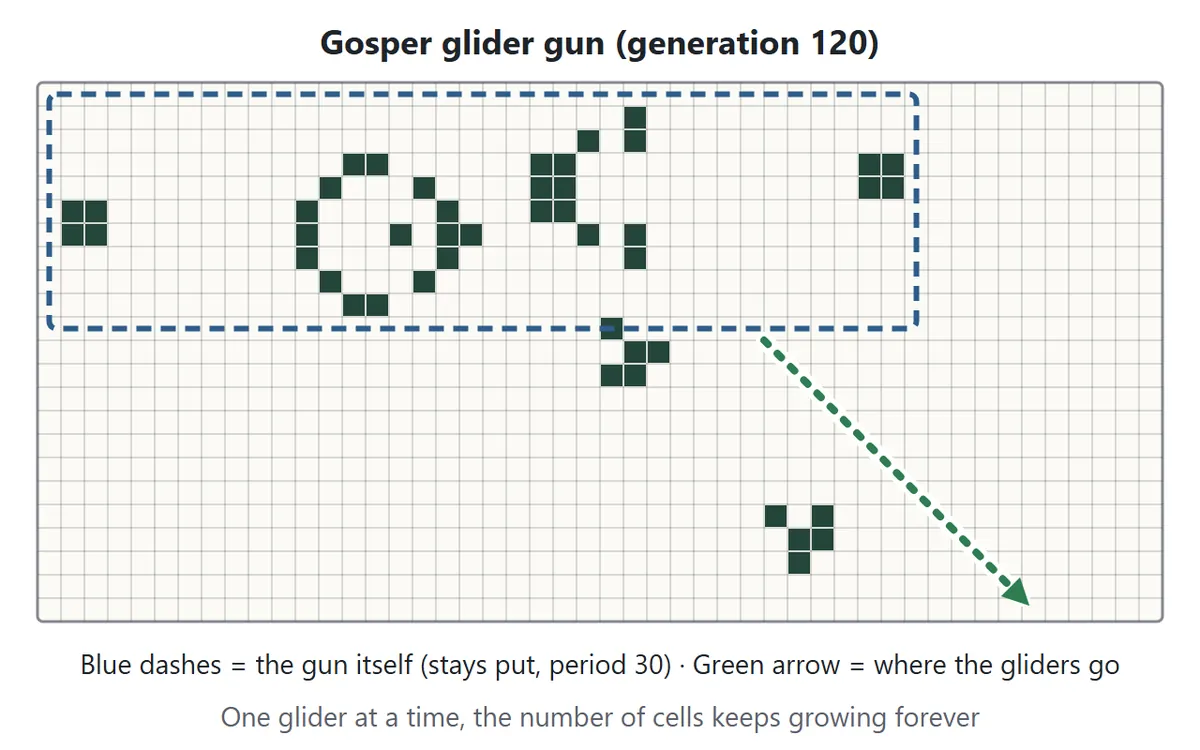
Conway originally guessed that no starting pattern could grow forever, and offered a 50-dollar prize to anyone who could prove or disprove it by the end of 1970. In November of that year a team at MIT led by Bill Gosper won the prize with the glider gun: the gun stays in place, repeats itself every 30 generations and sends out one glider each time, so the number of live cells keeps growing without limit. You can place it on a 48×48 board or larger. On a wrap-around board, watch what happens when the stream of gliders loops back around and hits the gun.
Challenges
Choose Challenges under Mode in the settings for nine small puzzles. Each one gives you a set number of cells and a goal: build a shape that never changes from 4 cells, a blinking shape from 3, a shape that travels from 5, grow a beehive or a set of traffic lights, make a shape that survives five generations but then vanishes, keep 5 cells from settling down for 100 generations, and find how long a straight line must be to become a period-15 oscillator. Place your cells and press Check to run the generations. If it doesn't work, you'll see what went wrong and when, and Edit again brings back your starting shape so you can adjust it. Stuck? Hint gives a clue, and pressing it again places a sample answer.
Conway's Game of Life tips: how to find interesting patterns
1. Step through it slowly
Before pressing Play, press Step a few times with the preview turned on. Counting neighbors yourself and checking the rings and crosses is the fastest way to get a feel for the rules.
2. Start small
One or two cells always die at once. Three in a line make a blinker, three in an L make a block. Keep adding one cell at a time and see which shapes die, which freeze and which keep moving.
3. Try straight lines of different lengths
A single row of cells behaves very differently depending on its length. Five cells become traffic lights (four blinkers in a cross), seven become four beehives, and ten become a pentadecathlon. Make a table and see what else you can discover.
4. Draw symmetrical shapes
A pattern that is symmetrical stays symmetrical as it evolves, so mirror-image drawings tend to produce beautiful, kaleidoscope-like results. Try a snowflake, a face or your initials drawn twice back to back.
5. Crash patterns into each other
Send two gliders toward each other, or aim a glider at a block. Depending on how they meet, they may vanish, turn into something new or start a chain reaction. Moving one of them by a single square can completely change the result.
6. Watch a random soup settle
A random board is wild at first, then slowly calms down into scattered blocks, beehives and blinkers, often with a few gliders escaping. See how many generations it takes, and which leftovers are the most common.
Conway's Game of Life FAQ
Is there a way to win?
No. Your only move is choosing the starting pattern; after that the rules decide everything. That is why it is called a zero-player game. If you want a goal, try the Challenges mode.
Does it ever end?
There is no limit on the number of generations. The simulator only stops by itself when every cell has died or when the board stops changing, because there is nothing left to watch.
Why don't the methuselahs match the numbers in the library?
Numbers such as 1,103 generations for the R-pentomino and 5,206 for the acorn are measured on an unlimited grid. These patterns spread far and throw off gliders, so on a finite board they eventually hit the edge or wrap around and behave differently. Place them in the middle of a 96×96 board to follow them for as long as possible.
Can I play with a keyboard?
Yes. Use the arrow keys to choose a square and Enter to add or remove a cell. Space plays and pauses, N steps one generation, keys 1 to 4 set the speed and P toggles the preview. Your board is saved on this device, so you can press Continue later to pick up where you left off. Sound is off at first; press “Sound: off” to turn on the sound effects.
Is Conway's Game of Life really a computer?
In a sense, yes. People have built logic gates, memory and even complete working computers out of gliders, guns and other patterns. In theory, anything a computer can calculate can be calculated inside Life – it is “Turing complete”.
History of Conway's Game of Life
Conway's Game of Life became famous after Martin Gardner described it in his “Mathematical Games” column in the October 1970 issue of Scientific American. Conway had spent a long time trying out different rules, looking for one where simple starting patterns would grow and change for a long time without it being obvious how they would end. At first people worked it out by hand on graph paper or on a Go board with counters, but the game arrived just as computers were becoming available, and many programmers left it running at night on otherwise idle machines. Since then it has become the best-known example of a cellular automaton, and it is still used to introduce ideas from mathematics, biology and computer science.