 Yorimichi Games
How to Play Tangram
A tangram is a puzzle made from one square cut into seven flat pieces. In this online tangram game you get a dark silhouette, and your job is to rebuild that shape using all seven pieces. The puzzle is solved when the silhouette is completely covered: no gaps, nothing sticking out, and no pieces lying on top of each other. That is the whole set of rules, so you can start in seconds, yet some shapes will keep even experienced solvers thinking for a good while.
The game has 53 original tangram puzzles in seven groups (animals, people, buildings, vehicles, things, letters and signs, and geometric shapes), a new daily puzzle every day, a hint button that shows one piece at a time, and a record of your best time for every puzzle. Everything runs in the browser on a phone, tablet, Chromebook or computer, with no download and no account.
The seven tangram pieces
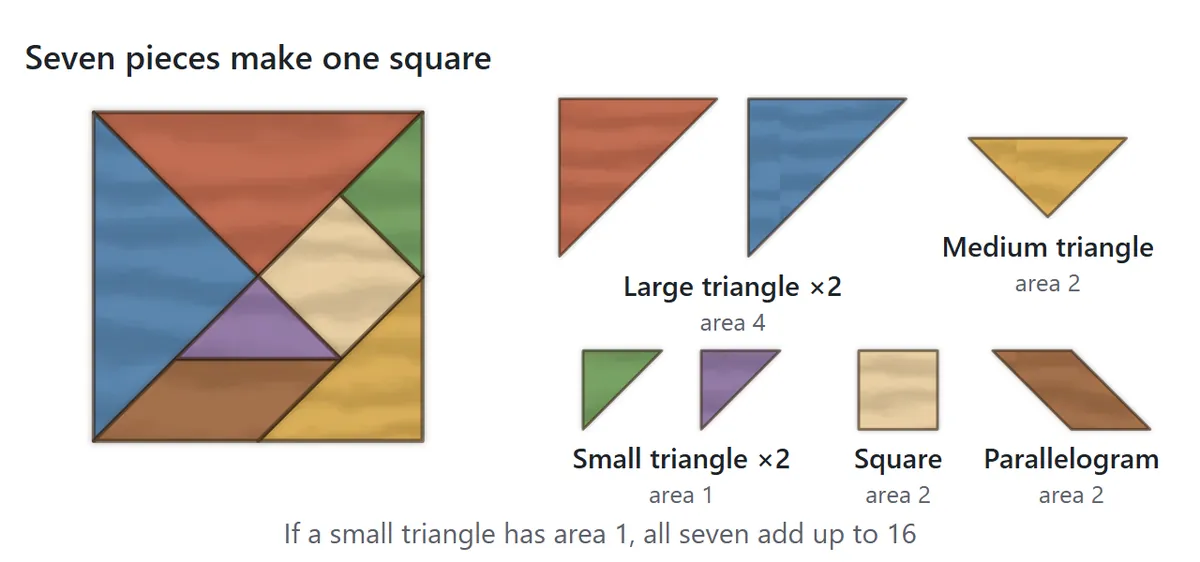
The set, sometimes called the tans, always has the same seven pieces: two large triangles, one medium triangle, two small triangles, one square and one parallelogram (a slanted four-sided shape). All five triangles are right isosceles triangles; only their sizes differ. The sizes are linked in a neat way. Two small triangles cover the same area as the medium triangle, the square or the parallelogram, and two medium triangles would cover one large triangle. Keep these area relationships in mind, because they are one of the best tools you have for solving harder shapes.
Moving the pieces
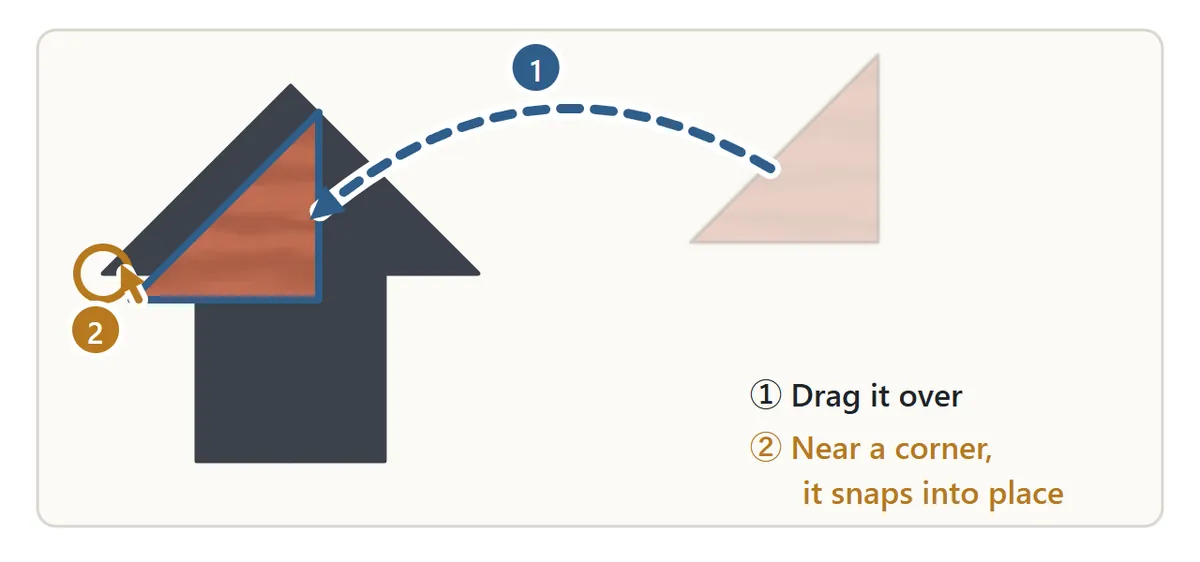
Grab a piece with your finger or mouse and drag it onto the silhouette. When a corner or edge of the piece comes close to a corner or edge of the silhouette, or to a corner of a piece you have already placed, it snaps into the exact position, so you never have to line things up pixel by pixel. When all seven pieces fit, the outline of the silhouette lights up green and the puzzle’s name appears.
Rotating and flipping

Tap or click a piece to rotate it 45 degrees clockwise; eight taps bring it all the way around. The Left and Right buttons under the board turn the selected piece either way. The parallelogram is the one piece that changes when you turn it over, so it can also be flipped with the Flip button or a quick double-tap. Flipping a triangle or the square gives the same shape as rotating it, so they never need flipping.
You can also play with a keyboard: Tab selects a piece, the arrow keys nudge it (hold Shift for bigger steps), R rotates it, F flips the parallelogram, H gives a hint and Z undoes a move. Snapping takes care of the final position.
Tangram Rules
Tangram rules are short, and almost every book and puzzle site uses the same ones:
- Use all seven pieces in every puzzle. A solution with a piece left over does not count.
- Pieces lie flat and must not overlap. While you are working, pieces may cross each other, but the finished shape has no overlaps.
- Cover the silhouette exactly. Because the seven pieces and the silhouette have the same total area, no overlap and nothing outside also means no gaps.
- Pieces may be rotated and turned over. In practice only the parallelogram looks different when flipped.
- Any arrangement that fills the shape is correct. Many silhouettes can be built in more than one way, and the game accepts every one of them, not just the answer it has stored.
Difficulty: Hint Lines, Daily Puzzle and Choosing a Shape
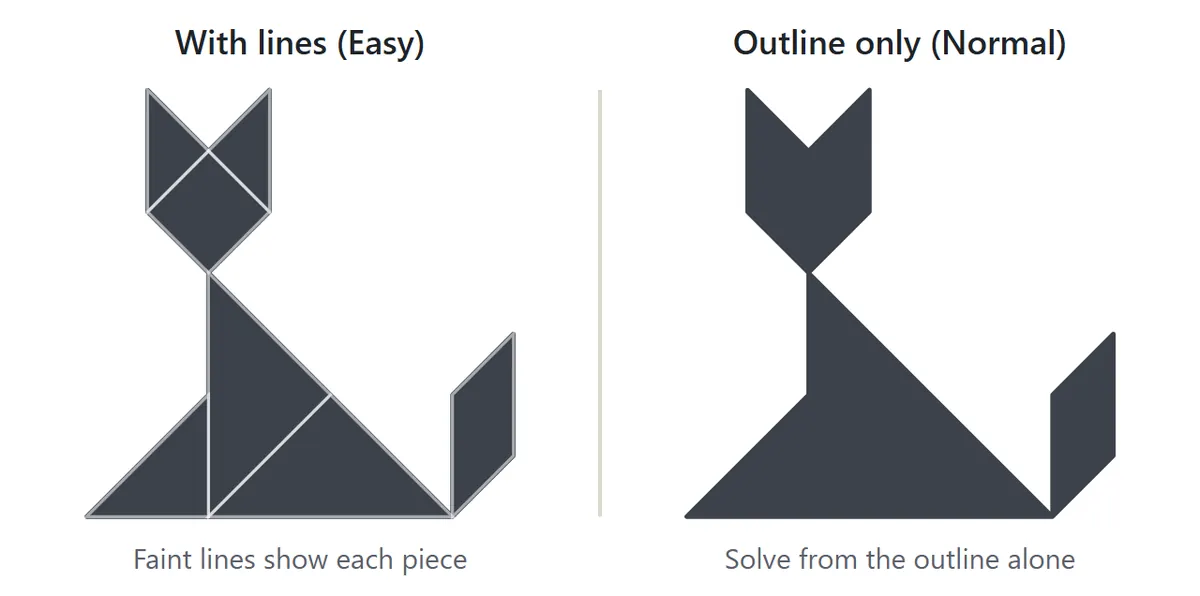
| Help | What you see | Best for |
|---|---|---|
| With lines (Easy) | Faint lines inside the silhouette mark every piece | First-timers, or a relaxed game |
| Outline only (Normal) | Just the outer shape | Classic tangram: find every piece yourself |
There are three ways to pick a puzzle. The daily puzzle is one shape per day, and everyone who plays on the same date gets the same one, so it is a nice thing to compare times on. Choose from list shows all 53 silhouettes; filter them by group and pick whatever you like. Puzzles you have solved get a check mark. Random hands you a shape you have not solved yet.
Every puzzle has been checked to be solvable with the seven pieces. If you are stuck, press Hint and the correct spot for one piece appears as a faint outline; press it again and that piece slides into place. Solution moves all seven pieces to a correct position so you can study the answer. A solve that used hints does not count as a personal best, and a puzzle where you looked at the solution is not recorded at all.
Tangram Puzzle Tips and Strategy
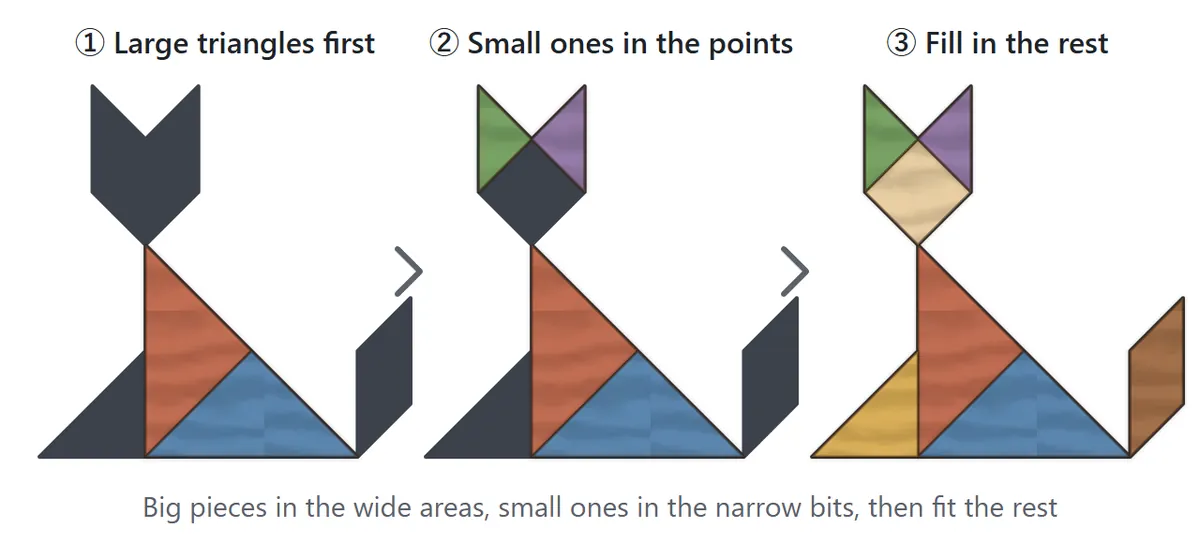
1. Start with the large triangles
The two large triangles make up half of the total area. Look for the widest, heaviest part of the silhouette (a body, a hull, the base of a building) and try to fit both of them there first. Once they are placed, the space left over is much smaller and the positions of the other pieces start to suggest themselves.
2. Small pieces go in the points
Ears, beaks, tails, feet and other sharp, narrow points are usually small triangles. A long slanted strip is often the parallelogram, and a diamond-shaped head is often the square turned 45 degrees. Working backwards from these small details is frequently faster than starting in the middle.
3. Read the angles
Every corner of every piece is 45, 90 or 135 degrees (the 135-degree corners belong to the parallelogram). A sharp 45-degree corner on the silhouette must come from a triangle or the parallelogram, while a right angle could be almost anything. Filling corners first narrows down the options quickly.
4. Count the area
If a small triangle has an area of 1, the medium triangle, the square and the parallelogram have 2 each, the large triangles have 4 each, and the whole set adds up to 16. When a gap of area 2 is left, you know it takes the medium triangle, the square, the parallelogram or both small triangles, which is a surprisingly powerful way to rule things out.
5. Check which way the parallelogram faces
When everything else fits but one piece refuses to go in, the parallelogram is usually lying the wrong way up. Flip it and try again. This is the single most common reason a nearly finished tangram will not close.
6. When you are stuck, take pieces back out
If the last one or two pieces will not fit, an earlier choice is wrong. Use Undo to step back, or swap the positions of the two large triangles and rebuild around them. A good way to practice is to solve a puzzle with the lines turned on, then solve it again with the outline only.
Tangram FAQ
Can tangram pieces overlap?
No. All seven pieces have to be used and none may lie on top of another. The puzzle only counts as solved when the silhouette is covered with no overlaps and no gaps. Pieces can cross while you are still moving them around.
Does a tangram puzzle have only one solution?
Not always. The two large triangles and the two small triangles are identical, so swapping them gives the same picture, and some shapes can be built in completely different ways. The game checks whether the silhouette is filled, so any correct arrangement is accepted.
How many shapes can you make with a tangram?
Thousands; collections of tangram figures run into the thousands and people keep inventing new ones. There is one famous exact number, though: only 13 convex shapes (shapes with no dents) can be made from all seven pieces. Ten of them are in the Shapes group of this game, and the house is another one.
I placed every piece, so why is it not solved?
There is still a small gap or overlap somewhere. Look for a bit of the dark silhouette showing through, or two pieces that cross. A parallelogram facing the wrong way is another very common cause.
Is the daily puzzle the same for everyone?
Yes. Everyone playing on the same date gets the same shape. The date comes from your own device, and solving it on consecutive days builds a streak.
Can I stop and continue later?
Yes. Open the game again in the same browser on the same device and press Continue on the settings screen; the pieces and the timer pick up where you left off. The game starts muted. Press “Sound: off” to hear a click when a piece snaps into place and a chime when you finish.
History of the Tangram
The tangram comes from China, where it is known as qiqiaoban, often translated as “seven boards of skill.” Nobody knows exactly who invented it or when, and the popular story that it is thousands of years old was a hoax spread in 1903 by the American puzzle writer Sam Loyd. What is certain is that books of tangram problems were being printed in China by the early 1800s. Soon afterwards the puzzle reached Europe and America, where it became a real craze, and sets and problem books sold in large numbers. Japan had a similar seven-piece puzzle of its own, described in a book from 1742 called Sei Shonagon Chie no Ita, although its pieces are cut differently. More than two hundred years later, the tangram is still one of the best-known dissection puzzles in the world, loved as a quick brain teaser and as a hands-on way to explore shapes, angles and area.