 Yorimichi Games


How to play Lateral Thinking Puzzles
A lateral thinking puzzle gives you a short story that doesn’t seem to make sense: someone gets home dry in a rainstorm without an umbrella, or comes in last and still wins first place. Your job is to work out the real story behind it, which we call “the truth.” The answer is never written in the puzzle itself. Instead, you ask questions that can be answered with yes or no, collect clues, and let go of your assumptions until the story clicks into place. In this game, you choose your questions from a list, and at the end you pick the truth from four possible explanations. There are 33 puzzles in three levels (12 Easy, 11 Normal and 10 Hard), all written specially for this game. There are no gruesome or sad stories, so they are suitable for mixed company, and you can play right away in your browser with no sign-up or download.
1. Read the puzzle
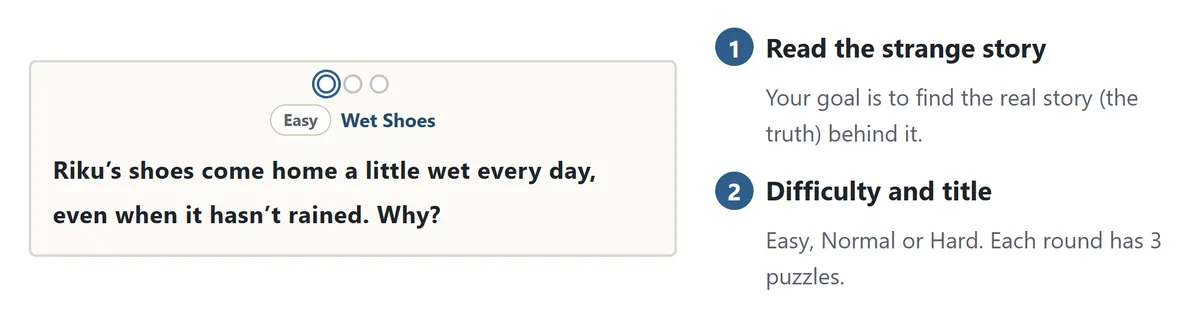
Press “Start” and the first puzzle appears. A round has three puzzles. Read the story carefully and find the part that feels wrong. Something that normally wouldn’t happen (shoes getting wet on a dry day) is your way in. Ask yourself what you are taking for granted when you read it.
2. Ask yes/no questions
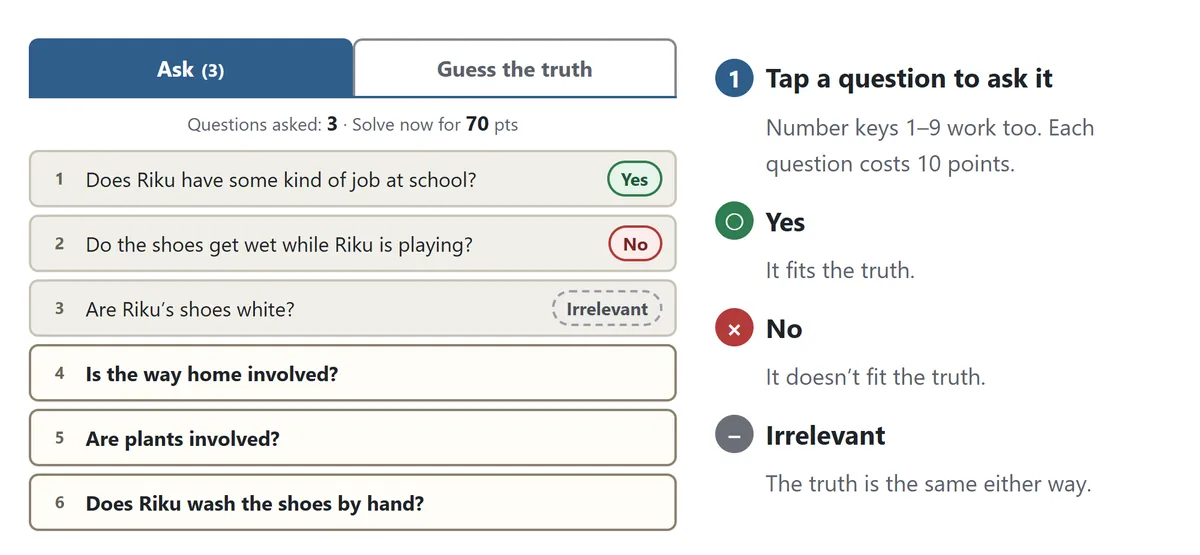
On the “Ask” tab, tap any question you want to ask. The answer appears at once and stays next to the question. There are three kinds of answer. “Yes” means it fits the truth, “No” means it doesn’t, and “Irrelevant” means the truth is the same either way. An “Irrelevant” answer is useful too: it tells you that you can stop thinking about that direction. Each question costs 10 points, so asking everything is a poor strategy. Think about which question will tell you the most before you tap.
3. Guess the truth from four explanations
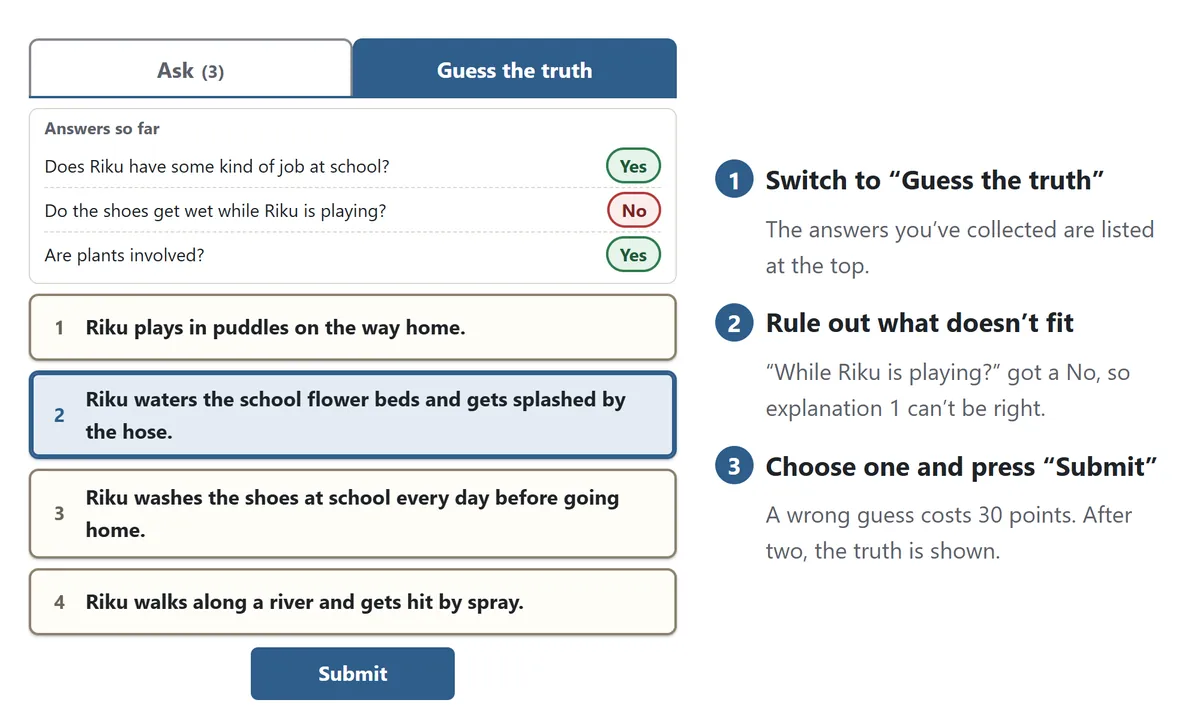
When you think you know what happened, switch to “Guess the truth.” The answers you have collected are listed at the top. Go through the four explanations and cross out every one that contradicts an answer. For example, if “Do the shoes get wet while Riku is playing?” got a “No,” then “Riku plays in puddles on the way home” cannot be right. Choose the explanation that survives and press “Submit.” A wrong guess costs 30 points, and you can go back to asking questions. After two wrong guesses, the truth is shown and that puzzle is over.
4. Read the truth and the key questions
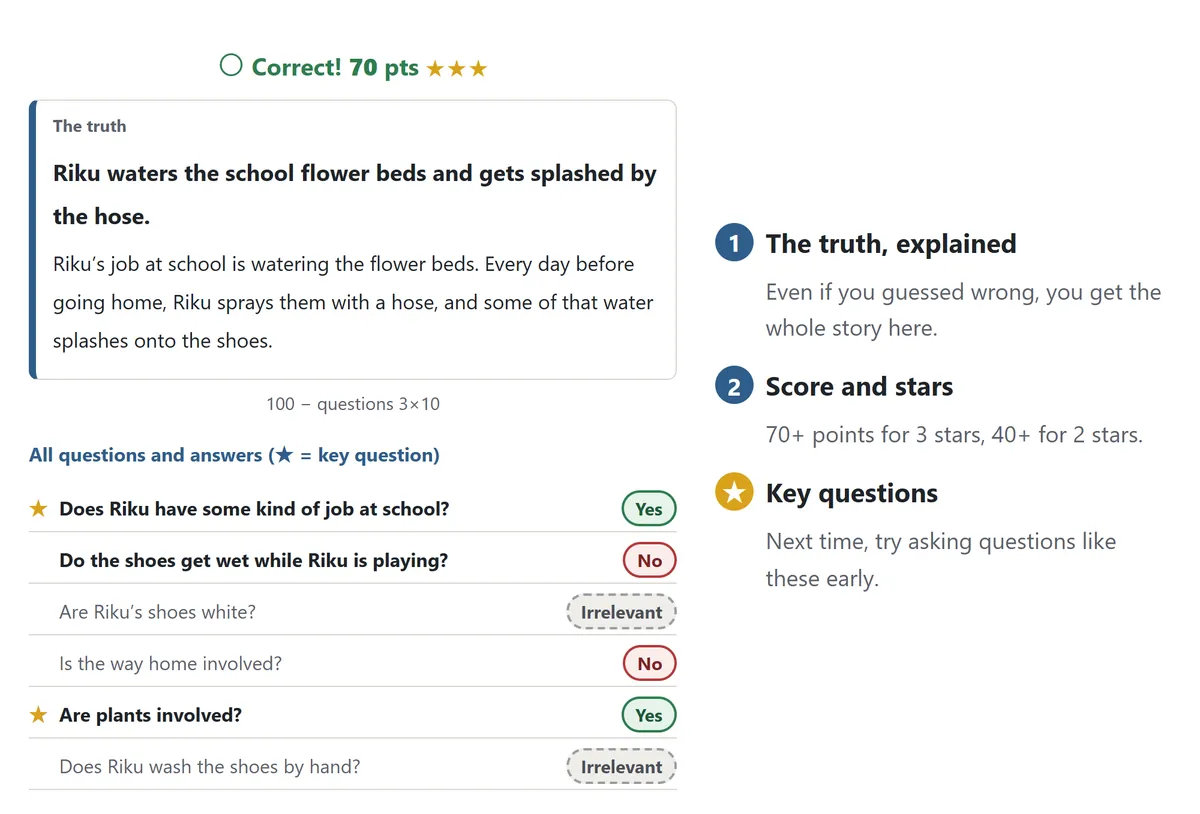
After you answer, you see the truth, a longer explanation and your score. Open “All questions and answers” to see the answers to the questions you didn’t ask. The questions marked with a star are the key questions: the ones that separate the truth from the other explanations. Noticing what makes a question “key” is the fastest way to get better at these puzzles.
Lateral thinking puzzle scoring
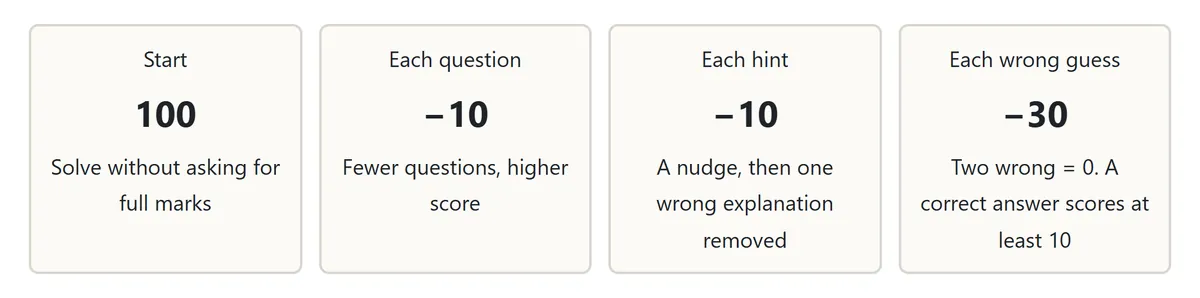
| Action | Points |
|---|---|
| Starting points | 100 |
| Ask a question | −10 |
| Use a hint (up to 2) | −10 |
| Wrong guess | −30 (two wrong = 0) |
| Correct answer | at least 10 |
Score 70 or more for three stars, 40 or more for two stars, and any correct answer earns at least one star. The total of your three puzzles is saved as your personal best for that difficulty. If you are stuck, press “Hint.” The first hint gives you a nudge in the right direction, and the second one removes one wrong explanation from the list.
Easy, Normal and Hard puzzles
| Level | What the puzzles are like |
|---|---|
| Easy | Everyday mysteries, such as an umbrella on a sunny day or a house with no alarm clock. One or two good questions usually point to the truth. |
| Normal | Clocks that are off, plants and animals, the way a race is judged. You need to combine at least two answers. |
| Hard | Assumptions hidden in names and words, words with two meanings, and a little science (air pressure). The wrong explanations are very convincing. |
If you are new to lateral thinking puzzles, start with Easy and move up when you feel ready. “Mix” gives you one puzzle from each level. Puzzles you haven’t seen yet are always chosen first, so if you keep playing you will meet every puzzle.
Play as a group: host and guessers
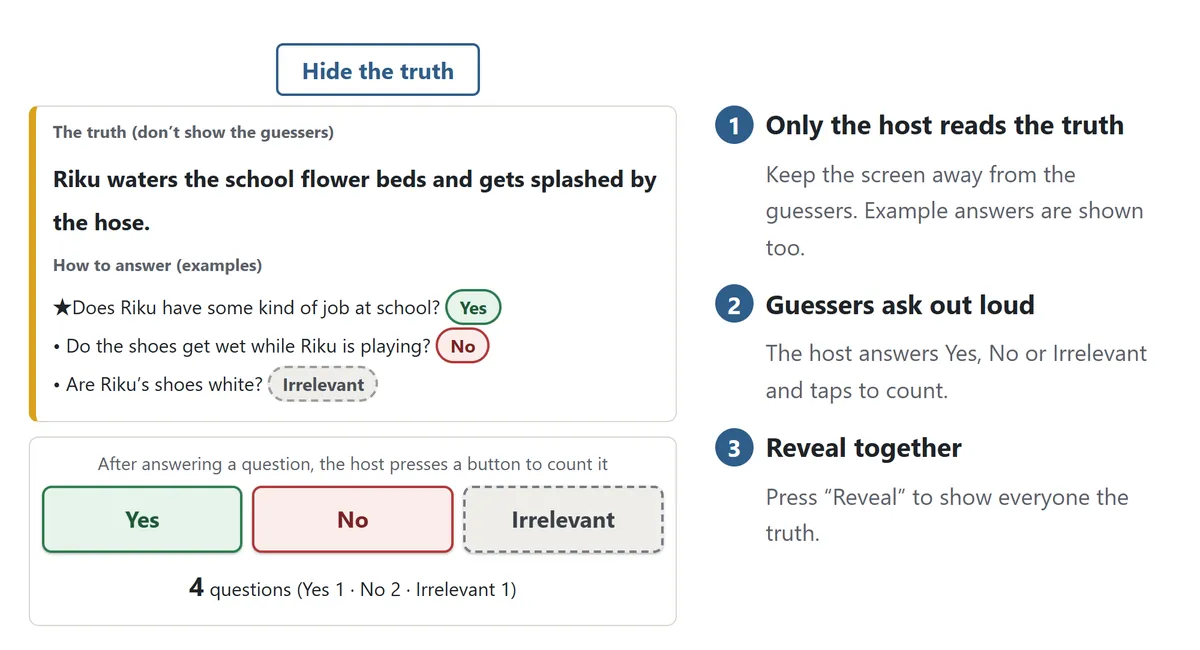
Choose “Group (host and guessers)” in the settings to play the classic way, with friends or family around one screen. The host keeps the screen hidden from everyone else, presses “Show the truth (host only)” and reads the truth along with example answers. The guessers read the puzzle aloud and ask any yes/no questions they like, out loud. The host answers “Yes,” “No” or “Irrelevant” and taps the matching button each time, so the game keeps count of the questions. When someone tells the whole story, press “Reveal” to show everyone the truth. If the guessers run out of ideas, open “Example questions” for a list of useful things to ask. It makes a good icebreaker, a party game or a quick brain teaser on a car trip.
A tip for hosts: answer only what was asked, and stick to the story as it is written. If a question can’t be answered with a simple yes or no, ask the guesser to rephrase it. When a guesser is close but not quite there, “Yes, but there’s more to it” is a fair answer in the group game.
Tips for solving lateral thinking puzzles
1. Question the “obvious” things one at a time
When we hear that someone was “reading a book,” we picture a paper book. When we hear a pet’s name like “Rover,” we picture a dog. Most lateral thinking puzzles are built on assumptions like these. Go through the story and ask yourself what you decided without being told.
2. Start with questions that split the possibilities
Broad questions such as “Is a person involved?” or “Is it alive?” cut the list of possible stories in half, whatever the answer. Ask those first. Narrow, detailed questions are more useful once you have only two or three stories left.
3. “Irrelevant” is a clue too
When a question comes back “Irrelevant,” don’t think of it as a wasted question. It tells you that one whole direction doesn’t matter, so the space you need to search just got smaller.
4. Read the four explanations before asking
In this game, you can switch to “Guess the truth” at any time and read the four explanations. Do that before you ask anything. Then choose the question that best separates the explanations: if two of them involve a person and two don’t, “Is a person involved?” rules out two in one go. With practice you will often solve Easy puzzles with one or two questions.
5. Look for words with two meanings
Some puzzles turn on a single word. “Watch the pot” can mean “look at it” or “take care of it.” A “curtain” doesn’t have to be made of cloth. When a puzzle includes something someone said, check whether the speaker and the listener understood it in different ways.
6. Think about time and place
Many stories change completely when you ask “when?” or “where?” Was it really raining when the person left? Is the scene at the bottom of a mountain or at the top? Questions about time and place are short to ask and often decisive.
Lateral Thinking Puzzles FAQ
What is lateral thinking?
Lateral thinking means solving a problem by looking at it from an unexpected angle, instead of following the most obvious line of reasoning step by step. The term was coined by the psychologist Edward de Bono in the late 1960s. Lateral thinking puzzles are a playful way to practice it: the straightforward explanation is usually wrong, and the right one appears when you change your point of view.
What are yes/no puzzles or situation puzzles?
They are other names for the same kind of game. One person knows the story, and everyone else asks questions that can be answered with yes or no until they can explain what happened. They are also sometimes called “what happened?” riddles or mystery riddles.
Is this the same as the turtle soup puzzle?
The turtle soup puzzle is one of the best-known puzzles of this kind, and in Japan the whole genre is often named after it. The way you play is the same: you ask yes/no questions until you know the story. The puzzles in this game, however, are all new and were written for this game. None of them is a retelling of a famous puzzle, and none of them involves crime or death.
How is the solo game different from the classic game?
In the classic game, the guessers can ask anything, and the host must judge every question. Since a computer can’t do that well, the solo game offers a list of six to nine prepared questions for each puzzle, and you finish by choosing one of four explanations. Every wrong explanation clashes with at least one question’s answer, so a puzzle can always be solved by logic alone. If you prefer free questions, use the group mode.
Is there only one correct answer?
Yes. Each puzzle was checked so that every wrong explanation contradicts the answer to at least one question, and the puzzles were also solved by testers who saw only the story and the answers. If you still think another explanation fits, please let us know through the site’s feedback form.
Where are my scores saved?
Your personal bests and the puzzles you have solved are saved only in this browser on this device. If you stop in the middle, “Continue” takes you back to where you were, as long as you use the same browser. Sound is off at first; press “Sound: off” to turn on the sound effects.
Can I use the keyboard?
Yes. On a computer, press 1–9 to ask a question by its number, Q to switch to “Ask,” A to switch to “Guess the truth,” 1–4 to choose an explanation, Enter to submit or go to the next puzzle, and H for a hint. In the group game, the host can count answers with Y (Yes), N (No) and I (Irrelevant).
About lateral thinking puzzles
Puzzles where one person knows a strange story and the others question them to uncover it are played around the world, at parties, around campfires and on long car journeys. Because the stories are often open to many explanations, the goal is usually defined as finding the story the host has in mind, not just any story that fits. This game keeps that spirit while making it work for a single player: the questions and the possible explanations are fixed, so each puzzle has exactly one answer that can be reached by reasoning. Whether you play alone or as a group, the fun is the same: the moment when an odd little story suddenly makes perfect sense.
Comments
Write a comment
No comments yet.