 Yorimichi Games
How to play the Stroop test
This is a free online version of the Stroop test, a classic color word game from psychology. A color name such as RED, BLUE or GREEN appears in large letters, but it is printed in a different color of ink. Your job is to tap the button for the color of the ink, not the color the word names. If you see the word RED written in blue, the answer is blue. That is the whole rule, yet your hand keeps drifting toward the word. That tug is the famous Stroop effect, and this game lets you feel it and measure it. There is nothing to install and no account to create; it runs in the browser on computers, tablets and phones.
Reading the screen
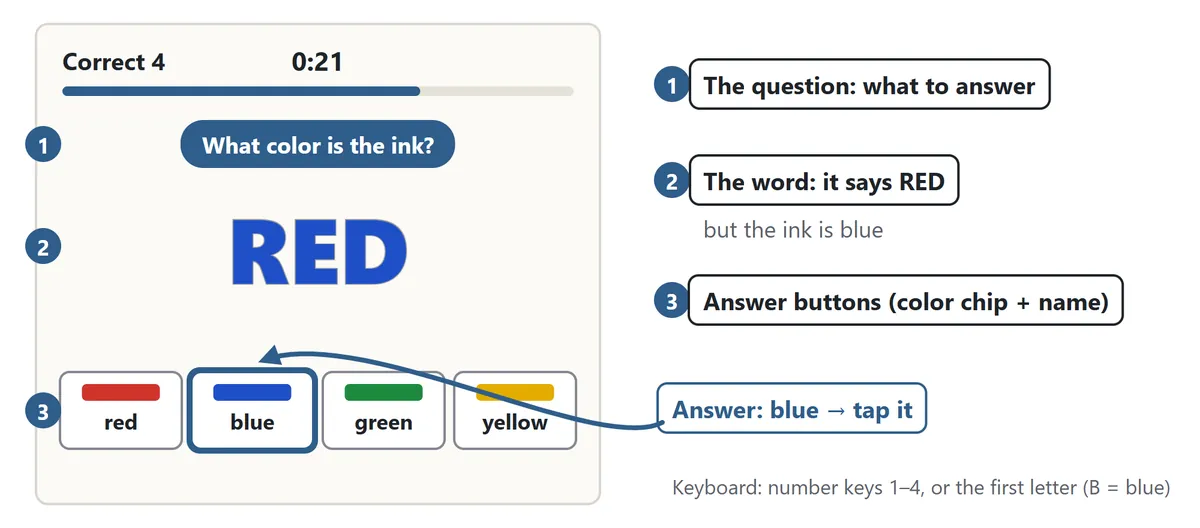
Press Start and, after a 3-2-1 countdown, the first word appears in the middle of the card. The small tag above it tells you what to answer. The row of buttons below shows each color as a chip together with its name, so you never have to rely on color alone to find the right button. Tap or click the button that matches the ink. On a keyboard you can press the number keys 1, 2, 3… from the left, or the first letter shown in the corner of each button (R for red, B for blue, K for black and so on). Esc pauses the game.
Correct answers, misses and time-outs
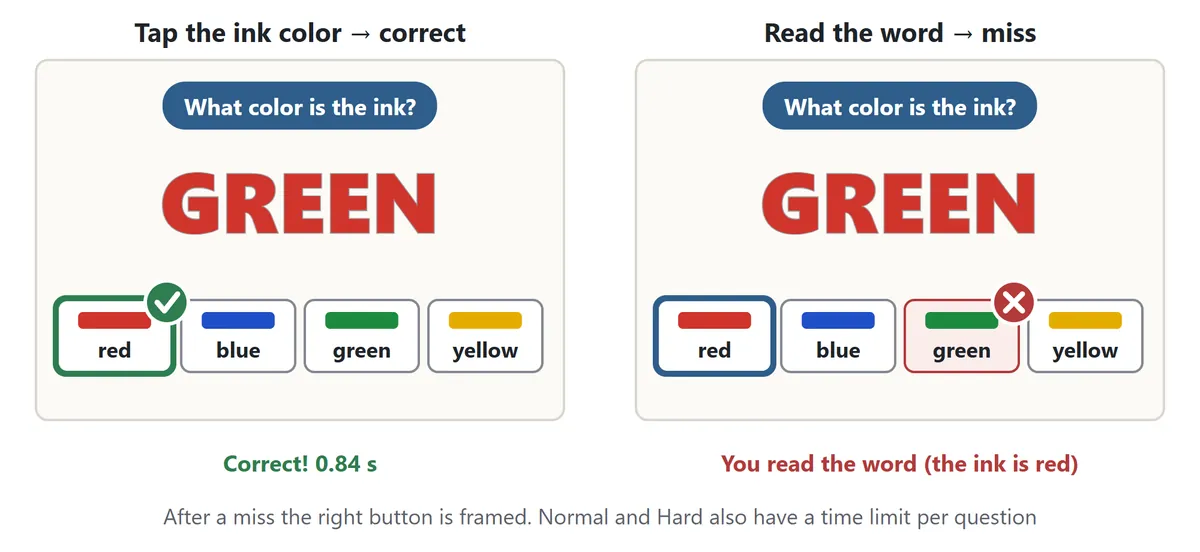
When you are right, your reaction time for that word appears and the next word follows almost at once. When you are wrong, the button you pressed is crossed out, the correct one is framed, and there is a short pause before the next word. If the button you pressed was the color the word names, the game says “You read the word”, which is by far the most common Stroop error. On Normal and Hard, each word also has its own time limit, shown by the thin bar under the word. If the bar runs out, it counts as a time-out, the same as a miss.
Mixed mode: what does the word say?
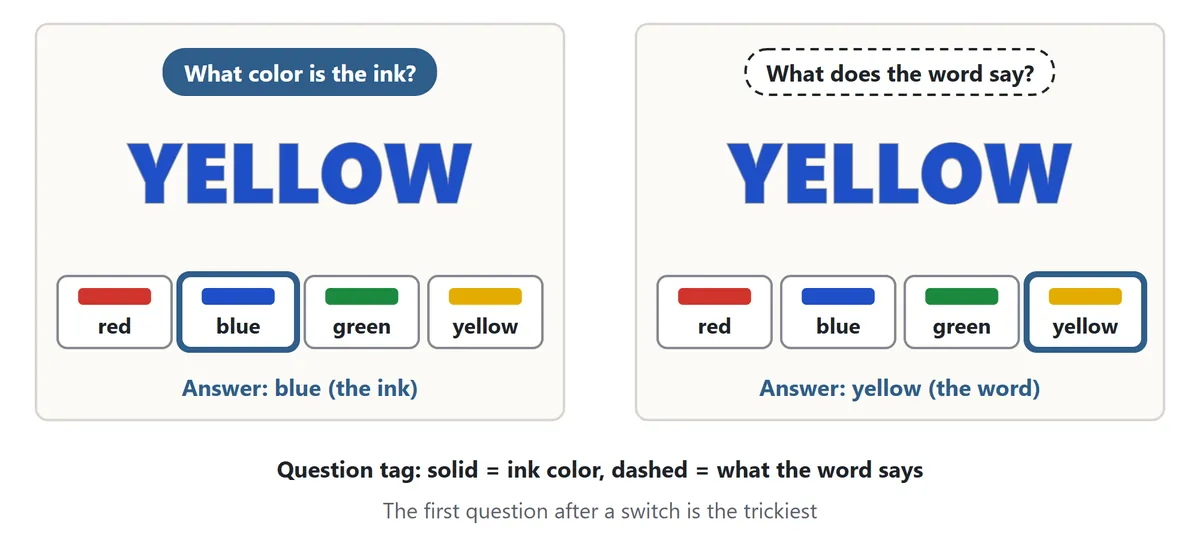
If you set “What to answer” to Mixed, about three questions in ten ask you to answer the word instead of the ink. The tag is solid when you should name the ink and dashed when you should read the word, so you can tell them apart without relying on color. The first question after a switch is the trickiest one; check the tag before you look at the word.
Stroop test modes and difficulty
| Mode | Goal |
|---|---|
| 30 / 60 seconds | As many correct answers as you can before time runs out. A miss costs no points, only a short pause |
| 20-question time trial | Answer 20 words as fast as you can. Each miss or time-out adds 2 seconds |
| Daily | A 20-question time trial on Normal, Mixed. Everyone gets the same questions on the same day |
There are three difficulty levels. Easy uses four colors and has no time limit per word. Normal uses five colors with two seconds per word, and Hard uses six colors with 1.6 seconds per word. More colors mean more buttons to scan, and a tight limit leaves less time to stop and check the ink before the word takes over. If you are new to the Stroop test, start with Easy for 30 seconds.
At the end you see your score (correct answers, or your time), your accuracy, and your average reaction time on correct answers. The results also split your times into congruent trials, where the word and the ink match (RED in red), and incongruent trials, where they differ (RED in blue). The gap between the two is your own Stroop effect for that round. Records are kept for each combination of mode, difficulty, answer type and color set.
A color-blind friendly color set
About one in twelve men of Northern European descent has some form of red-green color blindness. Under Colors, choose “No red/green” to play with blue, yellow, black, brown, gray and cyan. These six were picked so that they differ in lightness as well as on the blue–yellow axis, which keeps them distinct for most people with red-green color vision deficiency. In either set, every button shows the color name next to the color chip.
What is the Stroop effect?
The Stroop effect is named after the American psychologist John Ridley Stroop, who described it in 1935 in a paper titled “Studies of interference in serial verbal reactions” in the Journal of Experimental Psychology. He printed color names in inks of other colors and asked people to name the ink colors aloud, as fast as they could. Compared with naming the colors of plain colored squares, naming 100 ink colors took on average about 74 percent longer: 110.3 seconds instead of 63.3 seconds.
The reverse direction is the interesting part. When the same people simply read the words aloud and ignored the ink, they were barely slowed down at all; the difference from reading words printed in black was only about 5.6 percent, too small to be reliable. Words interfere strongly with naming colors, but colors hardly interfere with reading words. That imbalance is the heart of the Stroop effect, and it is why the “What does the word say?” questions in Mixed mode tend to feel easier.
Stroop was not the very first to notice this: a German psychologist, E. R. Jaensch, had reported a similar effect in 1929, and the idea goes back to 19th-century studies of how long it takes to read words versus name colors. Since then the Stroop task has become one of the most studied procedures in experimental psychology. A well-known 1991 review by Colin MacLeod summarized half a century of research on it.
Sources: Stroop, J. R. (1935). Studies of interference in serial verbal reactions. Journal of Experimental Psychology, 18(6), 643–662. MacLeod, C. M. (1991). Half a century of research on the Stroop effect: An integrative review. Psychological Bulletin, 109(2), 163–203. Wikipedia, “Stroop effect”.
Why the Stroop effect happens
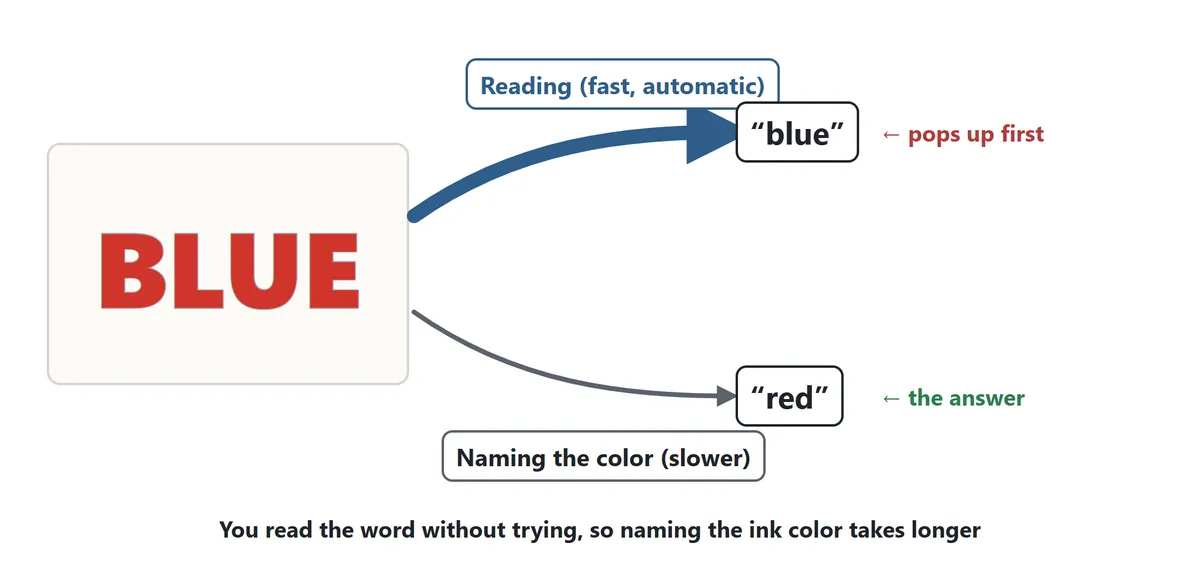
The most common explanation is automaticity. Adults have read words many thousands of times a day for years, so when a word appears, its meaning comes to mind whether you want it or not. Putting a name to a color is a slower, less practiced process. When you try to name the ink, the meaning of the word is already there and competes with the answer you need, so you hesitate or press the wrong button.
Stroop himself put the difference down to practice: we get far more practice reading words than naming colors. In his third experiment, eight days of practice at naming ink colors reduced the interference but did not remove it. Other accounts stress the relative speed of processing (the word simply arrives first) or selective attention (keeping your focus on the ink takes effort). Researchers still debate the details, but all of these accounts agree that the word and the color are processed at the same time and compete for the response.
Stroop test tips
1. Look at the color, not the letters
Trying to see the letters clearly makes you read them. Soften your focus and treat the word as a blob of color, or look at one thick stroke of a letter. The meaning gets in less easily that way.
2. Learn where the buttons are
The buttons never move during a round. After the first few words you will know that red is on the left and blue next to it, and you can stop searching. On a keyboard, keep your fingers resting on the number keys.
3. Say the color silently
Saying “blue” in your head as you look at the ink helps keep the word's meaning out. Once you get faster you may find you can drop this step.
4. Accuracy first, speed second
A miss costs a pause in the timed modes and two seconds in the time trial. Taking a fraction of a second longer to be sure usually gives a better final score than rushing.
5. In Mixed mode, read the tag first
Check whether the tag is solid (ink) or dashed (word) before your eyes go to the word. Most Mixed-mode misses happen right after the question switches.
6. Take breaks
Focus does not last long. After a few rounds, rest for a minute; your next round will often be better.
Stroop test FAQ
Will this train my brain?
This is a game for having fun with focus and seeing the Stroop effect for yourself. It does not claim to improve your brain or prevent any illness, and there is no solid evidence that practicing Stroop-style tasks improves thinking in everyday life.
What is a good reaction time?
There is no fixed standard. Reaction times depend on your device, screen size and whether you tap or click. Compare yourself with your own earlier scores on the same device, and look at the gap between congruent and incongruent trials.
Is this the clinical Stroop test?
No. Psychologists use standardized versions with set materials, instructions and scoring. This game borrows the idea for play and cannot be used to assess anyone.
I have trouble telling some colors apart. What can I do?
Choose “No red/green” under Colors. If a color is still hard to see, turning up your screen brightness can help. The game does not test color vision.
What is the Daily round?
A set of 20 questions that is the same for everyone on a given date, played as a time trial on Normal with Mixed questions. The game keeps your first time, your best time of the day and how many days in a row you have played.
What happens if I leave the page?
The game pauses automatically when you switch tabs, and you can pick up where you left off with Resume. If you close the page, Continue brings you back on the same device; the word you were answering is shown again so your reaction time stays fair. Records are stored only in your browser.
Does it make sounds?
Sound is off at first. Press “Sound: off” to turn on short effects for correct answers, misses and the last three seconds.