 Yorimichi Games
How to play the Speed card game
Speed is a two-player card game where you race to get rid of your cards. Two cards sit face up in the middle, and you play cards that are one higher or one lower than either of them. What makes Speed different from almost every other card game is that there are no turns. Both players play at the same time, as fast as they can spot a card that fits. Sharp eyes and quick hands beat careful planning.
On this page you play one on one against the computer. You can choose how fast it reacts and how often it misses a card it could have played. Speed is played with many small differences from family to family and from country to country, so the settings let you switch the details, and the rules section below explains how this version compares with the Speed and Spit rules common in the United States and Britain.
The table
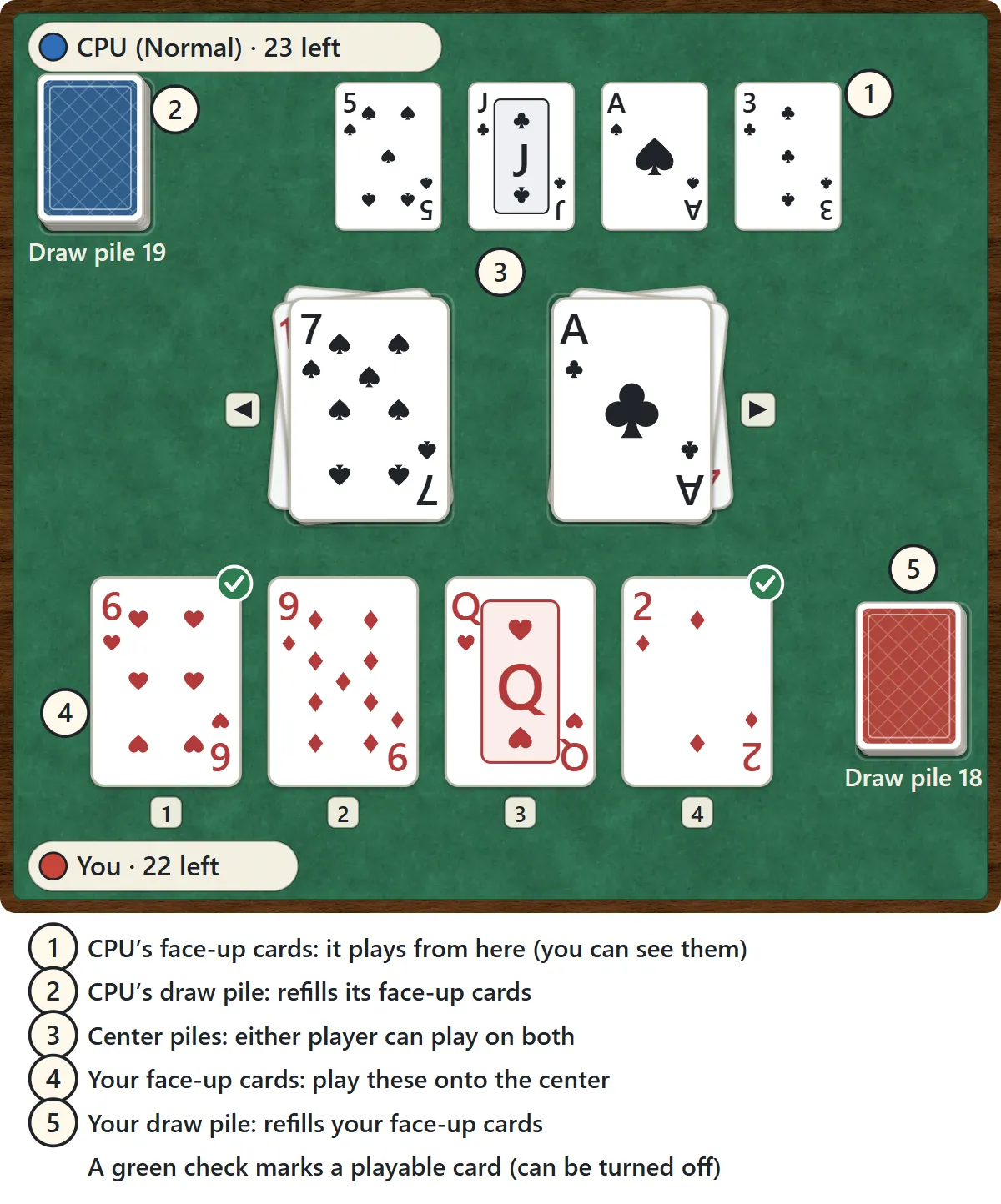
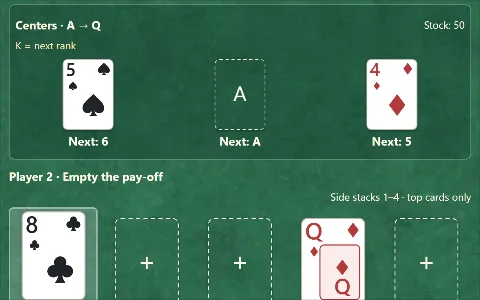
Each player has a row of face-up cards in front of them and a face-down draw pile. The two piles in the middle are the center piles. You can only play your face-up cards; whenever one is played, it is replaced from your draw pile, so you always have four in front of you until the pile runs out. The computer’s cards are face up too, so you can always see what it could play.
Setting up
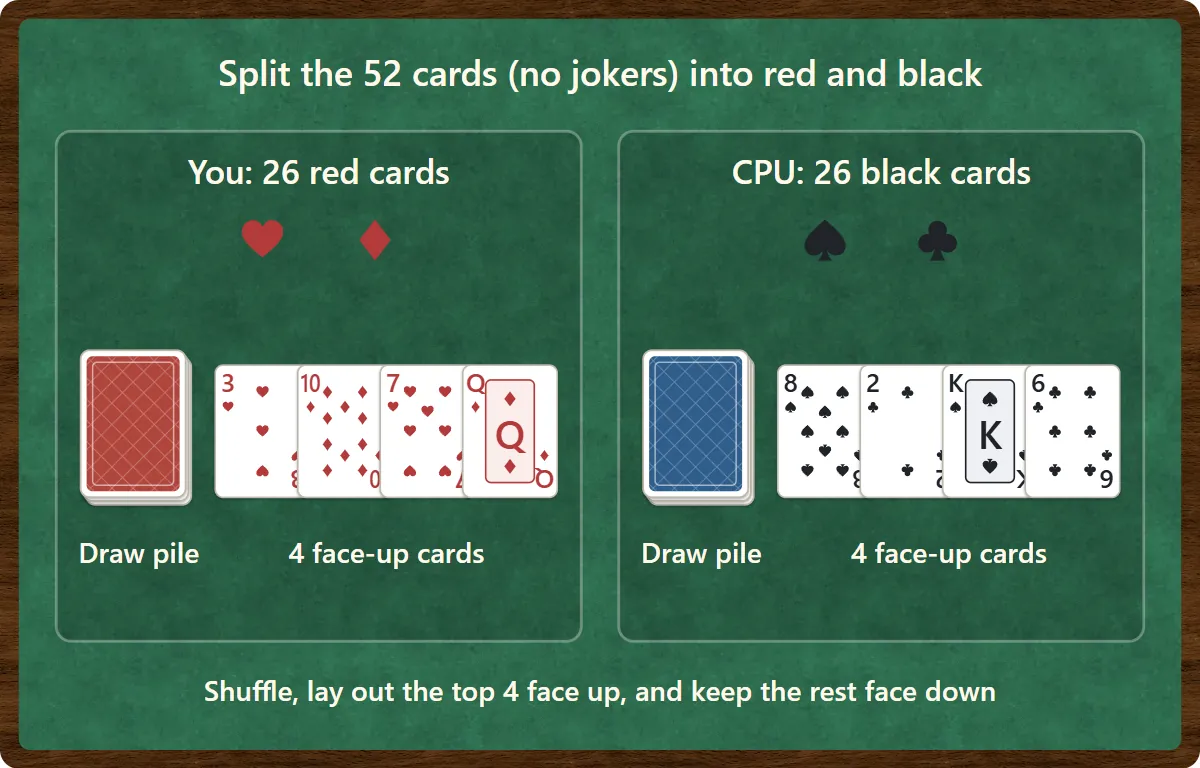
Take out the jokers and split the 52 cards by color: one player gets the 26 red cards (hearts and diamonds), the other the 26 black cards (spades and clubs). This is the usual way to deal in Japan, where this version comes from. Each player shuffles, turns the top four cards face up in a row, and keeps the rest face down as a draw pile. If you prefer, the settings let you shuffle the whole deck together and deal half to each player instead, as most American players do.
Start: “Ready… flip!”
When both players are ready, you both flip the top card of your draw pile into the middle at the same moment. Players call out something to keep it fair; English speakers often shout “Speed!” or “Spit!”, and in Japan the call is “Isse-no-se!” (roughly “one, two, three!”). Those two cards start the center piles, and from then on it is a free-for-all.
Speed card game rules: what you can play
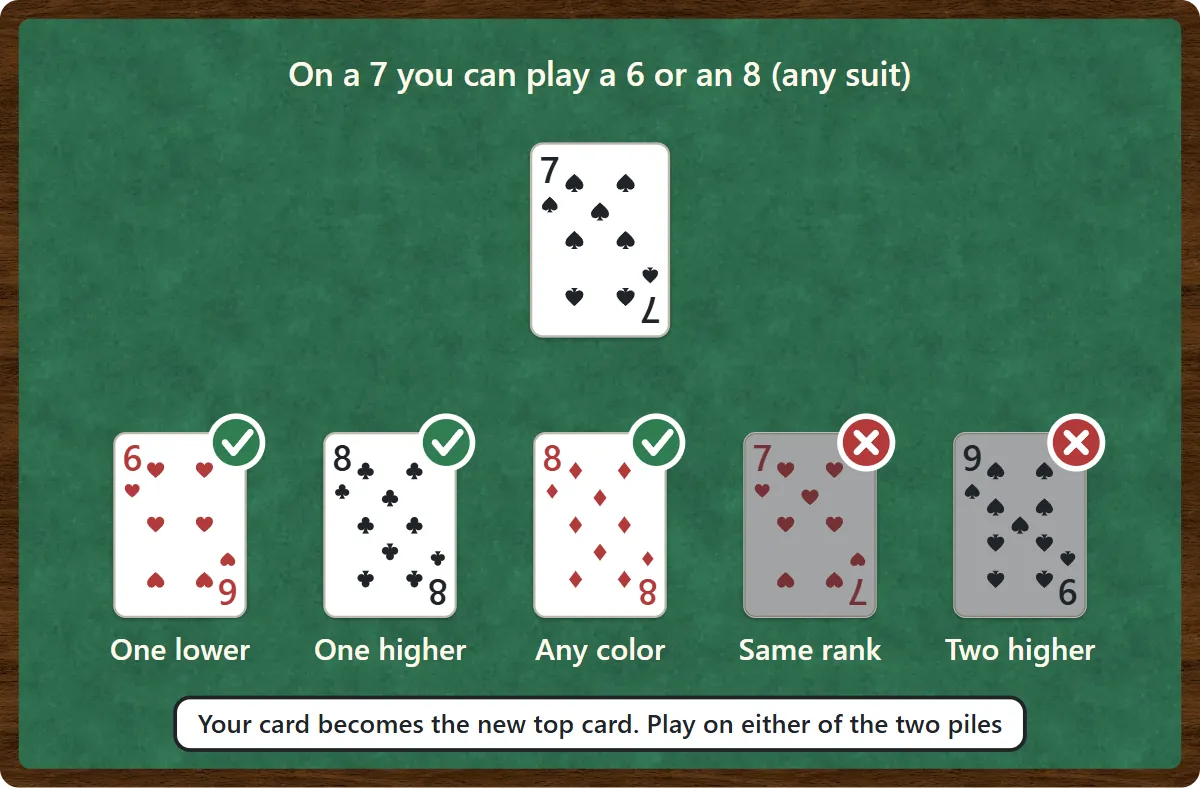
Any of your face-up cards can go on either center pile if its rank is exactly one higher or one lower than that pile’s top card. Suits and colors are ignored. The same rank does not fit, and neither does a card two or more steps away. Every card you play becomes the new top card, so an 8 on a 7 means the next cards that fit are 7 and 9. Both center piles belong to both players: play on whichever one you like.
Play one card at a time. In real life that means one hand only; on screen it means one tap or one drag per card.
Kings and aces connect
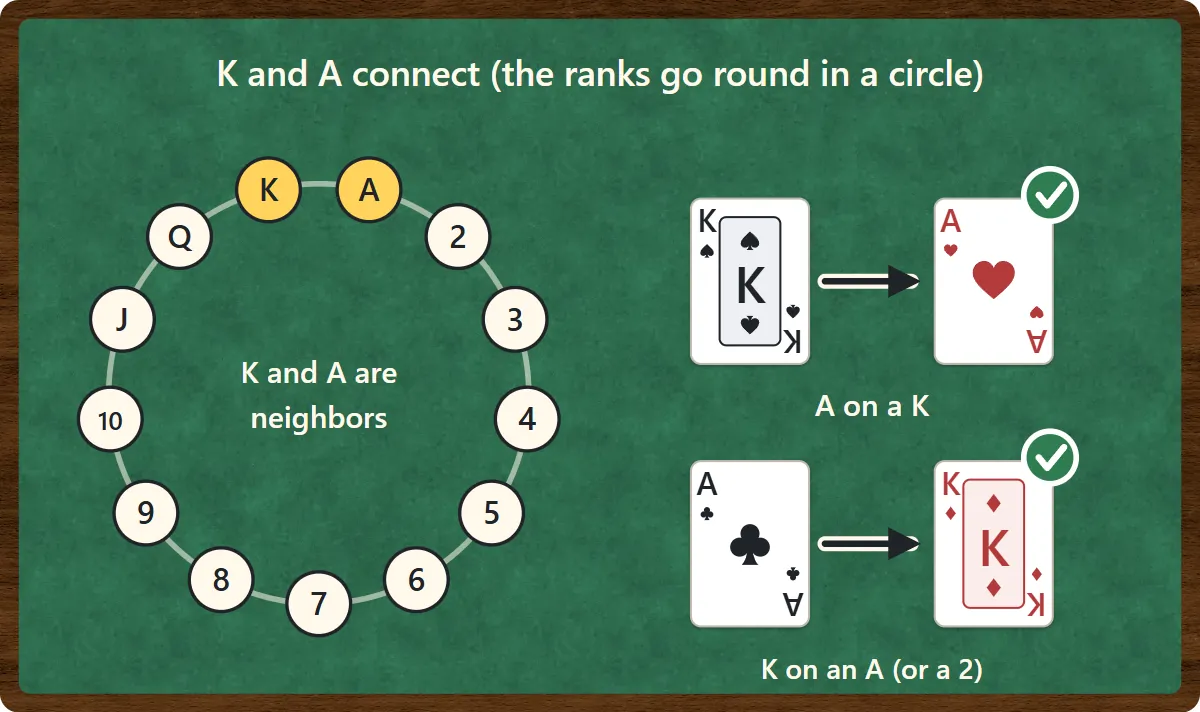
Most players treat the ranks as a circle, so a king is next to both the queen and the ace. You can play an ace or a queen on a king, and a king or a 2 on an ace. Some families don’t allow this “turning the corner”; switch off “K and A connect” if that is how you play.
Playing at the same time
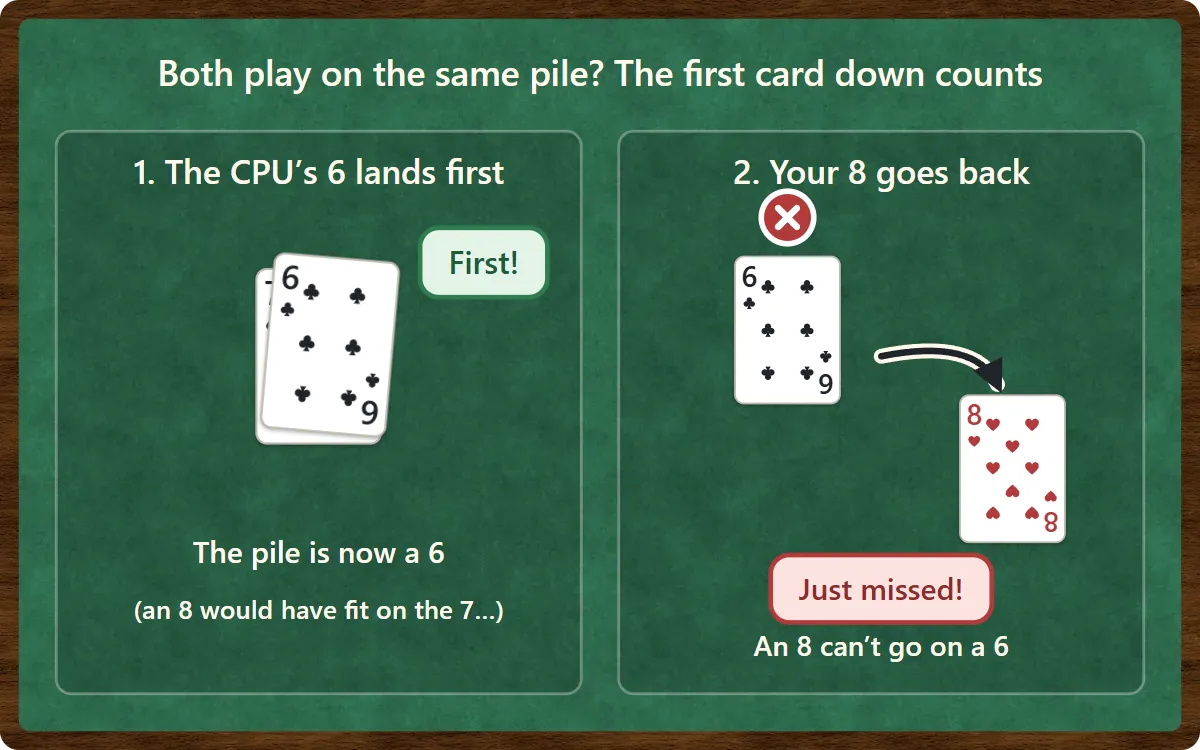
With no turns, both players will sometimes go for the same pile at once. The card that lands first counts. The later card has to fit on the new top card, and if it doesn’t, it goes back. In this game, if you play before the computer’s card reaches the pile, its card is the one that goes back. If the computer was a hair quicker, your card stays in your row and the game tells you it was “Just missed!”.
When nobody can play
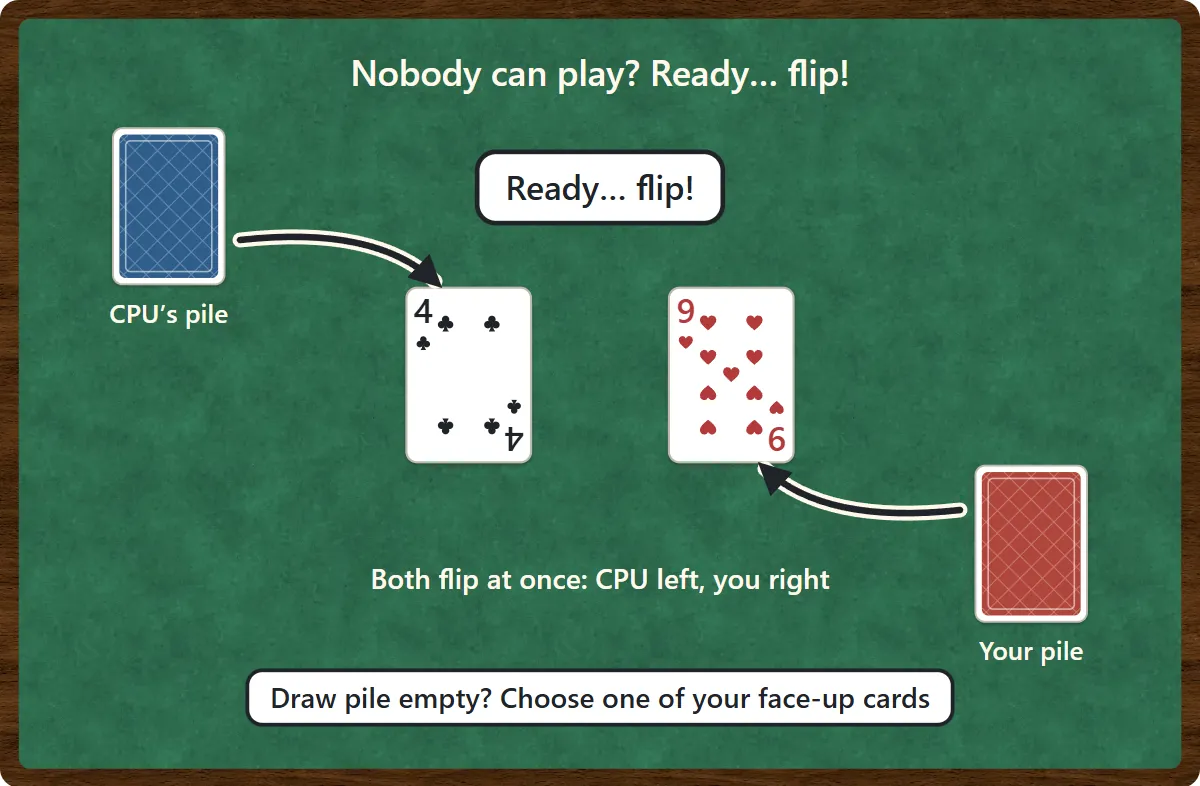
If only one player is stuck, they simply wait for the other to play. When neither player can play, you both flip the top card of your draw pile onto a center pile again, and the race continues. If your draw pile has run out, you choose one of your face-up cards to put on the center instead. In this game the flip happens automatically a moment after both players are stuck.
Winning
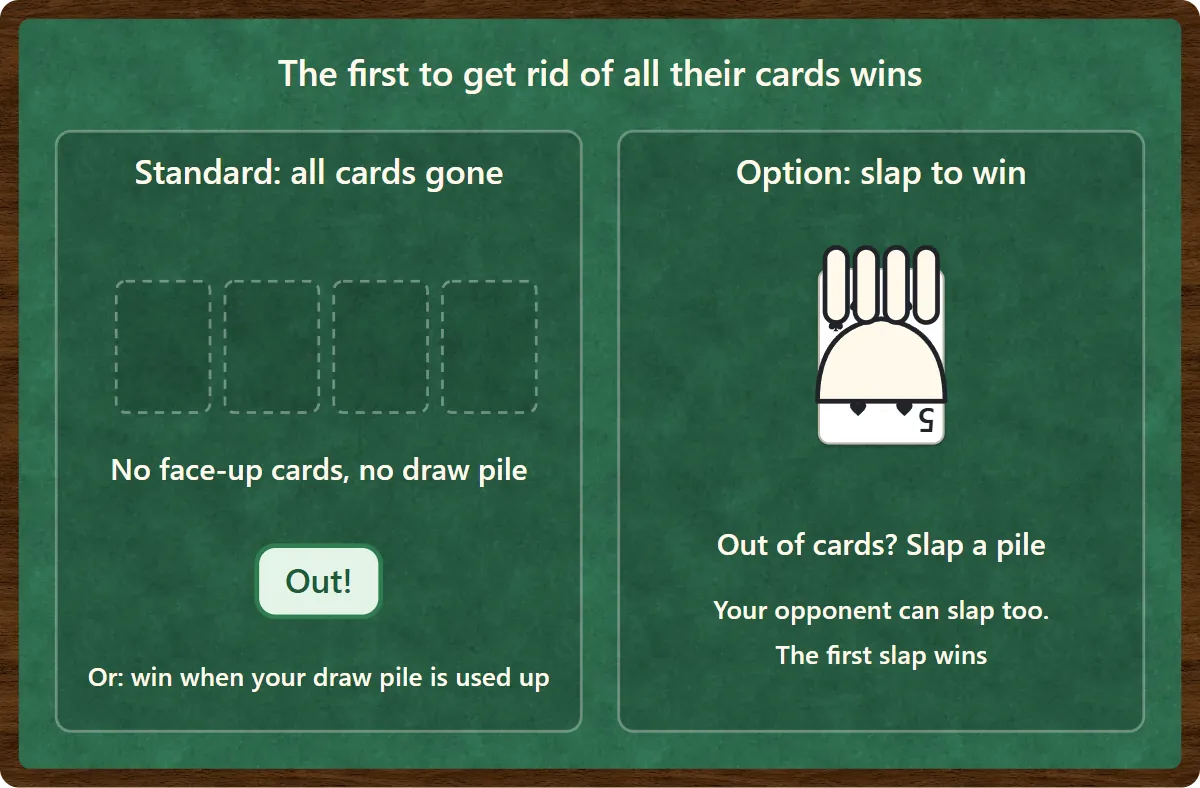
The first player to play every card, both the face-up row and the draw pile, wins. Many players finish with a flourish: the winner slaps the table and shouts “Speed!”. Choose “Then slap a pile” and you must slap a center pile after running out; the computer will race you for it, and whoever slaps first wins. You can also play that using up your draw pile is enough to win. If both players play their final card on the same flip, the game is a draw.
Speed vs. Spit: rule differences
Speed and Spit are close relatives, and the names are often swapped. Card game writers group them with the “competitive patience” games, where players race through what is basically a solitaire layout at the same time. Here is how the common versions compare:
| Rule | This game (Japanese Speed) | Speed / Spit in English |
|---|---|---|
| Deal | Red vs. black, 26 each | Shuffled deck, half each |
| Your cards | 4 face up, rest in a draw pile | Speed: 5 in hand. Spit: 5 face-up stock piles |
| Stuck | Flip from your own draw pile | Flip from spare piles beside the center |
| Ending | Play every card | Speed: empty hand and stock. Spit: several deals, slap the smaller pile |
In the American game usually called Speed, each player holds five cards in hand, kept hidden, with a face-down stock of about 15 cards. Two single cards are flipped in the middle, and two spare piles on either side supply new center cards when nobody can move. In Spit, each player lays out five stock piles of one to five cards with the top card face up, like a small solitaire layout, and flips their own “spit” card onto the center when both are stuck. When someone clears their layout, both players slap the smaller center pile to take it, and a new deal begins; you win by getting rid of all your cards across several deals.
The Japanese version played here is simpler to set up and quick to finish in one deal. To make it feel more like the American game, try five face-up cards and “Shuffle and deal half each”. You can also allow cards of the same rank, a rule some players use.
Speed card game strategy and tips
1. Watch both piles
If you stare at one center pile, you will miss plays on the other. Keep your eyes moving between them and hold the four ranks that fit in your head: with a 7 and a 2 showing, you are looking for 6, 8, A and 3.
2. Play in runs
With 5, 6 and 7 in your row and a 4 on the pile, play 5, then 6, then 7. Starting with the 7 would leave the others stranded. After every card, check whether you have the next one.
3. Look at your opponent’s row
The computer’s cards are face up. If the pile shows a 5 and you hold both a 4 and a 6, but the computer has a 7, playing the 6 hands it a move. Play the 4 instead when you can afford to.
4. Grab shared ranks first
When you and your opponent both hold the same rank, the first one to play it wins the race and the other card may no longer fit. Play those cards as soon as they become playable.
5. Be ready for the flip
The moment new center cards appear, both players are hunting at once. Memorize your own row before the flip so you can react instantly; getting the first card down often lets you string several together.
6. Don’t rush into mistakes
Tapping a card that doesn’t fit wastes time. While you learn, keep “Mark playable cards” on and practice spotting the right cards quickly.
Speed FAQ
Can I play a card of the same rank?
Not in the standard rules: only one higher or one lower fits. Some players allow the same rank, and you can switch that on under “Set the rules yourself”.
What happens when my draw pile runs out?
Nothing bad: you just stop refilling your row and keep playing the cards you have. When both players are stuck, you choose one of your face-up cards to put on the center instead of flipping from the pile.
What if we play on the same pile at the same moment?
The first card down counts. The other card goes back if it no longer fits. Here, you win the tie if you play before the computer’s card lands.
Which computer level should I choose?
Start with Easy if Speed is new to you: it moves slowly and often misses a play, so you have time to look. Normal is about as quick as a first-time player. Hard reacts faster, rarely misses, and prefers cards that let it keep going or that leave you nothing to play. Speed rewards practice, so you will get faster the more you play.
Does it work on a phone?
Yes. Tap a face-up card to play it (it goes to the left pile if both fit; drag it to choose). On a computer you can also use the number keys 1–4 to pick a card and the arrow keys to play it left or right. If you close the page mid-game, press Continue next time to pick up where you left off.
About Speed
Racing games like Speed and Spit are played by children and adults all over the world, and nobody knows exactly where they began. In Japan, Speed is one of the best-known two-player card games, usually dealt red against black with four cards face up. In the United States the five-card-hand version is common, while Spit, with its row of stock piles, is widely played in Britain and elsewhere. Whatever the local rules, the heart of the game is the same: no turns, two piles, and a race to be first.