 Yorimichi Games
How to play Spades
Spades is a trick-taking card game for four players in two teams. Partners sit across from each other, so the players on your left and right are your opponents. In each hand, everyone plays one card at a time, thirteen times over, and whoever plays the strongest card wins those four cards. Each round of four cards is called a trick.
What makes Spades different from most card games is the bid. Before any cards are played, every player says how many tricks they expect to win. The two bids of a partnership are added together to make the team’s contract. Fall short and you lose points; take too many and the extra tricks, called bags, slowly cost you. And as the name says, spades are always trumps. Here you team up with a computer partner against two computer opponents, so you can learn the game at your own pace without needing three friends.
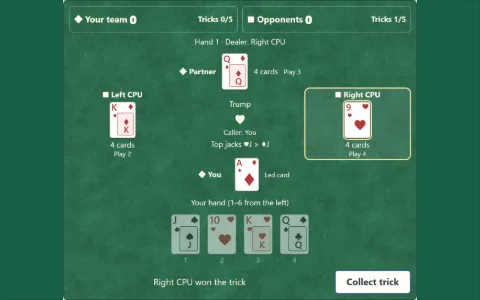
The Spades table

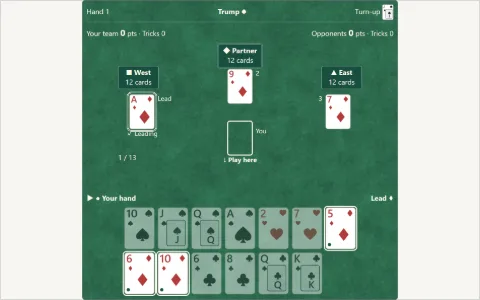
The game uses a standard 52-card deck with no jokers, and all 52 cards are dealt, so each player gets 13. In every suit the ace is highest, followed by king, queen, jack, 10 and so on down to the 2. Above the table you can always see each team’s score, its bags, and how many tricks it has won compared with its bid in the current hand.
Spades rules
Bidding: how many tricks will you win?

After the deal, bidding starts with the player to the dealer’s left and goes clockwise. Each player bids once, any number from 0 to 13, and bids can’t be changed afterward. Your bid and your partner’s bid are added together: if you bid 4 and your partner bids 3, your team must win at least 7 tricks between you, and it doesn’t matter which of you wins them.
A good way to estimate is to count your strong cards. An ace is nearly always a trick. A king usually wins one if you hold at least one other card in that suit. Spades are trumps, so the more spades you hold, the more tricks you can expect. When it’s your turn to bid, this game shows a suggested number and marks the cards it counted, so even your first game feels manageable.
Follow suit, and spades are trumps
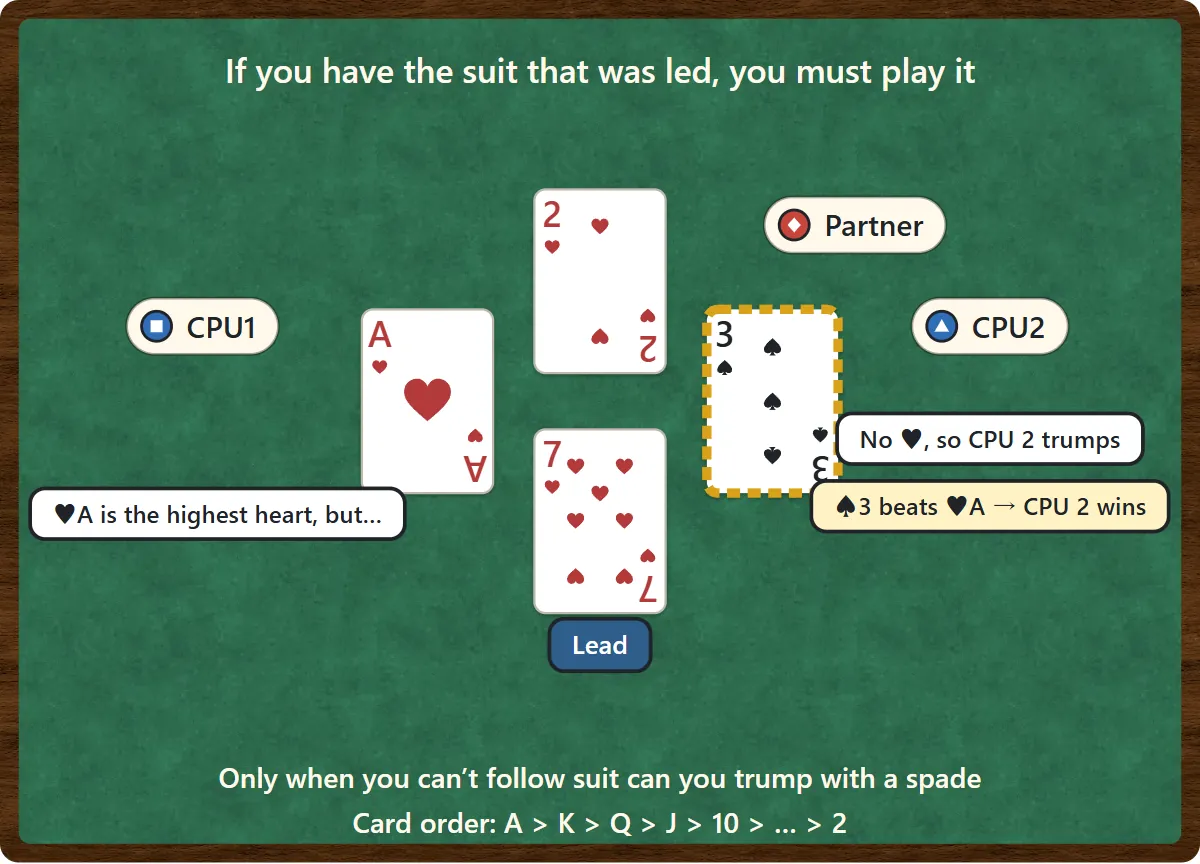
The player to the dealer’s left leads to the first trick, and the others play in turn clockwise. If you have a card of the suit that was led, you must play one. Only when you have none of that suit may you play something else. If that something else is a spade, you have trumped the trick: any spade beats every card of the other suits. When all four cards are down, the highest spade wins the trick; if no spade was played, the highest card of the suit led wins. The winner leads the next trick.
Breaking spades
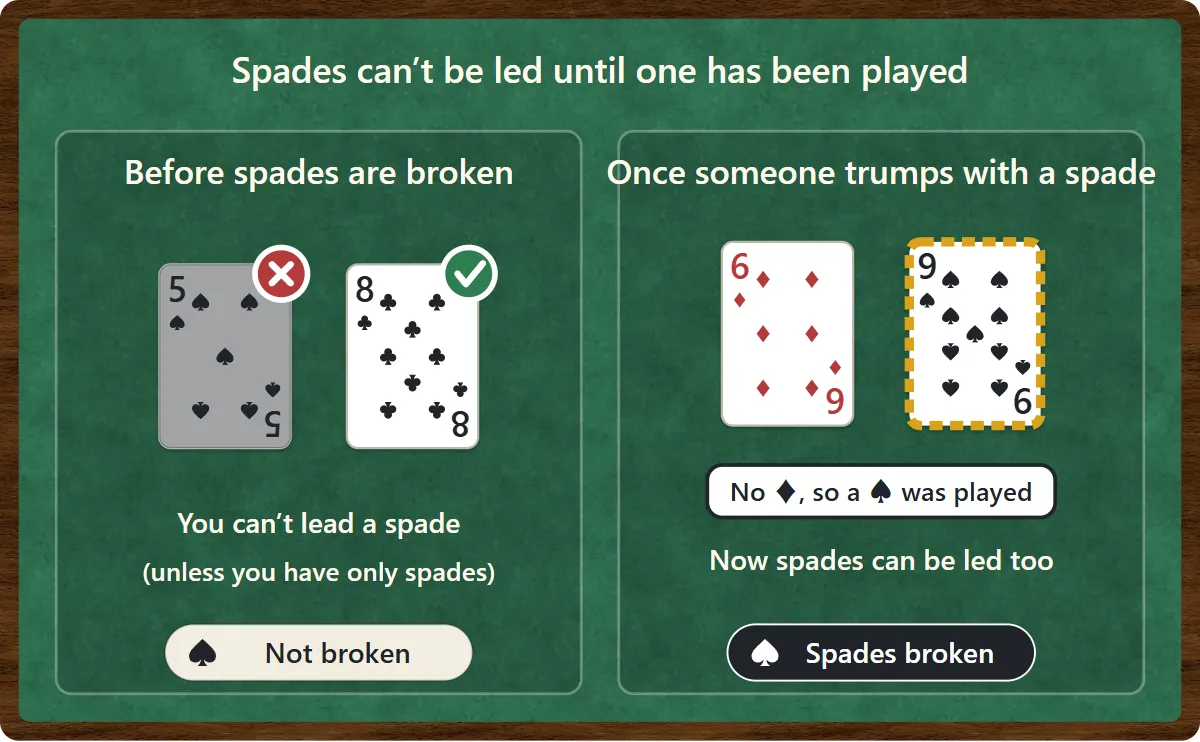
Until someone has played a spade, you may not lead one. Spades are usually broken when a player who can’t follow suit trumps with a spade; after that, anyone may lead spades. The one exception is a hand that holds nothing but spades: then you may lead a spade even before they are broken.
Spades scoring and bags
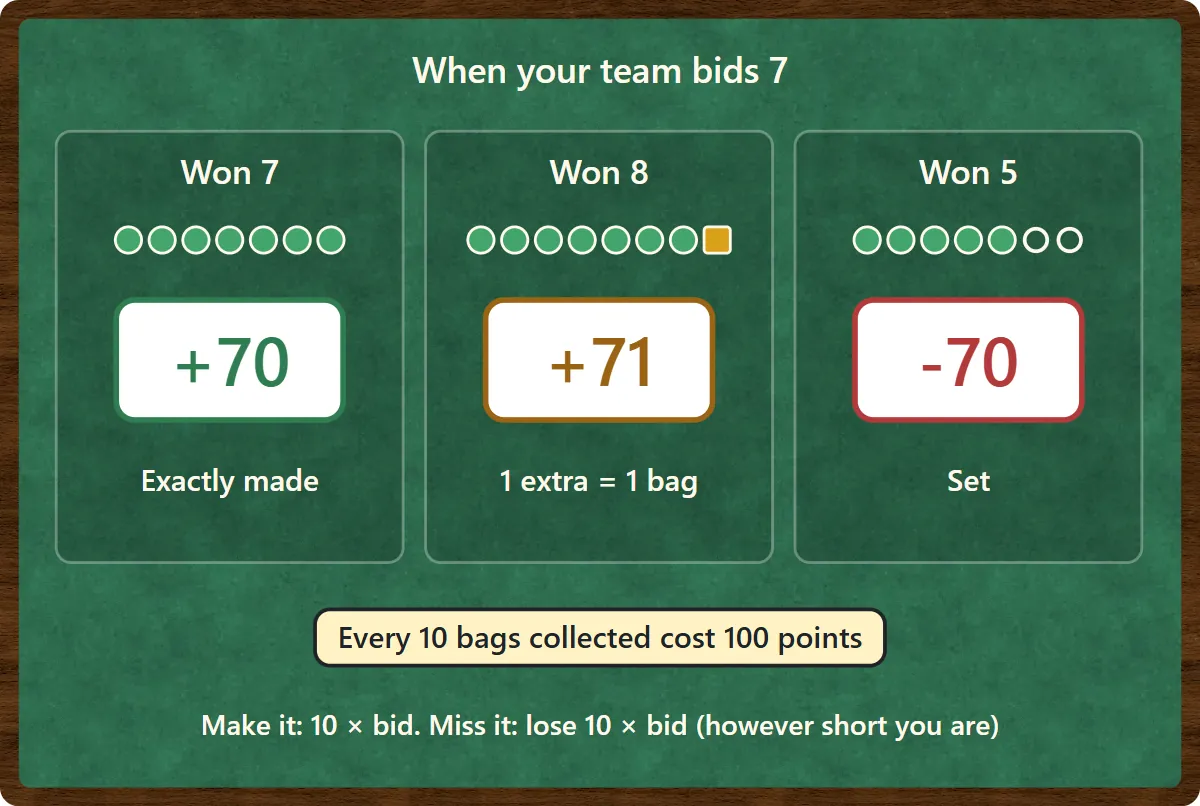
When all 13 tricks have been played, each team is scored. If your team won at least as many tricks as it bid, you score 10 points per trick bid, so a bid of 7 is worth 70. Each extra trick adds 1 point, but it also counts as a bag, and every 10 bags cost your team 100 points. If your team wins fewer tricks than it bid, it is “set” and loses 10 points per trick bid, no matter how close it came. Hands continue until a team reaches 500 points. If both teams pass 500 on the same hand, the higher score wins, and an exact tie means one more hand.
Nil: bidding zero
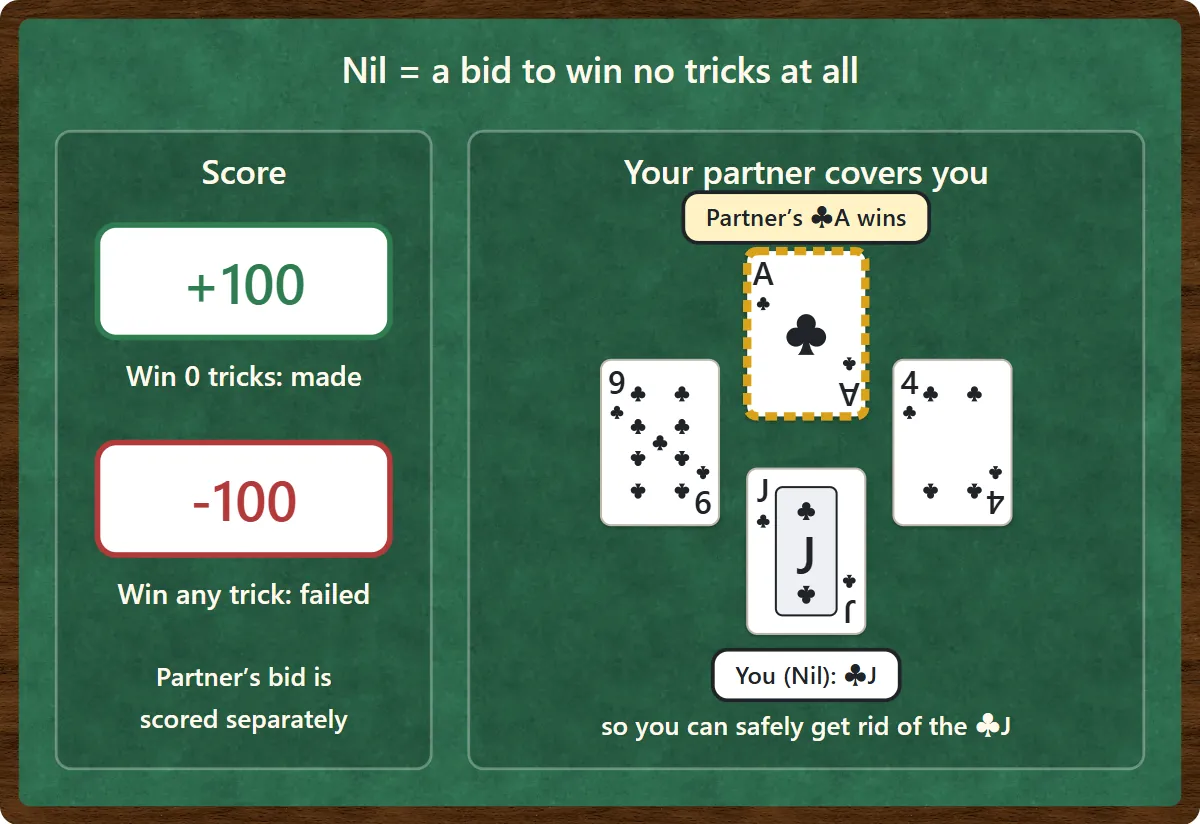
With a weak hand you can bid Nil, promising to win no tricks at all. If you manage it, your team scores 100; if you win even one trick, your team loses 100. The Nil score is added separately from your partner’s bid, which is scored as usual on the tricks your partner wins. Under the standard rule, tricks won by a failed Nil bidder don’t help the partner’s bid but do count as bags. If your partner bids Nil, play high cards so you win the tricks they might otherwise be forced to take.
Spades variations you can choose
| Rule | Standard | Options |
|---|---|---|
| First lead | Left of the dealer, no spades | Holder of the ♣2 |
| Breaking spades | On | Off (lead spades anytime) |
| Nil | On (±100) | Off (bid at least 1) |
| Blind Nil | Off | On (100+ behind, ±200) |
| Set team | Lose 10 × bid | Score 0 |
| 10 bags | −100 | No penalty |
| Game | 500 | 300, 200; lose at −200 |
Spades has many house rules, and families often play it a little differently. The “Easy rules” preset turns off Nil, scores a set team 0 instead of a penalty, and plays to 200, which is a good way to learn or to fit a game into a short break. Blind Nil, where a trailing player bids zero before looking and then swaps two cards with their partner, is available under Custom.
Spades strategy: tips to win more often
1. Bid a little low
Missing your contract costs the whole bid times ten, while one extra trick only adds a single bag. When you’re unsure, bid one fewer. Keep an eye on your bags, though: if your team is sitting on seven or eight, start bidding exactly, because the tenth bag costs 100 points.
2. Listen to your partner’s bid
If your partner has already bid high, many of the strong cards are in their hand, and your kings and queens may not win. You can shade your bid down. When the four bids add up to well over 13, someone is going to be set.
3. Create a void and trump
If you hold plenty of spades, play out a short side suit early. Once you have none of that suit left, you can trump it with a small spade, turning low trumps you didn’t count into extra tricks.
4. Once you’ve made your bid, stop winning
After your team reaches its contract, get rid of high cards on tricks you won’t win: play just under the current winning card. On the other hand, if the opponents still need tricks, taking a few more to set them can be worth a couple of bags.
5. Don’t overtake your partner
If your partner’s ace is already winning the trick, don’t throw your king on top. Play a low card and save your winners for tricks the opponents would otherwise take.
6. Attack an opponent’s Nil
When an opponent bids Nil, lead low cards in suits they still hold. If they are forced to win a trick, their team loses 100 points, which is often worth more than making your own bid exactly.
Spades FAQ
Can I trump with a spade if I have the suit that was led?
No. You must follow suit whenever you can. You may only play a spade on another suit’s lead when you have no cards of that suit. In this game, cards you can’t play are dimmed, and tapping one tells you why.
What happens to my partner’s bid if my Nil fails?
Your team loses 100 for the failed Nil. Under the standard rule, the tricks you won don’t count toward your partner’s bid; they count as bags instead. Your partner’s bid is scored on their own tricks. Under Custom you can choose to count the Nil bidder’s tricks toward the partner’s bid.
Can partners talk about their hands?
No. A bid is just a number, and you can’t tell your partner what cards you hold. Reading your partner’s bid and the cards they play is a big part of the fun.
Which difficulty should I choose?
If you’re new to Spades, start with Easy. The opponents grab tricks whenever they can, so they often overshoot or miss their bids, and you can learn the rules without much pressure. Normal opponents stop taking tricks once they’ve made their bid and will protect or attack a Nil. Hard opponents remember the cards that have been played and work to set your contract. Your computer partner always plays at Normal and tries to help you.
How long does a game take?
A game to 500 usually takes around ten to fifteen hands. For a shorter game, choose the Easy rules preset or set the winning score to 300 or 200. If you need to stop, close the page and press Continue next time; the game is saved in this browser only.
Where Spades comes from
Spades is generally said to have been created in the United States in the 1930s. It belongs to the same family as Bridge and Whist, where players compete to win tricks, but it simplifies things: spades are always trumps, and a bid is just a number of tricks. That made it quick to learn, and it became a favorite at family gatherings, in college dorms and among soldiers, who carried it overseas. Online play helped standardize the rules from the 1990s on, although many groups still keep their own house rules for Nil, bags and the first lead.