 Yorimichi Games
How to play the snake game
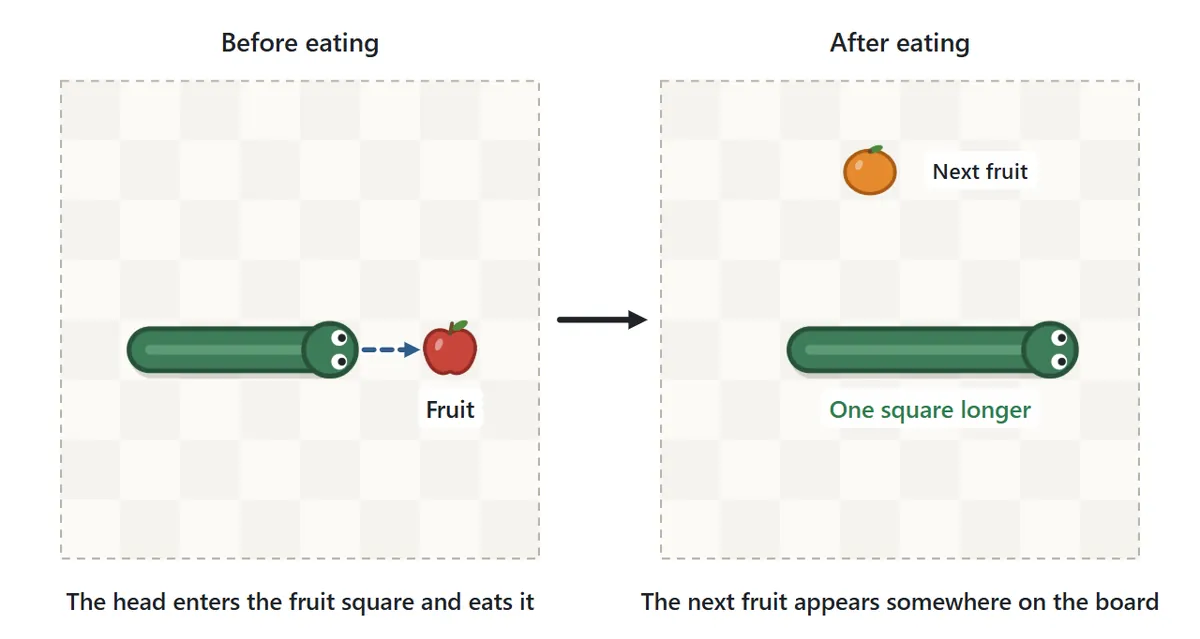
Snake is one of the simplest and most addictive games ever made. You control a snake that crawls across a grid and never stops moving. All you decide is which way it turns – up, down, left or right. Each piece of fruit it eats makes its body one square longer, and the game ends the moment its head runs into its own body. The longer the snake grows, the more of the board it fills, so every game starts relaxed and slowly turns into a puzzle about where you can still go.
When you press “Start”, the snake waits on the left side of the board, facing right. Press an arrow key or W, A, S, D, swipe on the board with your finger, or tap one of the arrow buttons under the board, and it sets off in that direction. There are four kinds of fruit – an apple, an orange, grapes and cherries – but each one counts the same. Every five pieces you eat, the snake speeds up a little, up to 15% faster than its starting speed.
Eat fruit to grow one square longer
Snake game rules: don’t hit your own body
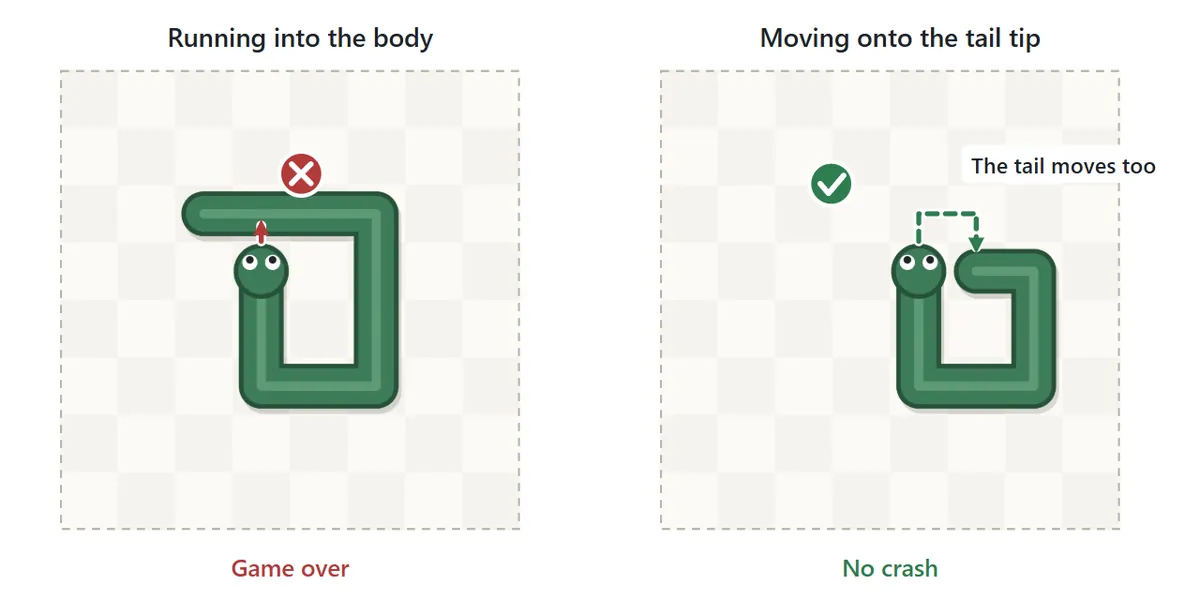
The game is over as soon as the snake’s head enters a square taken by its body. There is one exception that experienced players rely on: the very tip of the tail. The tail moves forward at the same moment as the head, so the square it leaves is free, and you can follow your own tail as closely as you like. On boards with rocks, hitting a rock also ends the game.
You can’t reverse straight back
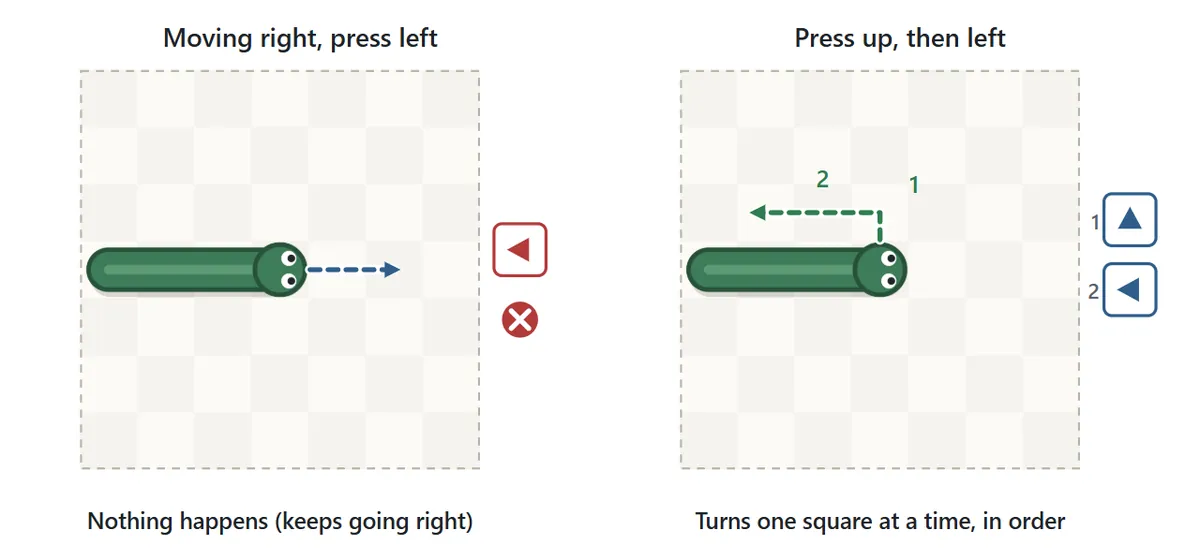
The snake cannot turn 180 degrees in one move. If it is heading right and you press left, nothing happens – otherwise it would instantly bite its own neck. To reverse, first press up or down, then left. Quick double presses are remembered in order and carried out one square at a time, so you can make a tight U-turn in a narrow corridor without mashing the keys.
Wrap-around or walls: choose your snake game
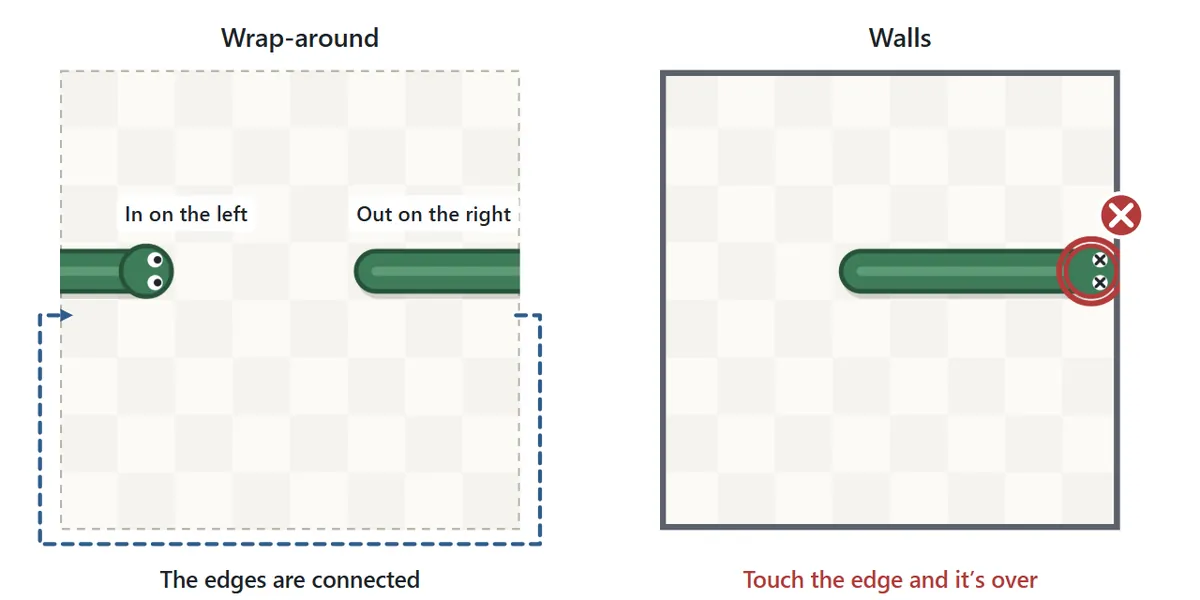
Snake games come in two classic flavors. In some, the edges of the board are walls; in others, the snake passes through an edge and reappears on the other side. This version lets you pick either, and it starts with wrap-around. Not having to worry about the edges lets new players chase fruit freely and survive much longer. Once you are comfortable, switch to walls: timing your turns near the edges becomes important and the game gets noticeably tougher. A dotted line around the board means wrap-around; a thick solid line means walls.
| Setting | What changes |
|---|---|
| Wrap-around | Leave through one edge, come back in on the opposite one. The easier choice. |
| Walls | Touching the edge of the board ends the game. Harder. |
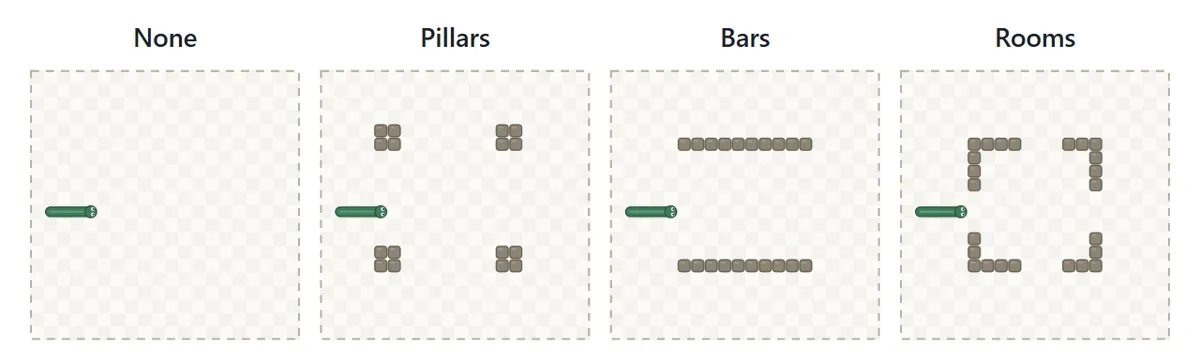
| Rocks: Pillars | Four 2×2 blocks of rock. A little harder. |
| Rocks: Bars | A long bar of rock near the top and the bottom. A little harder. |
| Rocks: Rooms | A square enclosure in the middle with four openings. Hard. |
| Daily Challenge | A rock layout that changes every day (20×20, wrap-around). Hard. |
Speed and board size
| Speed | Squares per second | Good for |
|---|---|---|
| Slow | About 4.5 | Your first games |
| Normal | About 7 | Once you know the controls |
| Fast | About 10.5 | Quick fingers |
A good first goal is 20 fruits on Slow with wrap-around. When you can do that, raise the speed, or try walls or a rock layout. A smaller board fills up with snake sooner; a larger one gives you room for longer runs. Your best score – the most fruit eaten – is saved on this device separately for every combination of speed, size, edges and rocks, so each setting has its own record to beat.
The Daily Challenge
The Daily Challenge gives everyone the same rock layout for the day, and even the first fruit appears in the same place. That makes it a fair way to compare scores with friends or family – ask them how many they managed today. When the date changes, a new layout arrives.
Snake game tips and strategy
1. Decide your turn early
The snake never stops, so don’t wait until you are next to the fruit or the wall to think. Plan two or three squares ahead: “I’ll turn here.” Pressing the key a moment before the square where you want to turn feels just right.
2. Keep the open space open
Once the snake is long, heading straight for the fruit matters less than leaving yourself a wide, open area to move in. If your body walls off a small pocket and you go inside to grab a fruit, you may not be able to get out again.
3. Circle along the edges
A long snake folds neatly if you run it in big loops along the edges of the board. With walls on, travel one square inside the edge, so that a late turn doesn’t mean crashing into the wall.
4. Follow your tail when in doubt
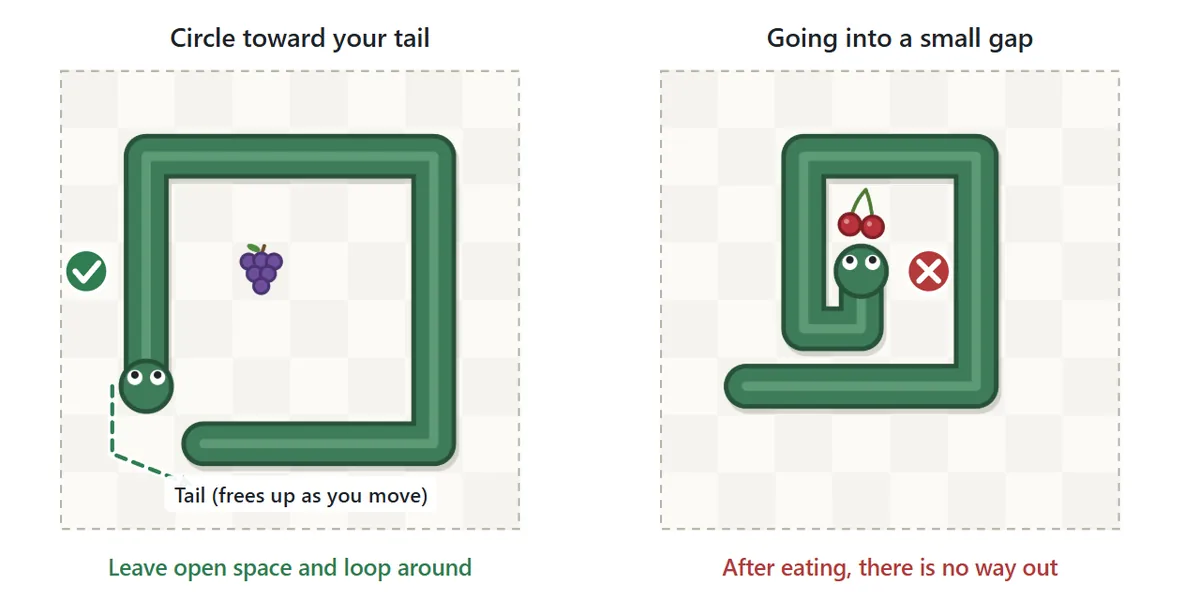
The tip of your tail frees up a square every time the snake moves. When you are not sure where to go, head toward your tail – it is the one direction that is almost never a dead end. If a fruit appears inside a loop of your body, don’t rush in; go around once so the gap widens before you go for it.
5. Use two quick presses to turn in tight spots
Between two parts of your body, press “up, then left” (or any pair) in quick succession to reverse in just two squares. The presses are carried out in order, one square each, so there is no need to hammer the keys.
6. Use wrap-around as a shortcut
With wrap-around on, a fruit near the far edge may be closer if you go the other way and pass through the edge. Think of the board as one continuous surface and you will find more routes.
Snake game FAQ
Can I play on a phone or tablet?
Yes. Swipe on the board or use the arrow buttons under it to turn. You can keep your finger down and keep swiping to turn again and again, and the game doesn’t stop if your finger slides off the board.
Can I pause?
Press the pause button in the middle of the arrow buttons, or the P or Esc key. The game also pauses by itself when you switch to another tab or app, or click outside the game on a computer. Press “Resume” or any direction key to carry on.
Can I stop and continue later?
On the same device and browser, press “Continue” to pick up with the same length and score. The snake starts out standing still, so press a direction to set it moving again.
Where are my scores saved?
Your best score for each combination of settings is stored in this browser on this device. There is no account or sign-up. The game starts muted; press “Sound: off” to hear a sound when you eat fruit and when you crash.
What happens if I fill the entire board?
Covering every free square with your snake clears the game. It is very hard, but on the small board it can be done.
A short history of the snake game
The idea behind snake goes back to arcade games of the mid-1970s, in which each player steered a line that kept growing behind them, and whoever crashed into a line or a wall first lost. Later came the one-player version where the line becomes a creature that grows by eating, and it spread widely as a sample program on home computers and as a game built into mobile phones, which is how many people first played it. Over the years it has appeared in countless forms – with edges that wrap around, with maze-like walls, faster or slower – but the core has never changed: keep moving, keep eating and don’t bite yourself.