 Yorimichi Games
How to play Shisen-Sho
Shisen-Sho is a solo puzzle played with mahjong tiles. The tiles are laid out flat in a grid, and your job is to remove them two at a time. You may take a pair only if the two tiles are identical and you can join them with a line that bends no more than twice. Clear every tile and you win. You don’t need to know anything about the four-player game of mahjong – if you can spot two matching pictures, you can play.
The game is also known as Shisen, Four Rivers and, in Japan, Nikakudori, which means “taking with two corners” and describes the main rule nicely. Many online versions call this style of puzzle mahjong connect.
The board
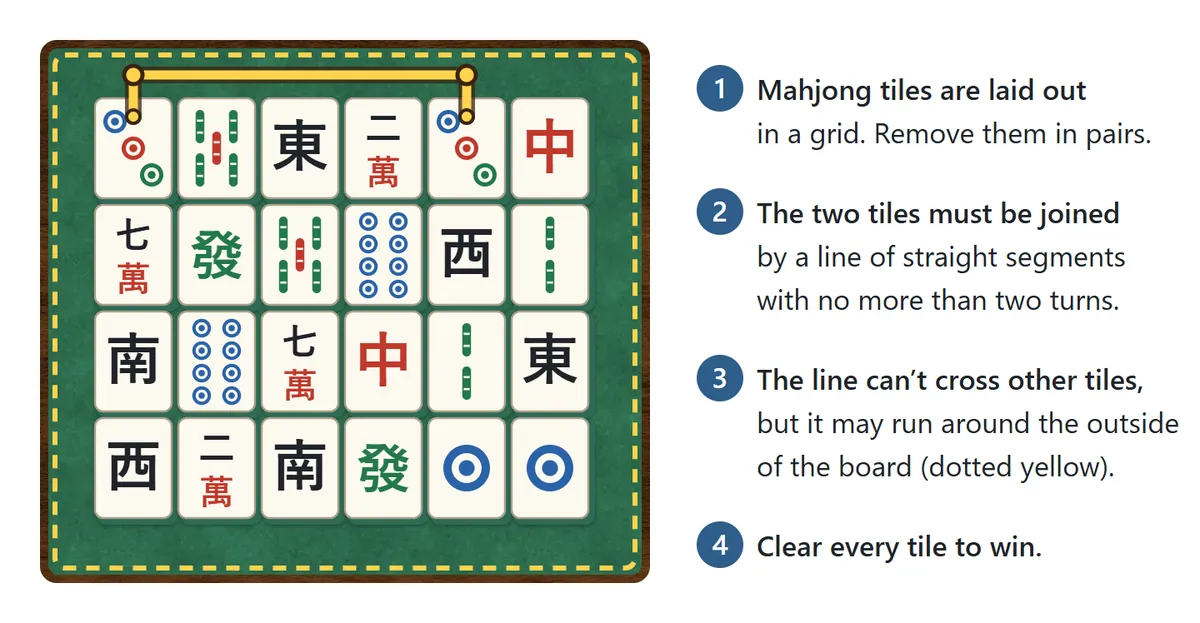
Unlike stacked mahjong solitaire, every tile sits on a single layer, so there are no hidden tiles underneath. Whether a pair can be removed depends only on the path between the two tiles. The path is made of horizontal and vertical segments – never diagonal. It may not pass over any tile, but it can run through empty squares (spaces where tiles have already been removed) and through the empty lane that surrounds the whole board.
The tiles
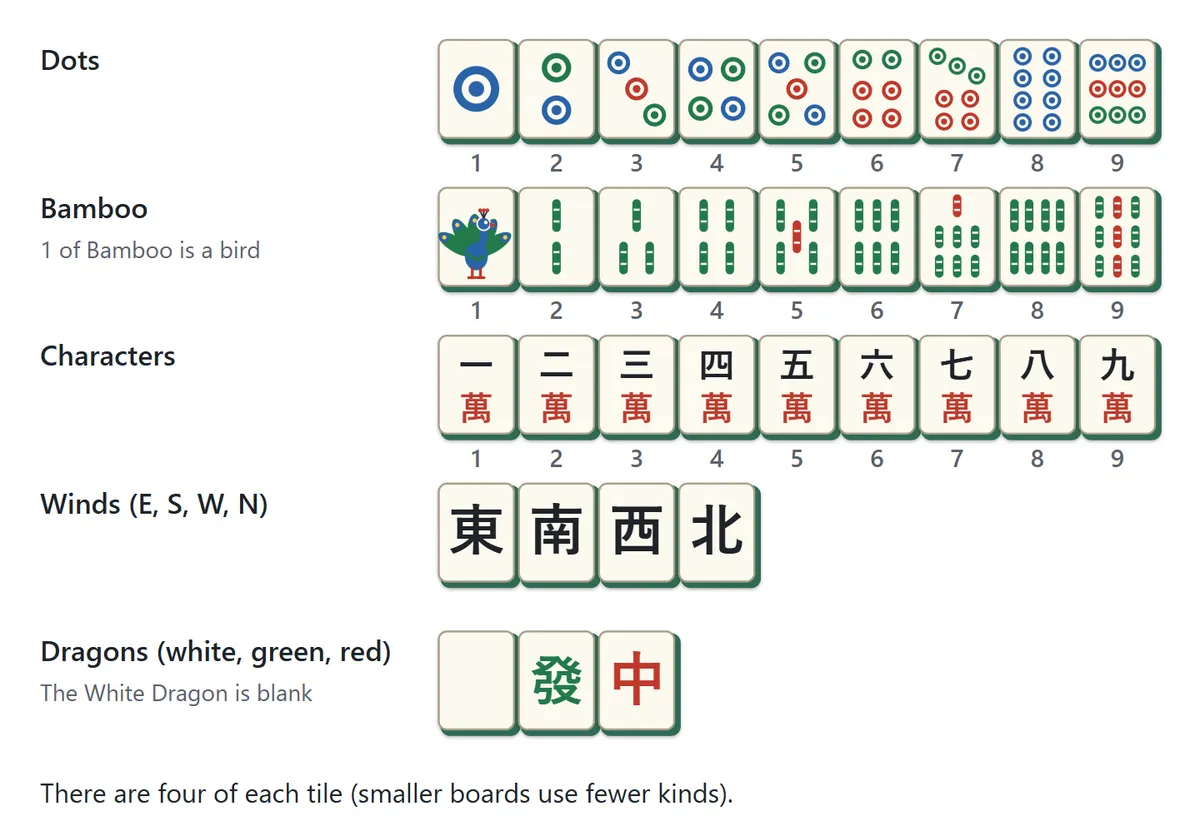
There are three suits numbered 1 to 9: Dots (circles), Bamboo (sticks) and Characters (the tiles with a number written above a red symbol). On top of those come four Winds – East, South, West and North – and three Dragons: white, green and red. Every tile appears four times. Two tiles fool beginners: the 1 of Bamboo is drawn as a bird instead of a single stick, and the White Dragon is a blank tile. If the numbers are hard to read, switch on “Numbers” and each suit tile shows its value in the corner.
Shisen-Sho rules: how tiles connect
No turns: neighbors and straight lines
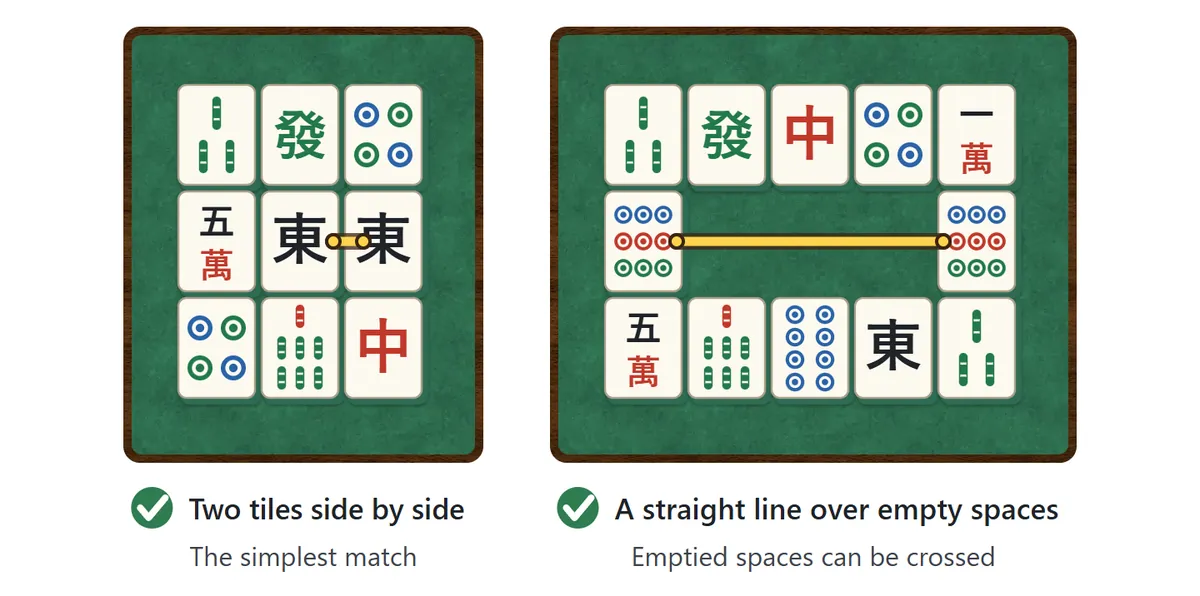
The easiest pairs are identical tiles that are right next to each other, either side by side or one above the other. Tiles in the same row or column also connect with a straight line if every square between them is empty. As the board thins out, pairs that were far apart become straight-line matches.
One turn: the L shape
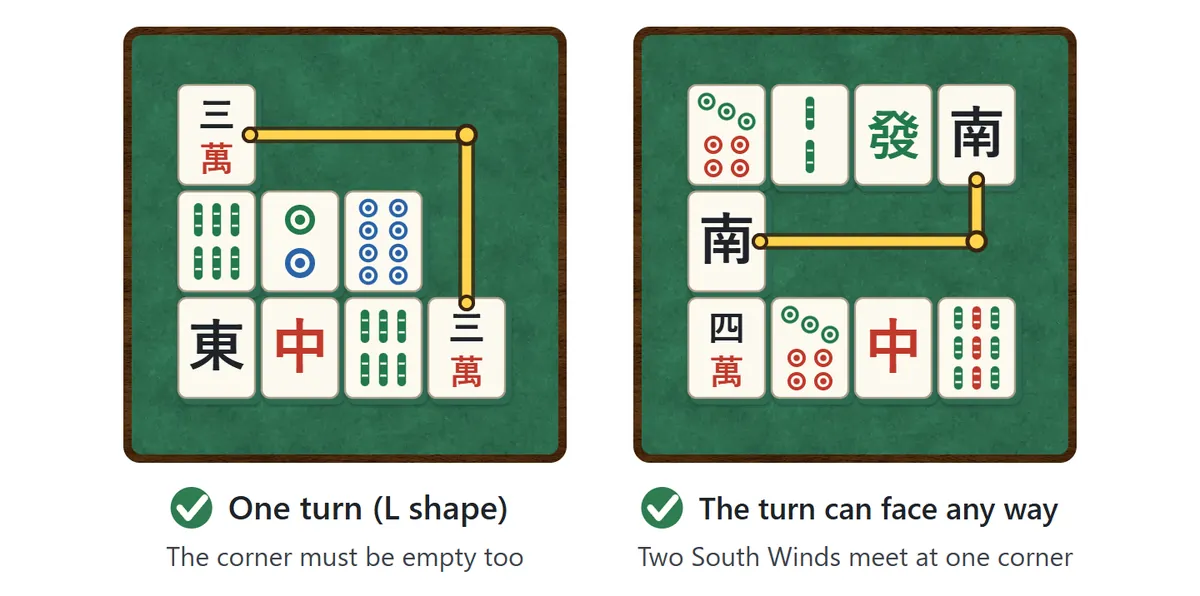
When two tiles are neither in the same row nor in the same column, the line must turn. One turn gives an L shape. Remember that the corner square itself must be empty. Every pair has two possible L shapes – go across first, or go up or down first – so check both.
Two turns: Z and U shapes

The line may turn twice. That allows Z shapes (right, down, right) and U shapes that step out and come back. Tiles on the edge of the board can use the outside lane, so at the start of a game the outer tiles are the easiest ones to reach.
What doesn’t count
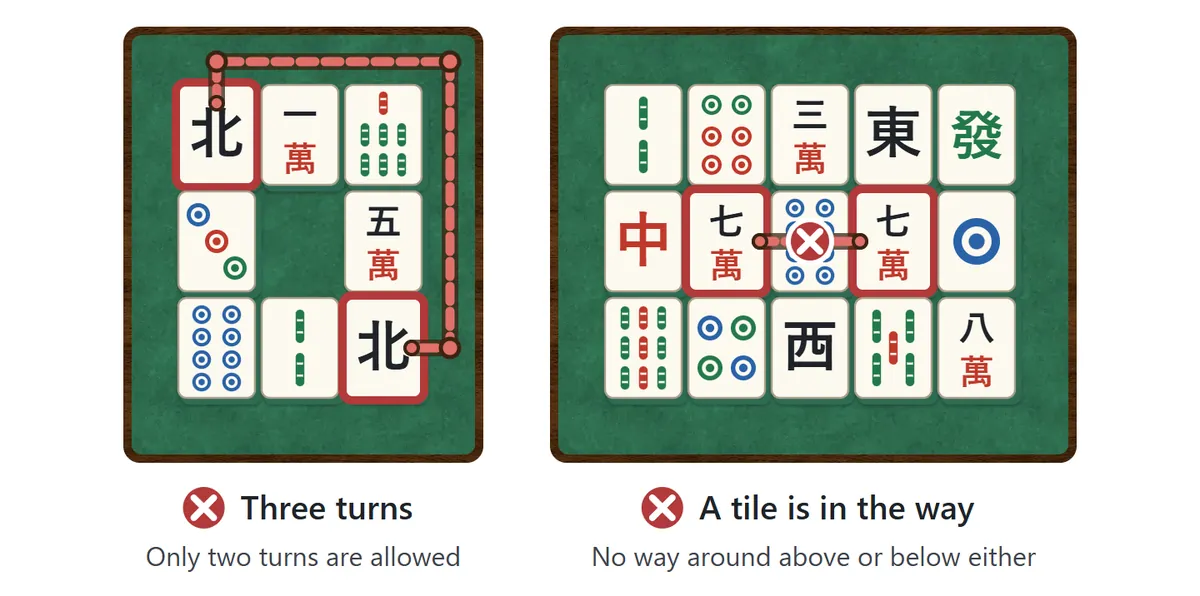
Two identical tiles cannot be removed if every possible line needs three or more turns, or if every route is blocked by other tiles. When you try such a pair here, the tile flashes red and a short note explains why.
Winning and getting stuck
You win when the board is empty. If no identical tiles can be connected any more, the game is stuck. In classic arcade versions that meant game over, but many modern versions let you shuffle the remaining tiles. This version does both: every deal is checked in advance to make sure it can be cleared, and if you paint yourself into a corner you can undo as far back as you like or shuffle what is left into a layout that can still be solved.
Using this game
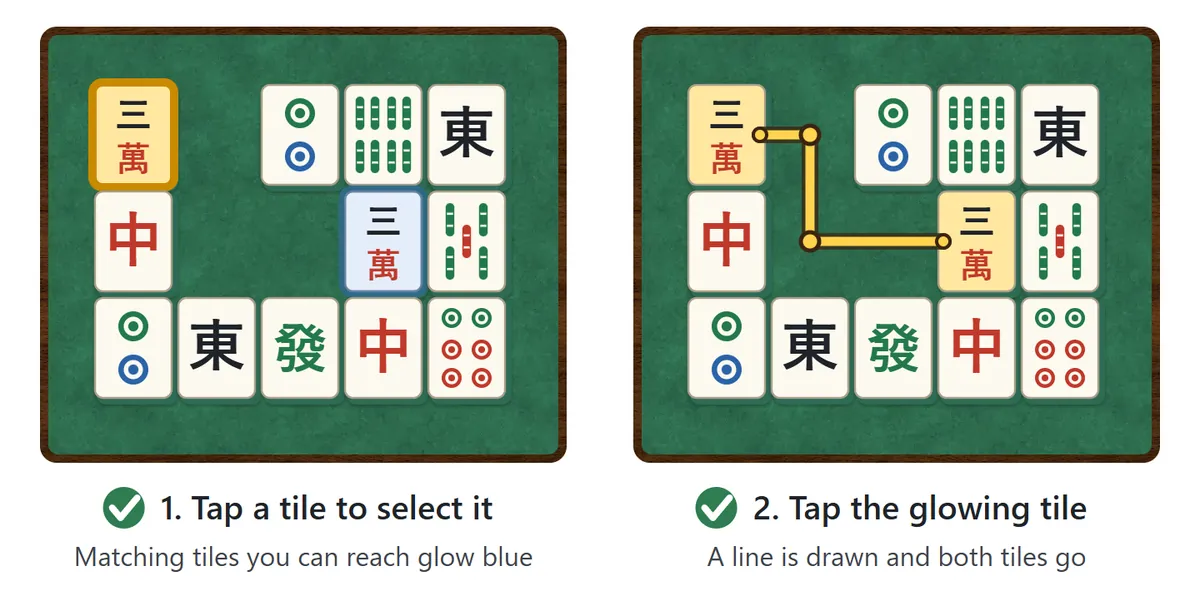
Tap or click a tile to select it. Every identical tile it can currently connect to glows blue. Tap one of those and the connecting line is drawn on the board before both tiles disappear, so you can always see why a move worked. If only one tile can be reached, a quick double tap removes the pair.
Undo goes back one move at a time with no limit. Hint points out a pair that keeps the board solvable and shows it with dotted frames and a dotted line; if the board can no longer be cleared, it tells you how many moves to undo. Shuffle rearranges the remaining tiles into a solvable layout when you run out of moves.
Board sizes and game modes
| Size | Tiles | Feel |
|---|---|---|
| Small | 6 × 6, 36 tiles | A few minutes. Good for learning |
| Medium | 8 × 9, 72 tiles | Big tiles on a phone. A short break |
| Large | 8 × 17, 136 tiles | The classic full board |
The smaller boards use fewer kinds of tile (still four of each). The daily deal is a Medium board that is the same for everyone on the same day, so you can compare times with friends. Deal by number lets you replay any deal. On a phone held upright, the long Large board is drawn standing on its side; the rules don’t change. Turn your phone sideways if you prefer it wide.
Shisen-Sho strategy and tips
1. Work from the outside in
Edge tiles can use the lane around the board, so they are the easiest to remove. Clearing the rim first opens up “doorways” that let lines reach deeper into the grid.
2. The last two of a kind are always safe
When only two tiles of a kind remain, they can only ever be matched with each other. If you can connect them, take them – removing tiles only creates more room for lines, so it never hurts.
3. With four of a kind, choose the pairing carefully
If all four copies are still on the board, which two you remove first decides how the other two must be paired. Before you commit, check that the remaining two will still have a route. If you can remove all four at once in two moves, that is the safest choice of all.
4. Watch out for the crossed square
If two kinds end up in a 2 × 2 square with the same tiles on opposite corners (A and B on top, B and A below), neither pair can be connected without a third turn. Break up shapes like this early, while there is still space around them.
5. Don’t split the board into islands
Taking tiles out of the middle can cut the board into separate clusters. Tiles buried inside a cluster are hard to reach, so try to keep the empty areas connected.
6. Use Undo freely
There is no penalty for undoing, so experiment. Only games finished without hints or shuffles count toward your best time, which gives you something to aim for once you know the rules.
Shisen-Sho FAQ
How is Shisen-Sho different from mahjong solitaire?
In classic mahjong solitaire the tiles are stacked in several layers, and a tile is free when nothing lies on top of it and its left or right side is open. In Shisen-Sho all tiles lie on one flat layer, and what matters is whether two tiles can be joined by a line with at most two turns. The goal is the same: remove every tile in matching pairs.
Is every deal solvable?
Yes. Each deal is checked by a solver before it is shown, so there is always a way to clear it. You can still get stuck by removing pairs in an unlucky order, but Undo and Hint will always get you back on track.
What does “Shisen-Sho” mean?
It is the Japanese reading of Sichuan, the Chinese province. The place has nothing to do with the rules; the name is usually thought to have been chosen simply to give the game an exotic flavor.
Are flower and season tiles used?
No. The classic 8 × 17 board holds exactly 136 tiles – the 34 regular kinds, four of each – so flowers and seasons are left out. Some computer versions add them and let any flower match any other flower, but that is less common.
Can I play on a phone or tablet?
Yes, in any modern browser, with no download or account. If you leave in the middle of a game, open the page again on the same device and choose Continue. Sound is off until you turn it on.
Where Shisen-Sho comes from
The flat, connect-the-pair version of the mahjong tile puzzle is usually traced to Japanese arcade games from around 1989, and it soon spread to home consoles and computers. It has been a favorite on desktop computers ever since, and countless “connect” puzzles with fruit, animals or other pictures use exactly the same two-turn rule.