 Yorimichi Games
How to play Concentration
Concentration is the card game where every card starts face down and you try to find matching pairs by turning them over two at a time. If the two cards show the same rank – two sevens, two queens – you keep them. If they don’t, they go back face down exactly where they were, and the next player has a go. When the last pair has been taken, the player holding the most cards wins. It is also known as Pairs, and in Britain as Pelmanism; in Japan the same game is called 神経衰弱 (Shinkei-suijaku).
The rules take ten seconds to learn, which is why so many people meet Concentration as their very first card game. Yet the result depends almost entirely on how well you remember the cards that have already been shown, so it stays surprisingly competitive between adults. On this page you can play on your own against the clock, against one to three computer opponents, or pass a single phone or tablet around the table. The deck can be cut down to 20 or 12 cards for a short game, or made harder with the same-color and four-of-a-kind rules.
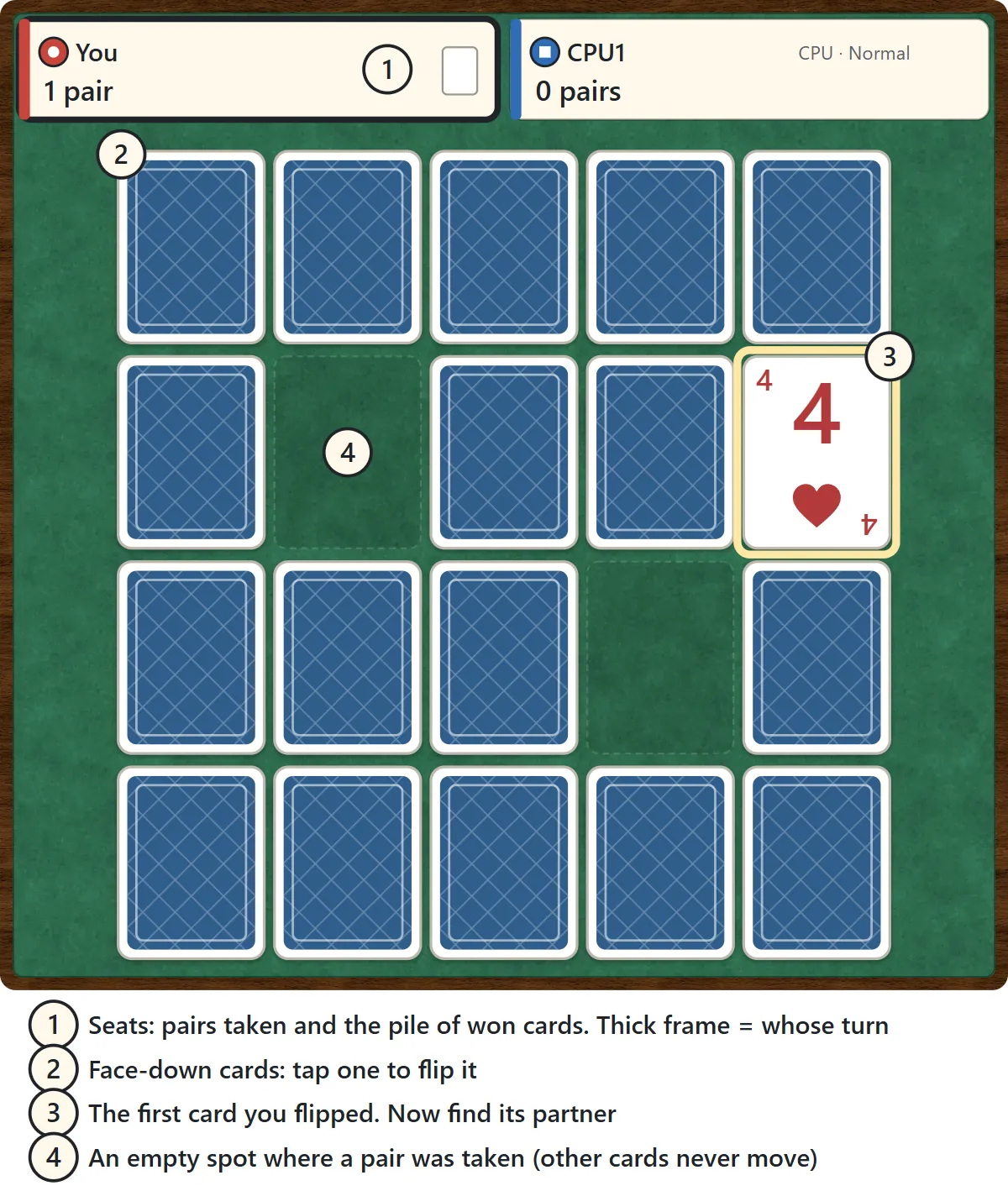
The table
1. Turn over any two cards
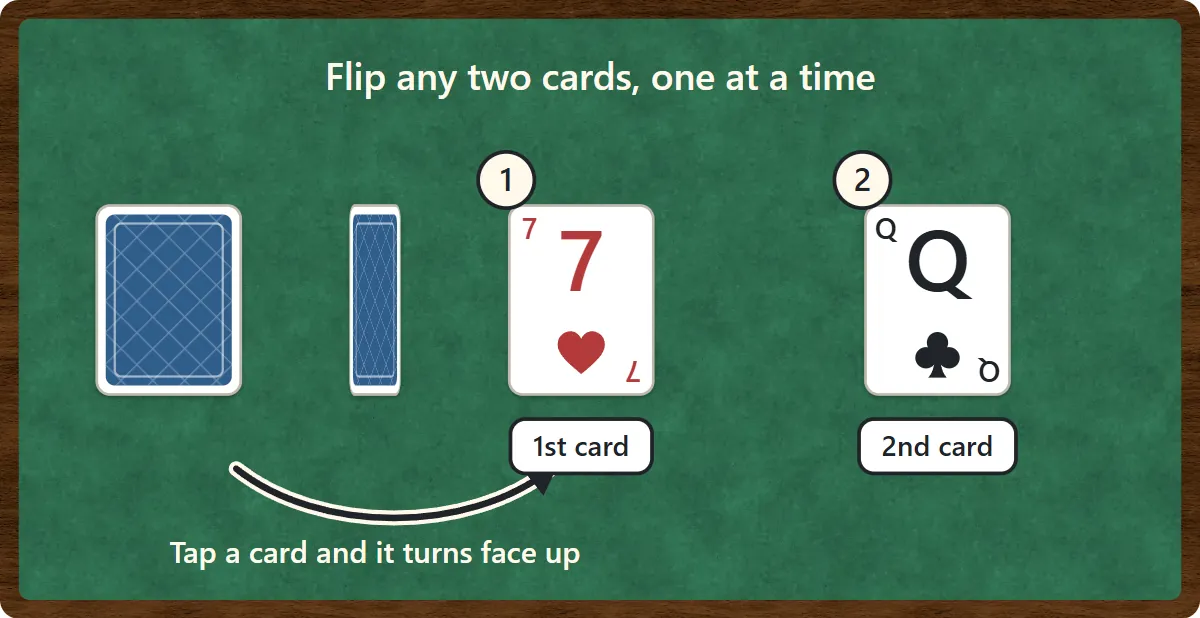
On your turn, tap or click any face-down card. It flips over so that everyone can see it. Then choose a second card and turn that over too. You may pick any two cards on the table, in any order.
2. Same rank: keep the pair and go again
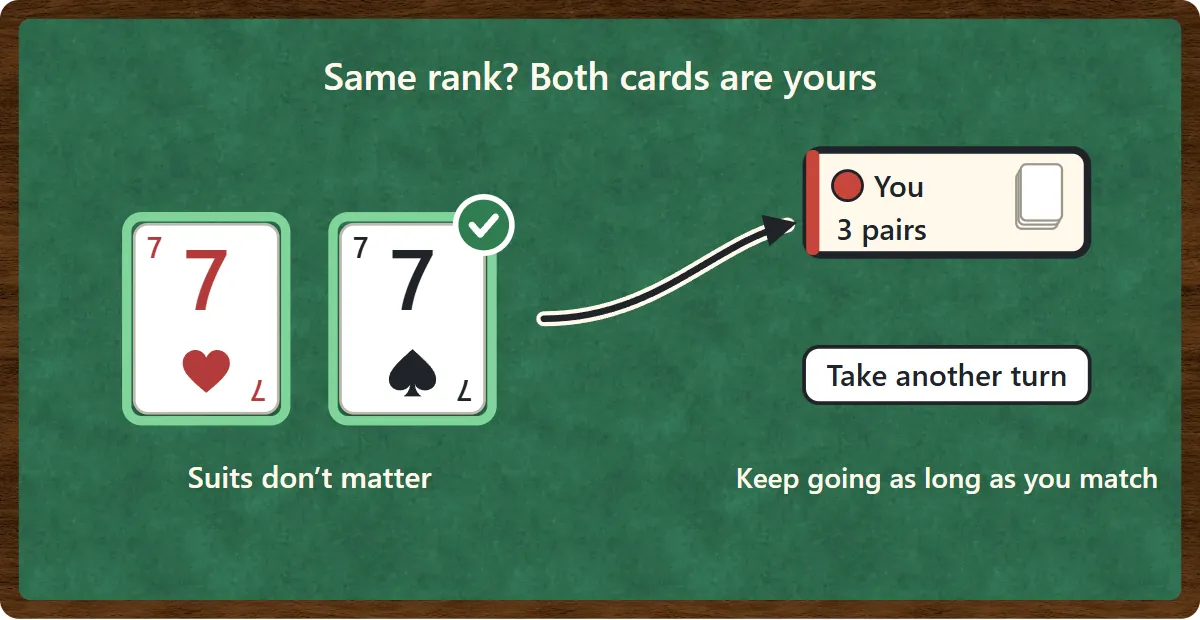
If the two cards have the same rank, they are a pair and they are yours. The suits don’t need to match, so the 7 of hearts pairs with the 7 of spades. Your pair flies over to your seat, and you take another turn. As long as you keep finding pairs you keep playing, so a good memory can clear several pairs in one go.
3. No match: turn them back over
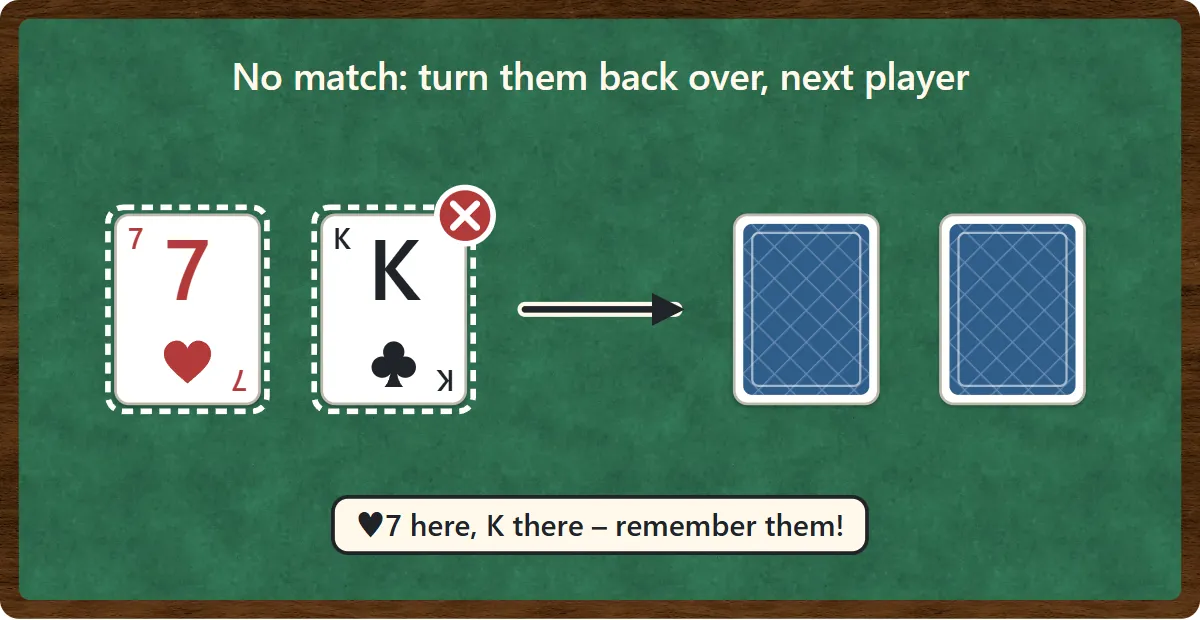
If the ranks are different, it’s a miss. Both cards stay face up for a moment and then go back face down in the same places, and play passes to the next player. That brief moment is the heart of the game. Whether it was your miss or somebody else’s, try to lock in what each card was and where it lies. You can choose how long misses stay visible – short, normal or long – and tapping any card while they are showing turns them over right away.
4. The game ends when the table is empty
When every pair has been taken, the player with the most cards wins. Players with the same number of cards share the same place. In the solo game there is no opponent; instead, your score is the number of moves (each time you turn over two cards counts as one move) and the time it took to clear the table.
Concentration card game rules and variations
Families play Concentration in slightly different ways, so this version lets you pick one of four common rule sets, or build your own with Custom.
| Rule set | Cards | What you need to match |
|---|---|---|
| Standard | 52 | 2 cards of the same rank |
| Small deck | 20 (A–5) | 2 cards of the same rank |
| Same color | 52 | 2 cards of the same rank and color |
| Four of a kind | 52 | All 4 cards of one rank |
With Custom you can also choose the size of the deck (52, 28, 20 or 12 cards), whether to add two jokers (and whether the joker pair scores double), and whether a player who finds a pair goes again or passes the turn.
Same color
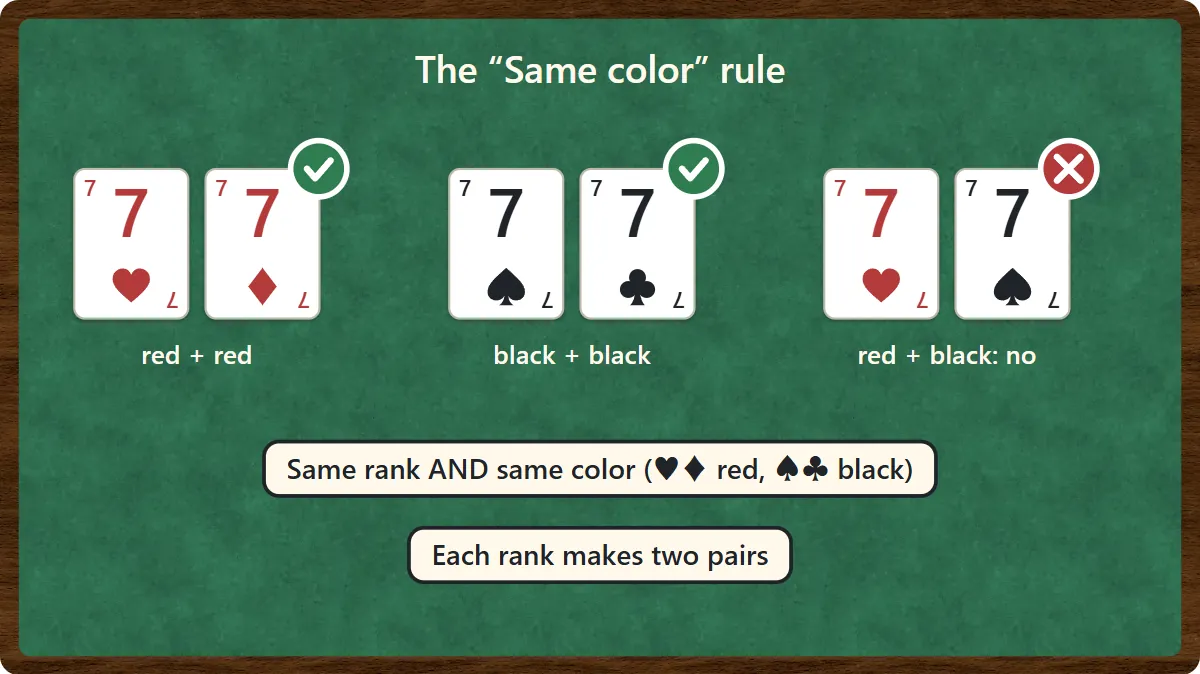
Cards of the same rank count as a pair only when they are also the same color. Hearts and diamonds are red, spades and clubs are black. So the 7 of hearts pairs with the 7 of diamonds, and the 7 of spades pairs with the 7 of clubs, but the 7 of hearts and the 7 of spades do not match. There is twice as much to keep track of, which makes this a good challenge for experienced players.
Four of a kind
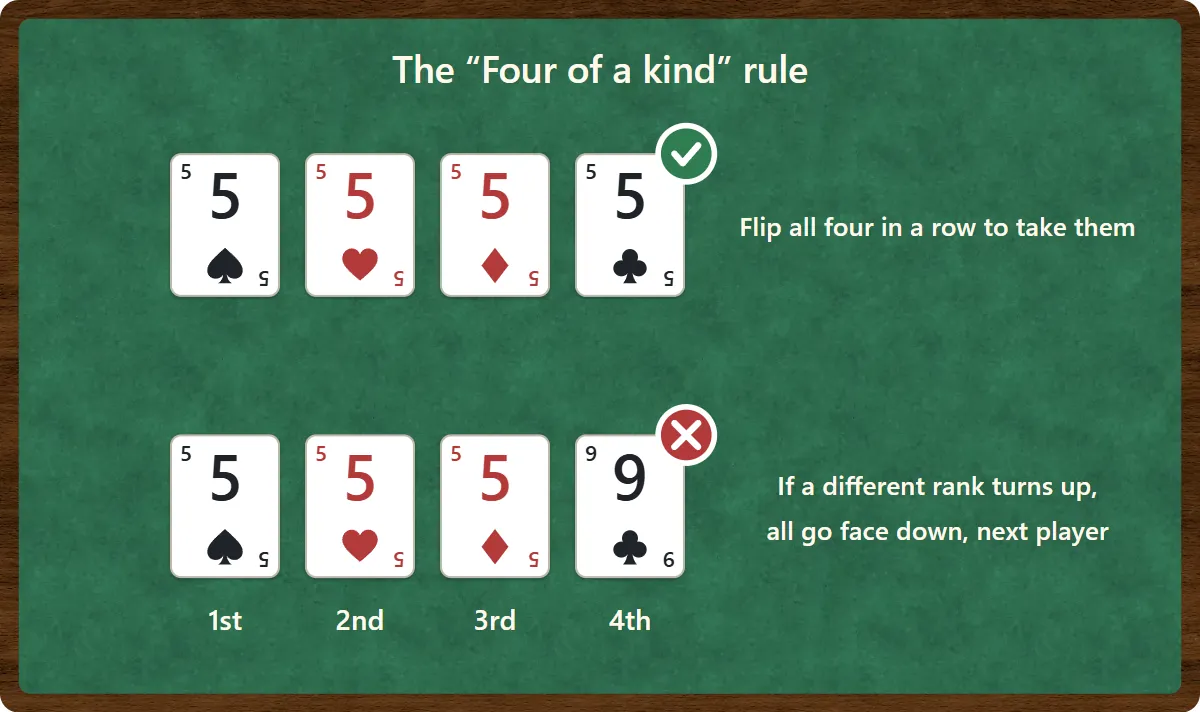
Instead of pairs, you collect all four cards of a rank in one turn. If your second card matches the first, you turn over a third; if that matches too, you turn over a fourth. The moment a different rank appears, every card you turned over this turn goes back face down and the turn passes. You need to know where all four cards are, so this is by far the toughest way to play.
Playing with jokers
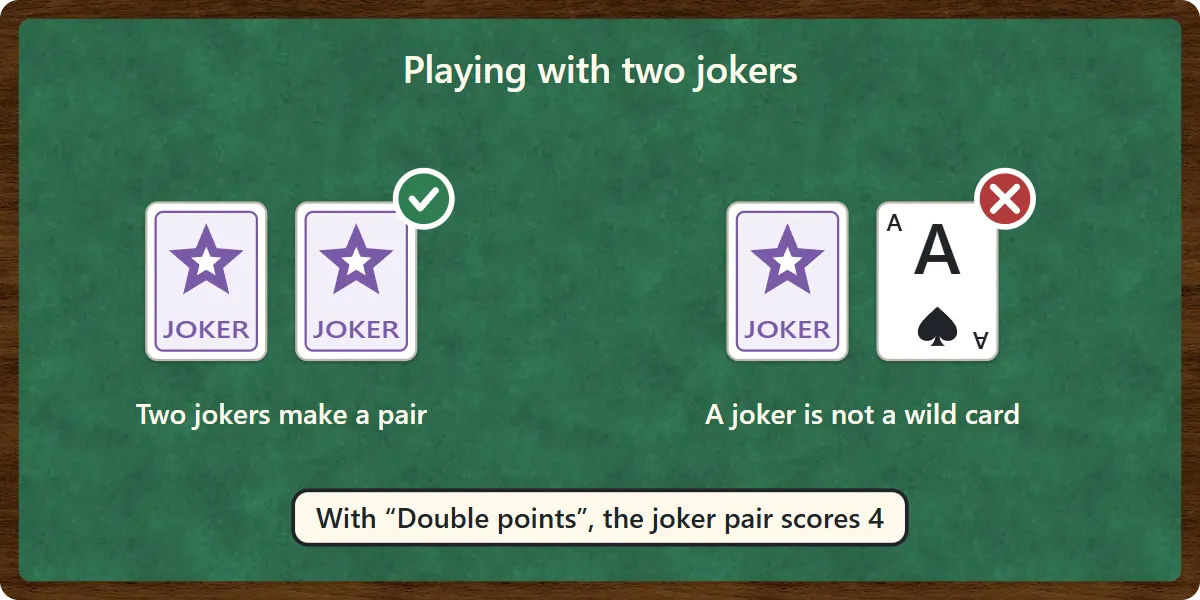
Add two jokers and they form a pair of their own. A joker is not wild: it can’t stand in for any other card. With the double-points option, the joker pair is worth 4 points instead of 2, which can swing a close game right at the end.
Fewer cards for a quicker game
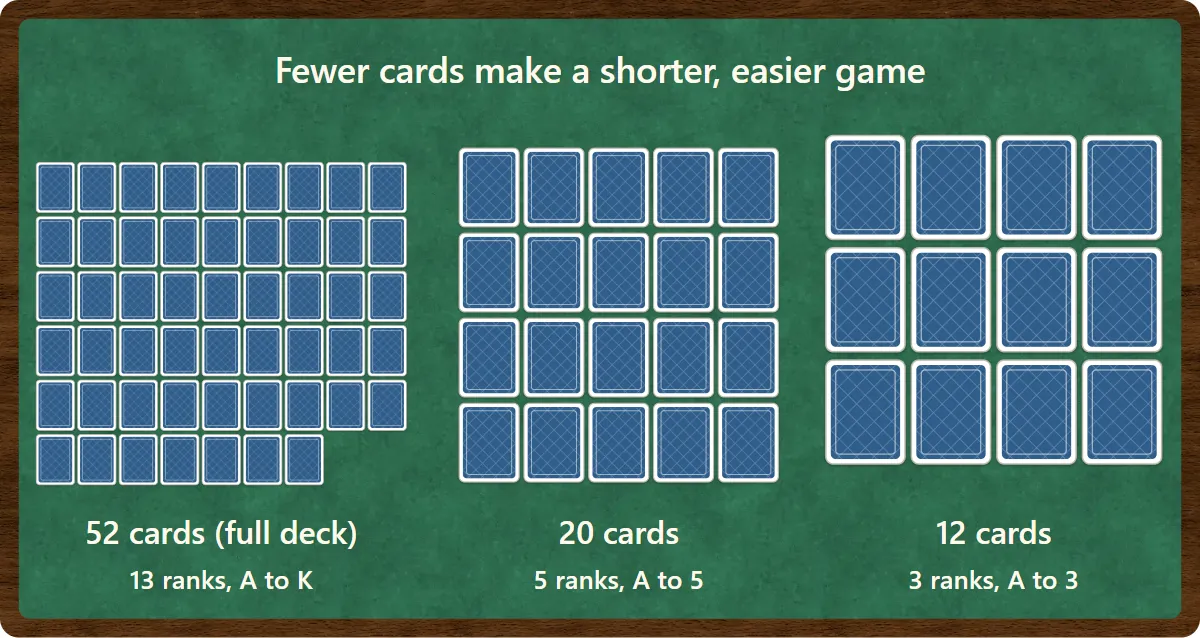
A full deck of 52 cards is a lot to remember, even for adults. For a quick round, or when you are playing with someone new to the game, cut it down to 20 cards (ace to 5) or 12 cards (ace to 3). The cards are drawn bigger and a game lasts only a few minutes. Every deck size still contains all four cards of each rank it uses.
Three ways to play
- Solo – clear the table in as few moves and as little time as you can. Your best result is saved for each deck size and rule set, so you can always try to beat your own record.
- vs Computer – play against one to three computer opponents. The level is simply how good their memory is. An Easy opponent overlooks a lot and forgets quickly. A Hard opponent also remembers the cards you turn over and will pounce on your misses. Even a Hard opponent has limits, though, so a sharp memory can beat it.
- Pass and play – two to four people share one device. Each change of turn is announced in large letters (“Blue’s turn”), so you know when to hand it over.
Concentration strategy: tips to win
1. Remember rough areas, not exact spots
Trying to memorize the exact position of every card quickly overloads anyone. Split the table into a few zones in your head instead – “an 8 somewhere top left”, “the second queen on the right edge”. A rough area narrows your choice down to a handful of cards, which is often all you need.
2. Watch your opponents’ cards just as closely
Don’t switch off when it isn’t your turn. Every miss by another player is free information for you. If an opponent flips a card whose partner you already know, you have a guaranteed pair waiting on your next turn – as long as you remember it.
3. Turn over an unknown card first
When you don’t know the location of any complete pair, start your turn with a card you have never seen. If it turns out to be the partner of a card you remember, you can pick up the pair immediately. Starting with a card you already know usually leaves you guessing on the second card.
4. Think before you flip the second card
If your first card has no known partner, turning over another unseen card shows everyone a new card. Flipping a card whose position is already known instead gives nothing away. This defensive move becomes more and more useful near the end of the game, when there are few cards left and every new card shown is a gift to the next player.
5. Say it in your head
Quietly naming what you see – “seven top right, king in the middle” – helps a surprising amount. Some players make up little rhymes or link a rank to a position. When you play as a family, saying it out loud can be part of the fun.
6. Count down the endgame
Late in the game, think about which ranks have not been taken yet. With few cards left, the odds of finding a partner among the unseen cards go up sharply, and working out what must be left often lets you sweep the last few pairs in a single turn.
Concentration FAQ
Who is this game good for?
Anyone who can recognize the ranks from ace to 5 can play the small deck. Start with 12 or 20 cards and move up to 28 and then 52 as you get comfortable. Setting misses to stay visible for a long time also makes it easier to keep up.
Who goes first?
Here the first player is picked at random and shown in the middle of the table. At a real table, people often just let the youngest player start or toss a coin.
What happens if two players have the same number of cards?
It is a tie, and both players share the same place. With the double-points joker rule, players are ranked by points rather than cards.
What is a good score in the solo game?
With all 52 cards, even a player with perfect recall needs a little over 40 moves on average, because you have to see a card before you can match it. Set a record on the 20-card deck first and work your way up.
I keep turning over the same cards. Any advice?
When a pair is taken, its places stay empty and none of the other cards move. Use those gaps as landmarks – they make it much easier to recall which parts of the table you have already explored.
Can I play with a keyboard?
Yes. Use the arrow keys to choose a card and press Enter or Space to turn it over. While a miss is showing, pressing Enter turns the cards back over at once.
Where Concentration comes from
Matching games like this have been played with ordinary playing cards for a long time, and they are known by many names around the world. In the English-speaking world the name Concentration became especially familiar in the United States, where a long-running television game show of that name had contestants uncover matching prizes on a big board. In Britain the card game is often called Pelmanism, after a popular early-twentieth-century memory training course, and many families simply call it Pairs.
Besides the standard deck, the game is often played with special picture cards, and such matching sets remain a favorite first game in many homes. In Japan the card game is called 神経衰弱 (Shinkei-suijaku), an old-fashioned word meaning something like “nervous exhaustion” – a joking nod to how tiring it is to hold every card in your head. Nobody is quite sure when or why that name caught on. Whatever you call it, the challenge is the same: look carefully, remember, and turn over the right two cards.