 Yorimichi Games
How to play Sevens
Sevens is a card game for three or more players in which everyone works together to build four rows of cards, one row for each suit, starting from the 7s. On your turn you add one card to the end of a row. Whoever gets rid of all their cards first wins. It is easy enough to explain in a minute, yet there is a real game hidden inside it: you decide when to open a row for everyone and when to sit on a card so that other players get stuck.
The game goes by several names in English. In the United States it is usually called Fan Tan (not to be confused with the Chinese gambling game of the same name), in Britain it is often Parliament or Domino, and many people simply know it as Sevens or card dominoes. In Japan it is one of the best-loved family card games, played under the name Shichinarabe, “lining up sevens”. This version follows the popular Japanese rules, which add a pass limit and make holding back a central part of the game, and it lets you switch to the plain international style too.
You play against two to four computer players. Pick the number of players, the computer level and the rules above the table, then press Start.
The table at a glance
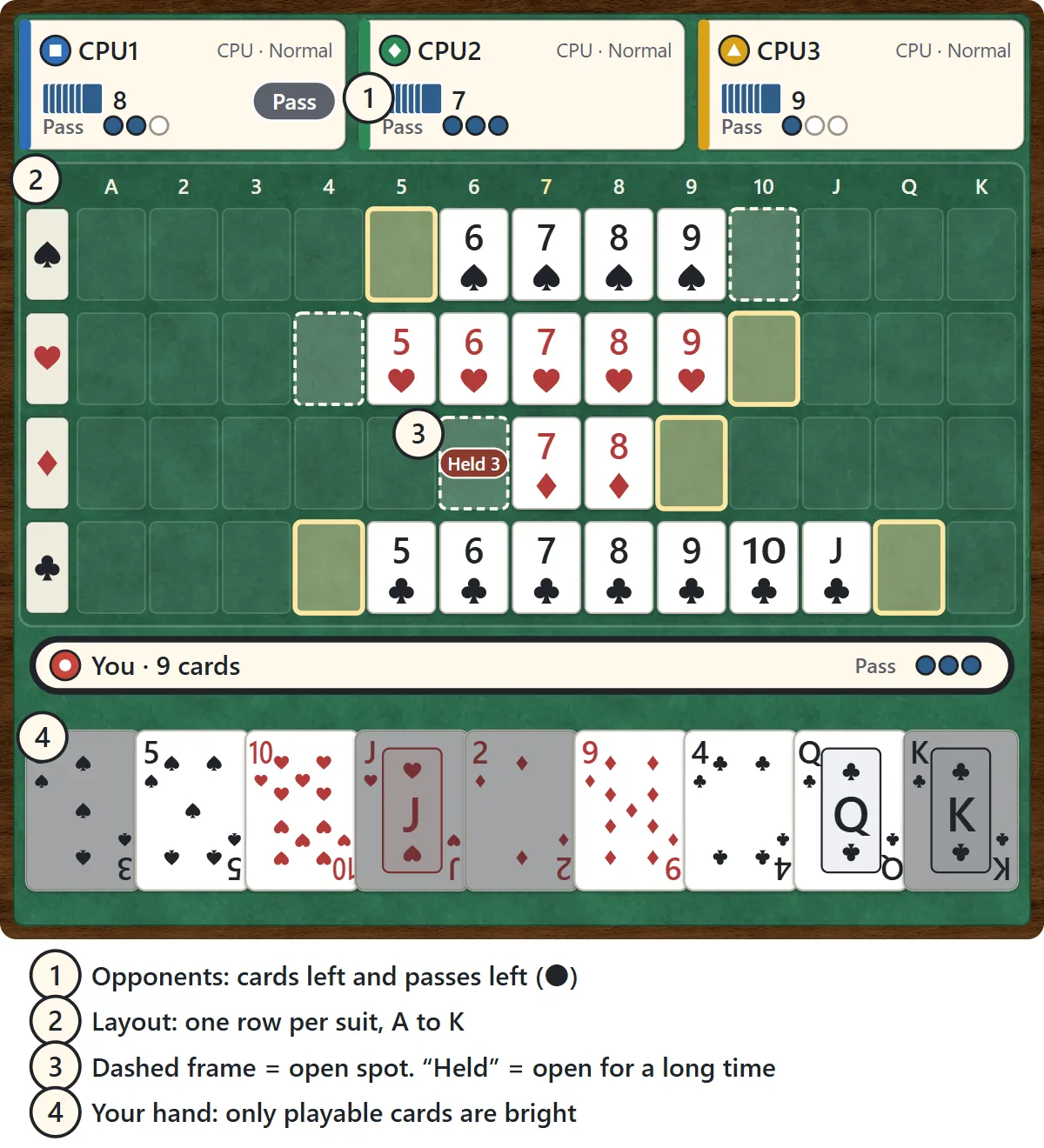
The layout has four rows, ♠, ♥, ♦ and ♣, and each row has thirteen spots from A on the left to K on the right. A dashed frame shows a spot where a card can be played right now; the frames where you can play are brighter. In your hand, only the cards you can play are bright, so you never have to hunt for a legal move. Tap a card to select it and its spot in the layout lights up. Tap the card again, tap the glowing spot, or press Play to put it down.
The deal and the first card
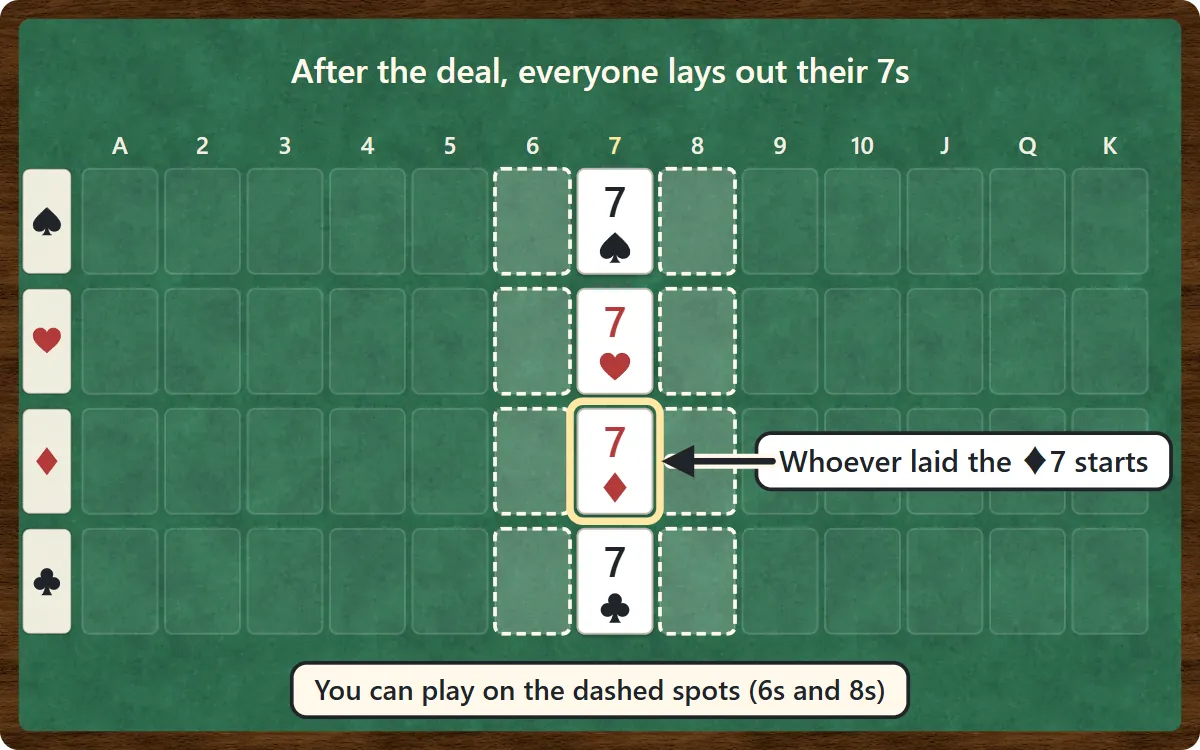
All 52 cards are dealt out, one at a time. If they don’t divide evenly, some players get one card more than others; that is part of the luck. In the Standard rules, everyone who holds a 7 then lays it in the middle of its row, so all four rows already have their 7 before the first turn. The player who laid the 7 of diamonds goes first, and play passes to the left (clockwise). On screen the order is you, CPU1, CPU2 and so on.
Which cards you can play
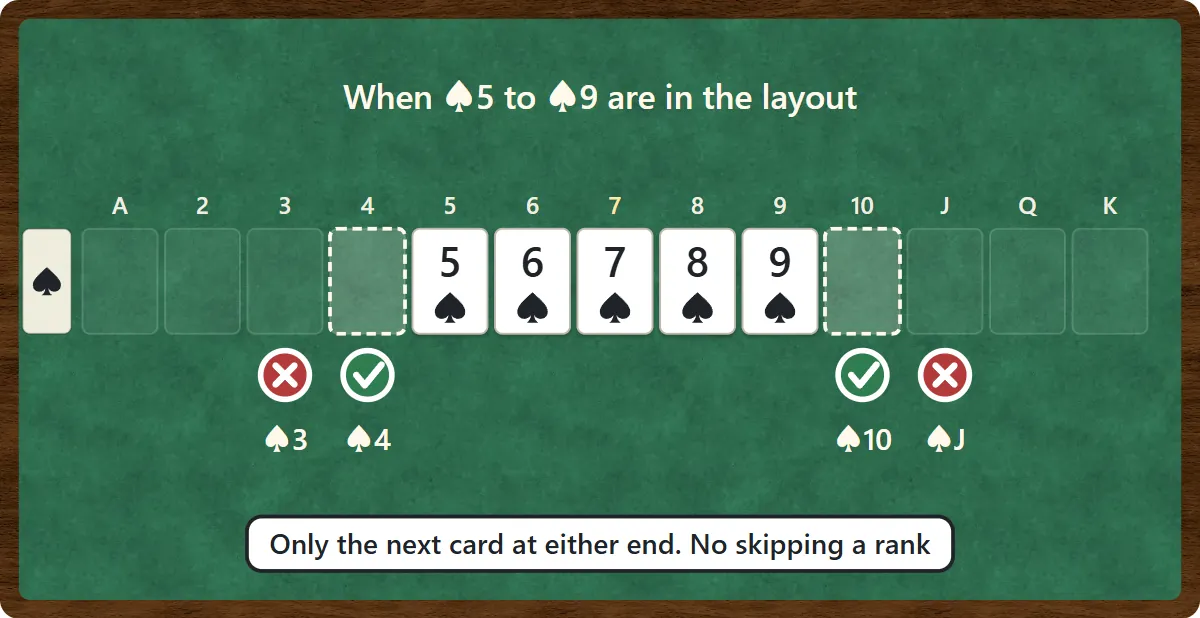
Each row grows outward from its 7 in both directions: 6, 5, 4 down to the A on one side, and 8, 9, 10 up to the K on the other. On your turn you play one card that is the same suit as a row and exactly one rank beyond one of its ends. If ♠5 to ♠9 are down, the only spade cards you can play are the ♠4 and the ♠10. You can’t skip ahead: the ♠3 has to wait until someone plays the ♠4.
Sevens card game rules
Passing: three passes, then you’re out

If you can’t play, you press Pass. In the Standard rules each player may pass three times per game. Once your three passes are used up, you must play whenever you can, and if you have nothing to play you are forced into a fourth pass, which eliminates you from the game.
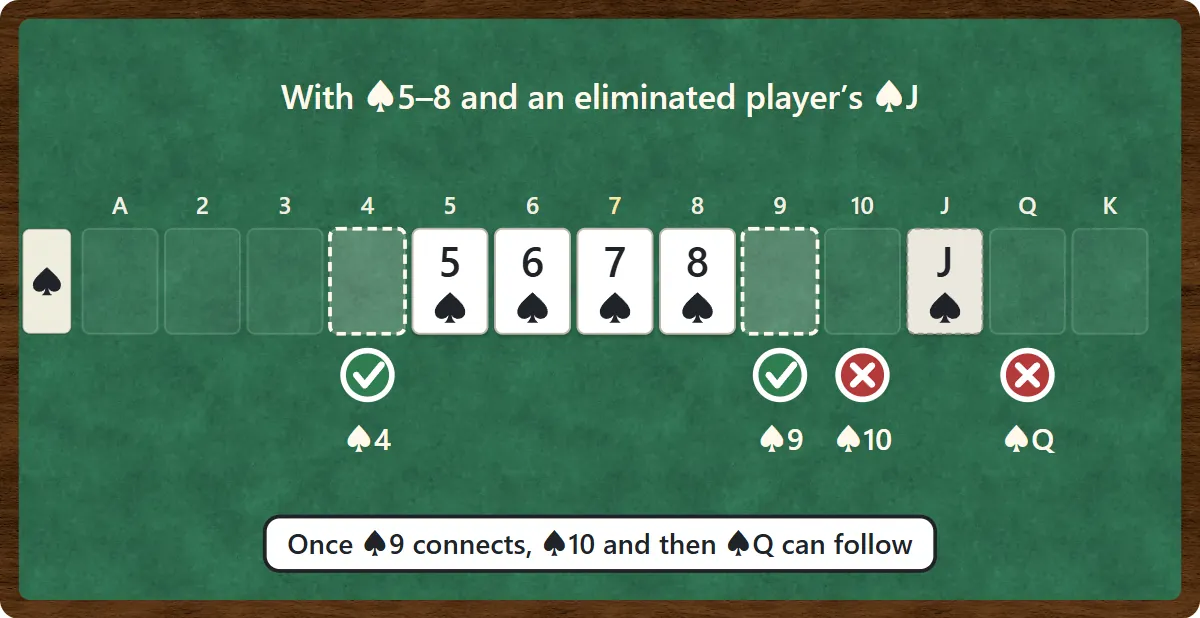
When a player is eliminated, all of their remaining cards are placed face up in their proper spots in the layout, even spots that are not yet connected to a 7. A card placed this way doesn’t open anything by itself: the cards beyond it still can’t be played until the row reaches it from the 7.
Going out and ranking
When you play your last card you go out, and players are ranked in the order they go out: 1st, 2nd and so on. The game ends when only one player is left holding cards. Eliminated players rank below everyone who went out or was left at the end, and the earlier you were eliminated, the lower you rank. If you choose a match of 3 or 5 games, each game awards points by place (with four players: 3 points for 1st, 2 for 2nd, 1 for 3rd, 0 for 4th), and the highest total wins the match.
Holding back: passing on purpose
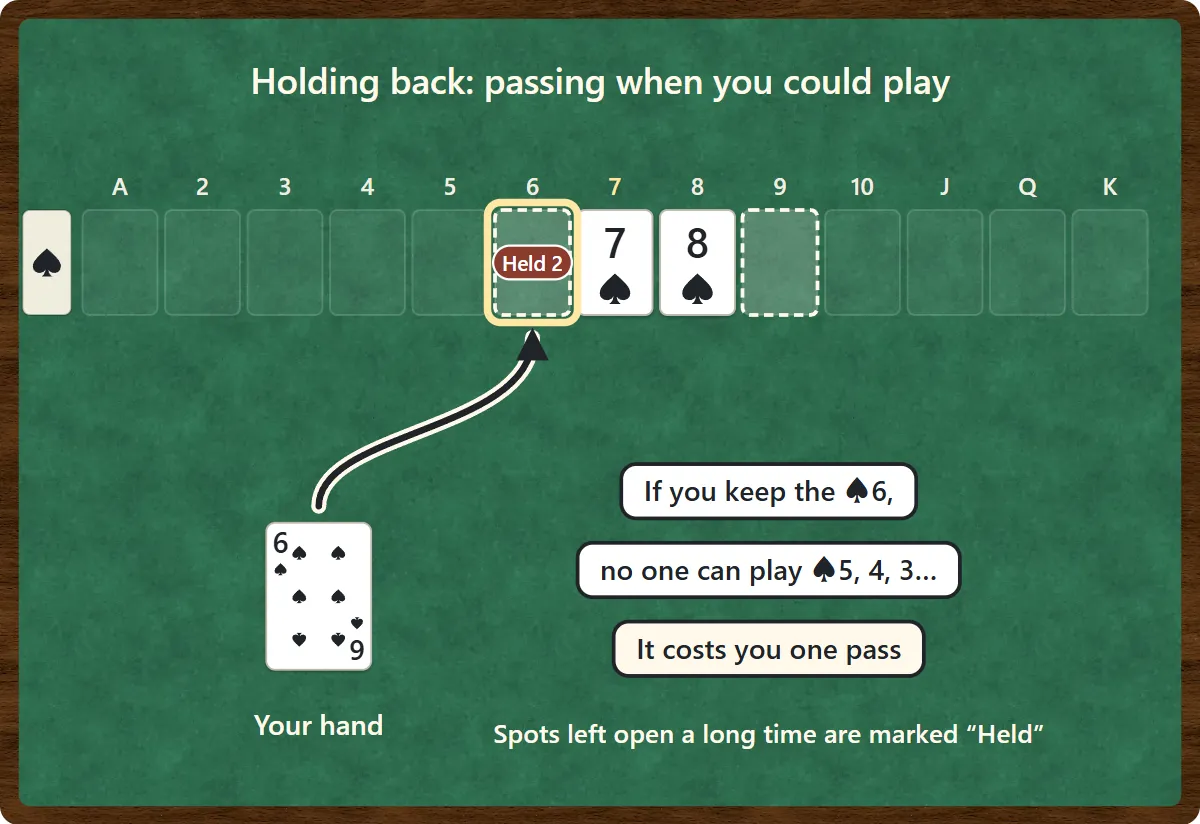
The heart of the Japanese game is that you may pass even when you have a card you could play. Suppose you hold the ♠6 and keep passing: anyone holding the ♠5, ♠4 or lower spades is stuck and has to burn their own passes. Of course, while you hold back your own hand doesn’t get smaller, and every pass you spend is one you can’t use later. On screen, a spot that has stayed open for two or more full rounds shows a Held chip with the number of rounds. You can’t see who is holding the card, but the chip is a good hint that someone is sitting on it.
Playing with a joker
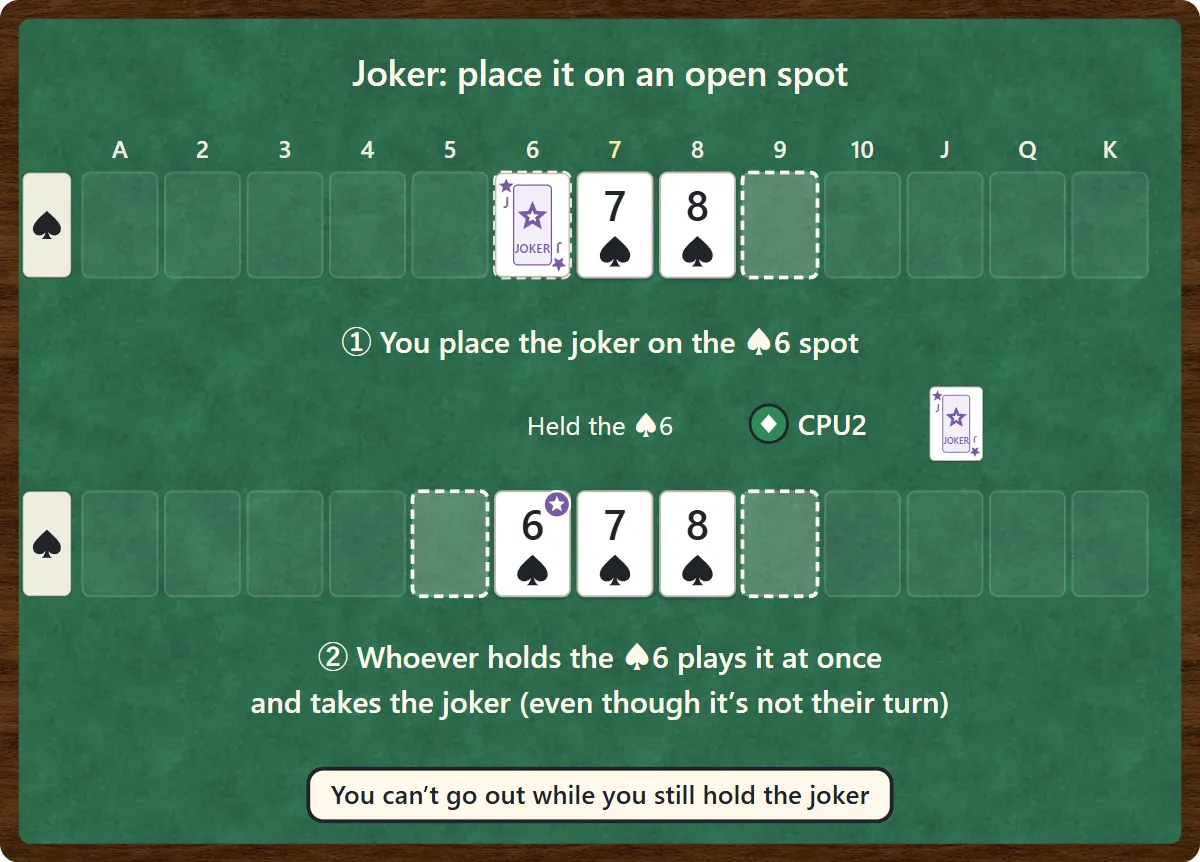
With the joker rules a single joker is added as a 53rd card. On your turn you can place it on any spot where a card could be played. The player who holds the card for that spot must play it immediately, even though it isn’t their turn, and takes the joker into their hand. It is the perfect way to break a block: if you suspect someone is holding back the ♥8, put the joker there and force it out. The player who receives the joker can use it again on their own turn. You can’t go out while you still hold the joker at the end, so don’t keep it too long.
Under Custom you can also choose the “bridge” style, where the joker fills a one-card gap together with the card beyond it (with ♠7 to ♠9 down, you play the joker on the ♠10 spot along with the ♠J), and you can decide whether playing the joker as your last card is allowed.
A and K: the tunnel
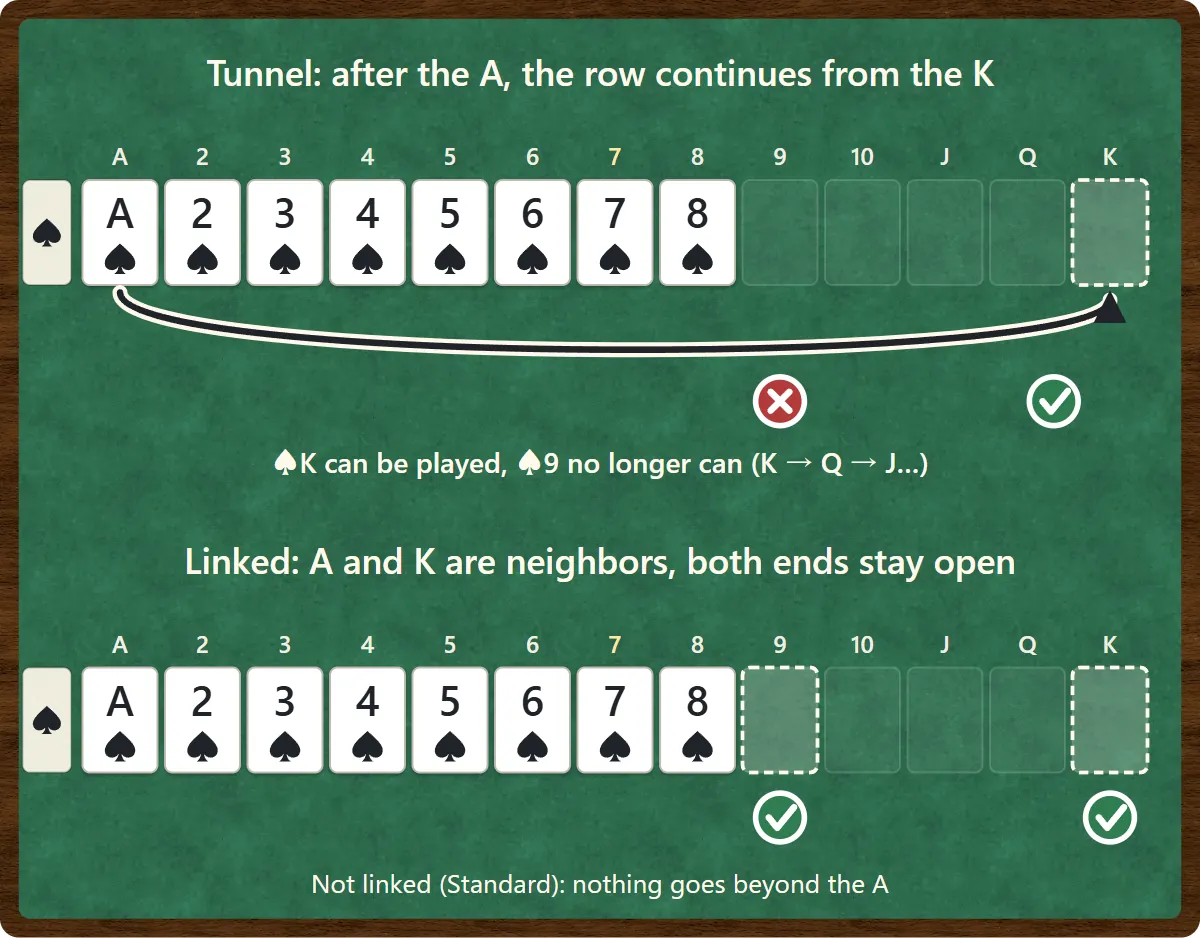
Normally the A and the K are the ends of each row. With the Tunnel rule they count as neighbors: once a row has been built down to the A, the next card can be the K, and the row carries on down through Q, J and so on. The catch is that the other end, beyond the 8, closes at that moment. A player who was blocking the 9 may suddenly find their plan working against them. With the Linked option, A and K are neighbors but both ends of the row stay open.
Rule sets compared
Sevens is played slightly differently from family to family, so the game offers four ready-made combinations. All of them share three passes, holding back, and eliminated cards going into the layout.
| Rule set | Joker | A and K |
|---|---|---|
| Standard | None | Not linked |
| With joker | 1 joker | Not linked |
| Tunnel | None | Tunnel |
| Joker + Tunnel | 1 joker | Tunnel |
Under Custom you can also set the number of passes (1, 2, 3, 5 or no limit), give players one extra pass for each 7 they laid out, remove an eliminated player’s cards face down instead (their rows then stay blocked for the rest of the game), forbid holding back so that you must play whenever you can, and play the 7s in turn instead of laying them out at the start (the first card is then the ♦7).
Sevens, Fan Tan and Parliament: how the Western rules differ
If you learned Sevens in Britain, America or Australia, a few things above may look unfamiliar. The most common English-language rules differ in these ways:
- No pass limit, and you must play if you can. In most Western versions you only pass when you have no legal card, and there is no limit on how many times you pass. Holding back on purpose is not allowed.
- The 7s are played in turn. Nobody lays out their 7s at the start. A 7 is just another card you can play on your turn to open its row. Some groups begin with the player to the dealer’s left, others with whoever holds the ♦7.
- No joker and no tunnel. The joker and the A–K rules are Japanese additions.
- Chips. In the gambling form of Fan Tan, each pass costs a chip paid into a pool, and the winner collects the pool plus a chip for every card left in the other players’ hands.
- The ace. Groups disagree about whether the ace sits below the 2 or above the K. In this game the ace is always the low end, below the 2.
To play the Western way here, choose Custom, set passes to No limit, untick “You may pass even when you can play” and untick “Lay out all 7s before play starts”. Settings are remembered in your browser, so you only need to do this once.
Sevens strategy and tips
1. Open the rows where your own cards follow
If you play the ♠6 and also hold the ♠5, you have set up your own next move. When you have a choice, play the card that leads to more of your own cards. A hand that keeps feeding itself rarely gets forced into passing.
2. Delay cards that only help your opponents
If you hold the ♠6 but none of the spades below it, playing the ♠6 only helps other people. Keep cards like that for later and play something else first whenever you can.
3. Hold back only while you can afford it
Blocking is powerful, but each turn you hold back costs a pass. Once you are down to your last pass, holding back is dangerous: if you can’t play next time, you are eliminated. Release a blocking card before your passes run low.
4. Watch out for a hand full of end cards
Aces, 2s, queens and kings can only be played once a row has grown all the way out to them. If you were dealt many of them, expect to pass a lot and save your passes for turns when you truly have nothing to play.
5. Keep an eye on other players’ passes
The dots on each seat show how many passes that player has left. A player with no passes left must play whenever they can, so they can’t block you. On the other hand, blocking a row that such a player badly needs can push them into elimination.
6. Read the Held chips
A spot that stays open round after round is probably being held back by someone. If you have many cards waiting beyond it, play from other rows and save your passes. If you have the joker, placing it on that spot breaks the block.
Sevens FAQ
How many times can I pass?
Three times per game with the Standard rules, which is the most common Japanese limit. The fourth pass eliminates you. Under Custom you can choose 1, 2, 3 or 5 passes, or no limit at all.
Can I pass when I have a card I could play?
In the Japanese rules, yes. It is called holding back, and it is where most of the tactics come from. If you prefer the Western rule that you must always play when you can, untick the holding-back option under Custom.
What happens to an eliminated player’s cards?
With the Standard rules they are placed in their own spots in the layout, which can suddenly unblock a row. If you choose to remove them face down, those cards never appear and the rows they belong to stay stuck.
Is Sevens the same game as Fan Tan?
As a card game, yes: Fan Tan, Parliament, Domino and Sevens are names for the same idea of building suits out from the 7s. The name Fan Tan is also used for an unrelated Chinese gambling game played with beans or coins, which is why many people add “card game” when they search for it.
Which computer level should I choose?
Easy plays whatever it can as soon as it can and never holds back, so it is a relaxed first game. Normal thinks about which rows help it and which only help others, and sometimes blocks. Hard looks ahead at how the game is likely to go and holds back at the moments that hurt most. The deal matters a lot in Sevens, so you can win or lose at any level.
Can I stop and continue later?
Yes. If you close the page in the middle of a game, press Continue the next time you open it on the same device and browser. Sound is off at first; press “Sound: off” to turn on the card sounds.
Where does Sevens come from?
Building sequences outward from a middle card is an old idea, and Sevens has long been played both as a family game and as a gambling game with a pool of chips. In English it kept several names side by side: Fan Tan in America, Parliament and Domino in Britain, and Sevens nearly everywhere. The name Domino comes from the way the rows grow card by card from the middle, much like a line of dominoes.
In Japan the game became a family favorite and grew its own set of house rules. Laying out all the 7s before play, the three-pass limit, eliminating a player who runs out of passes, the joker that forces a card out of someone’s hand, and the tunnel between A and K are all Japanese developments. Together they turn a simple game of patience into one of bluffing and timing, which is the version this page is built around.