 Yorimichi Games
How to play Seven Bridge
Seven Bridge is a rummy-style card game that has been popular in Japan for decades. Everyone starts with seven cards. You draw, you discard, and whenever you hold a group of matching cards you lay it on the table as a meld. The first player to get rid of every card “goes out”, and everyone else scores penalty points for the cards still in their hand. As the name suggests, the 7 is special: a single 7 counts as a meld on its own.
What makes Seven Bridge different from Western rummy is that you can grab a card someone else has just thrown away by calling “pon” or “chi”, two words borrowed from mahjong. You do not need to know mahjong to play; if you know the ranks and suits of a standard deck, you are ready. In this online version you play against one, two or three computer opponents.
Reading the table
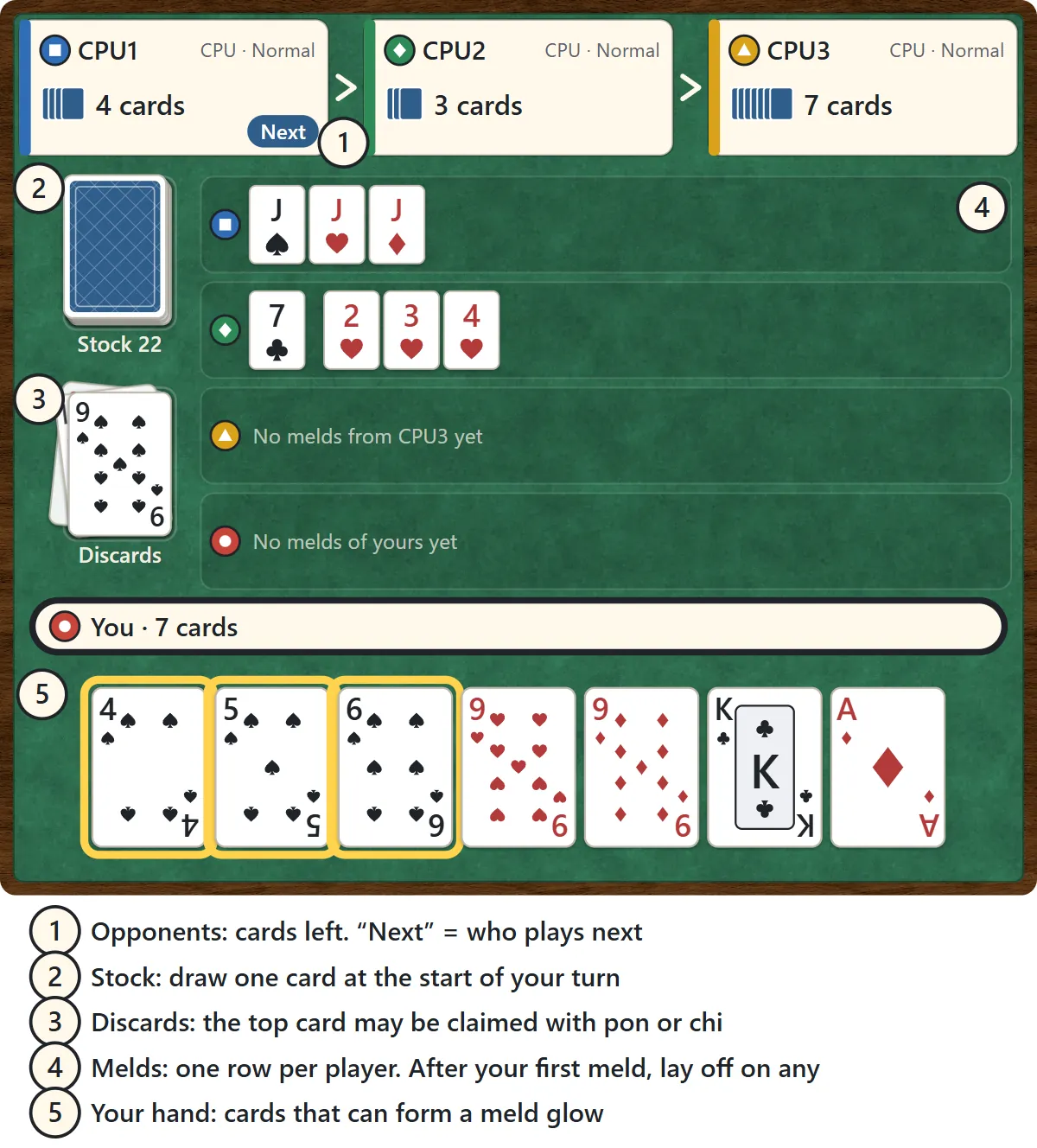
Each player is dealt seven cards and the rest form the stock. Play starts with the player to the dealer’s left and moves clockwise. Every meld on the table sits in its owner’s row, so you can always see who has put down what.
Seven Bridge melds: sets, runs and the lone 7
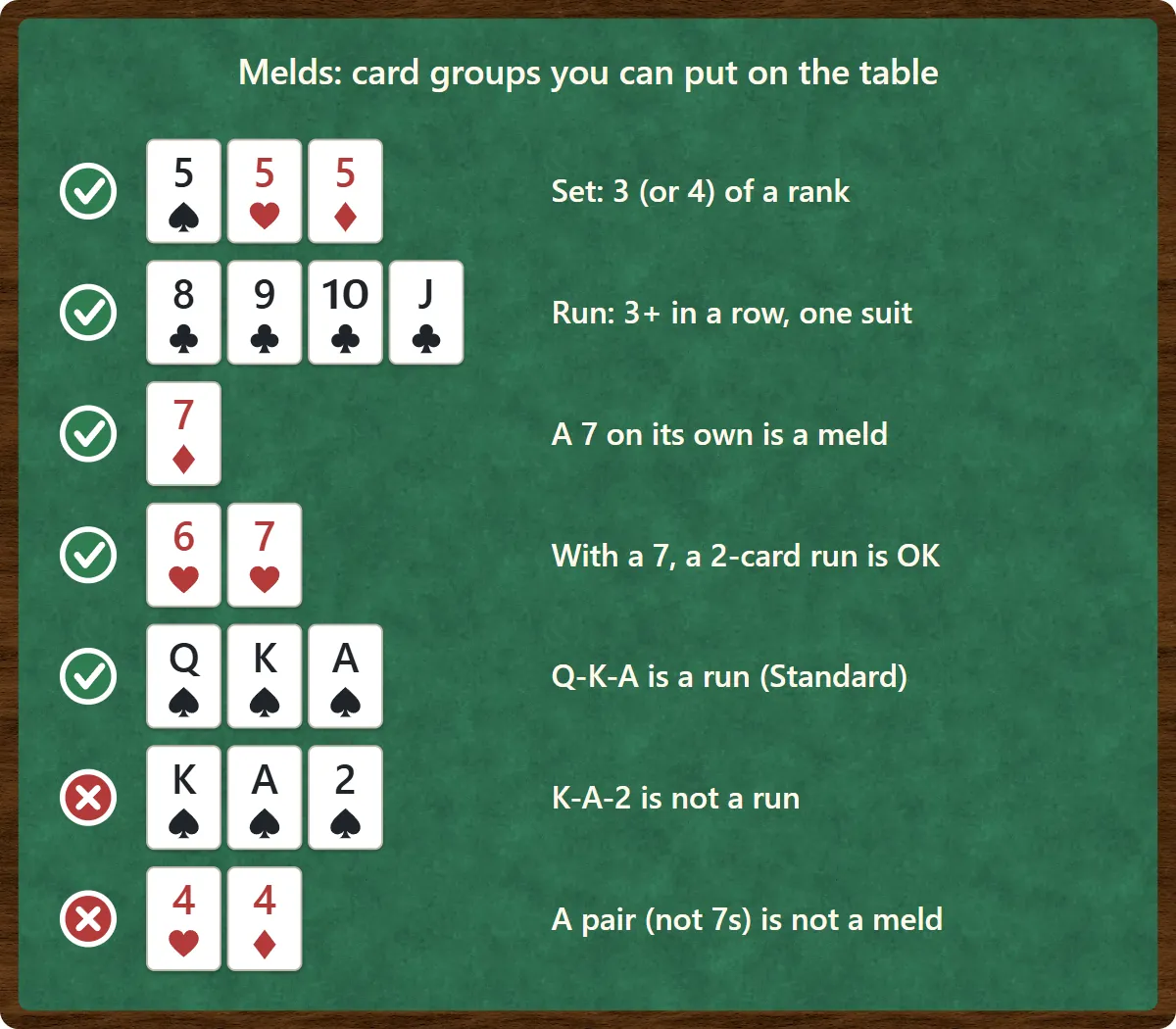
- Set: three or four cards of the same rank, such as 5♠ 5♥ 5♦.
- Run: three or more cards in sequence in the same suit, such as 8♣ 9♣ 10♣ J♣. The ace can sit next to the 2 or next to the king, but a run cannot wrap around the corner (K-A-2 is not allowed).
- The special 7: a 7 can be melded all by itself. Any run that contains a 7 needs only two cards, so 6♥ 7♥ or 7♥ 8♥ is fine.
What to do on your turn
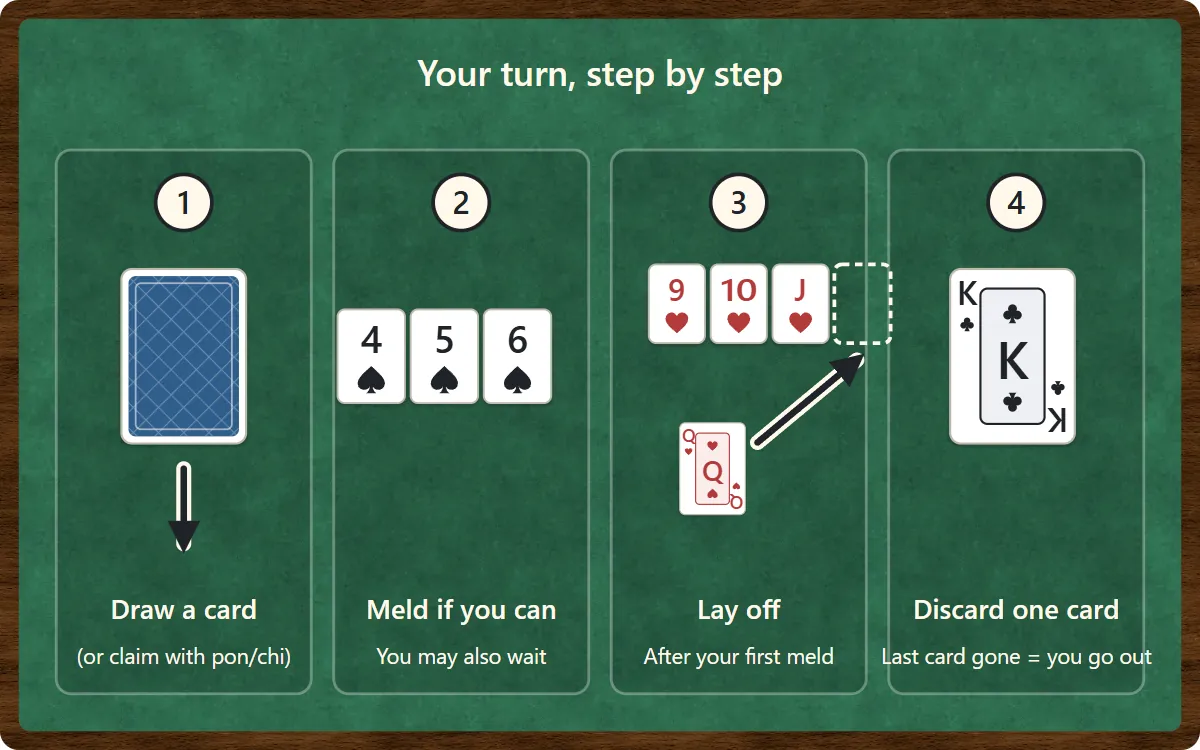
Start your turn by drawing one card from the stock. If you have a meld in your hand, you may put it down, although you are allowed to keep it for later. Next you may lay off cards on melds that are already on the table. Finally you discard one card to end your turn. You always discard exactly one card, and you go out at the moment you discard your last card.
Laying off
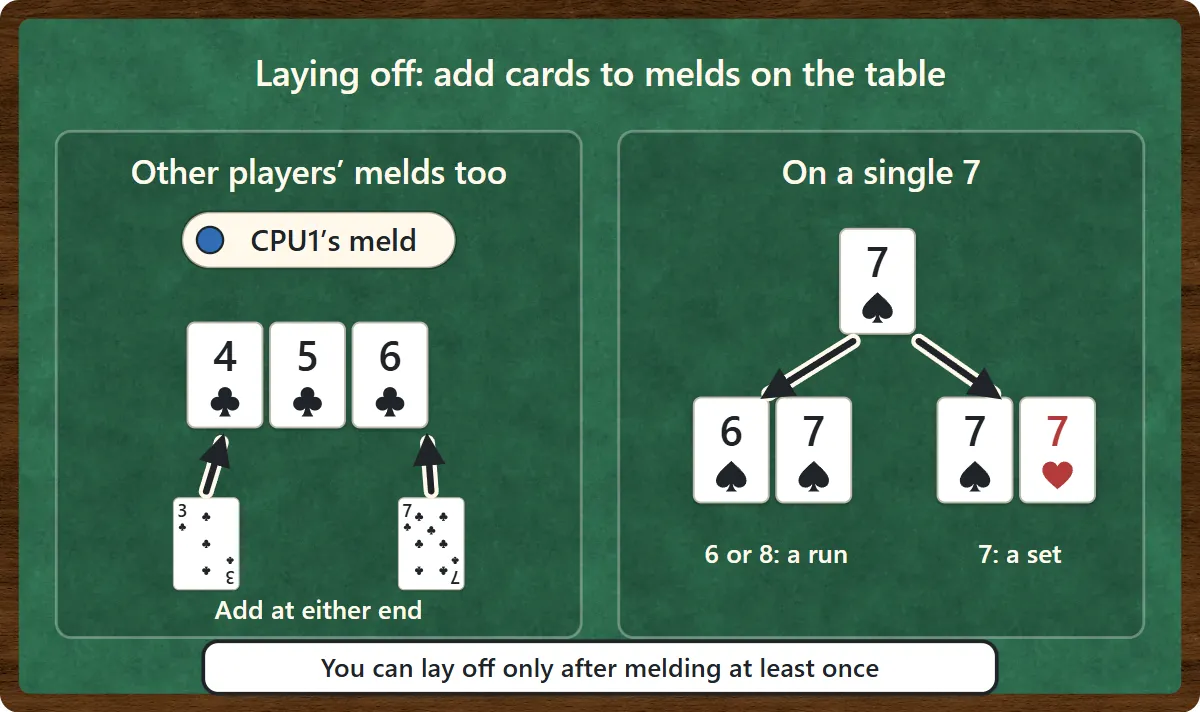
Laying off means adding single cards from your hand to a meld on the table. Add a matching rank to a set, or the next card at either end of a run. You can lay off on other players’ melds too, but only once you have put down a meld of your own. A lone 7 turns into a run if you add the 6 or 8 of the same suit, or into a set if you add another 7.
Pon and chi: claiming a discard
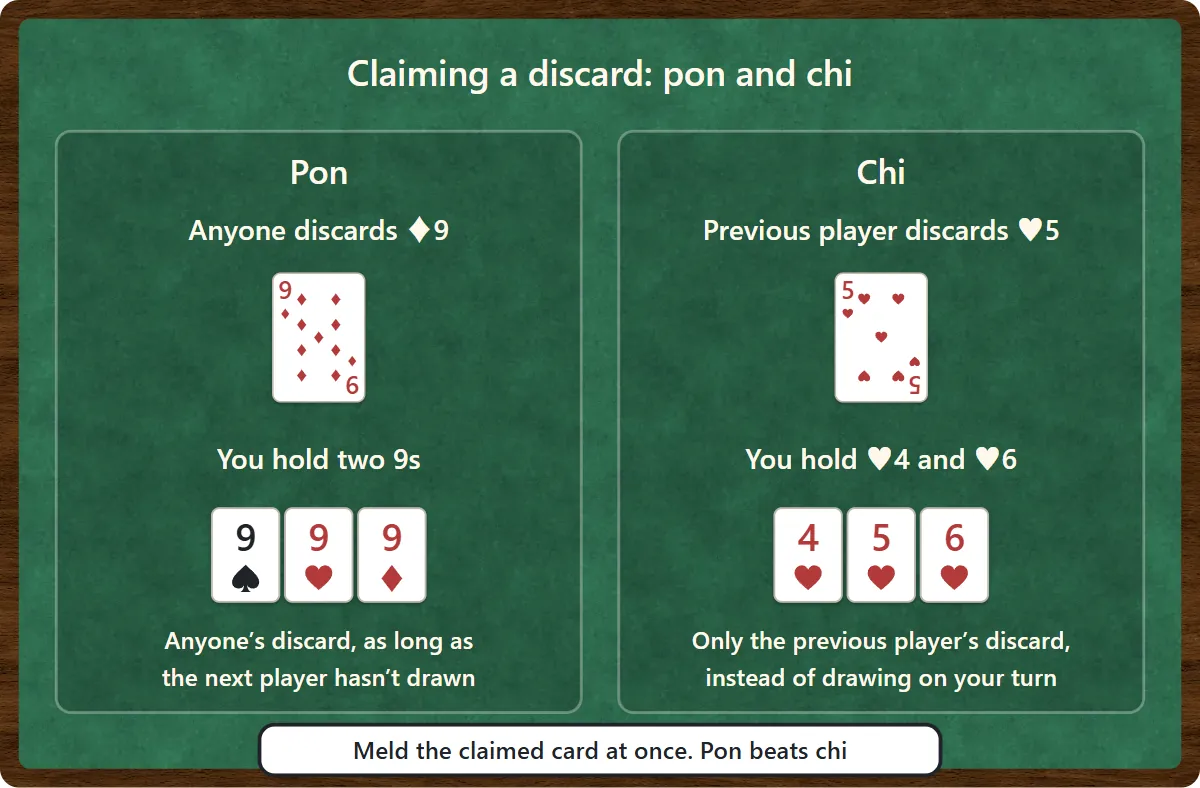
- Pon: if anyone discards a card and you hold two more of that rank, call “pon”, take it and meld the three cards. You can do this even when it is not your turn, as long as the next player has not drawn yet. Play then jumps to you, and anyone in between loses their turn.
- Chi: if the player just before you discards a card that completes a run with cards in your hand, you can take it instead of drawing at the start of your turn.
After a pon or chi you continue as on a normal turn: meld or lay off if you like, then discard one card. Nobody may claim a card during the first round, before they have had their first turn. If a pon and a chi are possible on the same card, the pon wins. In this game the Pon button waits for you, with no time limit.
Going out and Seven Bridge scoring

When someone goes out, every other player adds up the cards left in hand as penalty points. Aces and face cards count 10 and the other cards count their number. Each 7 still in your hand doubles your penalty. If a player goes out in one turn without having melded anything before, which many rummy players call going rummy, everyone else’s penalty is doubled. You play several games and the lowest total penalty wins the match.
Playing with a joker
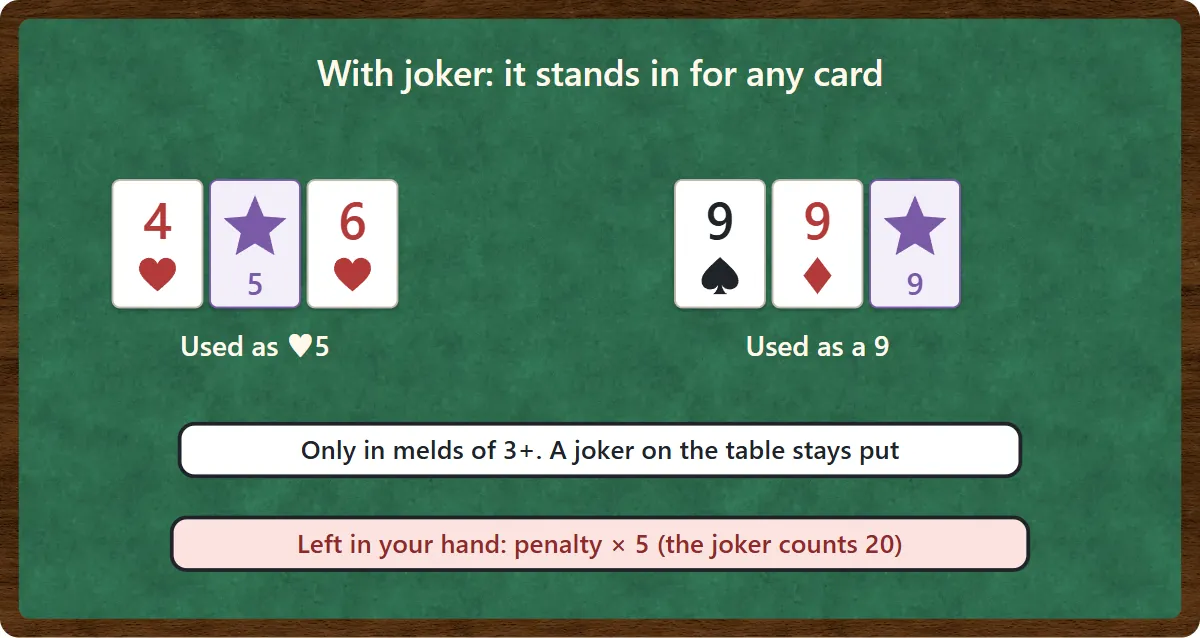
With the With joker rules, one joker is added to the deck. It can stand in for any card inside a meld of three or more cards. Once a joker is on the table it cannot be swapped out. If you are caught with it when someone else goes out, the joker counts 20 points and your whole penalty is multiplied by 5.
Seven Bridge rules and variations
Seven Bridge has no single official rulebook, and the scoring for aces, 7s and jokers changes from family to family. This game offers four common rule sets plus a custom option.
| Rule set | What changes |
|---|---|
| Standard | No joker. Q-K-A is a run. An ace left in hand counts 10. Each 7 left in hand doubles your penalty. Going out all at once doubles everyone else’s penalty. |
| With joker | Standard plus one joker. A joker left in hand counts 20 and multiplies your penalty by 5. |
| Simple | Like Standard, but 7s count just 7 points and there is no bonus for going out at once. |
| Ace low | The ace only goes below the 2 and counts 1 point. No Q-K-A. A 7 left in hand counts 20. |
In Custom you can also make an ace worth 15, give the player who goes out all at once −50 instead of doubling the others, let players go out without a final discard, or allow pon and chi from the very first round. Pick whatever matches the way you play at home.
Seven Bridge strategy tips
1. Put your 7s down right away
A 7 can be melded on its own, and a 7 stuck in your hand doubles your penalty. Meld it as soon as you can. Once it is on the table, it also becomes a place to lay off 6s, 8s and other 7s.
2. Get rid of high cards first
Aces and face cards cost 10 points each. If one of them is unlikely to become part of a meld, discard it early so that your penalty stays small if an opponent goes out before you.
3. Make your first meld quickly
You cannot lay off until you have melded once. As soon as your first meld is down, every meld on the table becomes a place to unload cards, and your hand can shrink very fast.
4. Use pon and chi
A pon or chi removes three cards from your hand in a single turn: two go into the meld and one is discarded. When the card you need is thrown away, grab it.
5. Watch what your opponents collect
If an opponent seems to be collecting a rank or a run, do not feed them that card. The next player can also chi your discard, so remember which suits they have melded or picked up.
6. Hurry when someone is close to going out
When an opponent is down to one or two cards, they may go out on their next turn. Meld whatever you can and throw away high cards first to limit the damage.
Seven Bridge FAQ
Is Seven Bridge related to contract bridge?
No. Contract bridge is a trick-taking game for four players in two partnerships and has nothing in common with Seven Bridge. Seven Bridge belongs to the rummy family: you collect matching cards and lay them down.
Do I have to discard a card when I go out?
In most versions, yes. You go out by discarding your last card, so you cannot empty your hand just by melding and laying off. In Custom you can turn this off.
Can I pon when it is not my turn?
Yes. Whoever discarded the card, if you hold two of the same rank you can pon before the next player draws, and play continues from you. Chi is only possible on the discard of the player right before you, at the start of your own turn.
Can I lay off on another player’s meld?
Yes, as long as you have melded at least once yourself. Adding to someone else’s meld gives them no advantage, so use every chance to shrink your hand.
Which CPU level should I choose?
Easy is a relaxed opponent that only claims discards on its own turn. Normal makes good use of pon, chi and laying off. Hard watches the cards on the table closely and keeps the cards that are most likely to connect. The deal plays a big part, so you can still beat the Hard computer.
Can I stop and continue later?
Yes. If you close the page in the middle of a match, press Continue the next time you open it. The save is kept only in this browser on this device.
What is Seven Bridge?
Seven Bridge (セブンブリッジ, sebun burijji) is a card game that spread in Japan as part of the worldwide rummy family. Because it uses the mahjong words pon and chi, it is often described as a cousin of mahjong, and some people call it “mahjong bridge” or “seven rummy”. It has long appeared in the rule leaflets that come with playing cards in Japan, and the way aces, 7s and the joker are scored still varies a lot from one household to the next.