 Yorimichi Games
How to play the War card game
War is about as simple as a card game gets, and that is exactly why so many people learn it first. Two players split a deck, turn over their top cards at the same moment, and the higher card takes both. When the two cards match, there is a “war”: extra cards go down and the winner of the war scoops up the whole pile. Keep going until one player has every card.
Nobody makes any decisions in War, so a five-year-old who has just learned the card ranks can play an adult on completely even terms. It is a gentle way to practice comparing numbers and handling cards, and it is surprisingly tense when a long war swings a dozen cards the other way. On this page you can play War against the computer, or play with a friend on one phone, tablet or computer.
Setting up: deal the deck in half
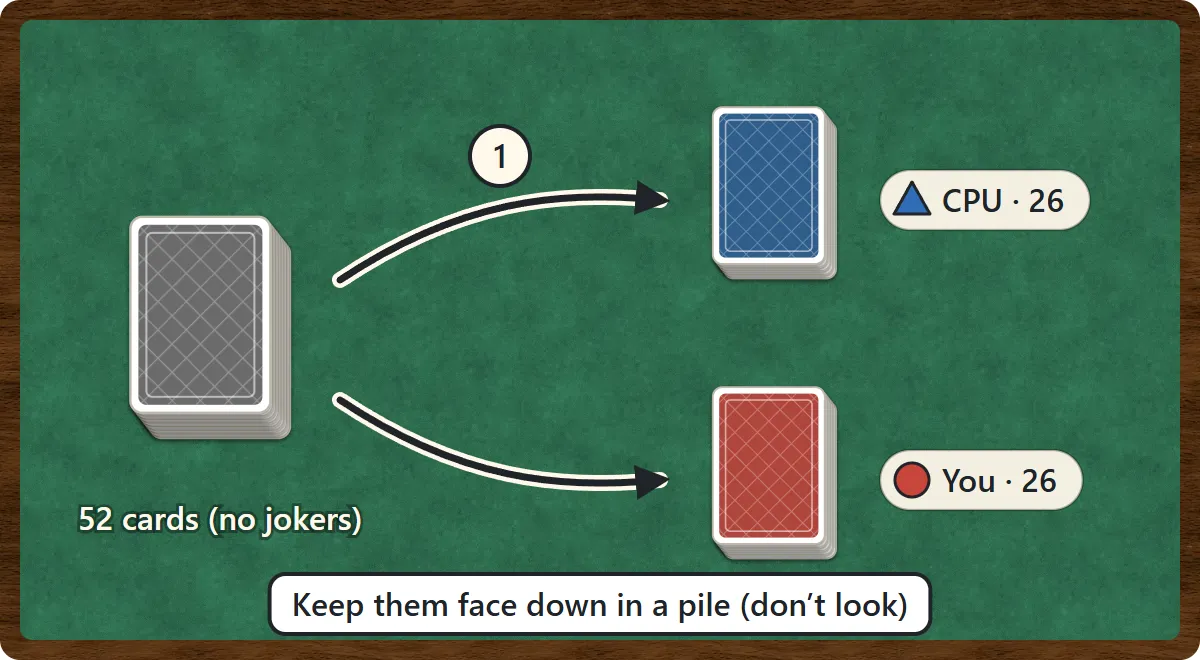
Take out the jokers, shuffle the 52 cards and deal them one at a time until each player has 26. Neither player looks at their cards. Square them up into a face-down pile in front of you; this is your stock, and you will only ever play from the top of it.
War card game rules: flip, compare, take
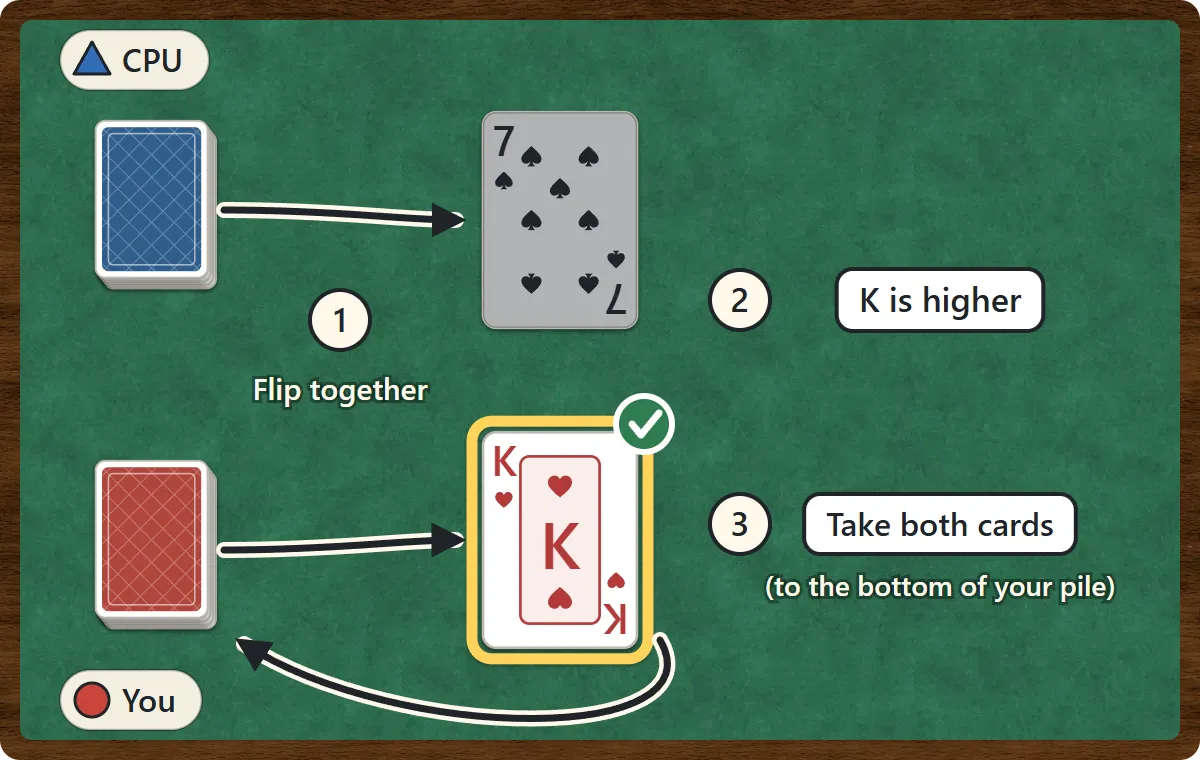
Both players turn their top card face up at the same time. Many families count “one, two, three” or say “ready, go” so that nobody peeks first. Whoever turned the higher card wins that battle: they take both cards and slide them face down under their own pile. Then you flip again, and again.
In this game, tap your pile (or press the Flip button or the space bar) and you and the computer flip together. In two-player mode each person taps their own pile. The first card to be tapped waits face down in the middle until the other player taps, and then both cards turn over at once, so nobody gets to react to the other card.
Card ranks: is the ace high in War?
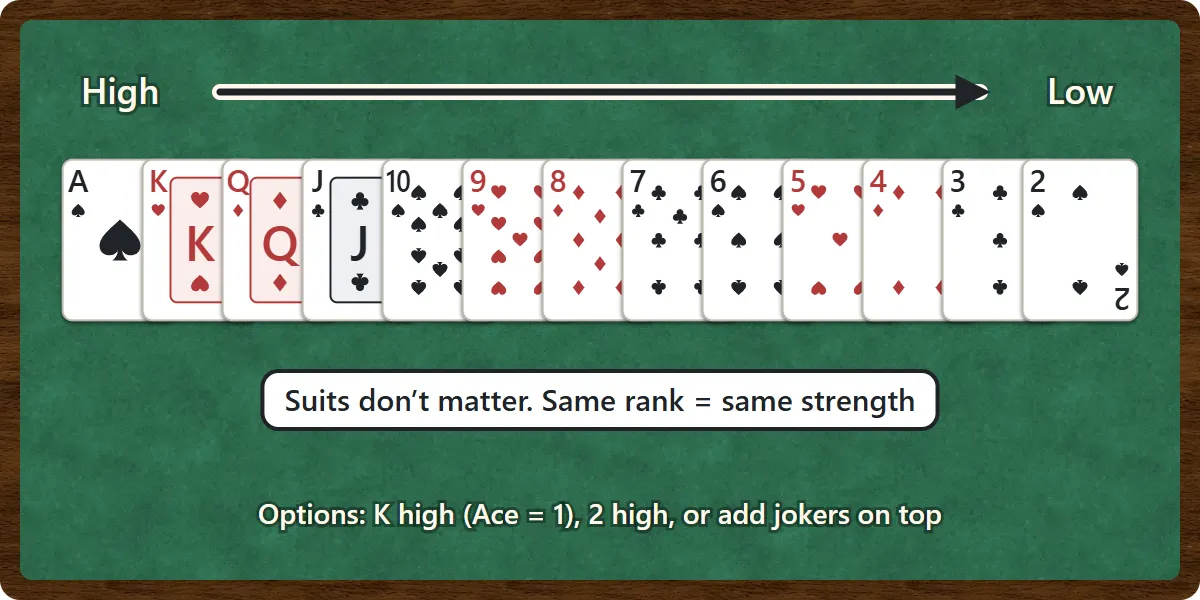
Yes. In the usual rules the ace is the highest card, followed by king, queen, jack, 10 and so on down to 2, the lowest. Suits are ignored completely. Some households treat the ace as a one (so the king is highest), and some use the order from climbing games where the 2 is the top card. You can pick any of these under More rules.
What happens in a war?
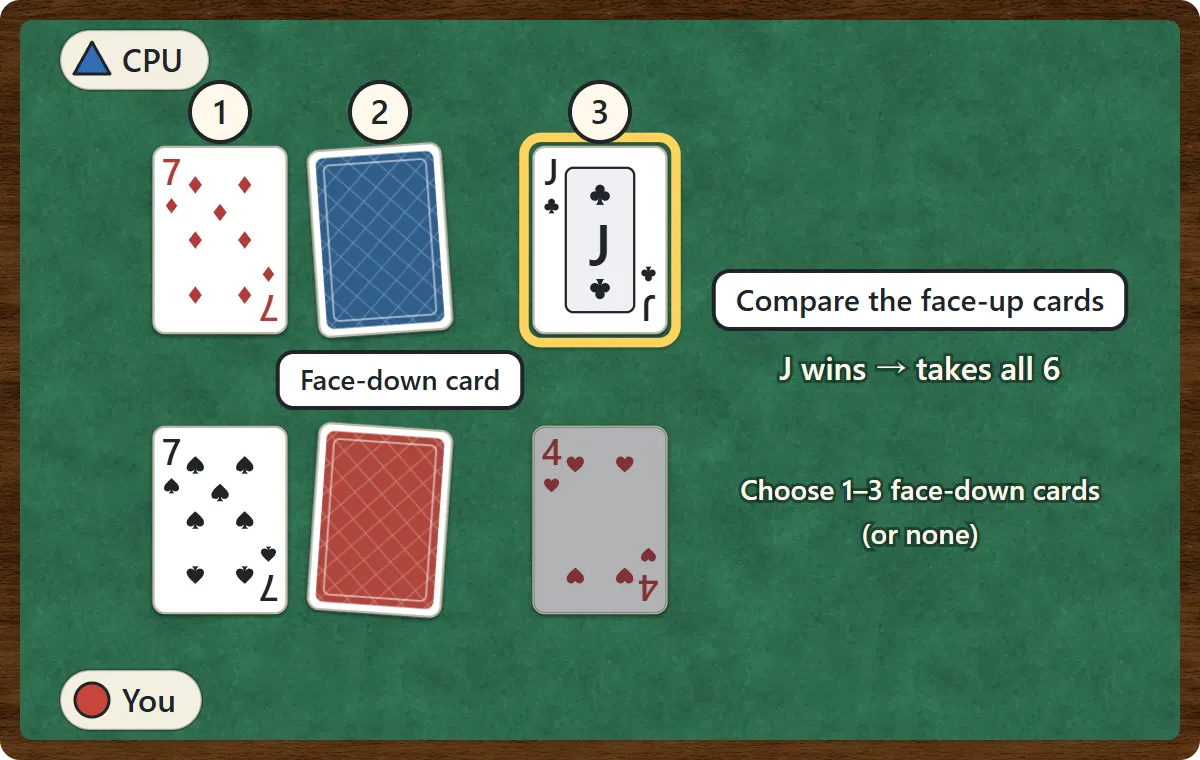
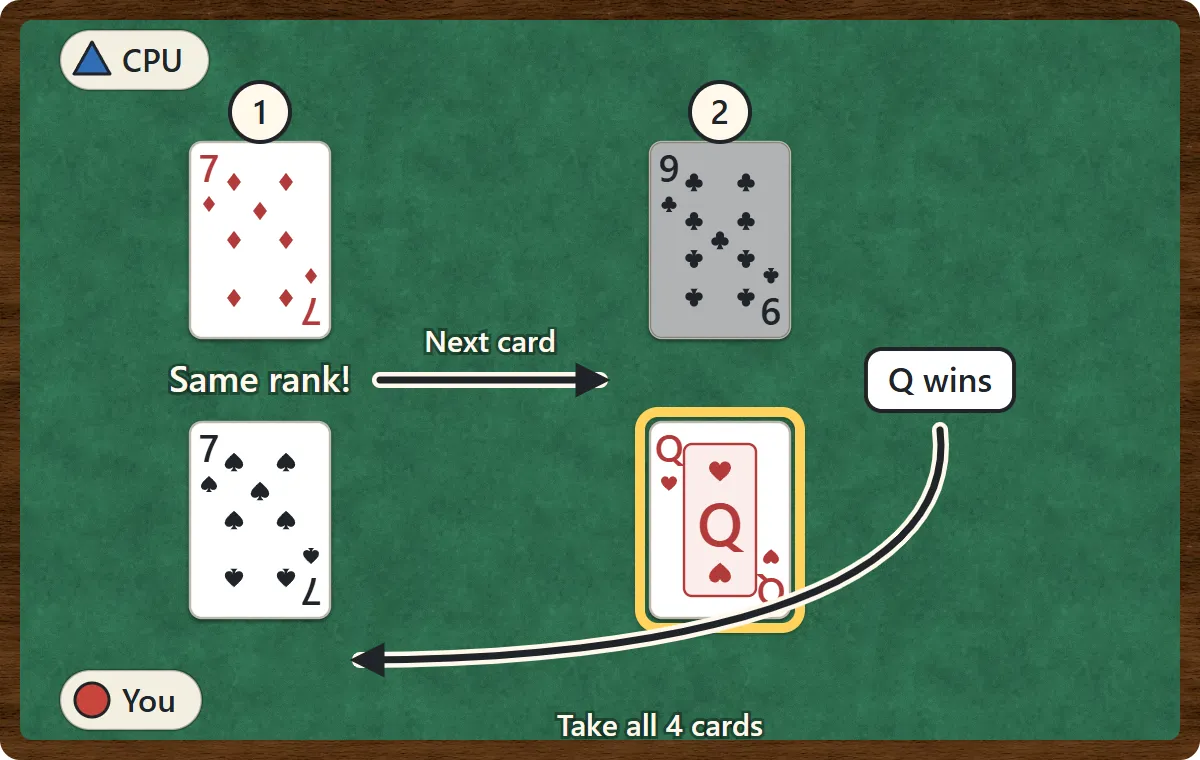
When both cards have the same rank, the cards stay on the table and a war begins. In the classic version each player places one card face down and then turns the next card face up. The higher of those new cards wins everything on the table, including the tied cards and the face-down cards. If the new cards tie as well, you go again: another face-down card, another face-up card, until someone wins.
Plenty of people play with three face-down cards instead of one, sometimes spelling out “W-A-R” as they lay them down. Others skip the face-down cards and simply flip the next card to break the tie, which is how the game is usually taught in Japan. This game lets you choose none, one, two or three face-down cards.
Running out of cards during a war
Most written rules don’t say what happens if a player runs out of cards in the middle of a war, so families disagree. Two answers are common. In the first, your last card is turned face up and fights for you for the rest of the war; if you have no cards at all, the card you already played stays in. In the second, a player who can’t finish the war simply loses the game. The first option is the default here, and you can switch to the second under More rules.
How to win: all the cards, or the most cards
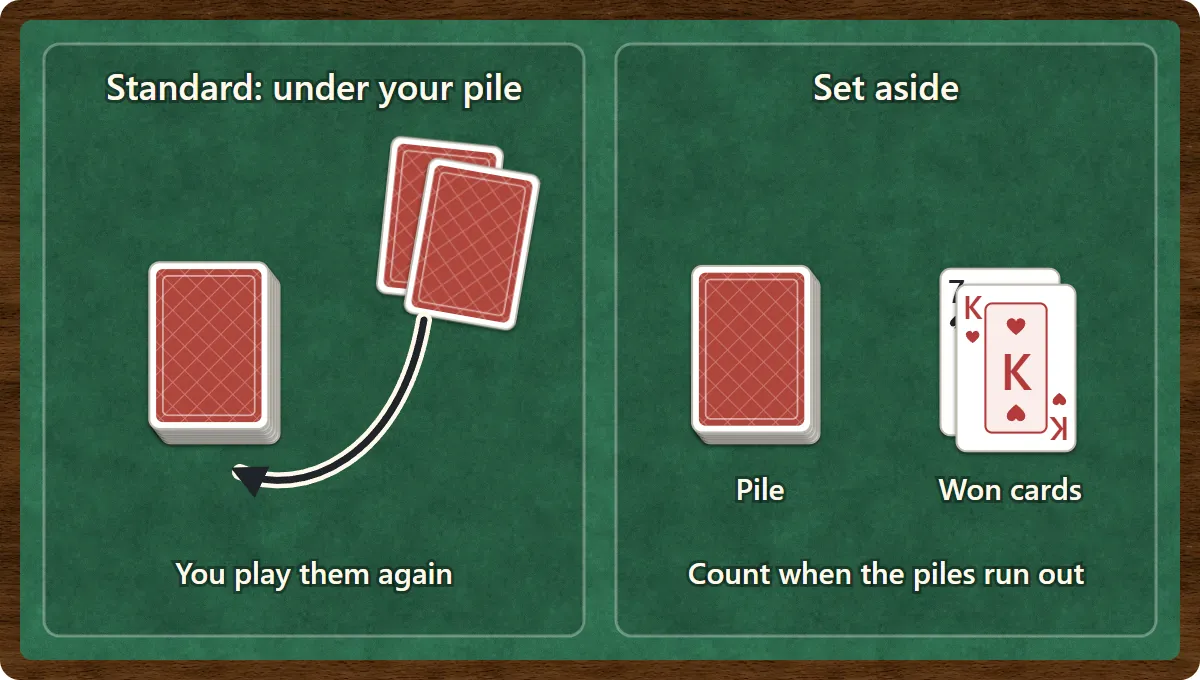
In the classic game, won cards go under your pile and come back into play, and you win by collecting all 52. Because cards keep changing hands, this can take hundreds of flips. A faster version puts won cards to one side instead. After 26 flips both piles are empty, and whoever won more cards is the winner.
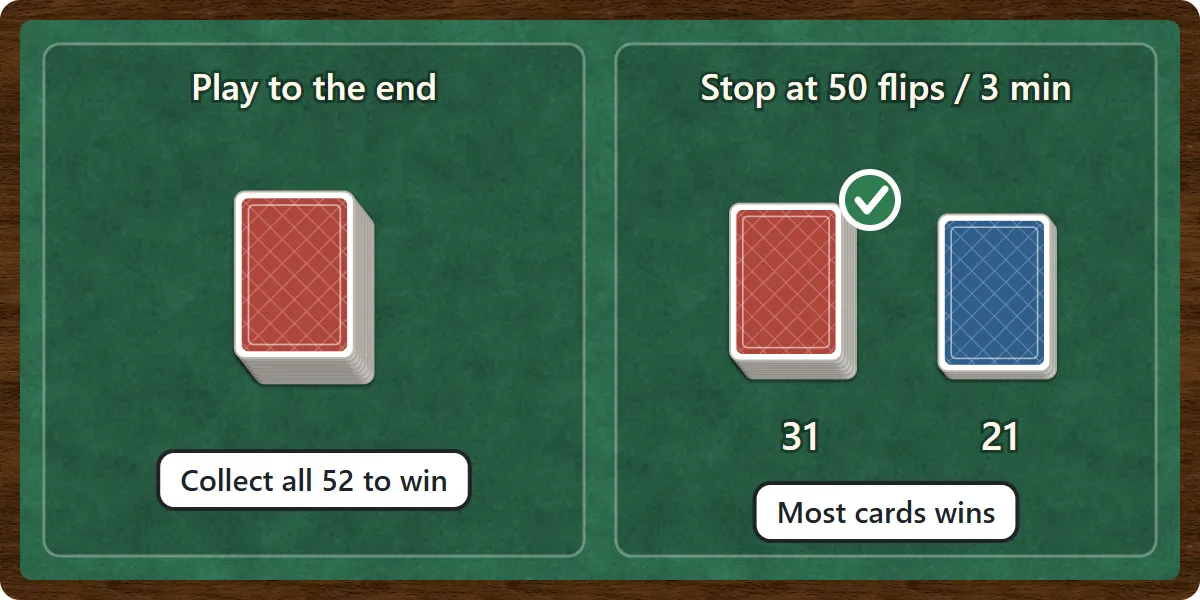
You can also stop after a fixed number of flips or minutes. This game offers 50 flips or 3 minutes; when time is up, the player holding more cards (pile plus any set-aside cards) wins, and equal counts are a draw.
War variations and house rules
| Rule | Classic War | Other options here |
|---|---|---|
| Highest card | Ace | King (ace low), or 2 |
| Jokers | None | Add two, or one for each player (highest cards) |
| Face-down cards in a war | 1 | None (Simple), 2 or 3 |
| Won cards | Under your pile | Set aside and count at the end |
| Short of cards in a war | Last card fights | That player loses |
| Game length | To the end | 50 flips or 3 minutes |
If you add two jokers, one player can end up with both. Choose “1 each” to bury one joker in each player’s pile instead, which keeps things fair. Jokers beat everything, and two jokers against each other start a war like any other tie.
War card game tips
War is decided by the order of the cards, so no strategy guarantees a win. There are still a few things that make it more fun.
1. Flip at exactly the same time
The whole game depends on nobody seeing the other card first. With real cards, count together and flip on the same beat. In the two-player mode here the first tapped card waits face down, so it never matters who taps first.
2. Use auto-flip and fast-forward for long games
A game played to the end can last hundreds of battles. Turn on Auto-flip to let the cards flip themselves, and Fast-forward to race through quiet stretches. If you only have a few minutes, choose 50 flips or 3 minutes before you start.
3. Shuffle the cards you win
If won cards always go back in the same order, the same patterns can repeat and a game may never end. Mixing them up a little before sliding them under your pile keeps the game moving. Your won cards are shuffled automatically here.
4. Try face-down cards for bigger swings
With one or three face-down cards, every war moves many more cards, so a player who is far behind can still come back. Once the basic game feels familiar, add face-down cards and see how much more dramatic the wars become.
5. Watch the card-count bar
The bar on the right of the table shows how many cards each player holds. Blue above the dotted middle line means the top player is ahead; red below it means you are. With no choices to make, cheering for the bar is half the fun.
War as a first card game
War teaches the basics of playing cards without any pressure: the four suits, the order of the ranks, and the everyday actions of shuffling, dealing, flipping and collecting. There is no hand to hold or fan out, which suits small hands. It is also steady practice in comparing numbers: after a game or two, players know instantly that a jack beats a ten and that an ace beats a king. Those ranks carry straight over to games like Speed, Crazy Eights, Old Maid and poker.
War card game FAQ
How many cards do you deal in War?
With two players, deal all 52 cards so each player has 26. If you add two jokers, each player gets 27.
Is the ace high or low in War?
The ace is usually high, the top card of all. Some people play with ace low, and you can choose that under More rules.
How long does a game of War take?
It varies a lot. Playing to the end often takes several hundred flips. Setting won cards aside ends the game after 26 flips, and you can also stop after 50 flips or 3 minutes.
Can you play War with 2 players on one device?
Yes. Choose “2 players, 1 screen”. The bottom player taps the bottom pile (or presses the space bar) and the top player taps the top pile (or presses F).
Does the computer level matter in a game of luck?
Anyone can win at any level. The Hard computer puts the cards it wins back under its pile in a smarter order, which you will notice most in long games with face-down cards. Easy is a relaxed choice for first-timers and young players.
Where does War come from?
War is played by children all over the world, and nobody knows exactly where it began. In Britain the same game is often called Battle. German books from the early 1800s already describe close relatives that use a smaller deck, and Russia has its own version called Drunkard. In Japan the game is known as 戦争 (sensō), and it is often the very first card game children learn.