 Yorimichi Games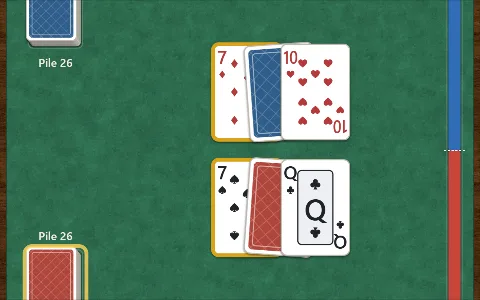
How to play Oicho-Kabu
Oicho-Kabu is a traditional Japanese card game about adding numbers. You take two or three cards and only the last digit of their total matters, so 7 + 8 = 15 counts as 5. The best possible hand is 9, called kabu. One player is the dealer and everyone else plays against the dealer. Instead of holding a hand of their own, the other players put points on the cards laid out in the middle of the table, and they gain those points if their card ends up higher than the dealer’s.
Here you play against one to three computer players. You start with 20 points each, and the points are simply the score of this game: there is nothing to buy or win outside it. Whoever has the most points when the last round ends finishes first.
The game was traditionally played with special kabufuda cards or with hanafuda, the Japanese flower cards. On this page you can choose standard playing cards (ace to 10, forty cards) or hanafuda (January to October, forty cards) under Cards in the settings. Jacks, queens and kings are not used, and neither are November and December. The counting and the special hands are identical with both decks.
Reading the table
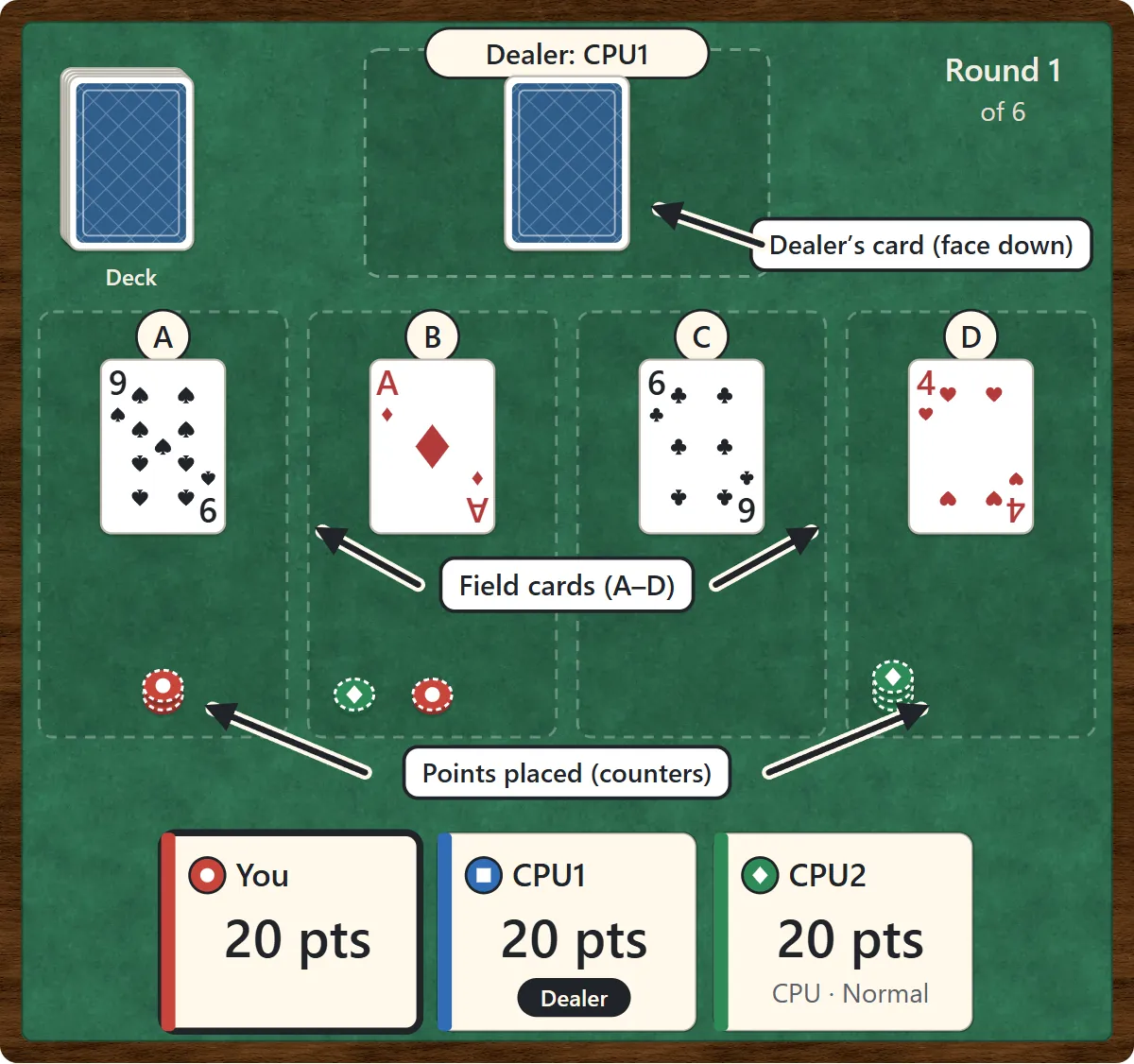
Every round, the dealer lays out four field cards face up and places one card face down for themselves. The other players then decide which field cards to back. You never own a card in Oicho-Kabu: you ride along with a field card, and any number of players can put points on the same one.
Counting points: the last digit
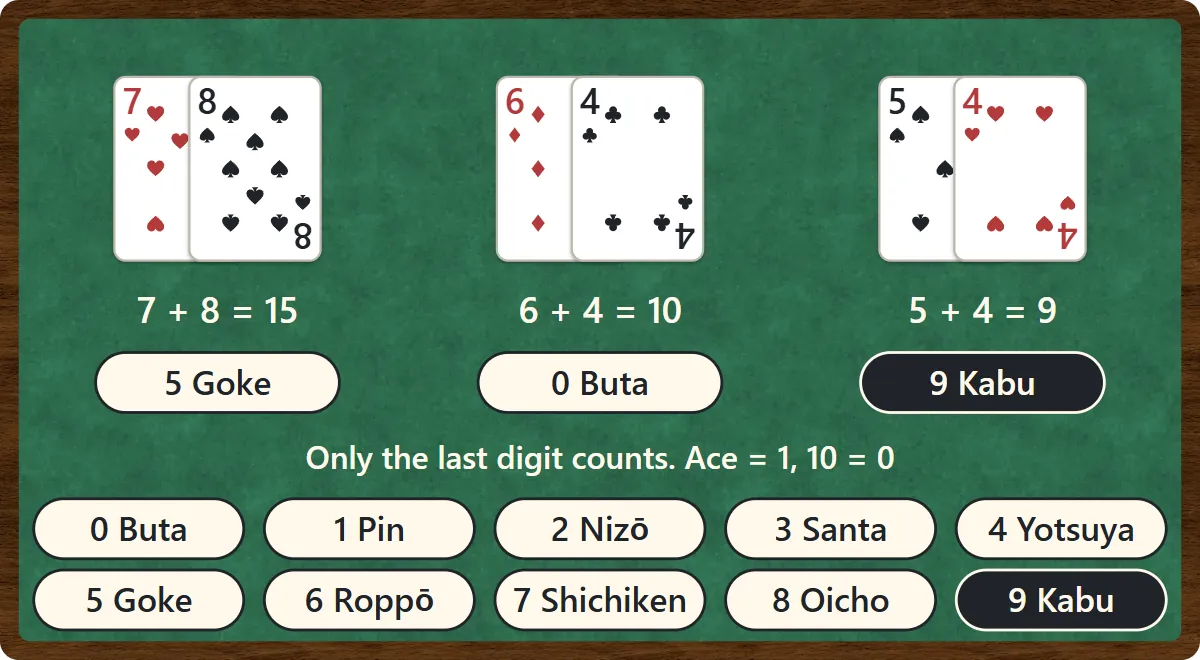
An ace is 1 and a 10 is 0. Add your cards and keep only the ones digit. Each value from 0 to 9 has a traditional name, and players often call hands by these names instead of the numbers:
| Value | Name | Value | Name |
|---|---|---|---|
| 0 | Buta | 5 | Goke |
| 1 | Pin | 6 | Roppō |
| 2 | Nizō | 7 | Shichiken |
| 3 | Santa | 8 | Oicho |
| 4 | Yotsuya | 9 | Kabu |
The name of the game joins the names of the two best values, 8 (oicho) and 9 (kabu).
Playing with hanafuda: the month is the number
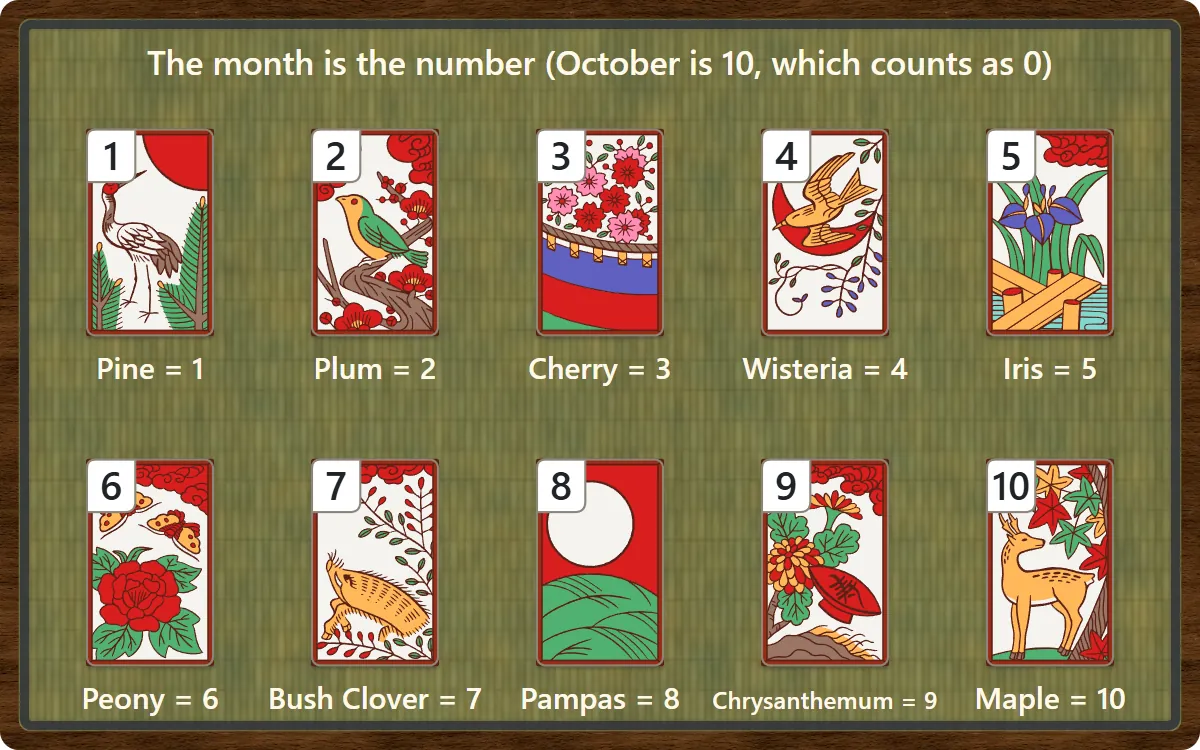
If you choose hanafuda, January (pine) is 1, February (plum) is 2, and so on up to October (maple), which is 10 and therefore counts as 0 like the 10 of a standard deck. Each month has four cards with different pictures, but in Oicho-Kabu only the month matters. You do not need to know the plants: the month number in the top-left corner of every card tells you its value.
How a round works
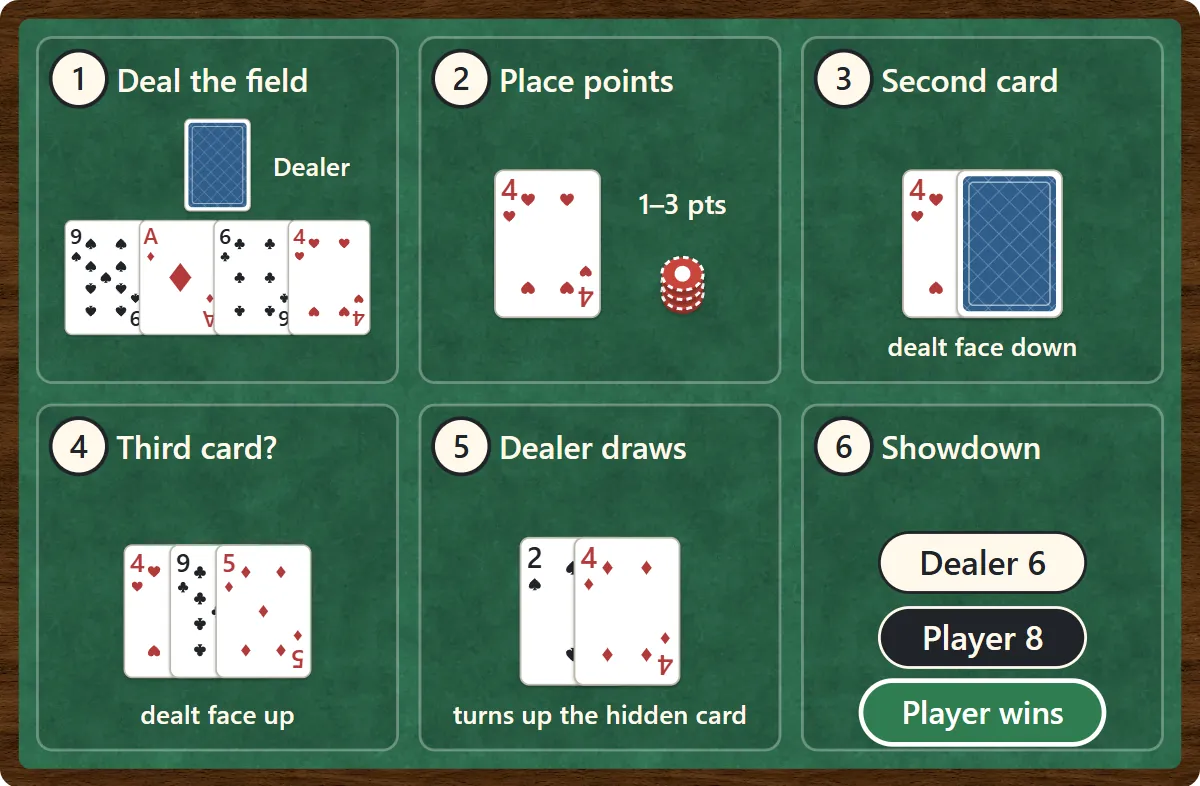
- The dealer lays out four field cards face up and one card face down for themselves.
- Starting with the player after the dealer, each player puts 1 to 3 points on any of the field cards. You can use as many field cards as you like.
- The dealer gives each field card that has points on it a second card, face down. Players who placed points on that card may look at it.
- For each field card, a third card may be drawn. Third cards are dealt face up.
- The dealer turns up the face-down card, draws a second one and decides on a third card in the same way.
- All hidden cards are turned over and each field card is compared with the dealer.
When several players have points on the same field card, the one sitting closest after the dealer decides on its third card, and everyone else on that card shares the result.
Oicho-Kabu rules for the third card
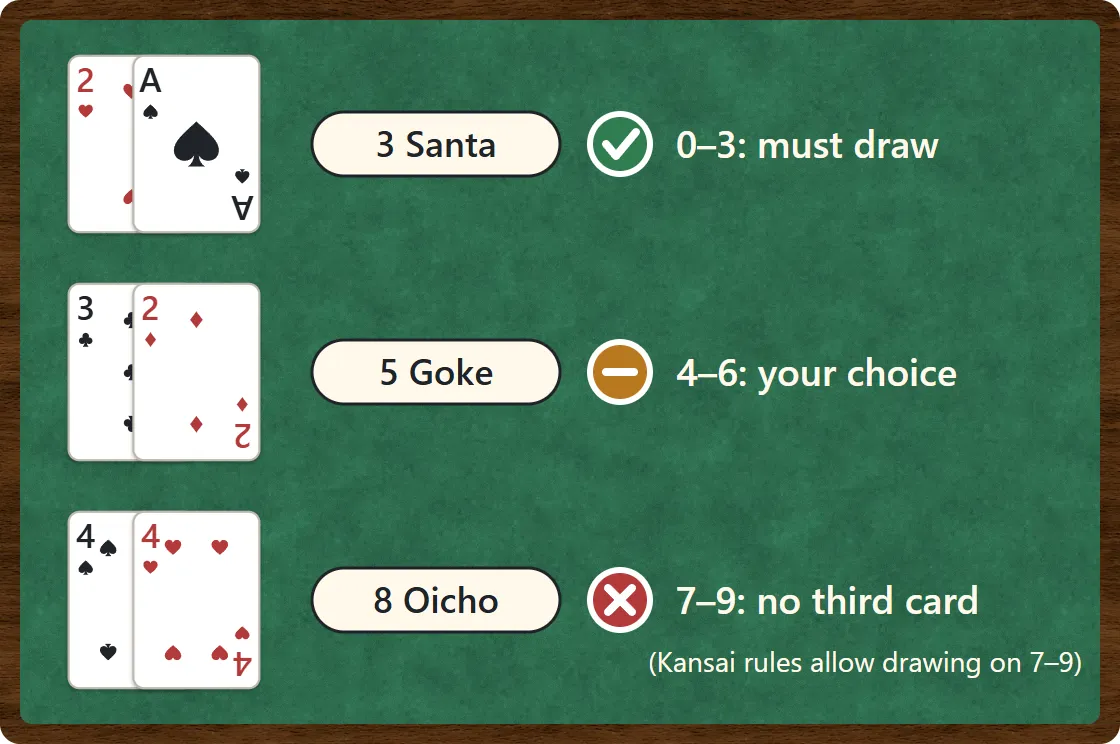
No hand ever has more than three cards. A third card can help or hurt: from 4 you might reach 9, or you might fall to 0. With the Kansai rules you may draw even on 7, 8 or 9.
Winning and losing points
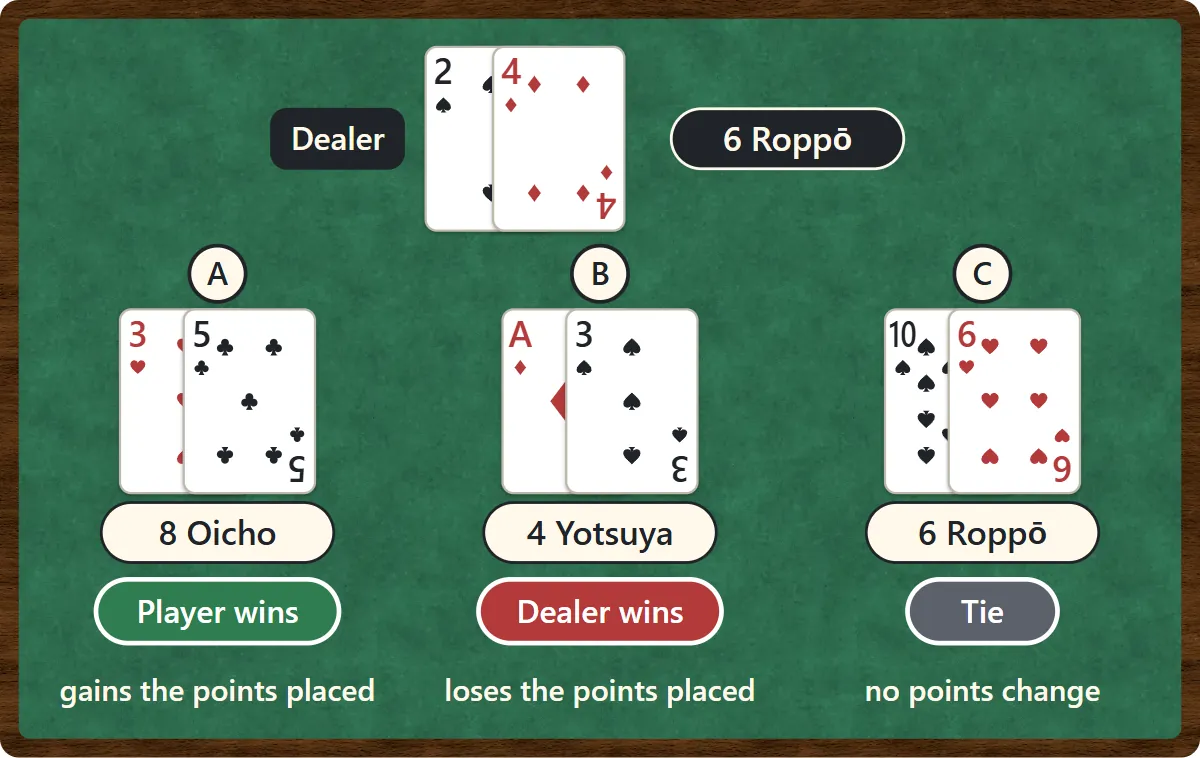
If a field card beats the dealer, every player on it gains as many points as they placed, taken from the dealer. If the dealer is higher, those points go to the dealer. Equal values are a tie and no points change hands, except under the Strong dealer rules, where the dealer wins ties. The deal passes around the table after every round, and at the end of the chosen number of rounds the highest total finishes first.
Special hands: Kuppin, Shippin and Arashi
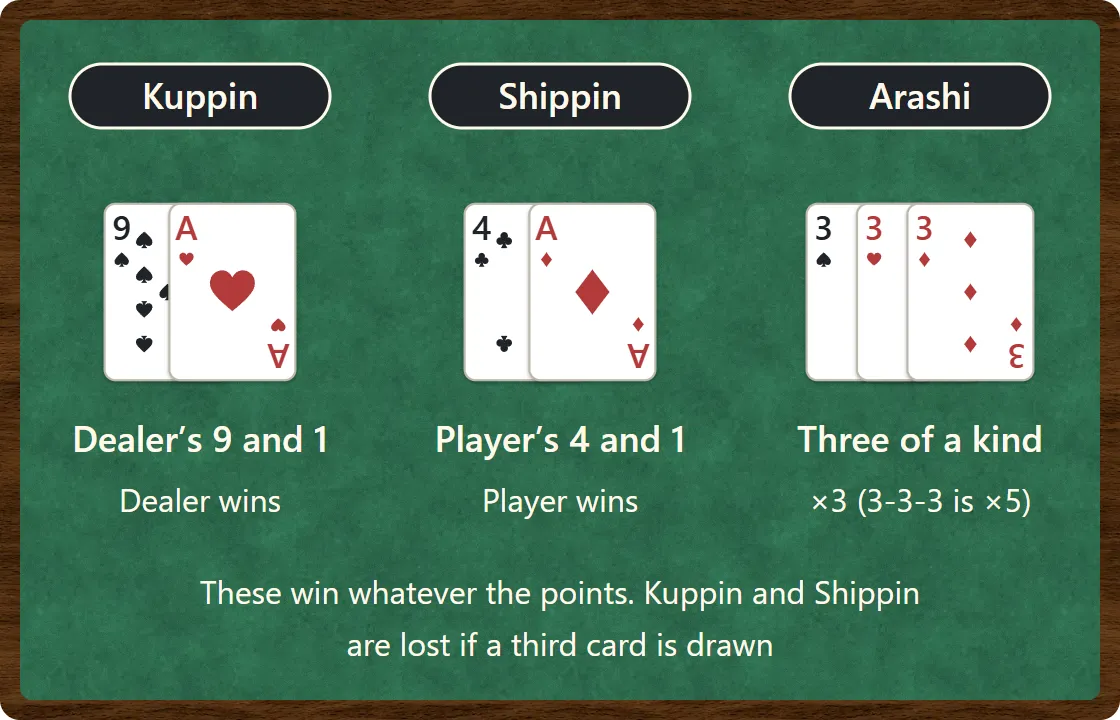
- Kuppin: the dealer’s first two cards are 9 and 1. That totals 0, yet the dealer wins.
- Shippin: a field card’s first two cards are 4 and 1. That totals 5, yet the player wins. If Kuppin and Shippin meet, Kuppin is stronger.
- Arashi: all three cards show the same number. It wins three times the points, and 3-3-3 is the strongest of all at five times. A player’s Arashi even beats the dealer’s Kuppin.
Kuppin and Shippin only exist with two cards, so drawing a third card breaks them. If you see 9 and 1 or 4 and 1, stand.
Standard, Kansai and Strong dealer rules
Oicho-Kabu is played very differently from region to region and from family to family. You can pick one of three common versions here or change each rule under Custom.
| Rule | Standard / Kansai | Strong dealer |
|---|---|---|
| Third card on 7 or more | Not allowed / allowed | Not allowed |
| Equal values | Tie | Dealer wins |
| Shippin (4 and 1) | Players’ hand | Dealer’s hand |
| Kuppin, Arashi | Yes | Yes |
The Strong dealer version is common in digital versions of the game. Because the deal rotates, everyone gets the same number of turns as the stronger dealer, so it is still fair over a full game.
Oicho-Kabu strategy tips
1. With 4 to 6, draw on 4 and stand on 6
Whether a third card helps depends on where you are now. From 4, drawing improves things more often than not; from 6, standing loses less. 5 sits right on the line. When in doubt, look at the dealer’s cards and the cards already showing on the other field cards.
2. Field cards showing an ace or a 4 are worth a look
If a field card’s first card is an ace or a 4, the second card might complete a Shippin, which wins outright for the players (unless you play Strong dealer). That makes those cards a little better than the rest.
3. Stand on a special hand
Kuppin and Shippin disappear the moment you draw. A 9 and 1 counts as 0 on points, so it is tempting to draw, but as the dealer you should stand and take the win.
4. Put more points where it counts
Each round is mostly luck. If you spread a little onto every field card, the wins and losses tend to cancel out. Choosing the most promising cards and placing more on them makes your score move.
5. Watch the gap near the end
In the last few rounds, adjust to the score. When you are ahead, place fewer points and protect your lead. When you are behind, put more points on a couple of cards to catch up.
6. As the dealer, read the players’ face-up cards
The dealer decides on a third card after all the players, and their third cards are dealt face up. Use that information. A field card that stood on two cards probably has 4 or more.
Oicho-Kabu FAQ
What happens if my points go below zero?
You keep playing to the end. The player with the most points after the last round finishes first.
Who decides the third card on a shared field card?
The player sitting closest after the dealer. If someone before you has points on the same card, you go along with their decision.
Which CPU level should I choose?
Easy is a good start. It sometimes draws on a special hand or stands when it should draw. Normal draws and stands by the basic rules of thumb. Hard reads the remaining cards from what is visible and changes how many points it places as the end approaches. The game has a lot of luck in it, so you can win or lose against any level.
Do playing cards and hanafuda change anything?
No. Both decks have four cards of each number from 1 to 10, so the odds and the special hands are the same. Pick whichever you prefer. You can even switch in the middle of a game from Settings and press Continue: the scores stay and only the card faces change.
Can I stop and continue later?
Yes. Open the page again on the same device and browser and press Continue to resume from the next round. Sound is off at first; press “Sound: off” to hear the cards being dealt and turned.
Where does Oicho-Kabu come from?
Oicho-Kabu is one of the oldest card games still played in Japan. The word oicho is usually traced back to the Portuguese word for eight, a reminder that playing cards first reached Japan with Portuguese traders in the sixteenth century. Over time the Japanese made their own decks, including the kabufuda with numbers from 1 to 10 that suit this game perfectly. Today many families simply enjoy it as a quick game of adding numbers, and it is a surprisingly good way to practise mental arithmetic.