 Yorimichi Games
How to play the dot connect puzzle
This is a single-player logic puzzle played on a square grid. Colored dots are scattered over the board, and every dot has exactly one partner with the same color and number. Your job is to link each pair with a single line. A 5×5 board has four to six pairs; a 10×10 board has around nine to twelve. Link every pair and fill every square on the board with lines, and the puzzle is solved.
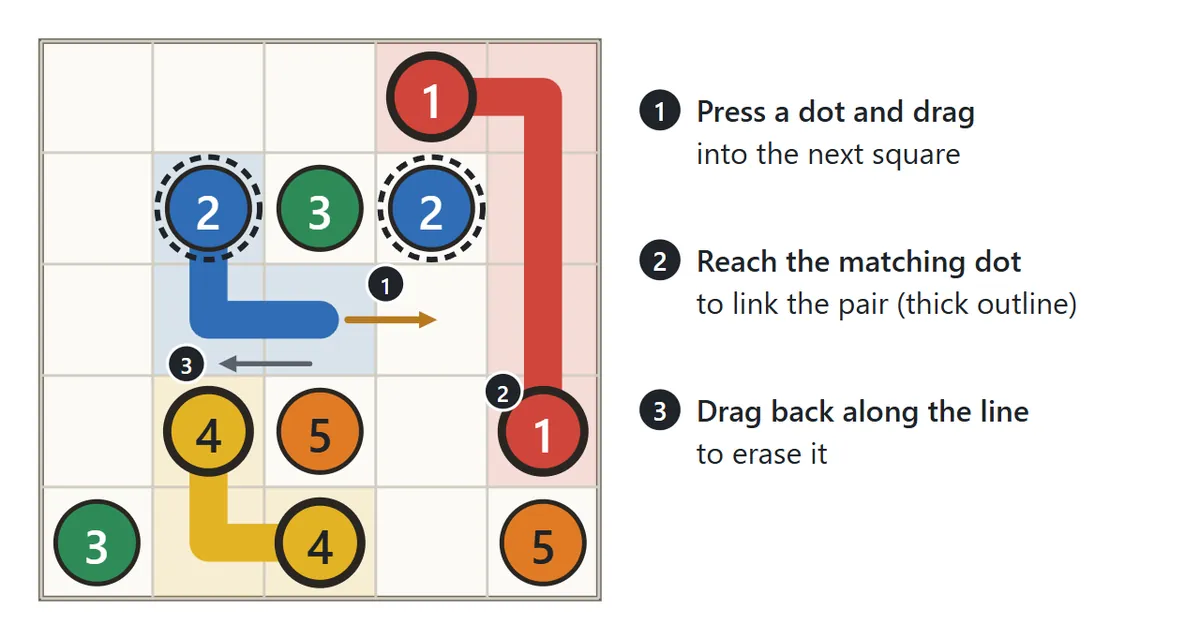
To draw a line, press a dot and drag your finger or mouse into a neighboring square. Lines run through the centers of the squares and can only go across or up and down, never diagonally. When the line reaches the other dot with the same number, that pair is linked and both dots get a thicker outline. If dragging is awkward, you can also press a dot and then tap the neighboring squares one at a time.
Made a mistake? Drag back along the line and the part you retrace is erased. Pressing a dot clears that number's whole line so you can start it again from there, and pressing the middle or the end of a line lets you carry on drawing from that point. Undo takes you back one step, and Clear all (press it twice) returns the board to the start.
Dot connect puzzle rules
| Rule | What it means |
|---|---|
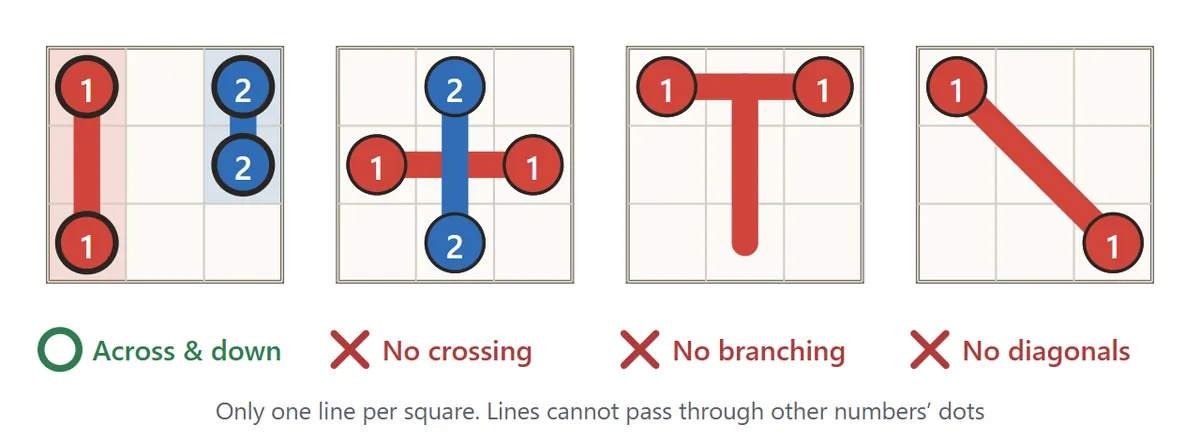
| Pairs | Link the two dots with the same number and color using one line |
| Direction | Lines pass through square centers, across or up and down. No diagonals |
| No crossing | Only one line may pass through a square. Lines never cross or overlap |
| No branching | A line never splits. Dots sit only at the two ends of a line |
| Other dots | A line cannot pass through a square holding a different number |
| Fill the board | By default every square must be filled. You can switch to Gaps allowed |
Fill every square
On top of linking every pair, this game asks you by default to fill every single square on the board with lines. Every puzzle has been built so that it has exactly one solution under this rule. The rule is also one of your best clues: if linking a pair by the shortest route would leave empty squares behind, that line must be taking a detour somewhere.
Choose Gaps allowed in the settings and a puzzle counts as solved as soon as every pair is linked, even if some squares are still empty. That is the older, looser form of the rule. The puzzles in this collection still have the same single solution under it, and when you finish, every square turns out to be filled anyway. The way you solve them is the same, so use this option if you would rather think only about linking the pairs.
Levels and puzzle sizes
| Level | Board size | Puzzles |
|---|---|---|
| Easy | 5×5 to 7×7 | 40 |
| Medium | 6×6 to 9×9 | 40 |
| Hard | 8×8 to 10×10 | 40 |
Even on the same size of board, puzzles with short, straight lines are easy, while puzzles where a long line winds all the way around the board are hard. Within each level the puzzles are ordered from the smallest boards and the most approachable layouts upward. The Daily puzzle picks one Medium puzzle for each date. Everyone who plays on the same day gets the same puzzle, and the game keeps track of how many days in a row you have solved it.
Tips and strategy
1. Start with dots that have only one way out
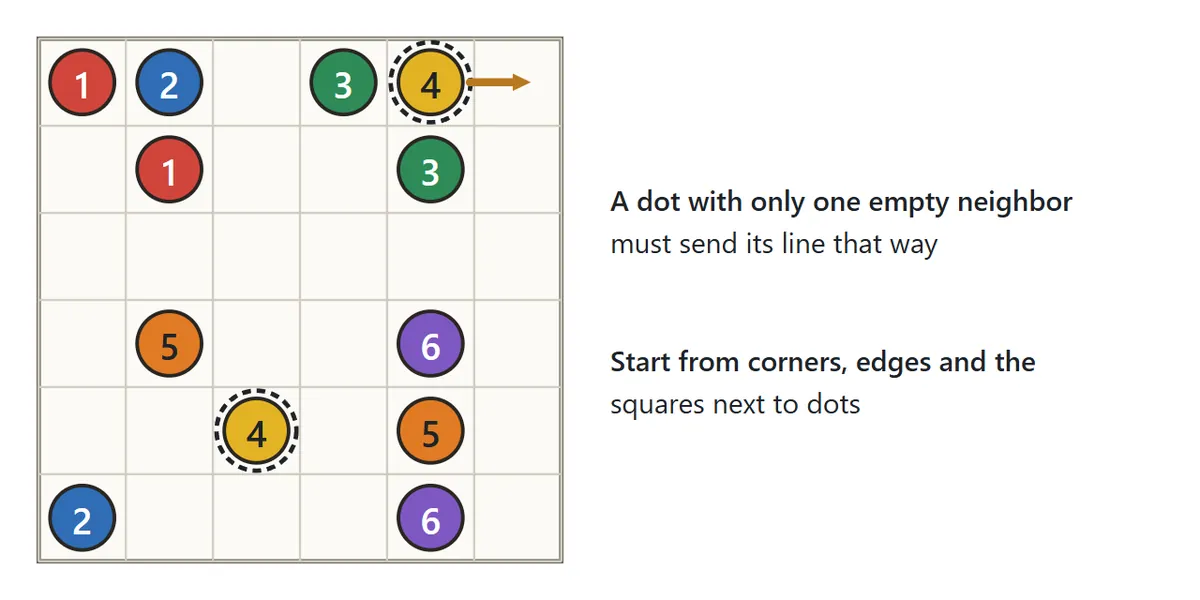
Look around each dot for one that has only a single empty neighboring square. The line leaving that dot has nowhere else to go. Corner squares and squares squeezed between the edge of the board and a dot are just as limited. Filling in these forced moves first removes a lot of guesswork.
2. Pairs along an edge usually follow the edge
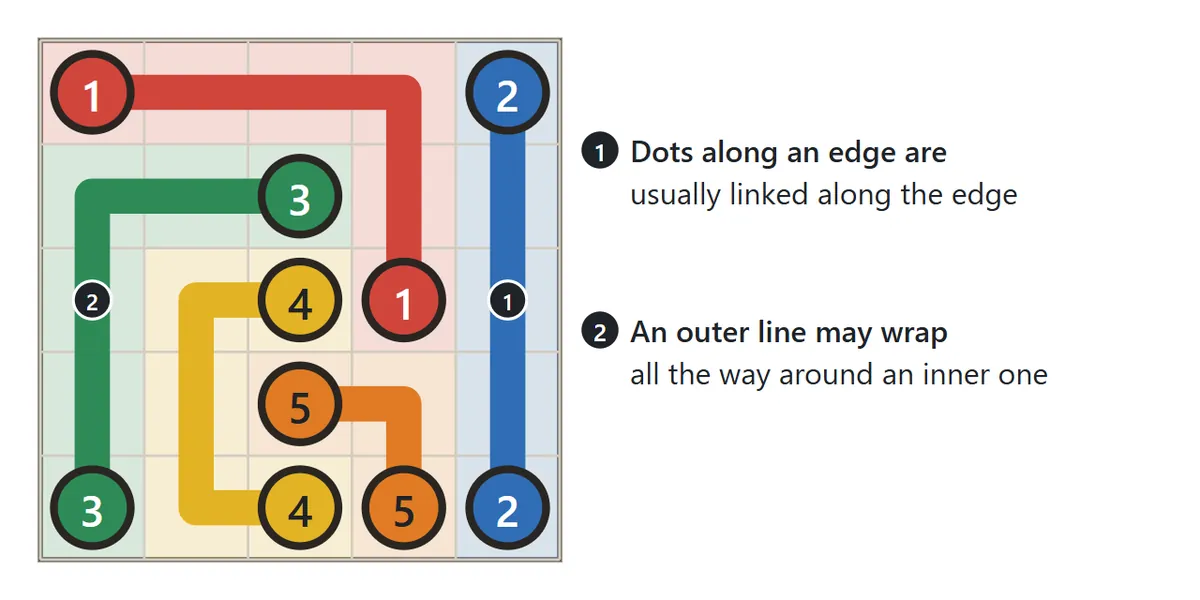
When both dots of a pair sit next to the same edge, they are usually linked by a line running along that edge. If the line leaves a one-square gap between itself and the edge, there is often no other line that can reach in and fill it.
3. Outer lines wrap around inner lines
If two dots are close together but a straight link would leave empty squares, that pair may be the one that wraps around the outside of other lines. Try linking the pairs near the middle of the board with short lines first, then think of the remaining pairs as wrapping around them.
4. Never trap empty squares
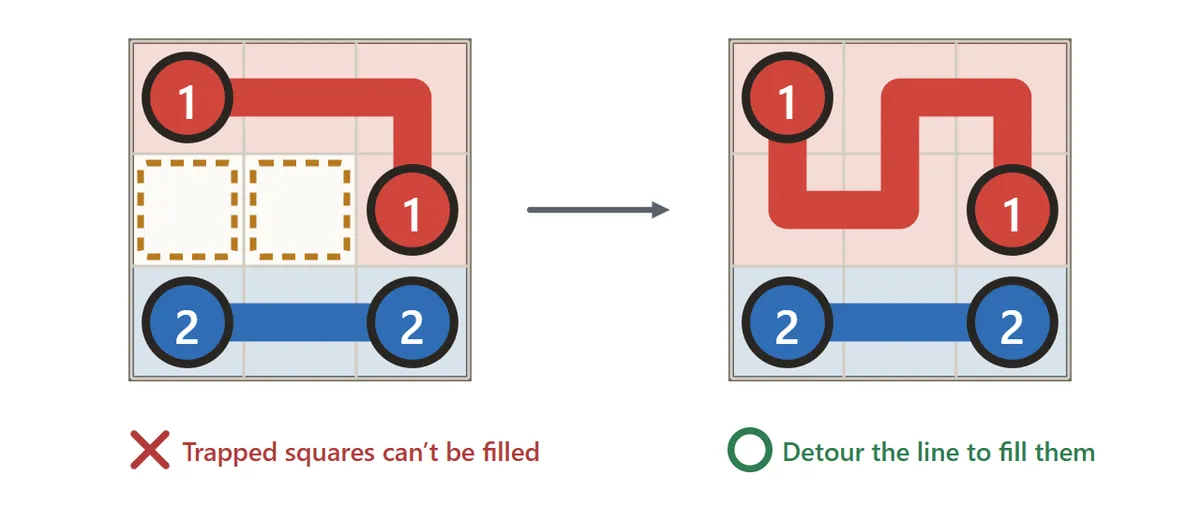
Each time you draw a line, check whether it has closed off any empty squares. Squares walled in by finished lines can never be filled. When that happens, reroute one of the surrounding lines so that it passes through the empty squares.
5. Watch out for pairs you have cut off
Linking one pair can block the route between the two dots of another pair. After drawing a line, check that every pair you have not linked yet still has a way through. It saves you from redrawing large parts of the board later.
6. Stuck? Take one hint
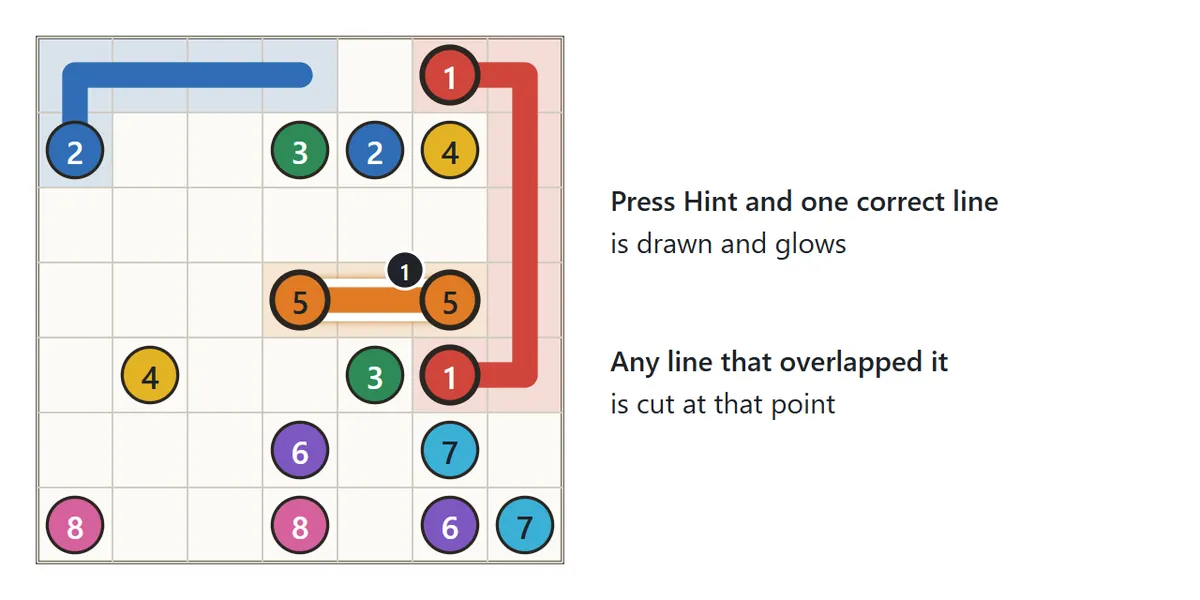
Press Hint and the game draws the correct line for one pair that is not linked yet. Any line that overlapped it is cut at that point, which also shows you where you went wrong. One correct line often unlocks the next pair, so using hints one at a time works best. Show answer (press it twice) reveals every line.
Dot connect puzzle FAQ
Does every puzzle have only one solution?
Yes. Every puzzle was made for this game and has exactly one solution, whether or not you require every square to be filled. If all your pairs look linked but the puzzle is not solved, some line must differ from the solution and has probably cut off another pair or left squares empty.
What if the colors are hard to tell apart?
Every dot shows a number as well as a color, so you can always link matching numbers. While you are drawing a line, both dots with that number get a dotted ring.
How are my times recorded?
The clock starts when you draw your first line. For each puzzle the game records how many times you have solved it and your fastest time without hints, and solved numbers get a check mark in the settings. Your records and any puzzle in progress are saved only in this browser on this device, so you can press Continue to carry on later.
Can I print puzzles to solve on paper?
Yes. The Print button opens a printable page with puzzles from the same level in black and white. One to six puzzles fit on a sheet depending on the board size, you can choose US Letter or A4 paper, and an answer page can be added.
Can I play with a keyboard?
Use the arrow keys (or W, A, S, D) to pick a square, then press Enter on a dot or a line to grab it. Draw with the arrow keys while holding it and press Enter again to let go. Z undoes and H gives a hint.
Is there sound?
Sound is off at first. Press Sound: off to hear effects when you draw a line and when a pair is linked.
History of the puzzle
Puzzles about joining matching symbols with lines that do not cross have been around for a long time. An early example is usually credited to the American puzzle maker Sam Loyd, who published one in a newspaper column in 1897. The English puzzlist Henry Dudeney included a similar problem in his 1917 book Amusements in Mathematics, built around cars driving from house to house along routes that must not meet.
The grid form, where matching numbers are linked through the squares of a board, spread through Japanese puzzle magazines in the late 1980s, and versions with letters instead of numbers exist as well. Today it is also a familiar game on phones and tablets, played with colored dots. In the traditional rule empty squares are allowed, but requiring every square to be filled makes it much easier to give each puzzle a single answer, so that is the standard rule in this game.