 Yorimichi Games
How to play SameGame
SameGame is a one-player puzzle about removing connected tiles of one colour. You begin with a complete board, choose a group, and watch the remaining tiles settle. Nothing new enters the board during play. Every tile is visible from the start, so your decisions depend on position and order rather than on a hidden draw. There is no timer. You can examine several groups, compare their possible effects, and make a move when you are ready.
The two goals are clearing the board and earning a high score. They do not always point to the same immediate choice. A large group may offer many points but leave a single tile stranded. A small group may be the key to bringing two larger groups together. Try the small board with three colours first. Once you can follow gravity and column movement, a larger board gives more opportunities to plan. SameGame is a family of tile-clearing puzzles with different scoring rules; the preset names here describe the rules you can choose on this page.
SameGame rules: connected groups
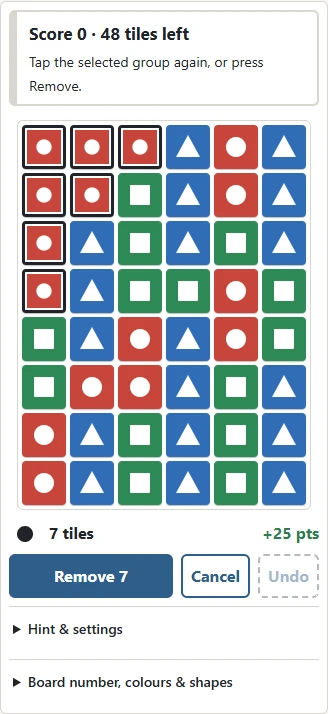
A legal group contains at least two tiles of the same colour connected horizontally or vertically. Diagonal contact does not count. The group may bend around a corner or stretch along a narrow path. If you can reach another tile by stepping only through side-connected tiles of that colour, it belongs to the same group. You remove the whole connected group, not a smaller part selected from it. A single tile cannot be removed on its own.
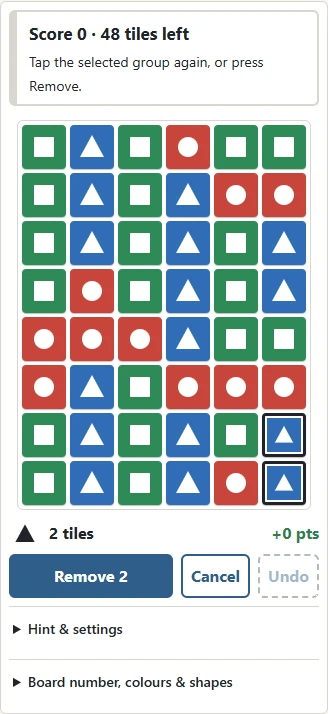
Tap or click once to select a group. All its tiles receive an outline, and the selection display shows how many tiles will disappear and how many points you will earn. Tap anywhere in that selected group again, or press Remove, to confirm. Selecting a different group changes the preview without making a move. Cancel, an empty board cell, the space around the board, or Escape clears your selection without removing tiles. Tapping the selected group again confirms it; it does not cancel. A preview does not change your score or move count, so you can compare several choices before committing.
Each colour also has a shape: red circles, blue triangles, green squares, yellow diamonds and purple stars. Matching shapes identify matching colours. This gives you another way to follow a group when two colours are difficult to distinguish. The icons are identifiers, not special powers. A star follows exactly the same removal rule as a circle.
Gravity and empty columns
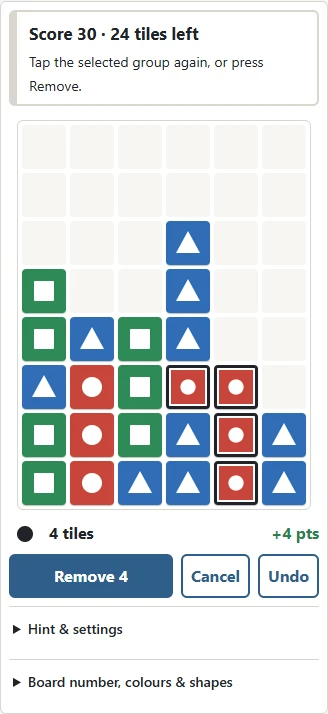
After a group disappears, tiles above its spaces fall down within their own columns. The order of the surviving tiles in a column stays the same. No tile jumps over another tile or crosses into a neighbouring column during this downward movement. Gaps disappear as the column settles from the bottom upward. This can make two previously separated tiles touch, or bring a tile alongside another group of its colour.
When an entire column becomes empty, every column to its right slides left to close the gap. The surviving columns keep their relative order. Horizontal movement happens only when a complete column is empty. A small hole halfway up a column does not make tiles move sideways into it. If several columns become empty in one move, all of them disappear from the space between surviving columns.
Think of a move in two stages: gravity first, column compression second. You cannot drag tiles freely, swap their positions, or rotate the board. There are no automatic chain removals. A group formed by the settling tiles remains on the board until you choose it on a later move. There are also no added rows, timed refills, explosive pieces or colour-changing actions in this version.
SameGame scoring and presets
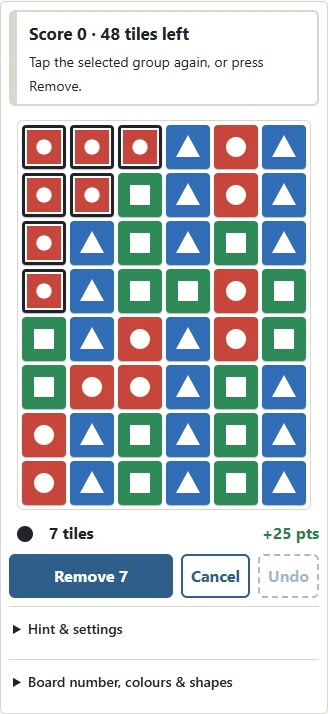
Basic scoring takes the number of removed tiles, subtracts two, and squares the result. Two tiles earn zero points, three earn one, four earn four, five earn nine, and six earn sixteen. Seven tiles earn twenty-five and eight earn thirty-six. Larger groups grow in value faster than the number of tiles. A single six-tile group earns sixteen points, while two separate three-tile groups earn only two points in total. Removing the same number of tiles therefore does not always produce the same score.
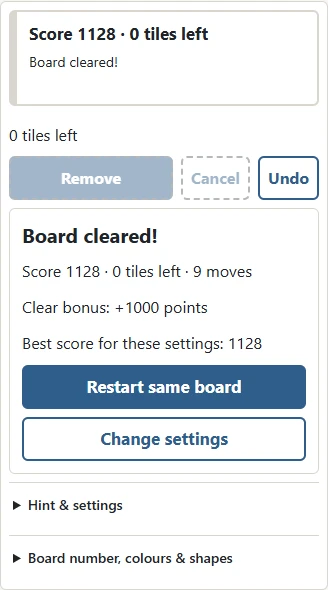
Basic also awards a one-thousand-point bonus for clearing the entire board. The bonus is added when your last removal leaves no tiles at all. Leaving even one tile means you have not cleared the board, so there is no clear bonus. There is no remaining-tile penalty and no reward for playing quickly. No bonus keeps the same group formula but removes the completion bonus. This is useful if you want to compare the value of your groups without a large final addition.
Pairs score uses the square of the group size minus one. A pair then earns one point, three tiles earn four, and four earn nine. Sum scoring adds the numbers from one through the group size: a pair earns three, three tiles earn six, four earn ten, and five earn fifteen. Custom lets you choose any of these three group formulas with either zero or one thousand as the clear bonus. The formula changes points, while group connectivity, gravity and leftward column movement stay the same. Always check your preset when comparing a score with another game.
Clearing the board or reaching a dead end
A board with no tiles left is cleared. If tiles remain but no connected group of two or more can be removed, the game ends at a dead end. The result shows your final score, remaining tile count and number of moves. Two tiles that touch only diagonally are still separate. Tiles of one colour with a different colour between them do not form a removable group until a legal move brings them together.
Solvable boards have at least one complete clearing sequence from the starting position. This does not mean every sequence works. Choosing a different order can still lead to a dead end. Random boards do not carry a clearing guarantee. They may be difficult, impossible to clear, or already have no legal group when they first appear. The result is shown immediately if such a board has no move.
Undo remains available after a dead end, so you can reconsider the last decision. Restart same board returns to the original layout. New board gives you a different layout using the current rules. To return to a particular starting position later, keep its board number and its settings. The same number needs the same board size, colour count and board type to reproduce the same arrangement. Changing the scoring formula changes points but does not change that arrangement.
SameGame strategy and tips
Start by identifying large groups, then ask whether removing one now prevents it from growing later. If two patches of the same colour are separated vertically by another colour, removing the middle group may merge them. That middle colour must itself form a legal group; an isolated tile cannot simply be taken away. Looking two moves ahead is often enough to discover a useful connection that is not obvious from group size alone.
The outer columns can be easier to reason about because fewer neighbours are involved. Clearing a middle column can bring two distant patches together when the columns slide left. However, the same movement may change the position of another colour you hoped to preserve. Before taking a large group, check not only its points but also the tiles that will remain around it.
If just one tile of a colour remains anywhere on the board, no other colour can become its matching partner. For a clear attempt, keep track of which colours are becoming scarce. Try to remove the last tiles of a colour together rather than leaving a single survivor. For a score attempt, a common colour may be worth saving while you remove other colours that separate its patches. These ideas can conflict, which is why previewing several choices is useful.
Hint selects a suggested group for you to inspect. It does not remove it automatically, promise a clear, or claim the highest possible score. You can still choose a different group. A hinted game is marked as practice, as is a game where you use Undo. Practice makes it possible to explore consequences without mixing assisted results into the usual best-score record.
Controls, board sizes and saved games
Small is six columns by eight rows, Standard is eight by ten, and Large is ten by twelve. Choose three, four or five colours. More colours generally make it harder to find large connected groups, but size alone does not define difficulty. A large board with fewer colours can offer very large groups. A small board can still require careful ordering near the end.
On a phone, tap a group to preview it, then confirm with another tap or Remove. Larger boards can be scrolled sideways inside the board area. The tiles keep their touch size rather than shrinking every column into the screen. On a computer, use the arrow keys to move the cursor, Enter or Space to select and confirm, Escape to cancel a selection, and Z to undo. Form fields keep their normal typing behaviour, and Enter activates focused buttons. Escape and Z also work when a game button below the board has focus. Open Hint & settings below the board for Hint, Restart same board, New board, Settings, Sound and Controls. Open Board number, colours & shapes to see the number and symbol key.
Sound starts off and can be enabled with the sound button. The page follows your device’s light or dark preference. Opening Settings pauses the current board; Continue returns to it. Progress is stored in this browser on this device, and the Japanese and English pages share the same saved game. Clearing browser storage removes that progress and the score records. Moving to another browser or device does not transfer them automatically.
Best scores are kept separately by board size, colour count, group formula, clear bonus and board type. Hint and Undo results are practice results and do not replace a normal best score. You can restart a board to try a different plan or enter a board number to revisit a familiar layout. There is no time requirement, so take as long as you need to compare the next possibilities.
Frequently asked questions
Why can I not remove two tiles of the same colour? Check whether they touch by a side or can be reached through other side-connected tiles of that colour. Diagonal contact and a different colour between them are not connections. Why did a pair earn no points? Basic scoring gives a pair zero, but removing it can still cause useful gravity or column movement. Why did a solvable board end at a dead end? Solvable describes the starting layout: at least one successful sequence exists. It does not promise success for every choice. Undo or restart to explore a different order. Random boards can include a colour that appears only once; no minimum number of tiles per colour is guaranteed.
A puzzle family with different scores
This connected-group puzzle appears under SameGame or Same Game in several puzzle collections. The rules provided by Simon Tatham, GNOME Swell Foop and Janko share the familiar settling-board idea. Their descriptions also show why a score should always be read alongside its scoring rules. Group formulas and completion bonuses vary. This version offers clearly labelled choices so you can compare group values without assuming that every SameGame implementation uses one universal scoring system.
Scoring quick reference
| Formula | 2 | 3 | 4 | 6 |
|---|---|---|---|---|
| (n−2)² | 0 | 1 | 4 | 16 |
| (n−1)² | 1 | 4 | 9 | 25 |
| n(n+1)/2 | 3 | 6 | 10 | 21 |