 Yorimichi Games
How to Play Reversi
Reversi is a two-player strategy board game played with round stones that are black on one side and white on the other. You place stones one at a time, and whenever you trap a line of your opponent’s stones between the stone you just placed and another of your own, all of the trapped stones flip over to your color. When the game ends, the player with more stones of their color on the board wins. You can learn the rules in a couple of minutes, yet a single move can turn half the board around, so a game is rarely decided until the very last stones go down.
On this page you can play Reversi online for free against the computer at three levels, or play a two-player game with a friend on the same phone, tablet or computer. There’s nothing to download and no account to create.
The starting position
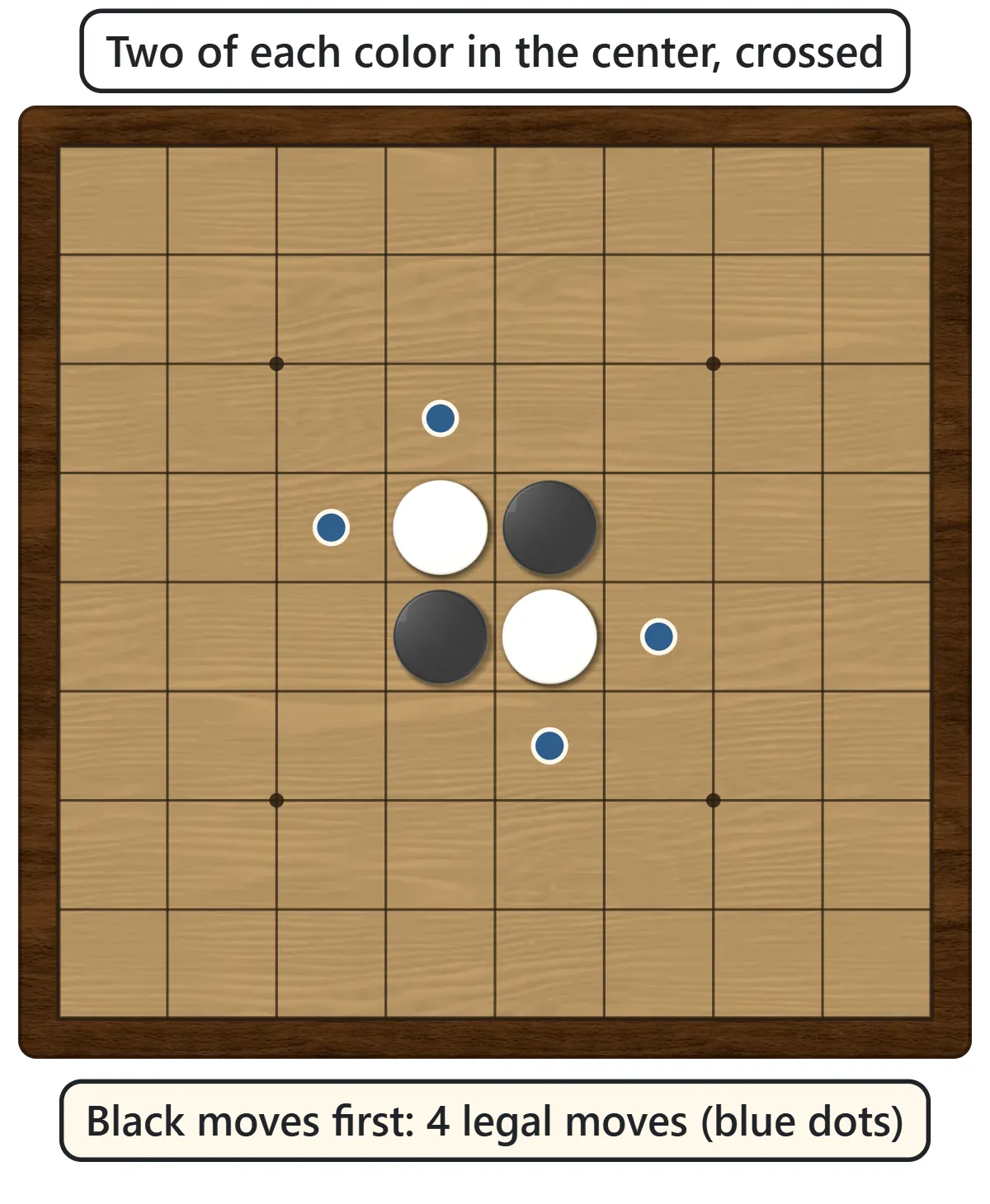
The standard board has 8 rows and 8 columns, 64 squares in all. At the start, four stones sit in the middle: white on the top-left and bottom-right squares, black on the top-right and bottom-left. Black always moves first, and then the players alternate. In this game you can choose to play Black, White or a random color against the computer — pick Black if you like to move first.
Outflank to flip
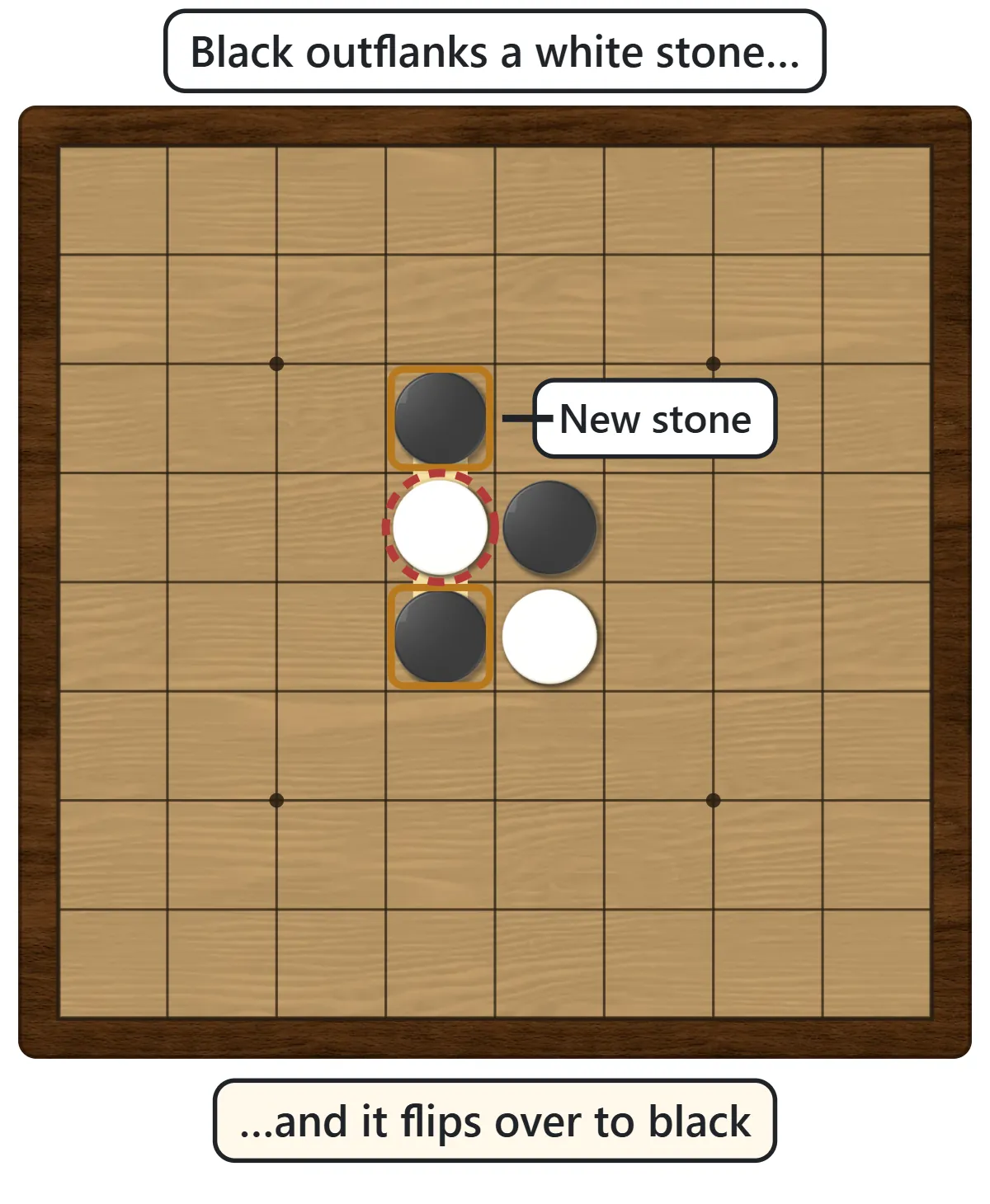
On your turn, place one stone of your color on an empty square. The move must outflank at least one of your opponent’s stones: there has to be a straight, unbroken line of their stones running from your new stone to another stone of yours. Every stone in that line flips to your color. In the game you’ll see the trapped stones turn over one by one, starting with the one closest to the stone you played.
Flip in every direction at once
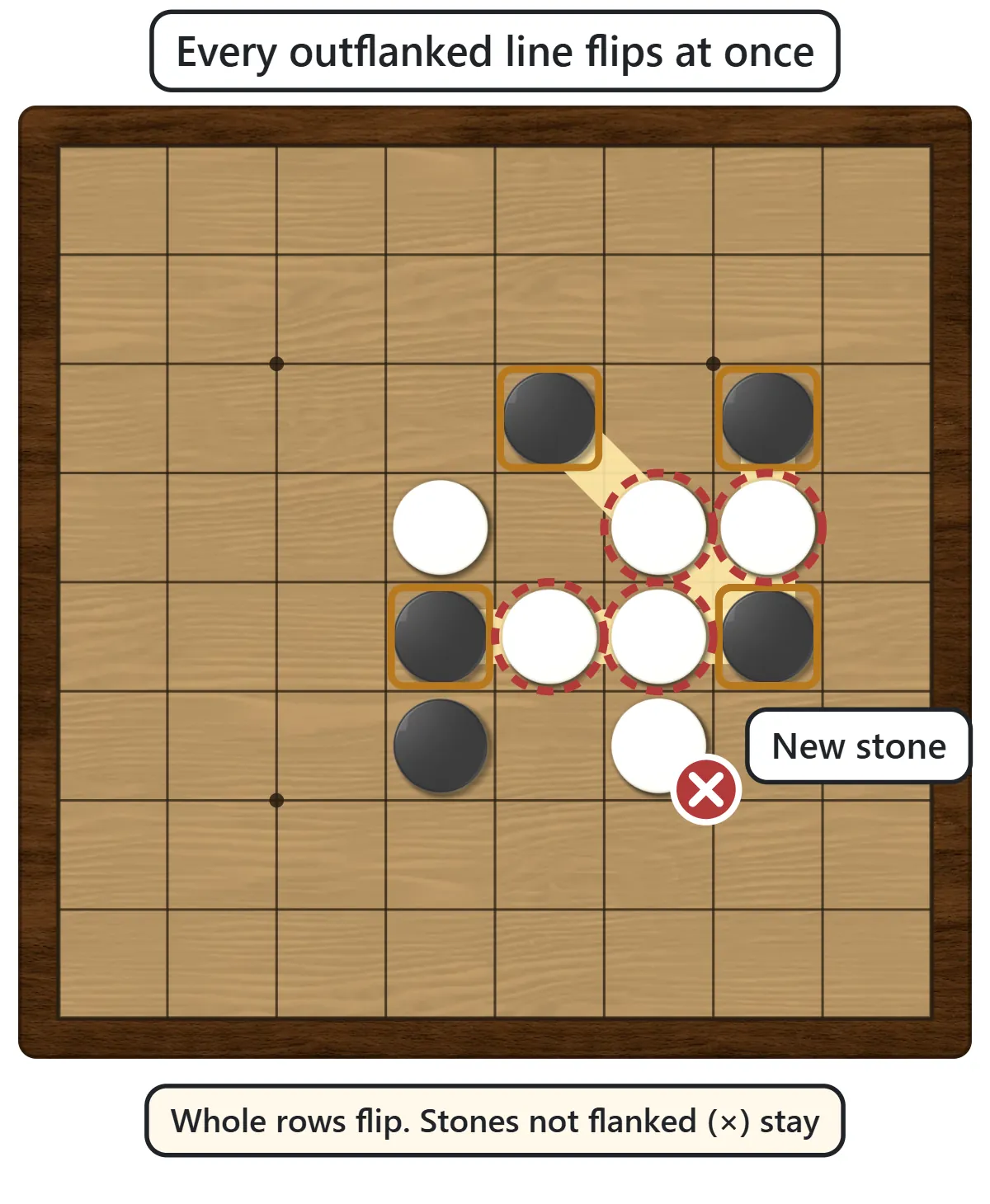
A line can run in any of the eight directions: horizontally, vertically or diagonally. It can be one stone long or stretch across the board. If a single move outflanks lines in several directions, every one of those lines flips — you can’t choose to flip some and leave others. Stones that aren’t actually trapped stay as they are, and flipping is never a chain reaction: a stone that has just turned over does not go on to flip anything else, even if it now happens to trap a line.
Legal moves: you must flip something
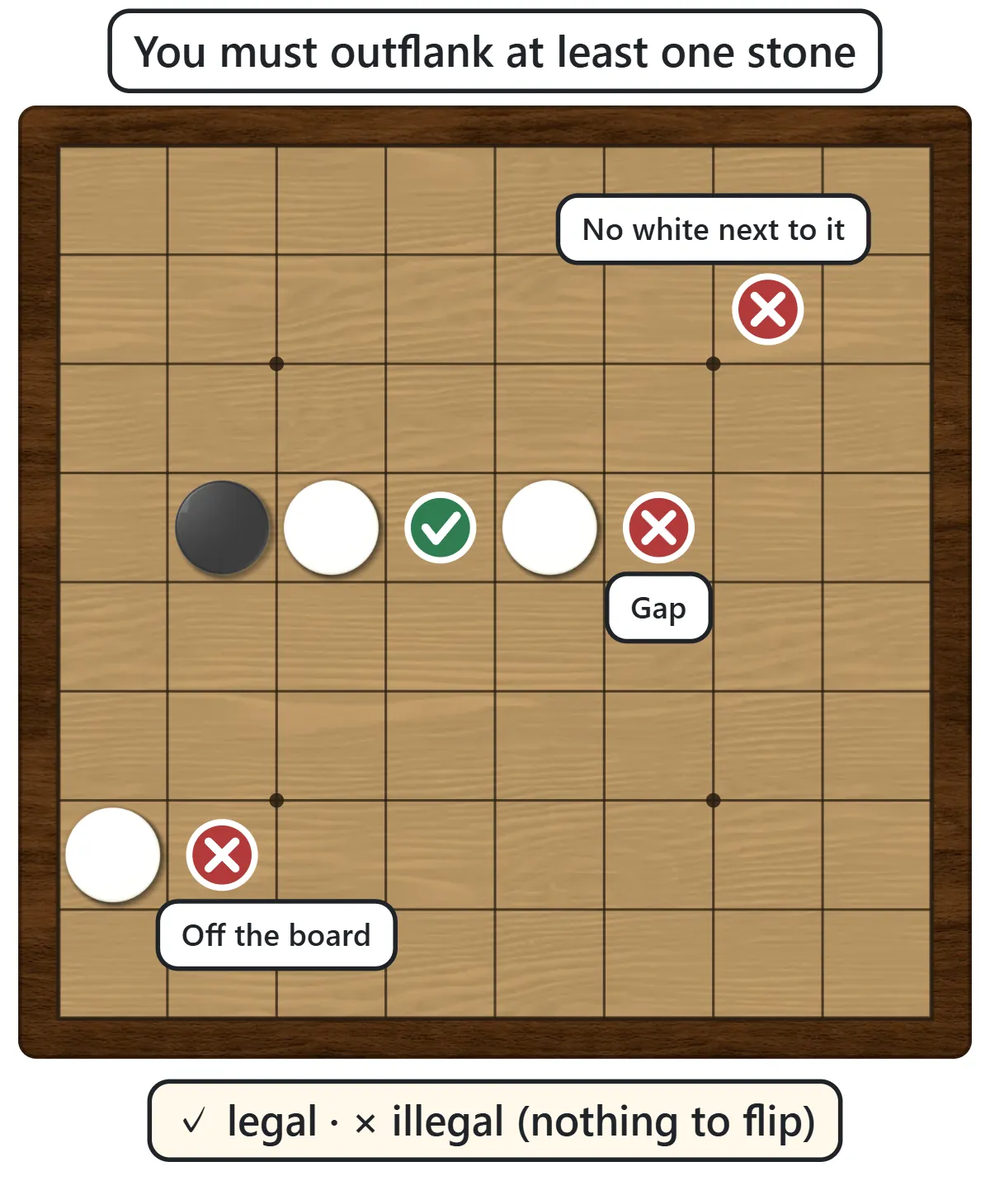
You may only play on a square that flips at least one stone. A move is illegal when there is an empty square in the middle of the line, when the line of your opponent’s stones runs off the edge of the board without reaching one of your stones, or when there is no opposing stone next to the square at all. The game marks every legal move with a small blue dot, so beginners don’t have to hunt for them (you can switch the dots off in the settings if you want a real challenge).
No legal move? You pass
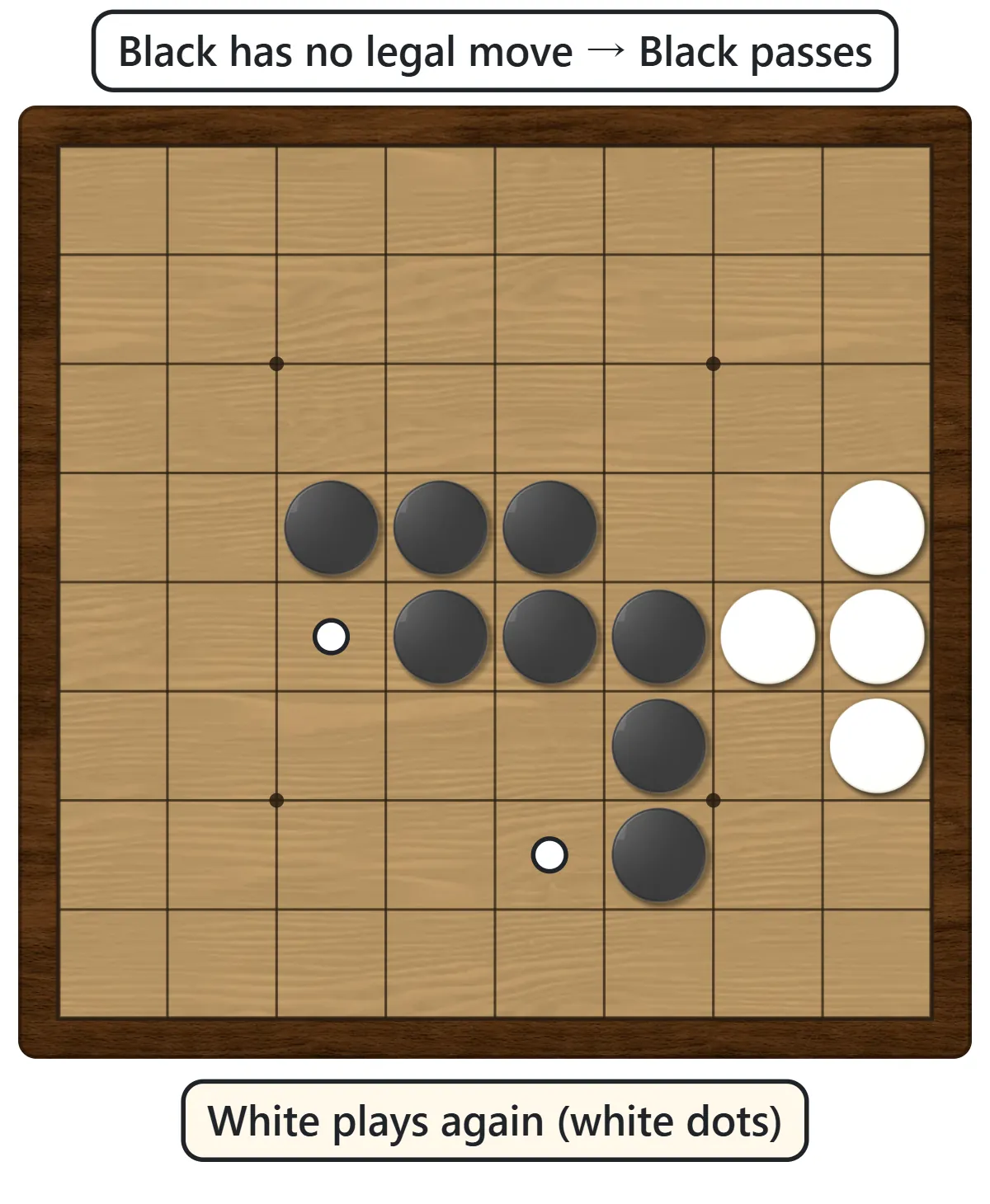
If you have no legal move, you must pass and your opponent plays again. There is no limit on how many times in a row a player can pass. But passing is never optional: as long as you have at least one legal move, you have to play it. When you have to pass in this game, a Pass button appears under the board.
How the game ends and who wins
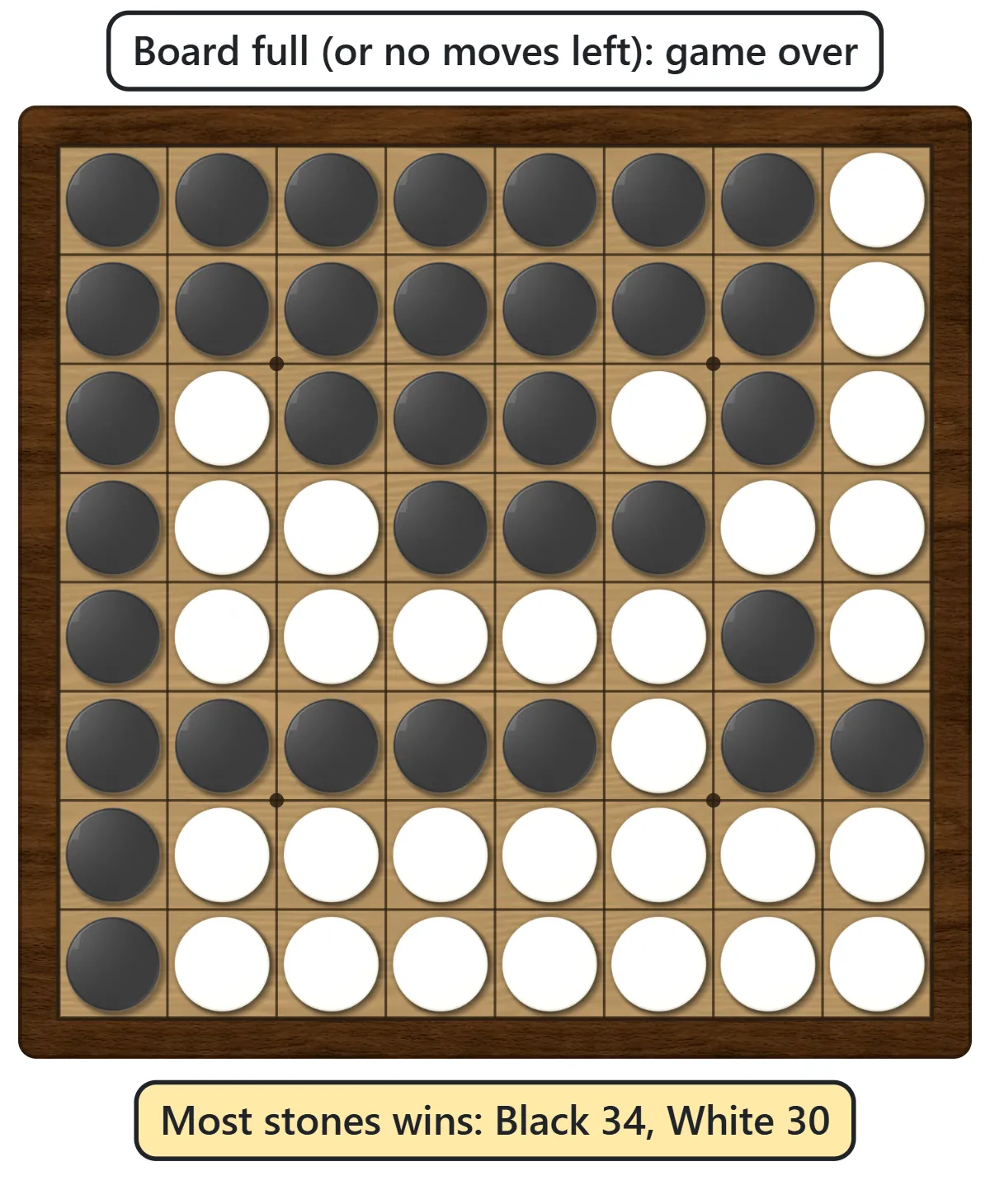
The game is over when every square is filled. It also ends early if neither player has a legal move — which includes the rare case where one color is wiped off the board entirely. Count the stones: the player with more stones of their color wins, and equal counts are a draw (32–32 on the standard board). In tournaments, when a game ends with empty squares left, those empty squares are added to the winner’s total. The result screen in this game shows that tournament score as well, so you can see how the game would have been recorded.
Reversi Rules: Board Sizes and Starting Positions
The 8×8 board is by far the most common, but the rules work on any even-sized board. Here you can also play on a small 6×6 board for quick games or a large 10×10 board for long, deep ones. Under “Custom” you can change the starting position too.
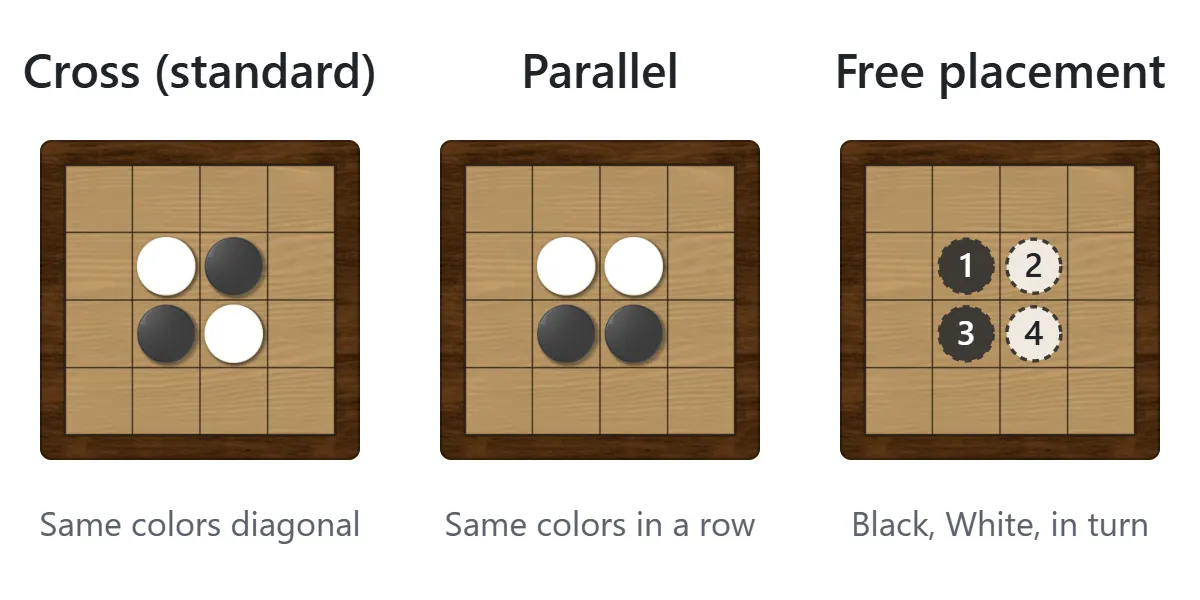
| Option | What it means |
|---|---|
| Standard (8×8) | Cross start in the center, Black moves first. The version played almost everywhere today |
| Small board (6×6) | Only 36 squares, so a game takes a few minutes. Great for practicing how to read ahead |
| Large board (10×10) | 100 squares and a long game, with many fights over corners and edges |
| Parallel | The top two center squares start white and the bottom two black |
| Free placement | The board starts empty and the players take turns placing the first four stones on the center squares, with no need to outflank. This is how Reversi was often played in the 19th century |
Reversi Strategy: Tips to Win
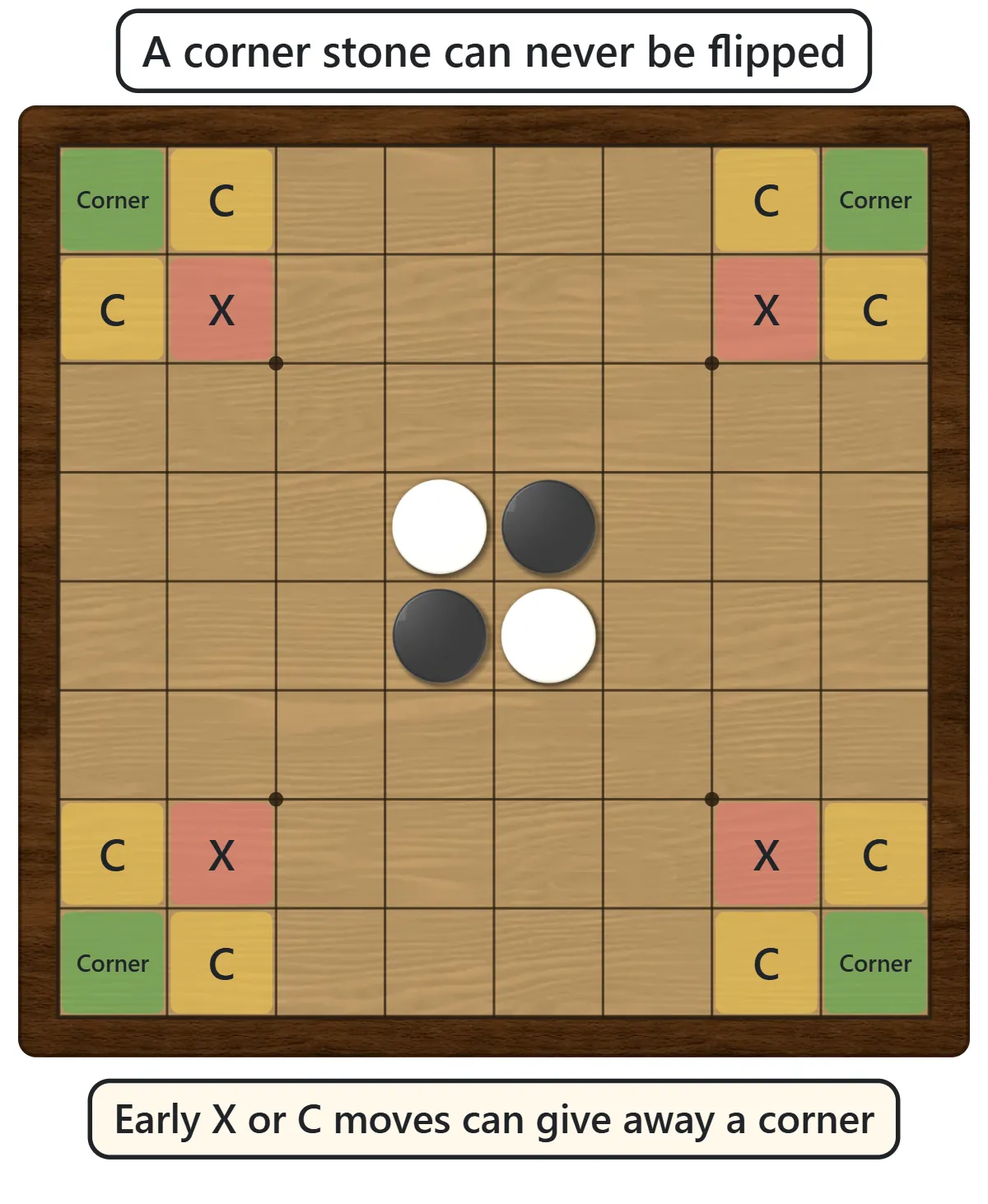
Beginners usually try to flip as many stones as possible on every move. It feels good, but it’s the most common reason for losing. These Reversi tips will help you beat the Easy and Normal computer quickly, and give the Hard level a real fight.
1. Take the corners
A stone in a corner can never be outflanked, because there is nothing beyond it in any direction. Once you own a corner, it stays yours for the rest of the game, and you can build more unflippable stones along the edges from it. Whenever a corner is available to you, think about taking it first.
2. Stay away from X-squares and C-squares
The square diagonally next to a corner is called an X-square, and the two squares beside a corner along the edges are called C-squares. If you put a stone there while the corner is still empty, you often give your opponent a way to take that corner. As long as you have other reasonable moves, avoid these squares early in the game.
3. Flip fewer stones in the opening
Only the final count matters. In the opening and middle game, having lots of stones actually hurts you: the more of your stones there are, the more targets your opponent has and the fewer moves you have. Experienced players often aim for quiet moves that flip just one or two stones.
4. Limit your opponent’s moves (mobility)
Good players watch mobility — how many legal moves each side has. If your opponent has only a few moves, sooner or later they’ll be forced to play one they don’t want, such as an X-square or C-square. Before you move, look at where your opponent could reply, and prefer moves that leave them fewer options.
5. Avoid frontier stones
A frontier stone is one of yours that touches an empty square. Every frontier stone is a potential target for your opponent. Moves that flip stones in the interior, surrounded by other stones, give your opponent almost nothing new to work with. Keeping your stones compact and inside is one of the best habits you can build.
6. Count carefully in the endgame
With only a handful of empty squares left, the order in which they are filled can swing the final score by a lot. Count which regions of the board have an odd or even number of empty squares and who will get the last move in each. This kind of counting often uncovers a winning line, even from what looks like a losing position.
Reversi FAQ
What happens if I can’t make a move?
You pass and your opponent plays again. You can only pass when you have no legal move at all. If neither player can move, the game ends immediately, even if there are empty squares left.
What if both players have the same number of stones?
The game is a draw. On the standard 8×8 board, that means 32 stones each.
Which computer level should I choose?
If you’re new to Reversi, start with Easy. It loves moves that flip lots of stones, doesn’t understand the value of corners and sometimes plays on a whim, so simply grabbing corners will get you wins. When that feels too easy, try Normal. It goes after corners and mostly avoids the squares next to them, but it still makes the odd careless move and doesn’t look at your reply, so setting a corner trap works well. Hard thinks about mobility and stable stones and plays the last few moves perfectly, though it can still slip now and then. If you know the ideas on this page about corners, edges and mobility, you can definitely beat it.
Can I undo a move or get a hint?
Yes. With Undo turned on in the settings, the Undo button takes back your last move (together with the computer’s reply). The Hint button shows, with a blue ring, the move the Hard computer would choose. The result screen tells you how many hints and undos you used.
Can two people play on one device?
Yes. Choose “A friend” as your opponent and pass the device back and forth. Black moves first, and the bar above the board always shows whose turn it is.
Can I stop and continue later?
Yes. Your game is saved automatically in the browser. Open this page again on the same device and browser and press Continue. Sound is off at first; press “Sound: off” to hear the stones being placed and flipped.
Does Reversi work on phones, tablets and Chromebooks?
Yes. The board resizes to fit your screen, and you can play by tapping, clicking, or with the keyboard (arrow keys to choose a square, Enter or Space to play).
History of Reversi
Reversi is generally said to have appeared in England toward the end of the 19th century, where two players both claimed to have invented it. The early game was a little different from today’s: players often began on an empty board and placed the first stones in the center wherever they liked, and in some versions each player had a fixed number of stones and had to pass once they ran out. The game soon spread to continental Europe and beyond, and by the Meiji era (around 1900) it had also reached Japan, where it appeared in books of games and was played under the name Genpei-go, after the Genji and the Heike, two famous rival samurai clans.
Over the 20th century the fixed crossed starting position and the rule that Black moves first became the standard, and that is the form played around the world today. The game has also become a classic test for computer programs, and in 2023 researchers announced that perfect play on the 8×8 board from the standard start leads to a draw. For everyday players, though, there is still plenty to discover in every game.