 Yorimichi Games
How to play Pyramid Solitaire
Pyramid Solitaire is a patience game for one player using a single deck of 52 cards. Twenty-eight cards are laid out in the shape of a pyramid, and you take them apart by removing pairs of cards that add up to 13. All you need is simple addition, so it is easy to learn, yet choosing which pair to take first makes a real difference. It has been a favorite among classic solitaire games for a long time.
The layout
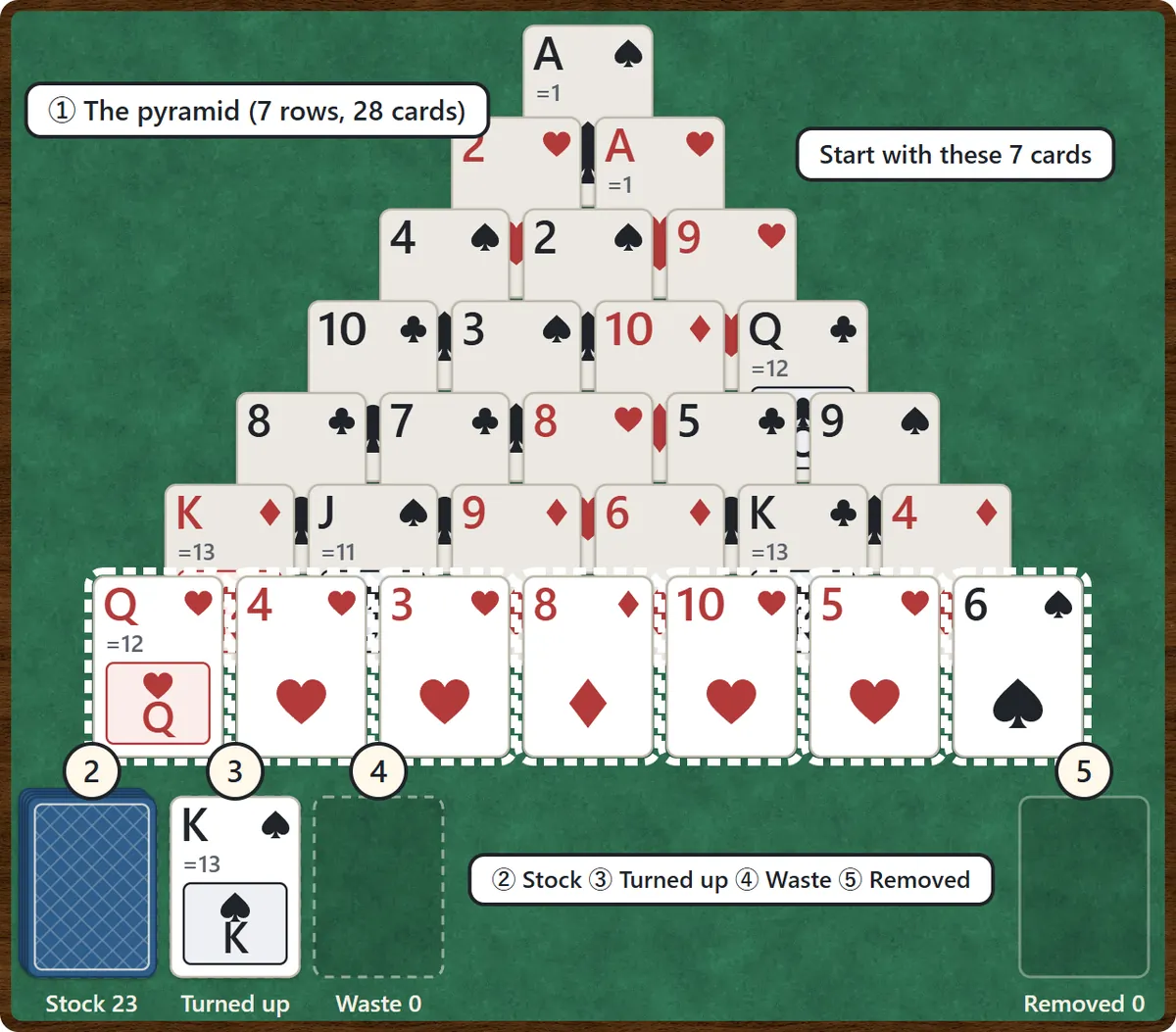
After shuffling, deal the cards into a pyramid: one card in the top row, two in the next, and so on down to seven cards in the seventh row, for 28 cards in all. Each card in a lower row overlaps two cards in the row above. The other 24 cards form the stock. In this game, the top card of the stock is always turned face up next to it as the turned-up card. Remove all 28 pyramid cards to win.
Pyramid Solitaire rules: pairs that add up to 13

Cards count at face value, with an ace worth 1, a jack 11, a queen 12 and a king 13. Only six combinations add up to 13: ace and queen, 2 and jack, 3 and 10, 4 and 9, 5 and 8, and 6 and 7. Suits and colors don’t matter. A king already makes 13, so it is removed by itself as soon as it is available. Two cards of the same rank, such as two 6s, never make a pair.
Only uncovered cards can be used

A card in the pyramid can’t be used while either of the two cards in the row below is still on top of it. Only when both of those cards have been removed is it uncovered and free to pair. That means an ace sitting on a queen can’t be paired with that queen, even though they add up to 13. In this game, cards that are still covered are shown slightly darker.
The stock, the turned-up card and the waste pile
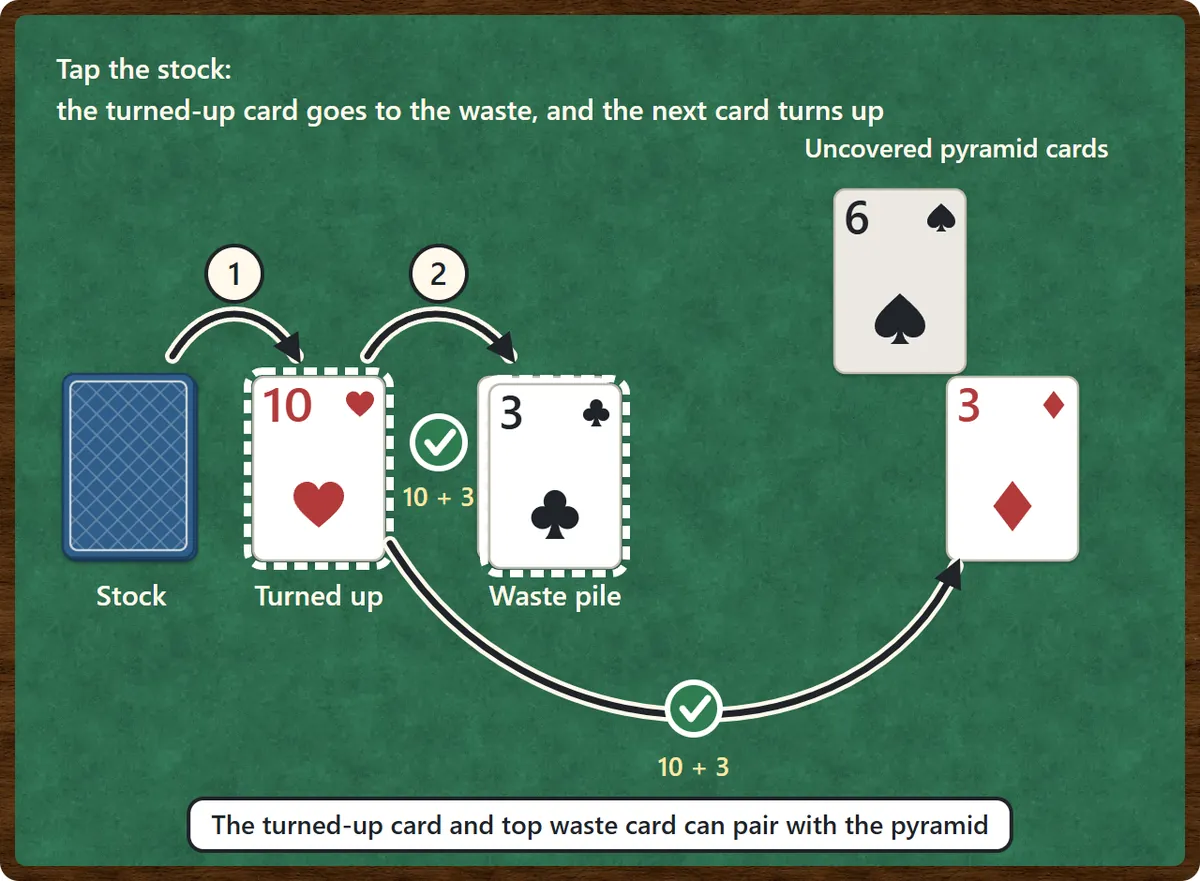
When no pair is available in the pyramid, turn to the stock. The turned-up card can pair with any uncovered card in the pyramid or with the top card of the waste pile. If you don’t use it, tap the stock: the turned-up card moves onto the waste pile and the next card from the stock turns up. Only the top card of the waste pile is available.
Redealing, and the three rule sets
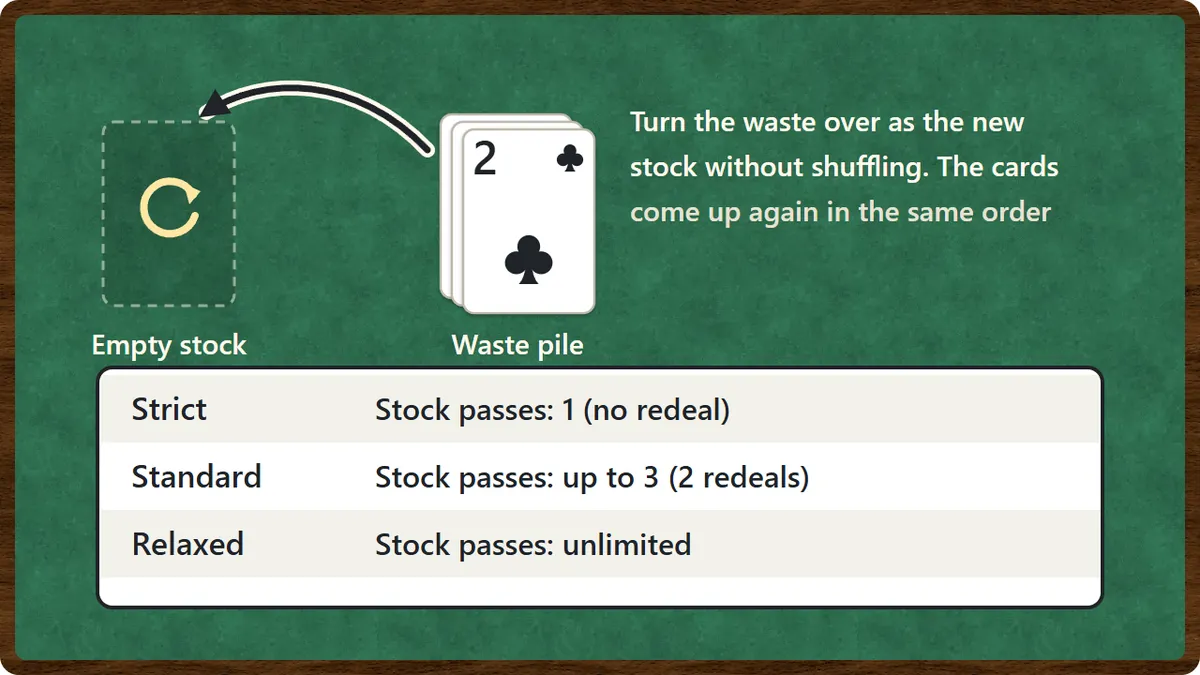
When you reach the end of the stock, you can turn the waste pile over to make a new stock and go through it again. This is called a redeal. The cards aren’t shuffled, so they come up in the same order as before. How many times you may go through the stock varies from book to book and from game to game, so this game lets you choose.
| Rules | Passes | What it’s like |
|---|---|---|
| Strict | 1, no redeal | The traditional, demanding version. You have to decide on every card whether to use it now or let it go. |
| Standard | Up to 3 (2 redeals) | The same as many solitaire collections. Remembering which cards are coming up gives you an edge. |
| Relaxed | Unlimited | For taking your time, or for learning the game. |
With Custom rules you can also set the goal to “Clear the stock and waste too”, which means pairing off all 52 cards. That is a much harder way to play. Every deal this game gives you has been checked to be winnable with the rules you picked, so you will never get a deal that can’t be cleared.
How to use this game
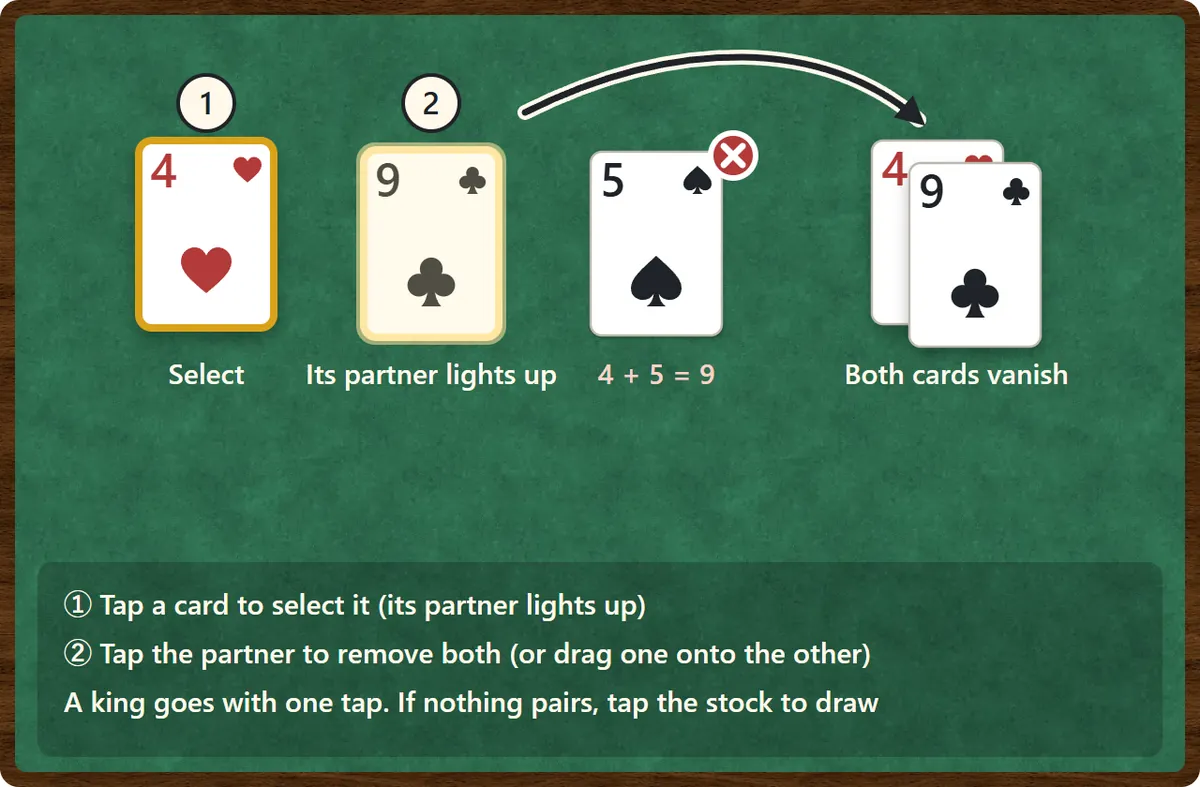
Tap or click a card to select it, and every card that pairs with it to make 13 lights up. Tap one of the highlighted cards and the two come together and disappear. You can also drag one card onto its partner. A king is removed with a single tap, and when a card has only one possible partner, a quick double-tap removes the pair. If you try a pair that doesn’t work, the game tells you why, for example “A 6 and an 8 add up to 14, so they can’t be removed.”
Undo takes back as many moves as you like. Hint marks a good next move with white frames, and if the position can no longer be won, it tells you how many moves to go back. On a keyboard, use the left and right arrow keys to move between available cards, Enter to select, Space or D to draw, Z to undo and H for a hint.
How Pyramid Solitaire scoring works
There is no single official way to score Pyramid, so this game uses a common method. You earn 5 points for every removal, whether it is a pair or a single king. On top of that, clearing a whole row of the pyramid earns a bonus that grows as you work upward.
| Row cleared | Bonus |
|---|---|
| Row 1 (bottom, 7 cards) | 25 |
| Row 2 | 50 |
| Row 3 | 75 |
| Row 4 | 100 |
| Row 5 | 150 |
| Row 6 | 250 |
| Row 7 (top card) | 500 |
If you run out of moves, the game also shows the traditional score: the number of cards left in the pyramid. Under that old method, lower is better and zero is a win. Your score and time count as a personal best only when you win without using hints.
Pyramid Solitaire strategy: tips to win more games
1. Remove kings right away
A king needs no partner, so there is never a reason to keep one. Take it as soon as it is uncovered, and the cards around and above it can start to open up.
2. Prefer pairs inside the pyramid
When two pyramid cards can pair with each other, you save the stock cards for later, when they may be the only partners for cards higher up. Still, look at which cards each pair would uncover before you choose.
3. Choose the pair that uncovers the most
If you have a choice between two cards of the same rank, take the one whose removal frees a card in the row above. The more cards you uncover, the more pairs become possible. Try to take the pyramid apart evenly from both sides rather than digging into one corner.
4. Check where the partners are hiding
If every 7 that could pair with a 6 near the top is buried underneath that 6, the 6 can never be removed. Before you use up the partners of a high card, make sure at least one of them will still be reachable when you need it.
5. Remember the order of the stock
Because a redeal doesn’t shuffle the cards, the stock always comes up in the same order. Pay attention on your first pass through it. On the next pass you can plan ahead, for example leaving a pyramid card in place because you know its partner is coming up soon.
6. When you’re stuck, go back
The order in which you take pairs changes everything in Pyramid. If you hit a dead end, undo a few moves and try a different combination, or ask for a hint.
Is every game of Pyramid Solitaire winnable?
No, and by a wide margin. Pyramid is one of the harder patience games to win with a random deal. Even if you knew where every card was and played perfectly, roughly two out of three deals could be cleared with three passes through the stock, and only about one in ten with a single pass. For the traditional strict game of removing all 52 cards, an old rule of thumb says you can expect to win about one game in fifty.
That is why this game only deals games that a computer has already solved under the rules you chose. The challenge is finding the right order of pairs, not hoping for a lucky deal. If you get stuck, the way through is there, and Hint can point you toward it.
Pyramid Solitaire FAQ
Can I pair the turned-up card with the top of the waste pile?
Yes. If the turned-up card and the top card of the waste pile add up to 13, you can remove them together. The next card in the waste pile then becomes the top card and can be used.
Can I pair two cards when one is covering the other?
Not in this game. Only uncovered cards can be used, so while an ace is lying on a queen, the queen isn’t available. Some versions allow this special case, but most don’t, and this game follows the more common rule.
Are the pyramid cards face up or face down?
All the pyramid cards are dealt face up, as in most modern versions, so you can see the whole layout and plan ahead. Some old rule books deal the upper rows face down and turn each card over when it is uncovered.
What is the Daily Deal?
The Daily Deal is one deal chosen for each date and played with the Standard rules. Everyone who plays on the same day gets the same cards, so you can compare scores and times with friends and family. Win it on consecutive days to build a streak.
Can I stop and continue later?
Yes. Open the game again on the same device and browser and press Continue. Your undo history is saved too. The game starts with the sound off; press “Sound: off” to hear sound effects when you remove cards.
Does it work on a phone, tablet or Chromebook?
Yes. The game runs in any modern browser with a mouse, a keyboard or a touch screen, and the cards are large enough to tap on a phone.
Where Pyramid Solitaire comes from
Pyramid is an old member of the family of “adding” patience games, where cards are removed in pairs that make a certain total. Nobody knows exactly when or where it was first played, and it takes its name simply from the shape of the layout. Descriptions appear in classic books of card games, and in the early 1990s it began to appear in solitaire collections for home computers, sometimes under other names. The details still vary from one version to the next, especially how many times you may go through the stock and whether you must also clear the stock to win. Its mix of quick arithmetic and planning ahead is a big part of why it remains so popular.