 Yorimichi Games
How to play Five Card Draw Poker
Five Card Draw is the poker game most people learn first. Everyone is dealt five cards that only they can see. You look at your hand, throw away the cards you don’t want, and draw the same number of new ones from the deck. Then all the hands are turned face up, and the best poker hand wins. That’s the whole game: know the hands, and decide what to keep.
On this page you can play it two ways. Hand practice is a solo mode where you deal, swap and score points for each hand you make, which is a relaxed way to learn the hand rankings. Vs computer puts you at a table with one to three computer players. You can play the simple version, where hands are just compared, or switch on point rounds to open, call, raise and fold the way a real poker game flows.
A quick word about points: every player starts with 100 points, and they are only a score for keeping track of who is ahead. There are no chips, nothing is won or lost outside the game, and your points reset whenever you start a new match.
The table
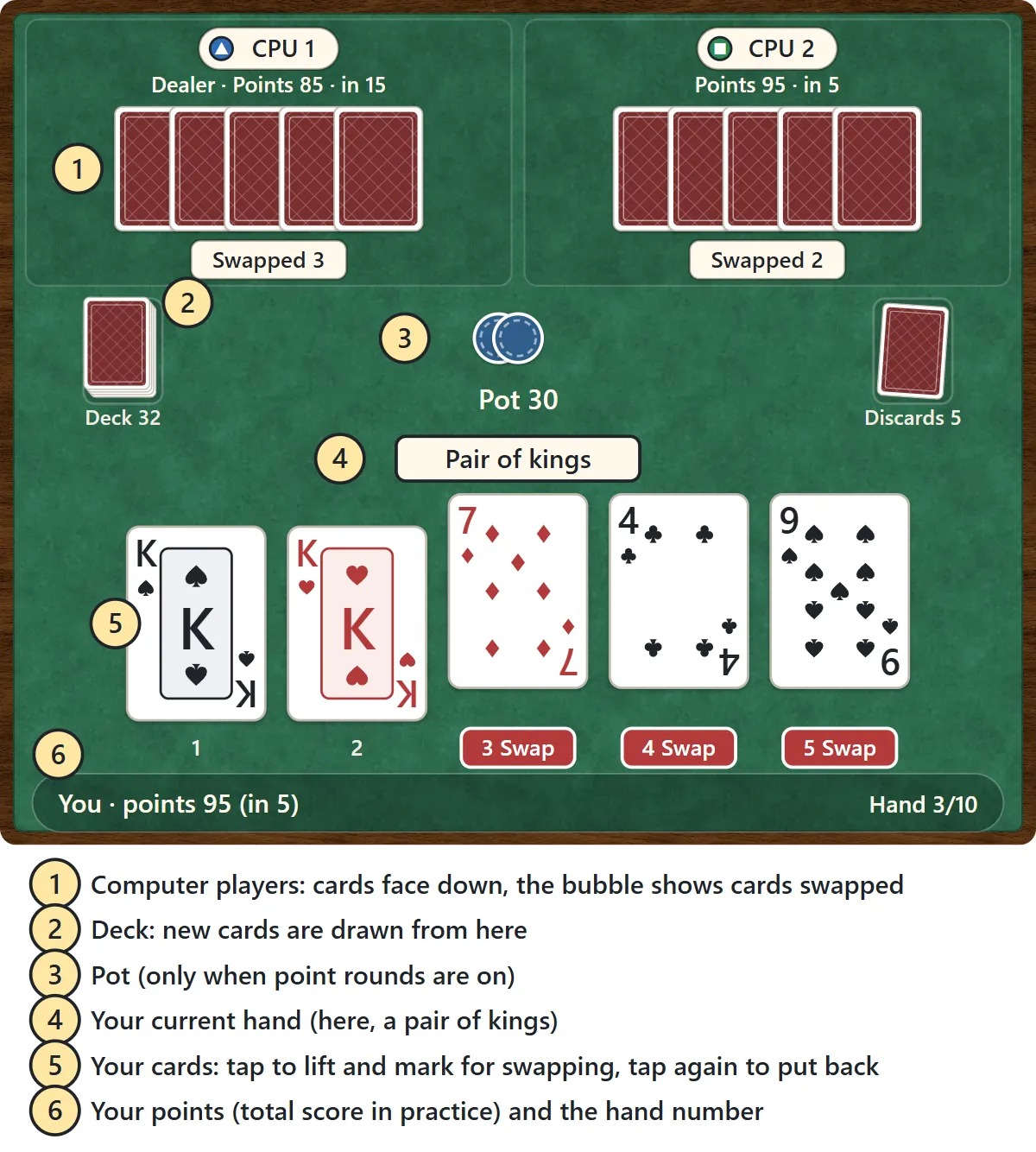
Your five cards are at the bottom, face up. Right above them you’ll see the name of the hand you are holding right now, such as “Pair of kings” or “High card (A)”. The computer players’ cards stay face down until the showdown; all you can see is how many cards each of them swapped. The list of poker hands below the table is always visible, and the hand you are holding is highlighted in it.
One hand, step by step
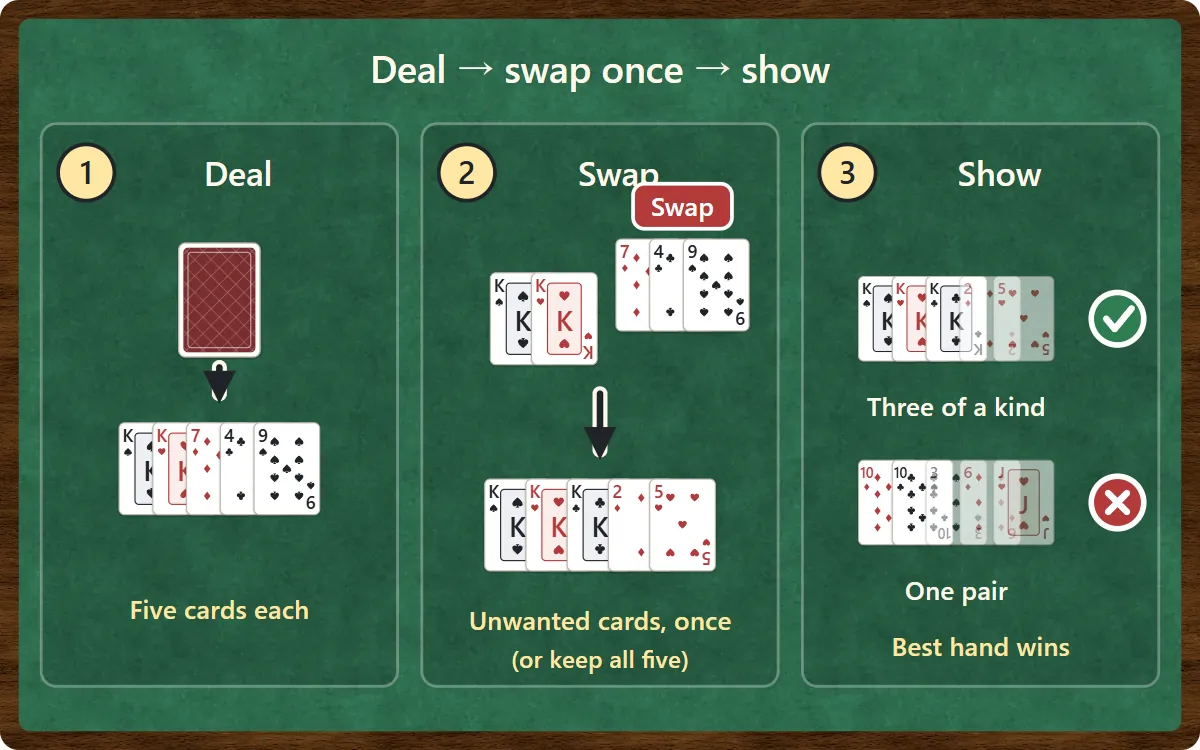
- The deal. Starting with the player after the dealer, everyone gets five cards, one at a time. The dealer moves one seat around the table after every hand.
- The draw. On your turn, tap the cards you want to get rid of and press Swap. They go to the discard pile and you draw the same number from the deck. You can swap anything from zero to five cards (unless the rules say otherwise), but you only get to do it once. Keeping all five is called standing pat.
- The showdown. When everyone has drawn, the hands are shown. The player with the highest-ranking hand wins.
Poker hand rankings
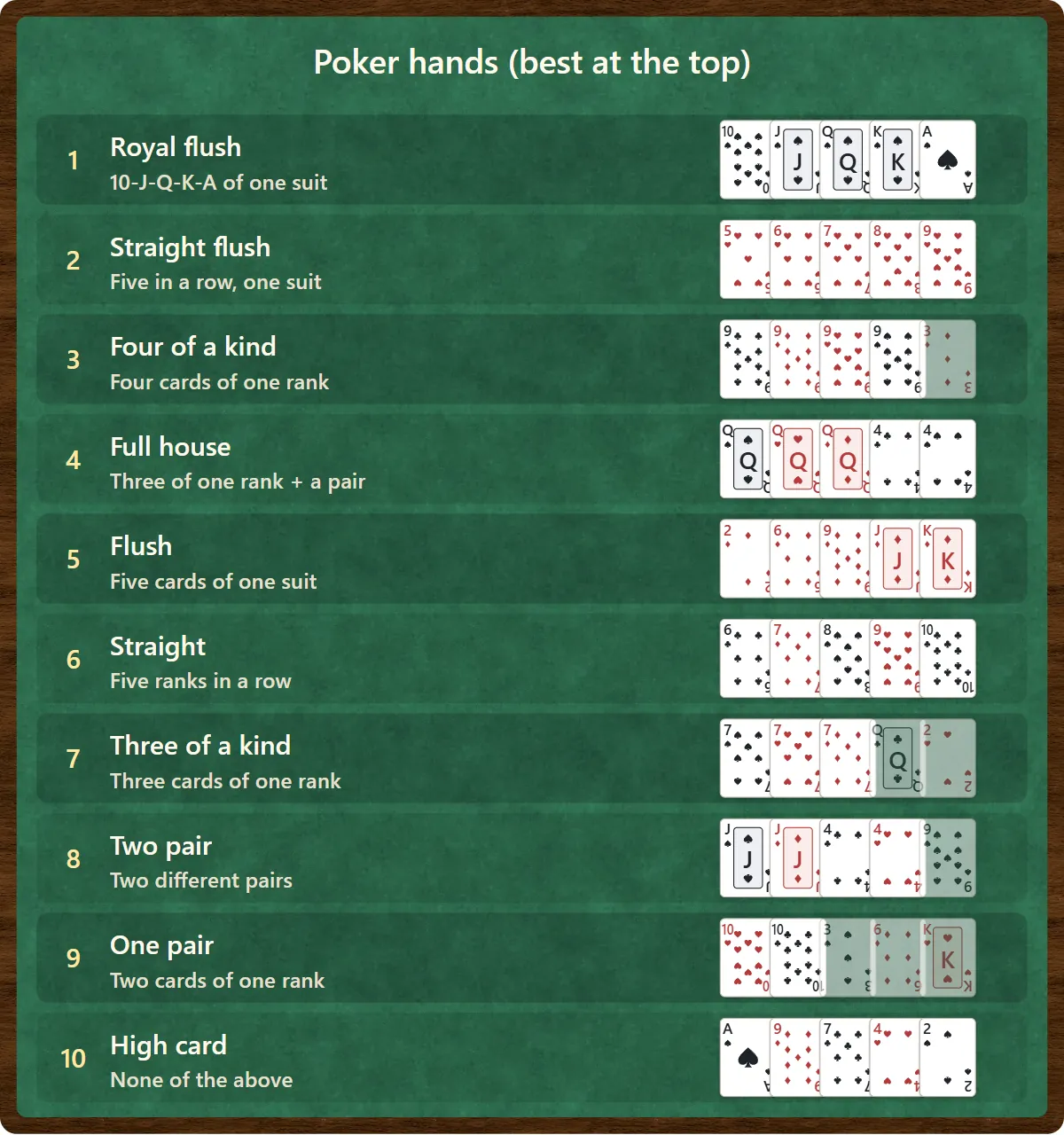
| Hand | What it is |
|---|---|
| Royal flush | 10, J, Q, K and A of the same suit |
| Straight flush | Five cards in a row, all of one suit |
| Four of a kind | Four cards of the same rank |
| Full house | Three of one rank plus a pair of another |
| Flush | Five cards of one suit, in any order |
| Straight | Five ranks in a row, any suits |
| Three of a kind | Three cards of the same rank |
| Two pair | Two different pairs |
| One pair | Two cards of the same rank |
| High card | None of the above |
Card ranks run A, K, Q, J, 10, 9 … 2, with the ace as the highest card. The game uses a standard 52-card deck without jokers, so there are no wild cards.
Aces in a straight
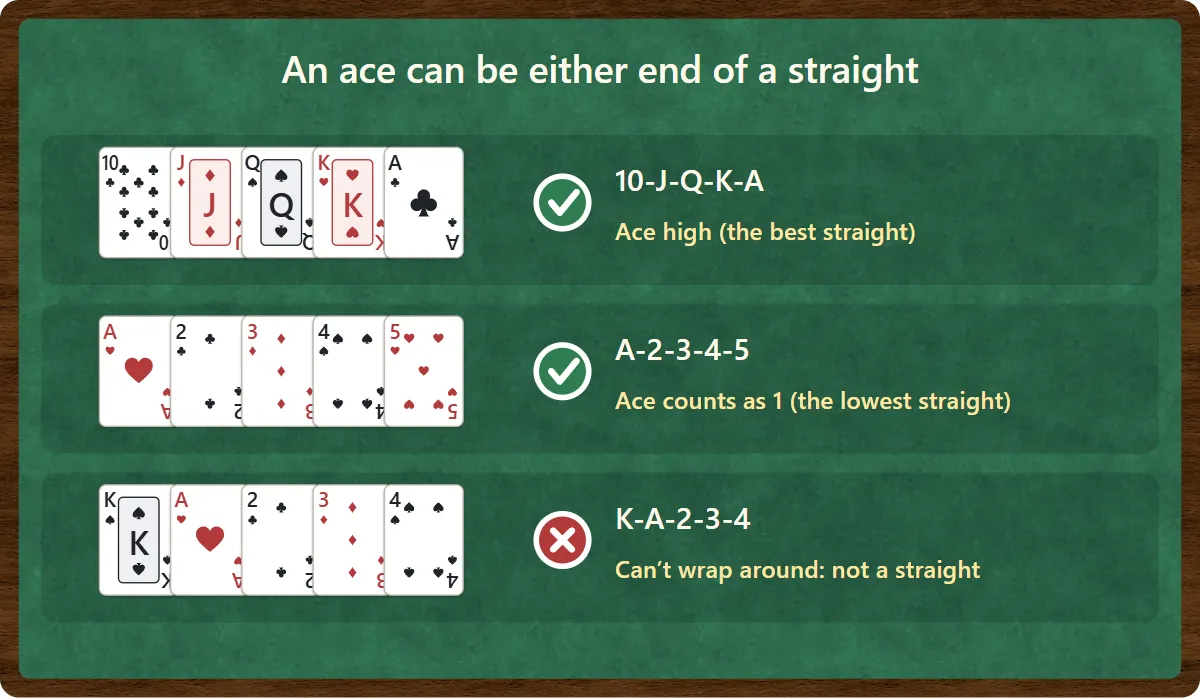
An ace can start a straight (A-2-3-4-5) or finish one (10-J-Q-K-A). What it can’t do is connect the two ends: K-A-2-3-4 is not a straight. When the ace is used low, it counts as a one, so A-2-3-4-5 (often called a “wheel”) is the lowest straight there is, and 10-J-Q-K-A is the highest.
Breaking ties: kickers and suits
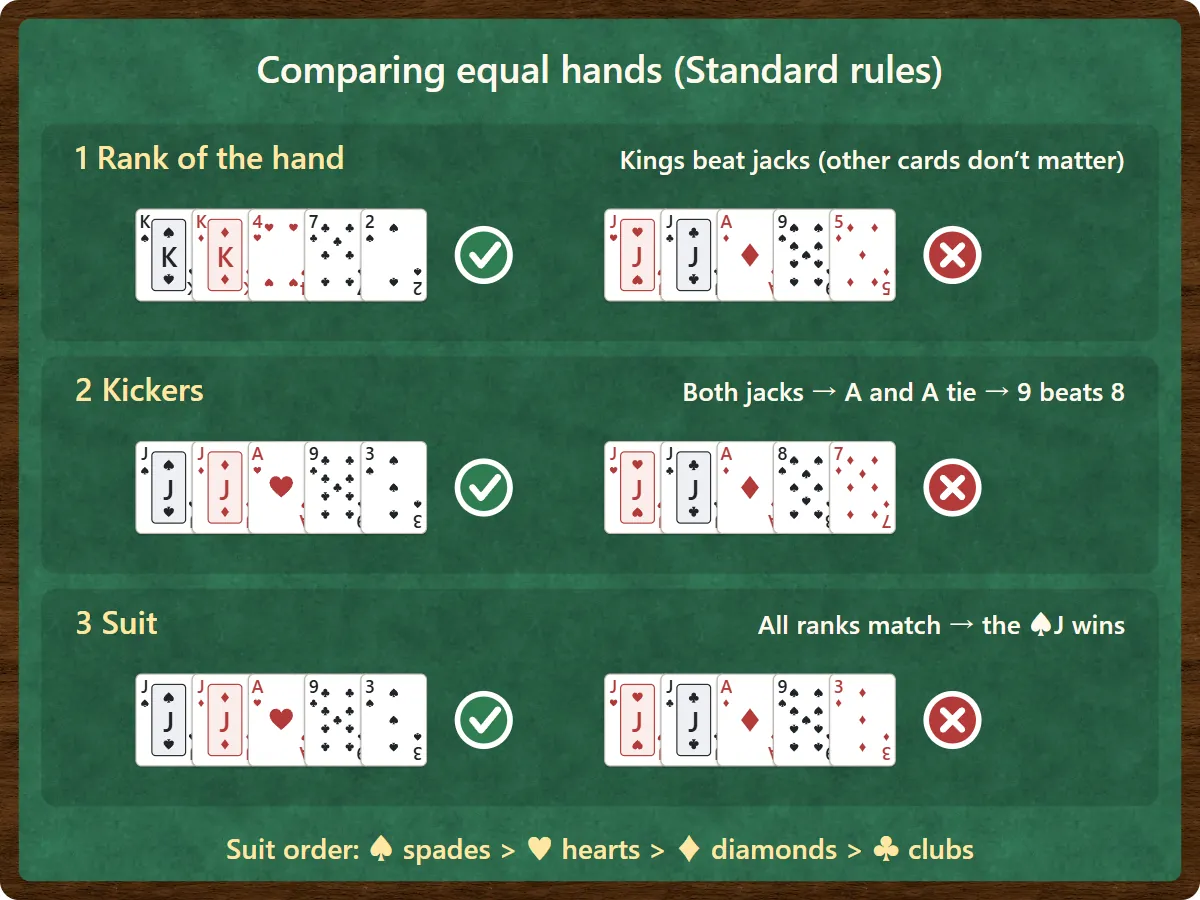
When two players have the same kind of hand, look first at the cards that make the hand. A pair of kings beats a pair of jacks. With two pair, compare the higher pair first. A full house is ranked by its three of a kind. Straights are ranked by their top card, and flushes and high-card hands are compared card by card from the top.
If that’s still equal, compare the leftover cards, known as kickers, from the highest down. Say two players both hold a pair of jacks. One has A-9-3 alongside it and the other has A-8-7. The aces match, so the next card decides: 9 beats 8. In the Standard rules, if every single rank matches, the suit of the top card breaks the tie, in the order spades, hearts, diamonds, clubs.
Five Card Draw rules on this site
Hand practice scoring
In Hand practice you play alone for 5, 10 or 20 hands and score points for each hand you finish with: one pair 1, two pair 2, three of a kind 3, straight 5, flush 6, full house 8, four of a kind 20, straight flush 40 and royal flush 80. Your best total for each length is saved, so you can try to beat it. Turn on the hint and it shows the chance of improving for each way of keeping your cards, which makes this mode a good place to learn the hands.
Point rounds: check, open, call, raise and fold
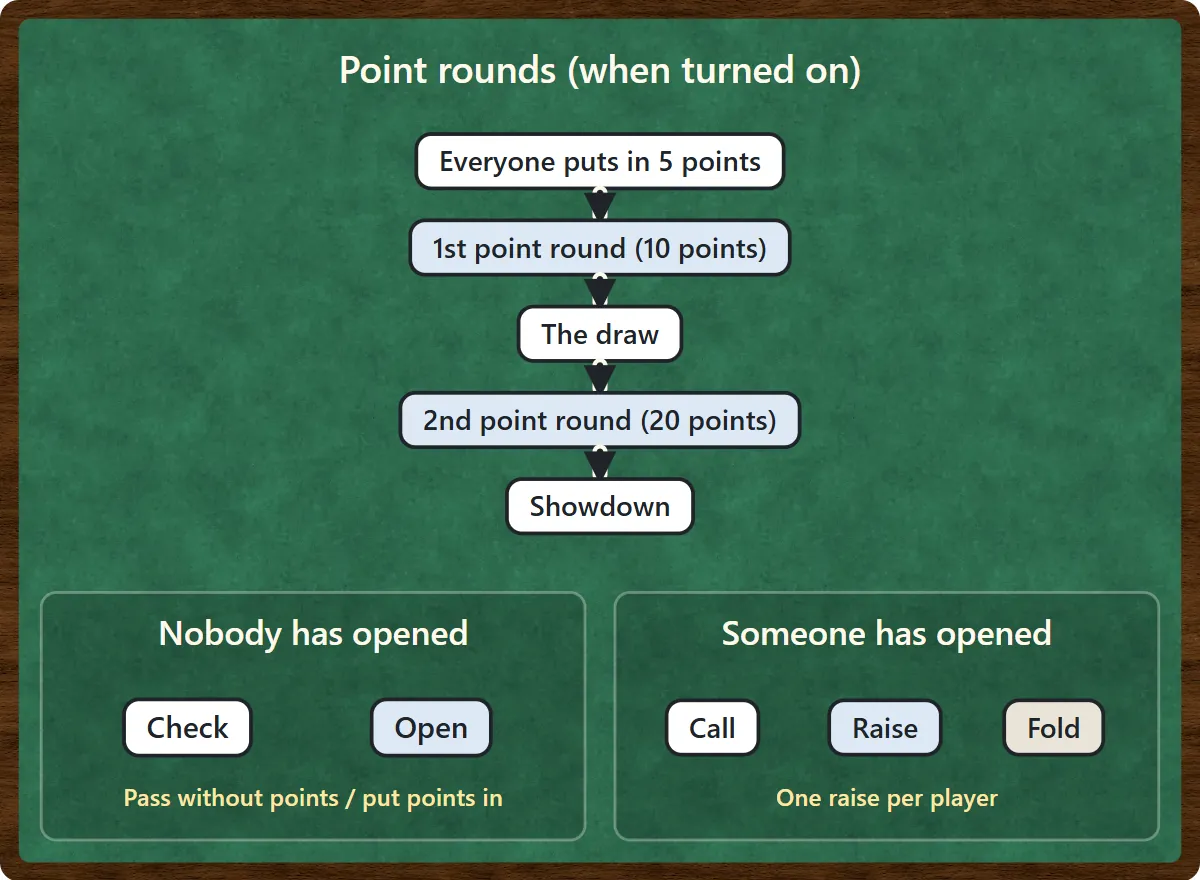
Against the computer, the simple setting just compares hands and counts how many you win. Once you’re comfortable, turn point rounds on. Everyone starts with 100 points and puts 5 into the middle (the pot) at the start of each hand. There is one point round before the draw and one after it. On your turn you choose one of these:
- Check: if nobody has put in points yet, pass to the next player without adding any.
- Open: put points into the pot (10 before the draw, 20 after it).
- Call: add the same amount as the last player so you stay in the hand.
- Raise: add 10 more than the last player (20 more after the draw). Each player can raise once per point round.
- Fold: drop out of this hand. The points you already put in stay in the pot.
Of the players who are still in at the end, the one with the best hand takes the whole pot. If everyone else folds, the last player left takes the pot without showing their cards. When the chosen number of hands is over, the player with the most points is first. To keep things simple, nobody can put in more than the player with the fewest points could match.
Rule variations
| Rule set | Equal hands | Cards you can swap |
|---|---|---|
| Standard | Kickers, then suit | Any number |
| Japanese | Pair or set only, then suit | Any number |
| Classic draw | Kickers, then a tie | Up to 3 (4 with an ace) |
Draw poker has been played at kitchen tables for a long time, and the small rules vary from group to group. In Japan, the long-standing family version compares only the rank of the pair or set and then goes straight to suits, so there is never a tie. The classic draw rules found in most English rule books never use suits; if two hands are equal right down to the last kicker, the pot is split. Those rules also limit the draw to three cards, or four when you keep an ace. The Standard setting sits between the two. With Custom you can pick each rule yourself.
Five Card Draw strategy and tips
1. Keep a pair and swap the other three
With one pair, the textbook play is to keep just the pair and draw three. It’s tempting to hold an ace next to it as a kicker, but drawing three cards gives you a better chance of making three of a kind or two pair.
2. Two pair draws one, three of a kind draws two
With two pair, swap the odd card and hope for a full house. With three of a kind, swap the other two for a shot at a full house or four of a kind. Never break up a hand that’s already made just to chase something bigger.
3. Four to a flush or an open straight is worth a draw
Four cards of one suit will become a flush roughly one time in five when you draw one card. Four cards in a row that are open at both ends, like 6-7-8-9, have about the same chance of making a straight. A gutshot, where the missing card is in the middle (5-6-8-9), comes in only about half as often.
4. With nothing, keep your highest card
If you have no pair and no draw, keeping an ace or a king and swapping four gives you the best chance at a high pair. With only small cards, swapping all five is a reasonable move.
5. Watch how many cards the others draw
The number of cards a player swaps says a lot. Standing pat usually means a straight or better. Drawing one often means two pair or a flush or straight draw. Drawing three usually means a single pair. When point rounds are on, use this to decide whether to stay in or fold.
6. When in doubt, press Hint
The hint lists the best ways to keep your cards along with the chance of making each hand, and marks the cards to keep with a green frame. During point rounds it also estimates your chance of winning based on how many cards everyone swapped, and tells you whether calling is worth it.
Five Card Draw FAQ
How many players can play Five Card Draw?
Two to six is the usual range with one 52-card deck. Here you can play alone in Hand practice or with up to three computer players. With seven or more at a real table, the deck can run short during the draw.
What happens when two players both have high card?
Compare the highest cards. If they match, compare the second highest, then the third, and so on. A hand with an ace beats any hand whose top card is a king.
Which is better, a flush or a straight?
A flush beats a straight. Five cards of the same suit are harder to get than five in a row. A full house beats both.
Does the computer look at my cards?
No. The computer players only know their own cards, how many cards everyone swapped and how everyone played their points. The deck is shuffled before every hand. Hard reads opponents from their draws and sometimes bluffs. Easy sometimes misjudges its hand or keeps an extra high card with a pair, the kind of choices many new players make.
Is poker just luck?
A single hand often comes down to the cards you’re dealt. Over a full match, though, better draws and better timing on when to fold add up. With point rounds on, not chasing weak hands and making the most of strong ones is what separates the players.
How do I play at home with a real deck?
Use one deck without jokers for two to six players. For point rounds, keep score on paper or use counters such as buttons or matchsticks. The points are only there to keep score.
Can I stop and come back later?
Yes. If you close the page in the middle of a match, press Continue next time. Your settings and records are stored only in this browser on this device.
Can I play with a keyboard?
Yes. Keys 1 to 5 select cards, Enter swaps (or moves to the next hand), C checks or calls, B opens or raises, F folds and T shows or hides the hint.
Where Five Card Draw comes from
Poker is usually said to have taken shape in the early 1800s along the Mississippi River in the United States. The first versions used only 20 cards. As players moved to the full 52-card deck, flushes and straights joined the list of hands, and the draw, a single chance to swap cards, turned it into the game played on this page. Many other forms of poker have appeared since, including games with shared cards in the middle of the table, but five cards and one draw remains the classic way to learn. In Japan, this is the version families have played for generations, and the names and order of the hands turn up in many other card games and puzzles.