 Yorimichi Games
How to Play the Pipe Puzzle
This pipe puzzle is a one-player logic game played on a square grid. Every tile holds a piece of pipe, and every pipe starts out turned the wrong way. In the middle of the board sits the water source. Water flows from the source into any pipe whose opening lines up with it, and from there into the next pipe, and so on. Your goal is to rotate the tiles until the water reaches every single pipe on the board. You can only turn the pieces – you never move, swap or place them – so the whole game is about finding the one direction each pipe must face. The rules take a minute to learn, and the puzzles range from a quick two-minute warm-up to a real brain-teaser.
Five kinds of pipe – tap to rotate
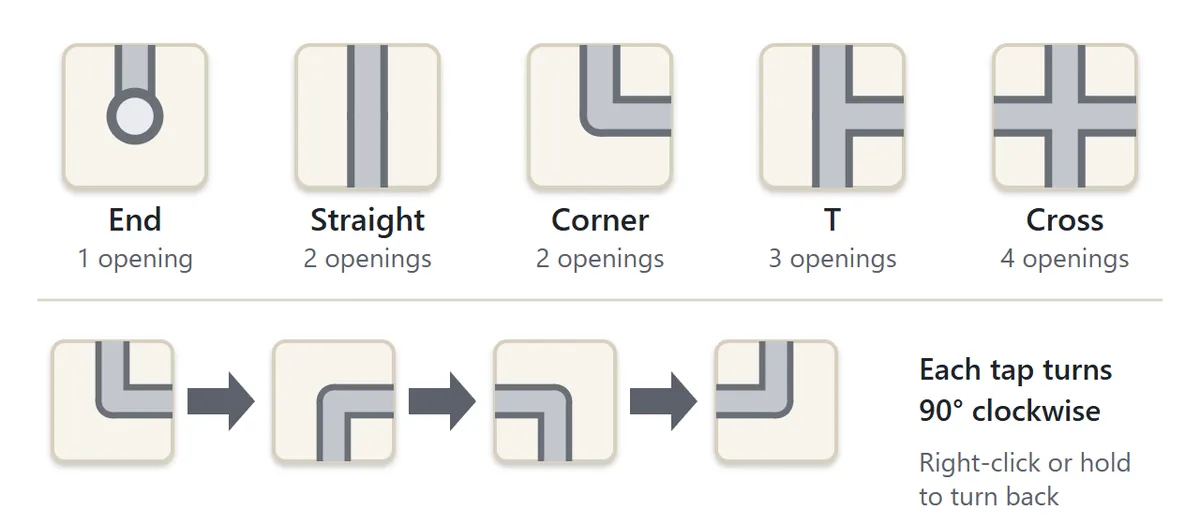
The pieces come in five shapes: an end with a single opening (a dead-end cap), a straight pipe, a corner that bends, a T that splits three ways and a cross that opens in all four directions. Tap or click a tile to rotate its pipe a quarter turn clockwise. To turn it counterclockwise, right-click with a mouse or press and hold on a phone or tablet. A straight pipe only has two different positions, and a cross looks the same however you turn it, so a cross never needs rotating.
Water flows where openings meet
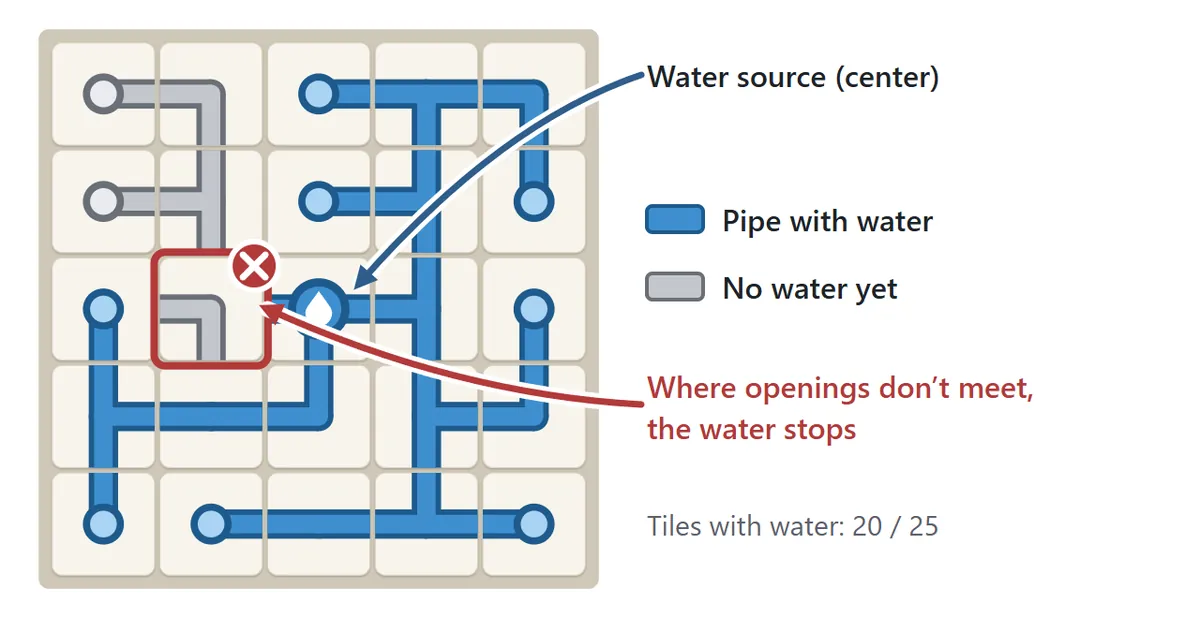
When the openings of two neighboring pipes face each other, water flows across and the pipe turns blue. Where an opening points at a wall or at the side of another pipe, the water stops. Because the flow updates every time you rotate a tile, the color of the pipes always shows how far your network reaches. The bar above the board also counts how many tiles have water.
Connect every pipe to solve the puzzle
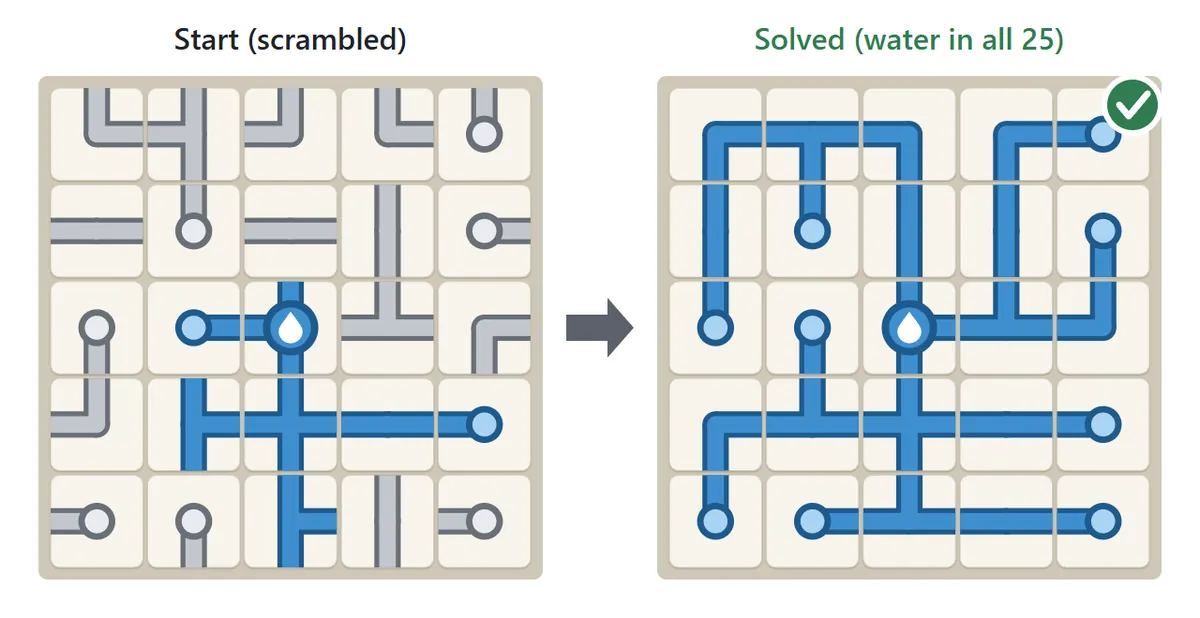
The puzzle is solved as soon as water reaches every tile. In the finished network, no pipe forms a closed loop, every opening is joined to a neighboring opening, and nothing points off the board or into a dead end. Each puzzle is created by first building a network like this and then scrambling every tile at random. Every puzzle has exactly one solution, so it can always be solved by reasoning – no lucky guesses required.
Board Sizes and Wrap-Around Edges
| Board | Tiles | Good for |
|---|---|---|
| 5×5 | 25 | Your first games – a few minutes each |
| 7×7 | 49 | Once you know the basic tricks |
| 9×9 | 81 | A longer, tougher challenge |
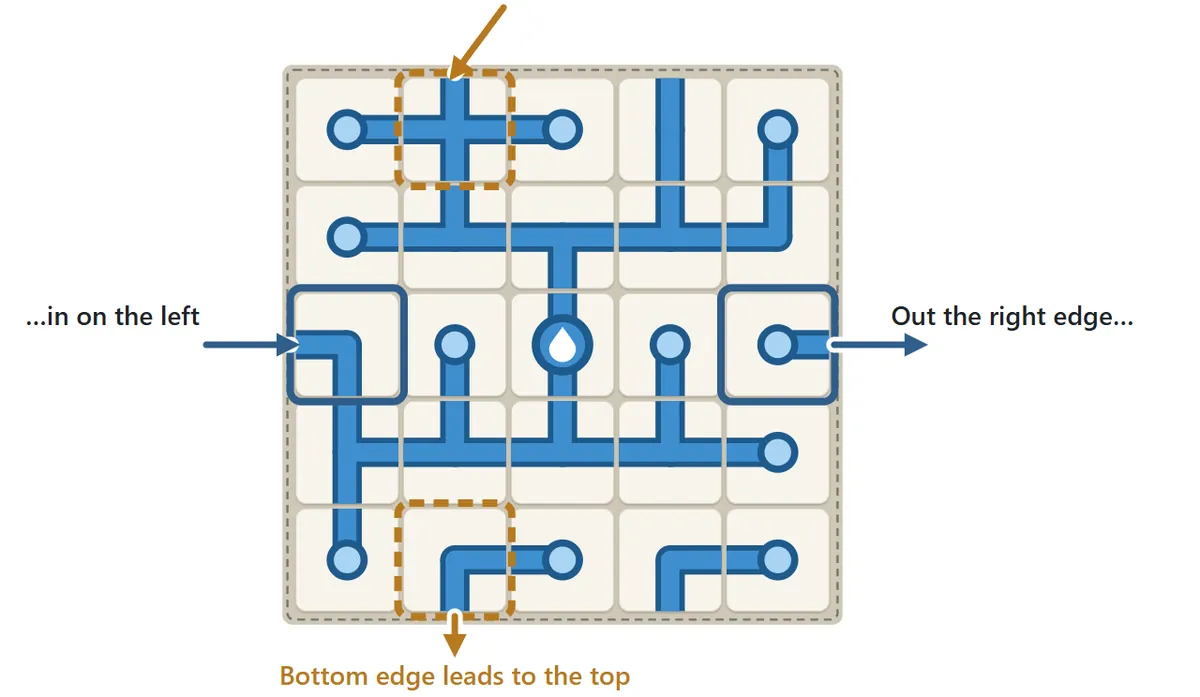
Set Edges to Wrap around for the advanced rules. An opening that leaves the right edge continues on the left edge of the same row, and an opening that leaves the bottom continues at the top of the same column. Because nothing can point off the board any more, the edge pipes no longer give you a free starting point, and the puzzle becomes much harder. A dashed line around the board shows that the edges are connected. The daily puzzle always uses the standard edges, with one puzzle for each board size.
Pipe Puzzle Strategy: How to Solve It
1. Start with the corners and edges
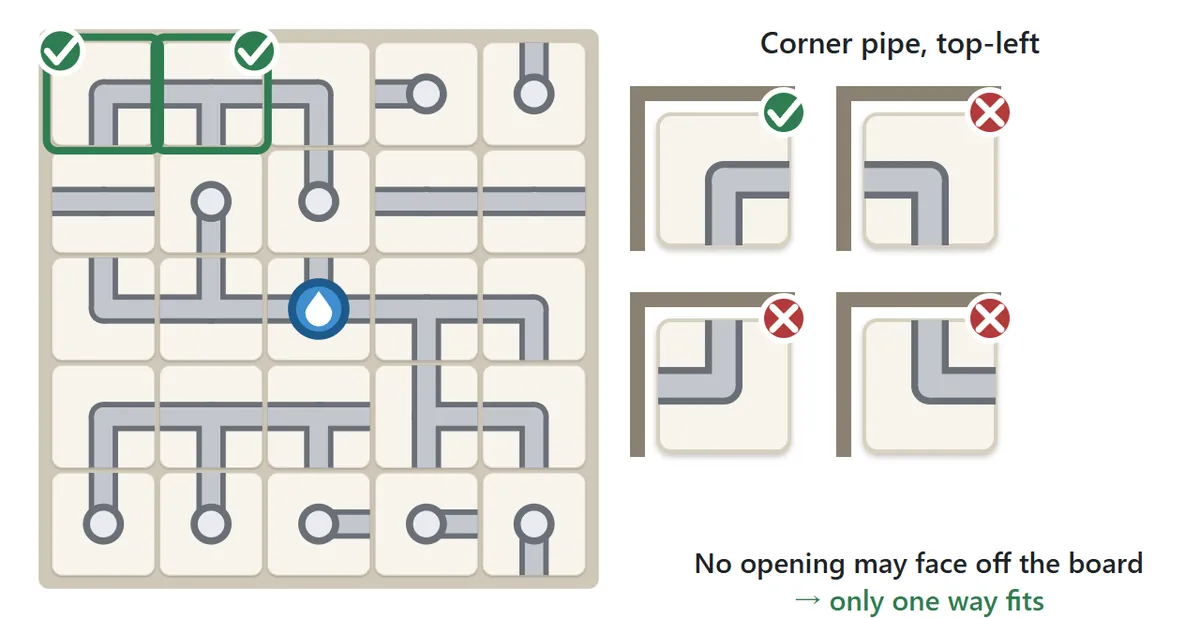
With standard edges, no opening may point off the board. That means a corner pipe sitting in a corner of the board has only one possible position, and so does a T pipe on an edge. A straight pipe on an edge can only run along it. Walk around the border first and fix every pipe whose position is forced. Each fixed pipe gives new information to its neighbors.
2. Lock the pipes you are sure of
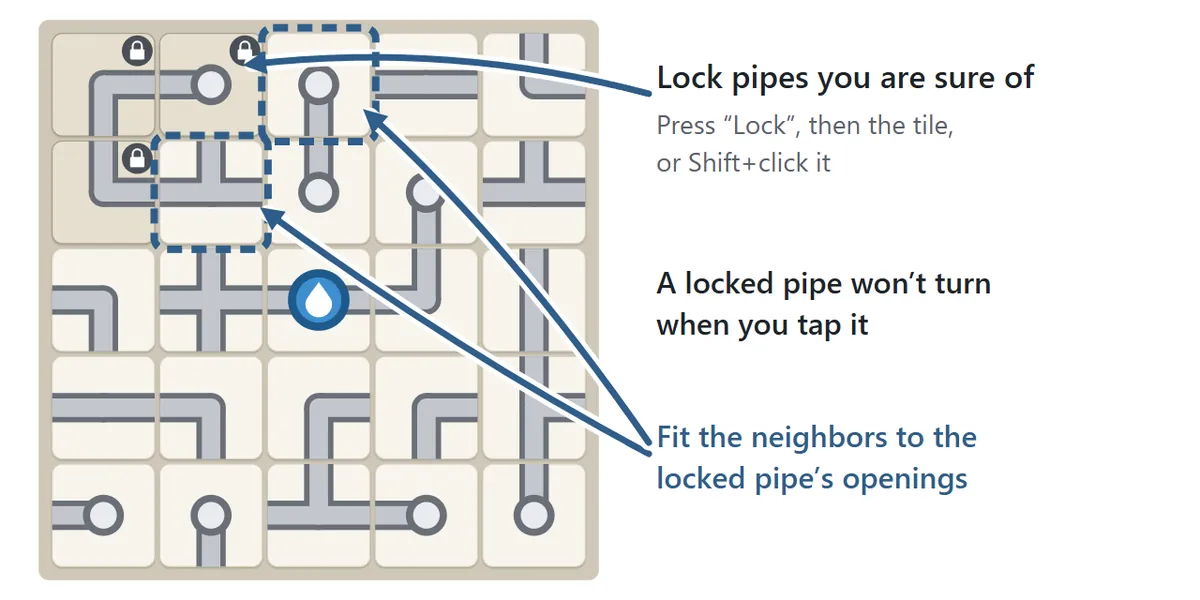
Once you know a pipe is right, lock it. Press the Lock button and then tap the tile, or hold Shift and click it. A locked tile won’t rotate when you tap it, so you can’t knock it out of place by mistake. Then look at the neighbors of your locked tiles: any opening that points at a neighbor has to be met by an opening from that neighbor, and any side without an opening must face a side without one. Deductions like this often ripple across the board one tile after another.
3. Never close off a group or make a loop
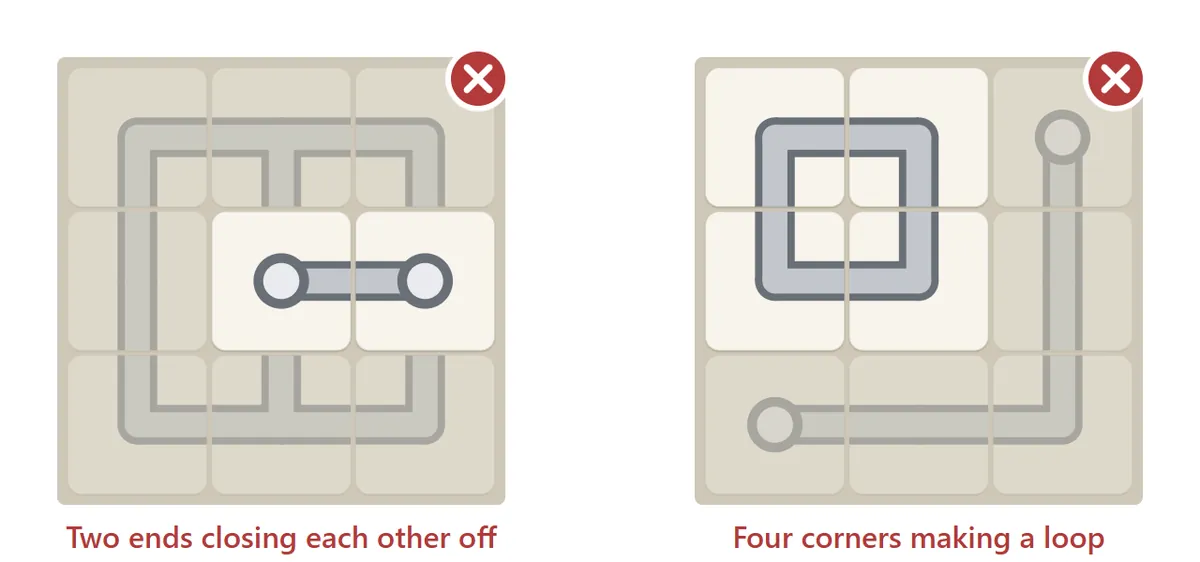
If two end pieces face each other, those two tiles form a closed group that can never connect to the rest of the network. The same goes for any small cluster that runs out of openings before it reaches the source. Loops are forbidden too: the solution spreads out like the branches of a tree, with exactly one route from the source to every tile. So whenever a position would seal off a group or close a loop, you can cross it off your list without trying it.
4. Grow the network out from the source
Working outward from the water source makes it easy to see your progress, since every connected pipe turns blue. A tile that a blue pipe points into must have an opening facing back. Combine that with the locked tiles around it and there are usually only one or two positions left to consider.
5. Undo and hints are there when you need them
When you are stuck, it is fine to try a rotation and take it back with Undo. If you still can’t see the next step, press Hint: the game turns one wrong pipe to its correct position and locks it. If you have locked a pipe in the wrong position, the hint fixes that one first. Games where you used hints or undo still count as solved, but not toward your personal best time.
6. Build up from small boards
A 5×5 board has only 25 pipes, which makes it perfect for learning to work in from the edges. When that feels easy, move up to 7×7 and 9×9, and finally try the wrap-around rules for the hardest challenge.
Pipe Puzzle FAQ
Does every puzzle have only one solution?
Yes. For each puzzle there is exactly one way to orient all the pipes (positions that look identical, like a straight pipe turned half a turn or a cross, count as the same).
What does the minimum number of moves mean?
It is the smallest number of turns needed to get from the starting board to the solution. A turn in either direction counts as one move, so turning a pipe once counterclockwise is cheaper than turning it three times clockwise. If you solve a puzzle in exactly the minimum, the result screen tells you.
Is the daily puzzle the same for everyone?
Yes – on the same date, everyone gets the same puzzle for each board size. The date comes from your own device. Your first attempt is saved as today’s record, and solving it on consecutive days builds a streak.
Can I play with a keyboard?
Yes. The arrow keys move a selection frame around the board, Space or D turns the selected pipe clockwise, A turns it counterclockwise, L locks or unlocks it, Z undoes a move and H gives a hint.
Can I stop and continue later?
Yes. Open the page again on the same device and browser and press Continue: the pipes, locks, move count and time all come back. Sound is off at first; press “Sound: off” to hear the pipes turn, the water flow and the fanfare when you solve a puzzle.
Where Does the Pipe Puzzle Come From?
Rotating scrambled pieces into a single network is often traced back to small computer games about wiring up a network of computers. In the early 2000s the idea spread as a simple web game, and since then it has appeared in puzzle collections on computers and in countless phone apps, dressed up as water pipes, electric cables or garden hoses. Wrap-around edges have been the classic advanced variant for almost as long. A well-made puzzle with a single solution unfolds step by step from the corners and edges, much like a number-placement puzzle, and that steady chain of small deductions is what makes a good pipe game so satisfying.