 Yorimichi Games
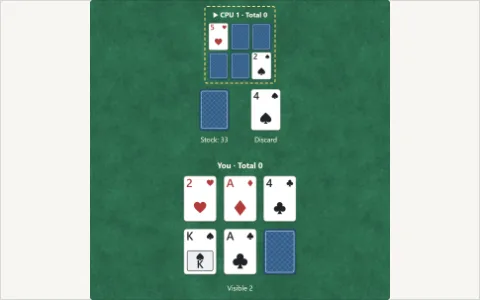
How to play single-deck Pinochle
Play a four-player partnership game with the player opposite you as your partner. You and North are Team A; East and West are Team B. This page uses a single forty-eight-card Pinochle pack, not the two-player drawing game or eighty-card double-deck game. Each suit contains two Aces, two Tens, two Kings, two Queens, two Jacks and two Nines. Everyone receives twelve cards. There are no Jokers, Twos through Eights, or cards left in a stock.
Two different activities build your team score. First, combinations already in one hand can earn meld. Then players compete to capture cards through twelve tricks. Bidding links these activities: the winner promises a total that their team must earn, and earns the right to choose trump. A promising collection of cards is useful, but it still needs sensible play and help from a partner. The game has no time limit, so you can inspect the controls and compare your next choices before confirming.
Pinochle bidding and choosing trump
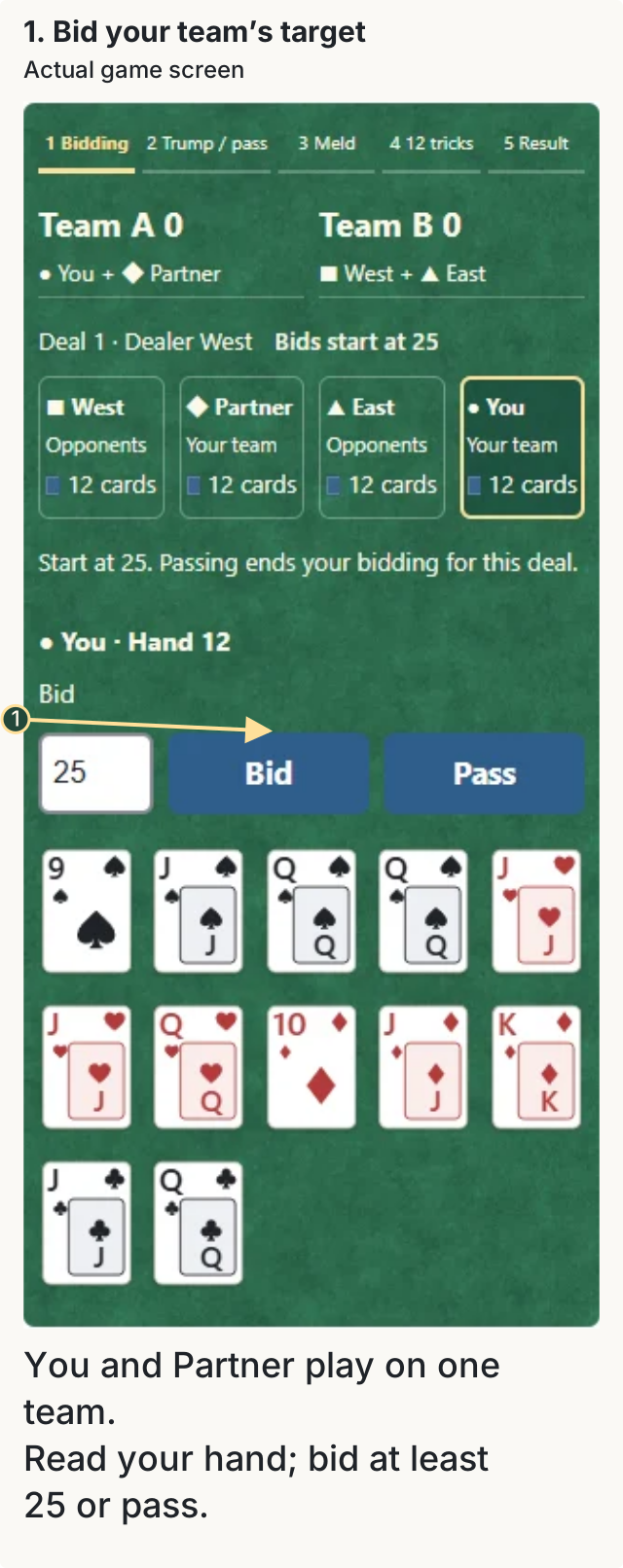
The player to the dealer’s left begins. The opening bid is twenty-five. A later bid must be at least one point above the current bid. Passing removes you from that deal’s auction. When one active bidder remains, that player names trump. If the first three players pass without bidding, the dealer takes the contract at twenty-five. Bid points describe the combined meld and captured-card score, not the number of tricks you will take.
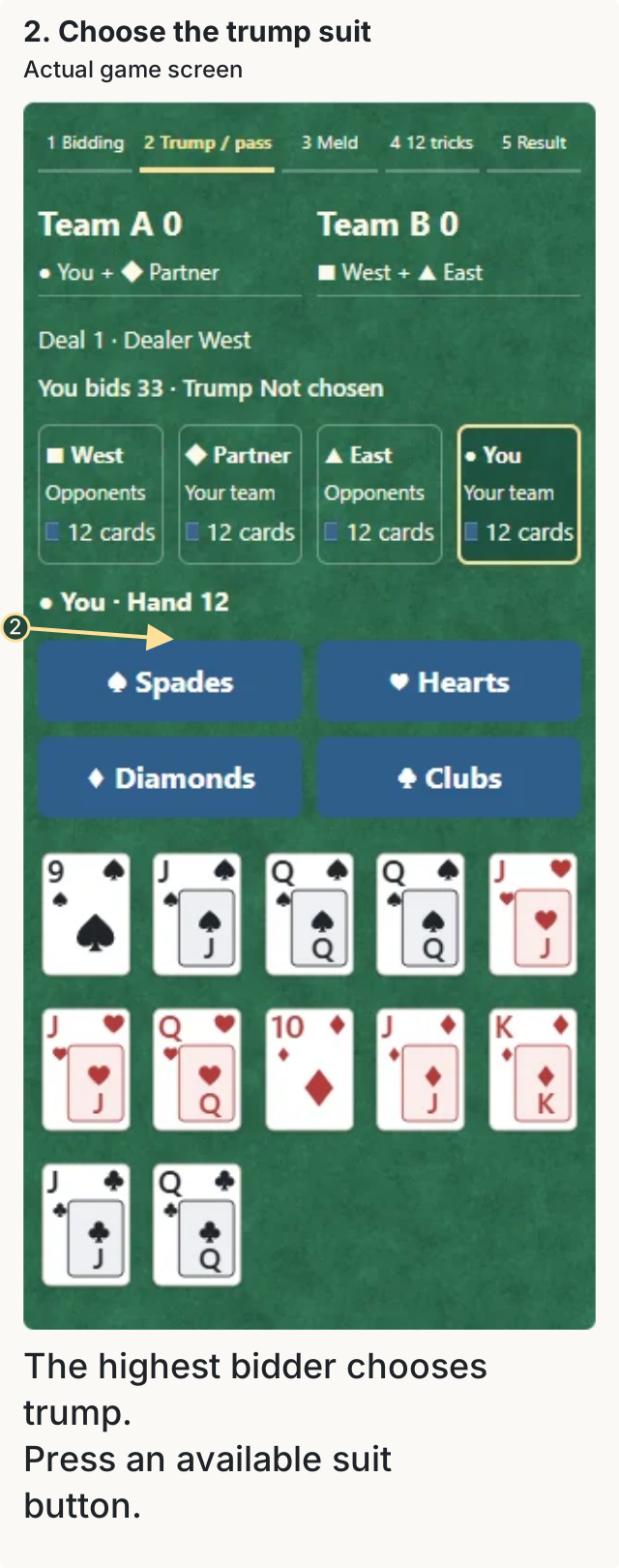
Trump is a suit whose cards beat every card of another suit. A Nine of trump beats a non-trump Ace. Within a suit, the order from high to low is Ace, Ten, King, Queen, Jack, Nine. The Ten’s position above the King is important. If identical copies compete, the one played first wins the tie. Choosing a suit as trump does not remove the duty to follow the led suit during play.
Basic settings allow any trump suit. The optional marriage requirement allows only a suit in which the bidder holds a King and Queen before the exchange. If the bidder has no eligible suit, the deal ends with the bid subtracted and no opponents’ meld awarded. Check this setting before bidding: a long suit and an eligible suit are not always the same thing.
Passing cards and the Pinochle meld chart
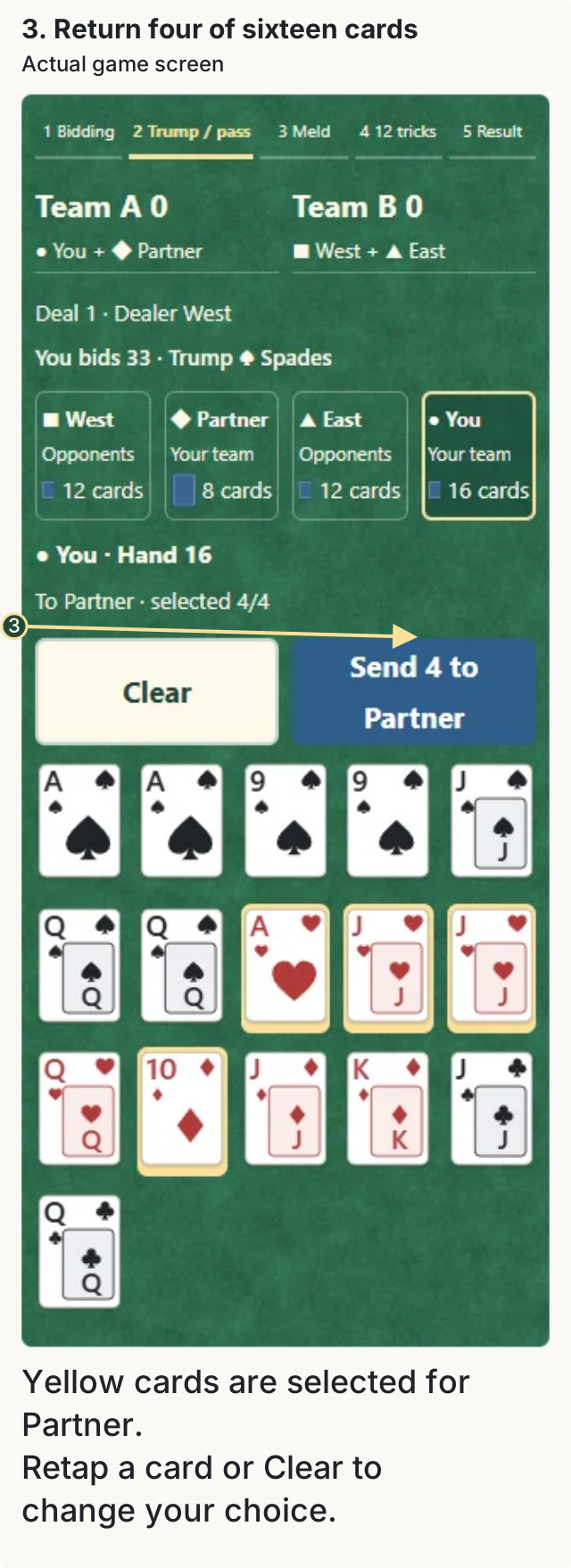
After trump is chosen, the bidder’s partner sends four cards. The bidder then returns four cards from the enlarged sixteen-card hand. Returning a received card is allowed. Everyone has twelve cards again before meld is counted. Three-card exchange and no exchange are also available. This is a sequential exchange between partners, not a simultaneous exchange or a transfer to opponents.
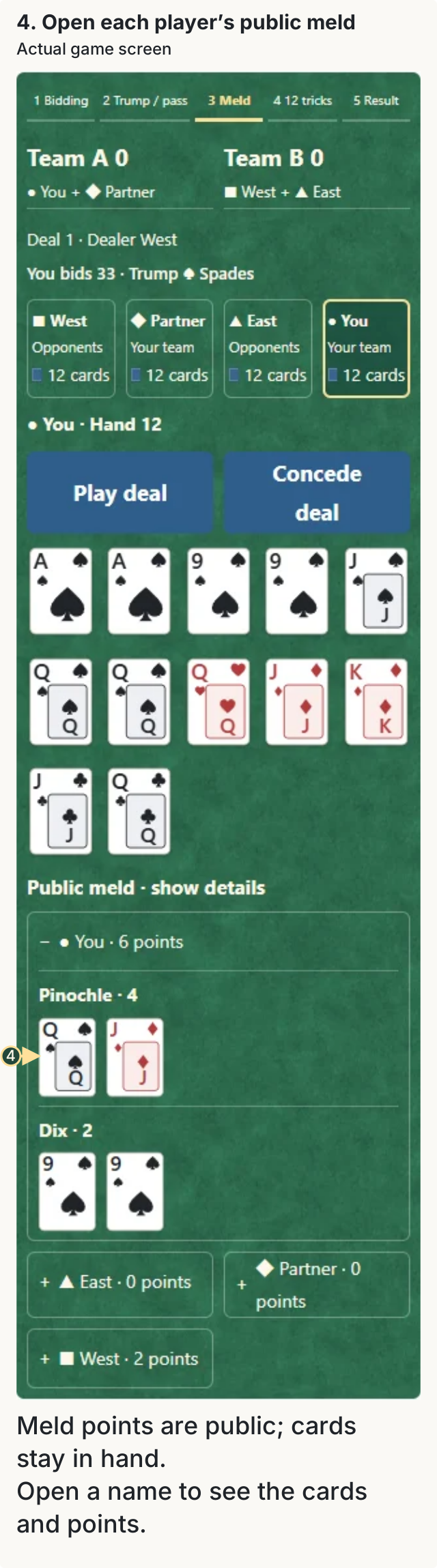
Meld must be held in one person’s hand. Partners cannot combine separate hands to form a run or an around. A trump run contains Ace, Ten, King, Queen and Jack and earns fifteen. Two complete runs earn one hundred and fifty. A King and Queen of one suit form a marriage: four in trump, two outside trump. A run’s own King and Queen do not also count as a marriage. A separate additional trump marriage earns four in Basic. A Nine of trump, called dix, earns one per copy.
Queen of Spades with Jack of Diamonds earns four for Pinochle. Two of each earn thirty for double Pinochle in Basic. Aces around, Kings around, Queens around and Jacks around need one card of the named rank in each of the four suits. They earn ten, eight, six and four respectively. Two in each suit earn one hundred, eighty, sixty and forty. Tens around earn nothing. The same card can contribute to different meld classes: a Queen may belong to an around and a Pinochle. Open a player’s meld details to inspect the combinations and the cards that were shown.
Pinochle trick-taking rules: follow, trump and overtake
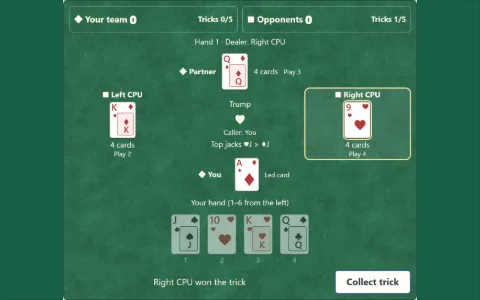
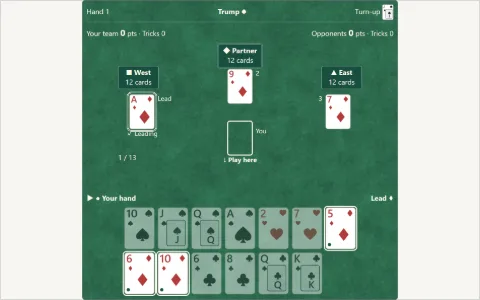
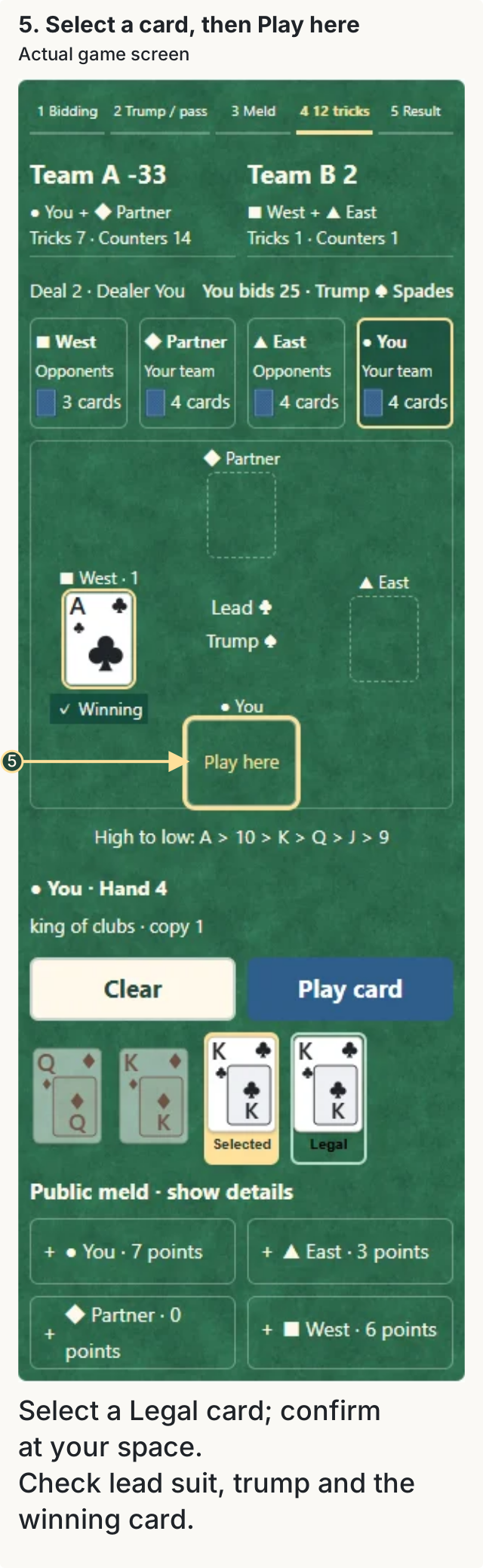
The bidder leads the first trick. Players proceed clockwise, each playing one card. If you have the led suit, you must follow it. If you are void in that suit and have trump, you must trump. Only a player holding neither the led suit nor trump may discard any other card. In Basic, within those duties you must beat the card currently winning if you can. This requirement applies even when your partner is winning.
Suppose Hearts were led and a later player trumped. A player who still holds Hearts must play Hearts, even if they also hold a stronger trump. Their Heart cannot beat the trump, so any Heart is legal. A player void in Hearts must play trump if available. In Basic they must overtrump if possible; if they cannot, they still play a lower trump rather than discard another suit. These cases explain why a powerful card can be unavailable while a weak one is legal.
The highest trump wins. Without trump, the highest card of the led suit wins. Identical copies do not overtake one another. The winner leads the next trick. After four cards are down, Continue lets you inspect the winner before collecting the trick. Select a card marked Legal, then confirm at your Play here space or with Play selected card. Tap the same card again to cancel its selection. Empty table space, Clear selection and Escape also cancel unconfirmed selections. Disabled cards show what the rules prevent at that moment.
Contracts, counters and winning a match
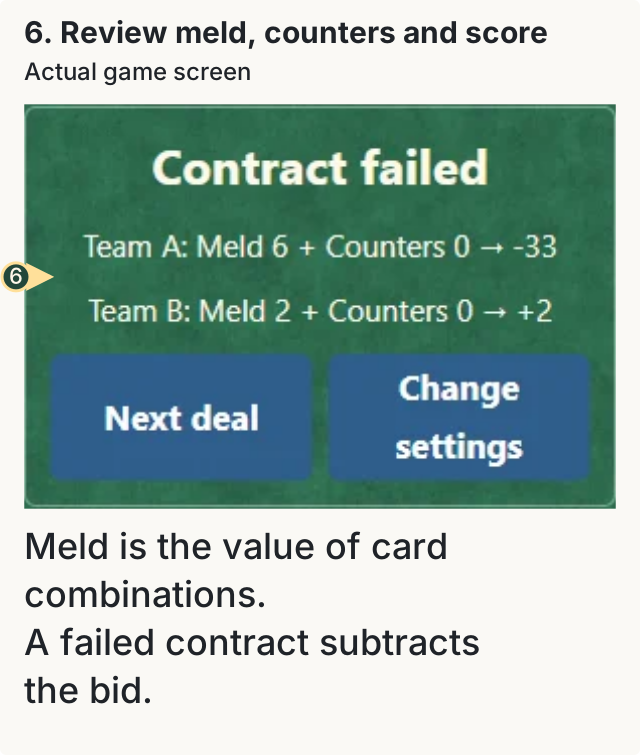
Captured Aces, Tens and Kings earn one point each. Queens, Jacks and Nines have no counter value. The final trick earns one additional point, making twenty-five counter points available in a complete deal. Meld and counters together are compared with the contract. On this page the declaring team must also capture at least one counter point. Making the contract adds the actual combined total. Failing subtracts the bid without adding that team’s meld or counters.
Defenders receiving at least one counter point add their meld and counters. With no counter points their meld is lost, except a defending team whose combined meld is only dix keeps that dix value. Merely taking a trick is not necessarily enough: a trick containing only Queens, Jacks and Nines has no counters. If the bidder’s team cannot meet the bid even with all twenty-five counters, starting play ends the deal automatically. The bidder may also concede at the meld review. A conceded deal subtracts the bid and gives the defenders their meld only.
The normal target is one hundred and fifty points. When both teams reach the target in the same deal, the bidding team wins. A shorter seventy-five-point target is available. You can instead play four or eight deals and compare final totals; an exact tie in that format is a draw. Negative scores are possible and remain part of the match. The result separates meld, counters and score changes so you can understand a successful contract or a set.
Single-deck Pinochle rule variations
Check the version whenever you compare a rule sheet or a score. Some descriptions use points ten times as large: a fifteen-point run becomes one hundred and fifty, and a twenty-five opening bid becomes two hundred and fifty. Scale the whole system together. Do not mix a large-unit bid with small-unit meld. The number of cards also matters. Double-deck and two-handed games change more than the size of a displayed score.
You can choose mandatory overtaking on all leads or only when trump is led. Under the second setting, a trump lead requires a higher trump if possible. On a non-trump lead you still follow suit or trump when void, but need not overtake either a led-suit card or an existing trump. The same-card tie rule remains unchanged. The settings also offer double Pinochle at thirty or thirty-two, and extra King or Queen in a single run at zero, two or four additional points. When both extra King and Queen exist, the additional marriage is four in the zero/two settings and eight in the four setting. No extra marriage is added to a double run.
There is no draw stock, eighty-card pack, special bidding signal system, alternative card-counter formula, early declaration of victory, or automatic redeal rule here. These differences are described rather than silently borrowed from another game. Agree on exchange size, marriage requirement, meld extras, overtaking and match length before starting a shared-device match.
Pinochle strategy: six useful habits
Separate card strength from card value. A Queen can win a trick without itself supplying a counter. A King supplies a counter but loses to a Ten in the same suit. This distinction helps you decide whether a trick is worth an expensive trump. Also remember the second copy. An Ace you have already seen does not mean all Aces of that suit have disappeared, although leading your own Ace before its twin arrives wins their tie.
Compare potential trump suits before bidding. Count the cards in each suit and check their meld. The longest suit need not contain the best run. Avoid promising a total that depends on an unseen perfect partner hand. If your partner already holds the bid, raising again gives your partnership a harder contract as well as control of trump. Think about what the extra responsibility buys.
During the exchange, consider the named trump suit and the combinations your partner may complete. Returning cards requires another inspection of your enlarged hand. Keep a completed run intact when possible, and look for an around before throwing away a seemingly ordinary card. A single Queen may help more than one meld class, so raw rank alone is not a good measure of its exchange value.
Once meld is shown, use that public information and watch the cards played. Knowing that high trumps have left the hands can turn a modest trump into a useful winner. If your partner is already winning, feed a counter where the legal-play rules permit. If an opponent will win regardless, a non-counter may limit the damage. Preserve a useful winner for the last trick when feasible, but do not save every high card until opponents can trump your non-trump winners. These are plans to compare, not guarantees.
Controls, computer difficulty and saved progress
Computer turns advance only when you press Step CPU at first. You can turn on automatic CPU play; it advances computer decisions but stops for your decisions, trick review and deal results. Easy opponents sometimes use important cards too early or miss a useful combination. Normal opponents pay more attention to partners and counters. Hard opponents use the cards publicly shown and played to consider what might remain. Your computer partner uses Normal difficulty. None of the levels guarantees a particular outcome.
The four-player shared-device mode hides private cards at each change of decision. Pass the device to the named player, then Reveal hand. Meld and played cards remain public. Keep other players from looking over your shoulder while the hand is visible. This is a local turn-taking format, not online multiplayer or a promise that private data is protected from someone inspecting the browser.
Settings pauses the current match. Continue restores the same deal, score and turn. Progress is stored in this browser on this device, with the Japanese and English pages sharing one save. Clearing browser storage removes it. Another browser or device does not automatically receive the match. An unconfirmed selection is cleared when returning to a saved game. On a computer, use Tab to move between controls, select a card, Enter to confirm it, and Escape to clear selected cards. Sound begins off.
Pinochle FAQ and the game’s different forms
Do meld cards disappear? No. After scoring the combinations you still play the same twelve cards. Can partners make a run together? No, a meld belongs to one hand. Why can I not play trump? If you have the suit that was led, following it comes first. Why did enough meld still produce a failed contract? You must save the declaring side’s meld by taking at least one counter point in this version. Who wins a tied fixed-deal match? Neither team; it is a draw. Who wins when both teams reach the normal target? The bidding team.
Pinochle has long been played in the United States and is described in several distinct forms. The familiar name alone does not tell you whether a page describes two-handed play, single-deck partnerships or a double-deck game. Start with players, pack and scoring units when comparing explanations. Learning one clearly stated version first makes later differences easier to recognise.
Pinochle meld chart
| Combination | Single | Double |
|---|---|---|
| Trump run | 15 | 150 |
| Trump marriage | 4 | 8 |
| Non-trump marriage | 2 | 4 |
| Pinochle | 4 | 30 / 32 |
| Aces around | 10 | 100 |
| Kings around | 8 | 80 |
| Queens around | 6 | 60 |
| Jacks around | 4 | 40 |
| Dix | 1 | 2 |