 Yorimichi Games
How to Play the Pentomino Puzzle
A pentomino is a shape made by joining five equal squares edge to edge. If you count shapes that match after turning or flipping as the same, there are exactly twelve of them. The pentomino puzzle asks you to use all twelve pieces to cover a board completely, with no gaps and no overlaps. Twelve pieces of five squares each make 60 squares, so every board in this game has exactly 60 squares too.
You don’t have to start from an empty board. On Easy and Normal, some pieces are already in place, and you fill the gaps that are left with the pieces in the tray. When every square of the board is covered, the puzzle is solved.
The 12 pentomino pieces
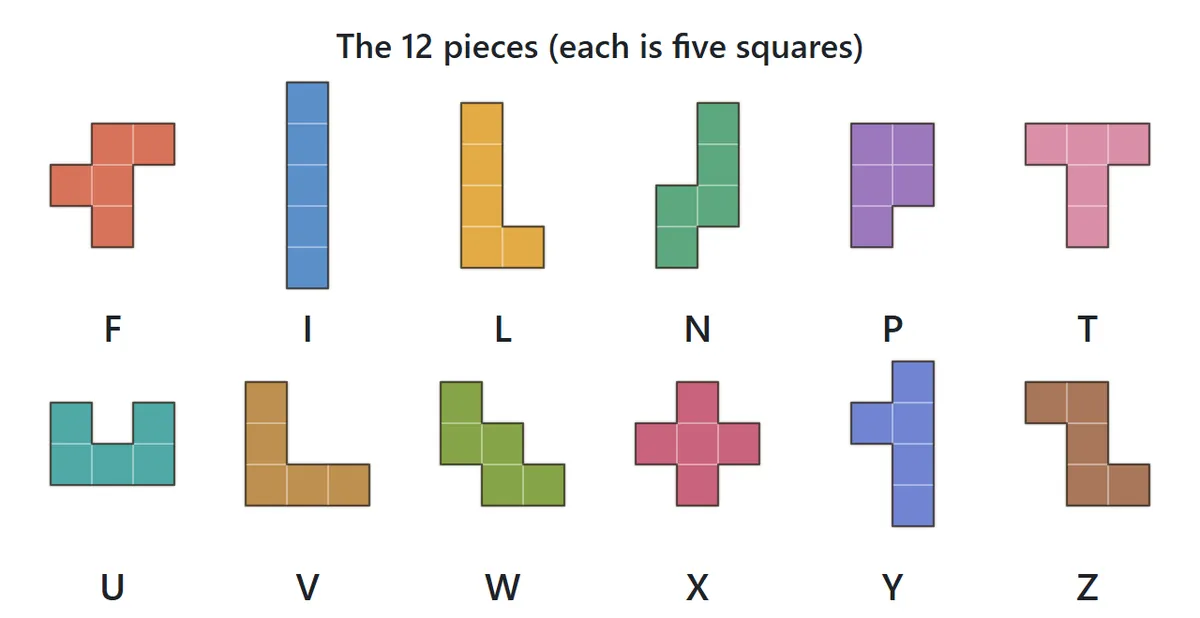
Each pentomino is named after a letter it looks like: I is a straight bar, X is a plus sign, T looks like a capital T, and U has a notch in the middle. The full set is F, I, L, N, P, T, U, V, W, X, Y and Z. An easy way to remember it is “the end of the alphabet, T to Z, plus F, I, L, N and P.” In the game, each piece shows its letter in the middle so you can learn the names as you play.
Placing pieces

Drag a piece from the tray onto the board with your finger or mouse. As you get close to a spot where it fits, a green dashed outline appears; let go and the piece drops neatly onto the grid. A piece can’t overlap another piece or hang off the edge of the board. You can pick up a placed piece again to move it, or drag it off the board to send it back to the tray. Gray pieces were placed at the start of the puzzle and can’t be moved.
Rotating and flipping
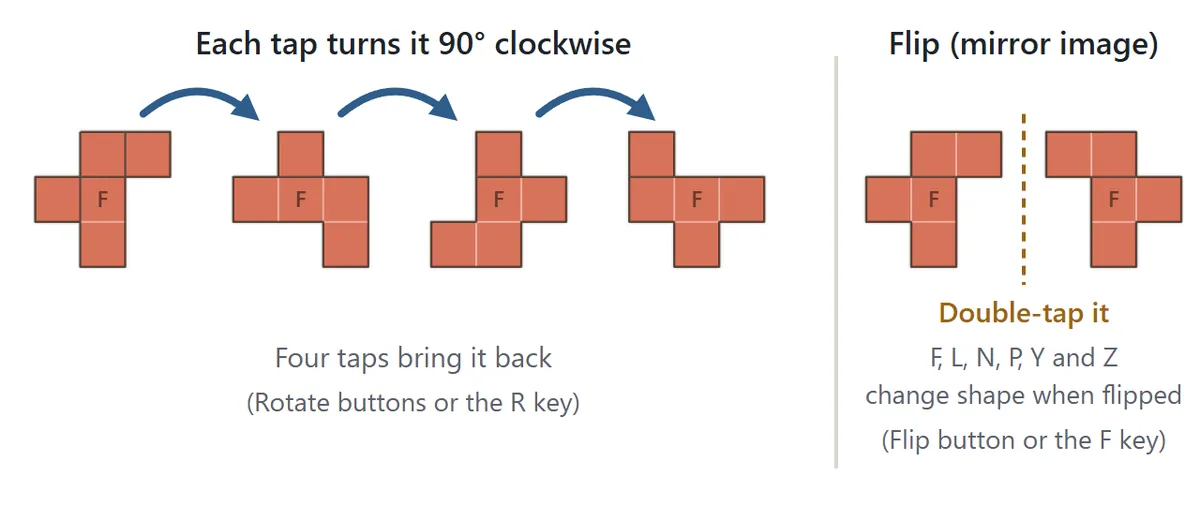
Tap or click a piece to turn it 90° clockwise. To turn the other way, use the Left button. Six pieces — F, L, N, P, Y and Z — become a different shape when you flip them over, so they can also be flipped: double-tap them quickly or press the Flip button. The other six, I, T, U, V, W and X, look the same flipped as they do rotated, so turning them is all you need.
You can also play with a keyboard: press Tab to choose a piece, R to rotate, F to flip, the arrow keys to move it on the board, and Enter to put it down.
Pentomino Rules
The rules fit in one sentence: use all twelve pentominoes, once each, to cover every square of the board without overlapping or leaving a gap. You may rotate any piece and turn it over. The pieces must lie on the grid, so every square of a piece covers exactly one square of the board. There are no other rules, which is exactly what makes the puzzle so addictive — the difficulty comes entirely from the shapes.
Pentomino Boards and How Many Solutions They Have
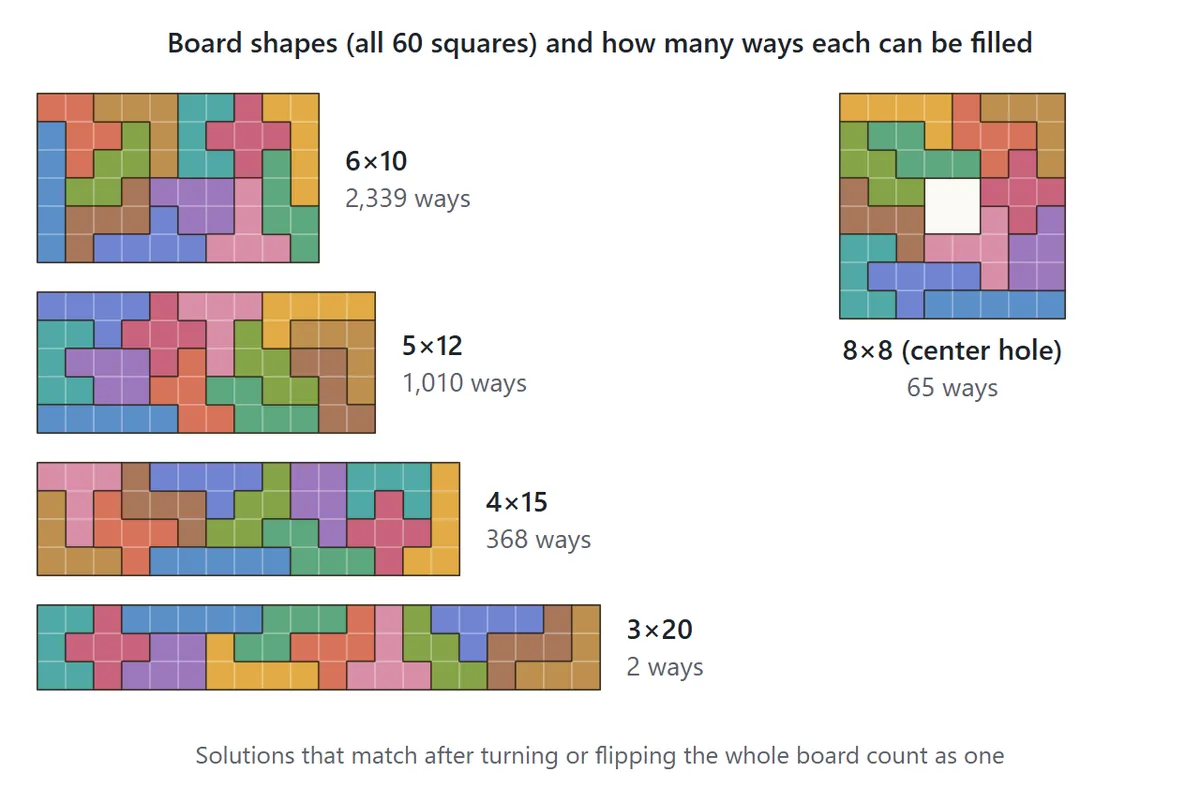
There are five boards. Each has 60 squares, yet some are far harder than others. The number of distinct solutions for each board has been worked out by computer (solutions that match after rotating or reflecting the whole board count once):
| Board | Solutions | What it’s like |
|---|---|---|
| 6×10 | 2,339 | The classic pentomino rectangle and the best place to start |
| 5×12 | 1,010 | A little longer and narrower, still friendly |
| 4×15 | 368 | The narrower the board, the fewer places each piece can go |
| 3×20 | 2 | Only two solutions exist — a real challenge |
| 8×8 (center hole) | 65 | A chessboard-sized square with the middle 2×2 removed |
Difficulty Levels and the Daily Puzzle
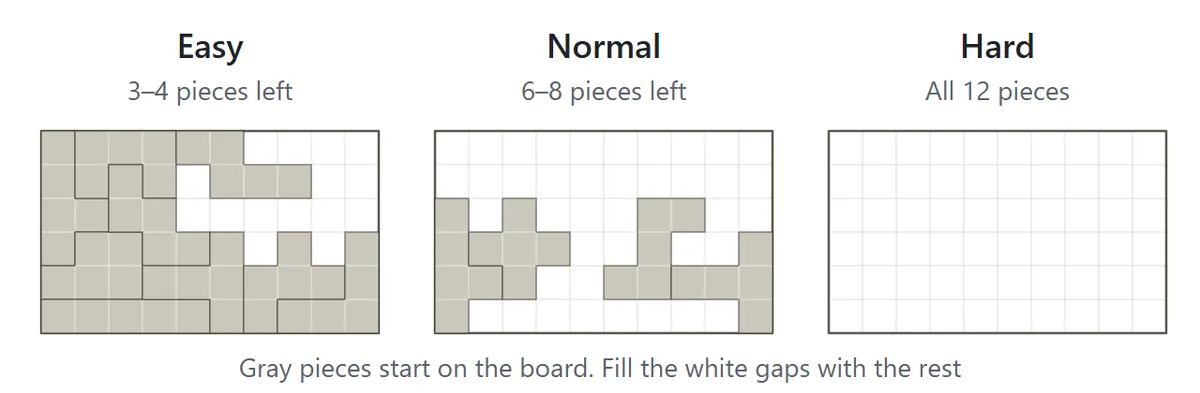
Easy starts with eight or nine pieces already on the board, so you only need to fit the last three or four. It’s a gentle way to learn how the pieces behave. Normal leaves six to eight pieces for you, which means you really have to think about which piece goes where. Hard gives you an empty board and all twelve pieces — the original pentomino puzzle. The pieces placed at the start always come from a real solution, so every puzzle can be solved. You don’t have to match that solution, though: any arrangement that fills the board counts.
The daily puzzle is one puzzle per day for each difficulty, and it’s the same for everyone on the same date. The board shape changes from day to day. Choose a board to play as many fresh puzzles as you like on the board and difficulty you pick. Your fastest time without hints is saved as a personal best for each board and difficulty.
Pentomino Puzzle Tips and Strategy
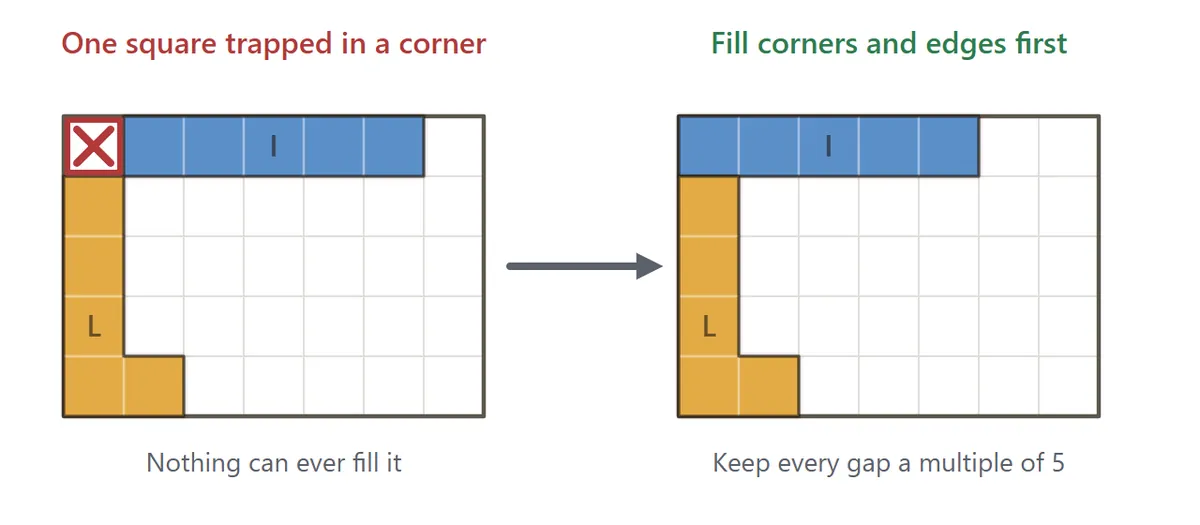
1. Keep every gap a multiple of five
Every piece covers five squares, so any region of empty squares that is cut off from the rest must have 5, 10, 15… squares, or it can never be filled. After each move, glance at the board for closed-off pockets. A single square stranded in a corner or a dead-end corridor three squares long are the most common mistakes.
2. Work from the corners and edges
Pieces dropped in the middle of the board tend to leave awkward little gaps around them. Pushing pieces snugly into corners and along the edges, then working inward, keeps the empty area tidy and much easier to reason about.
3. Place the awkward pieces early
The X piece sticks out in four directions, so it can’t sit flat against a corner or an edge, and the places it fits are limited. X and the bumpy pieces such as F, W and U are best placed early. The I and L pieces, on the other hand, slide neatly into long thin gaps, so it often pays to save them for the end.
4. On narrow boards, think about what can’t fit
On 3×20 and 4×15 boards, pieces wider than the board have to lie on their side. On the 3×20 board, for example, the center of the X can only be in the middle row. Starting from the pieces with the fewest options gives you a foothold.
5. Use a hint when you’re stuck
Press Hint and, if the board can still be finished the way it is, the correct spot for one more piece appears as a faint outline. Press Hint again and that piece moves into place. If your current layout can no longer be completed, the hint sends the piece that’s causing the trouble back to the tray instead. Rounds where you used a hint don’t count toward your personal best.
Pentominoes in Math Class
Pentominoes are a favorite in math lessons because they make area and symmetry something you can hold in your hands. Every piece has the same area — five squares — yet no two have the same shape, which shows clearly that equal area doesn’t mean equal shape. The board size follows from simple multiplication: 12 pieces × 5 squares = 60.
They are also a natural way to explore symmetry. T, U, V, W and X have a line of symmetry, while F, L, N, P, Y and Z turn into a different shape when reflected. X is symmetric in every direction and looks the same after a quarter turn. A nice follow-up activity is to count the shapes yourself: three squares make 2 different shapes (trominoes), four make 5 (tetrominoes), and five make the 12 pentominoes.
Pentomino FAQ
Can I flip the pieces over?
Yes. In the pentomino puzzle you may rotate pieces and turn them over freely. The well-known solution counts, such as 2,339 for the 6×10 rectangle, assume flipping is allowed.
Do I have to match the pieces that were placed for me?
No. You can put the remaining pieces anywhere and in any orientation. As soon as every square is covered, the puzzle is solved. Only the gray starting pieces stay fixed.
How many solutions does the 6×10 pentomino puzzle have?
There are 2,339 different ways to fill a 6×10 rectangle with the twelve pentominoes, counting solutions that are rotations or reflections of each other only once. That is why 6×10 is the easiest board here, while 3×20, with only two solutions, is by far the hardest.
Is the daily puzzle the same for everyone?
Yes, on the same date and at the same difficulty everyone gets the same puzzle. The date comes from your device’s clock. Solve it on consecutive days to build a streak.
Can I stop and continue later?
If you come back on the same device and browser, press Continue in the settings to pick up exactly where you left off, with the timer and every piece in place. Sound is off at first; press “Sound: off” to hear a click when a piece lands and a chime when you finish.
History of Pentominoes
Puzzles built from squares joined together are older than their name. The English puzzle writer Henry Dudeney included a pentomino puzzle in his 1907 book The Canterbury Puzzles. The word “pentomino” itself was coined by the American mathematician Solomon W. Golomb, who began studying shapes made of joined squares — he called them polyominoes — in the early 1950s. The name blends “penta,” Greek for five, with domino, the two-square piece.
Pentominoes also have a place in the history of computing. The 65 solutions of the 8×8 board with a center hole were counted by computer in 1958, and the 2,339 solutions of the 6×10 rectangle in 1960. With rules this short and answers this hard to find, pentominoes remain a favorite for puzzle lovers, math teachers and programmers practicing search algorithms alike.