 Yorimichi Games
How to Play Nine Men’s Morris
Nine Men’s Morris is a two-player strategy board game in which each side has nine pieces, white or black. You place your pieces on the points of the board and later move them, trying to line up three of your own along one line. That line of three is called a mill, and every time you form one you remove one of your opponent’s pieces. Reduce your opponent to two pieces, or trap them so they cannot move, and you win. There are no dice and no hidden information, so the game is decided purely by planning and reading ahead.
The game goes by many names. In English it is also called Mill, Merels or simply Morris, and in Germany and Switzerland, where it is still played in clubs and tournaments, it is known as Mühle. “Men” here just means the playing pieces.
The board and what a mill is
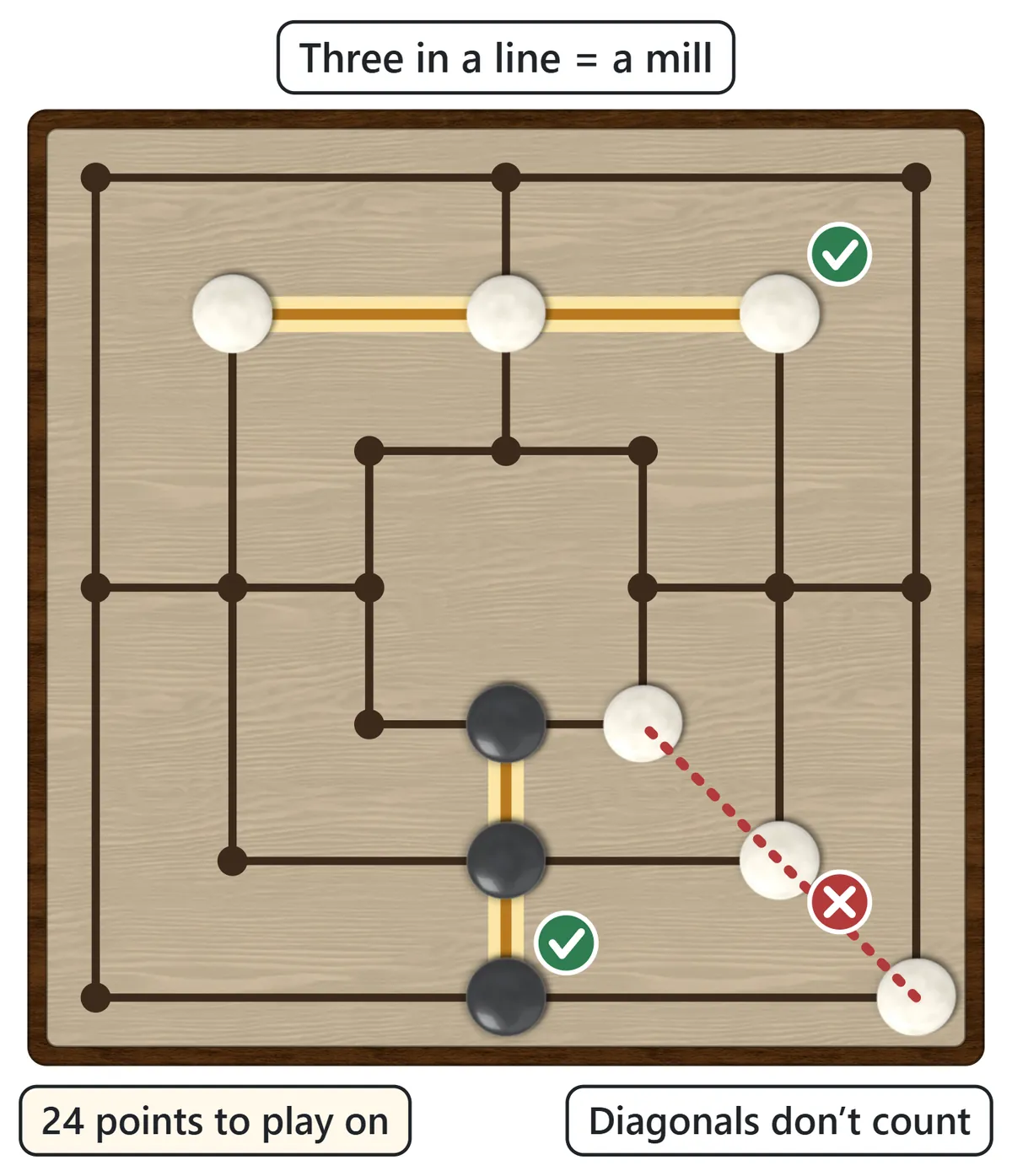
The board is made of three squares, one inside the other, connected by four lines that run through the middle of each side. Pieces are played on the 24 points where lines meet or turn a corner. The board starts empty.
A mill is three of your pieces on one straight line of the board, either horizontal or vertical. Three pieces in a diagonal never form a mill, because the board has no diagonal lines.
Phase 1: placing pieces
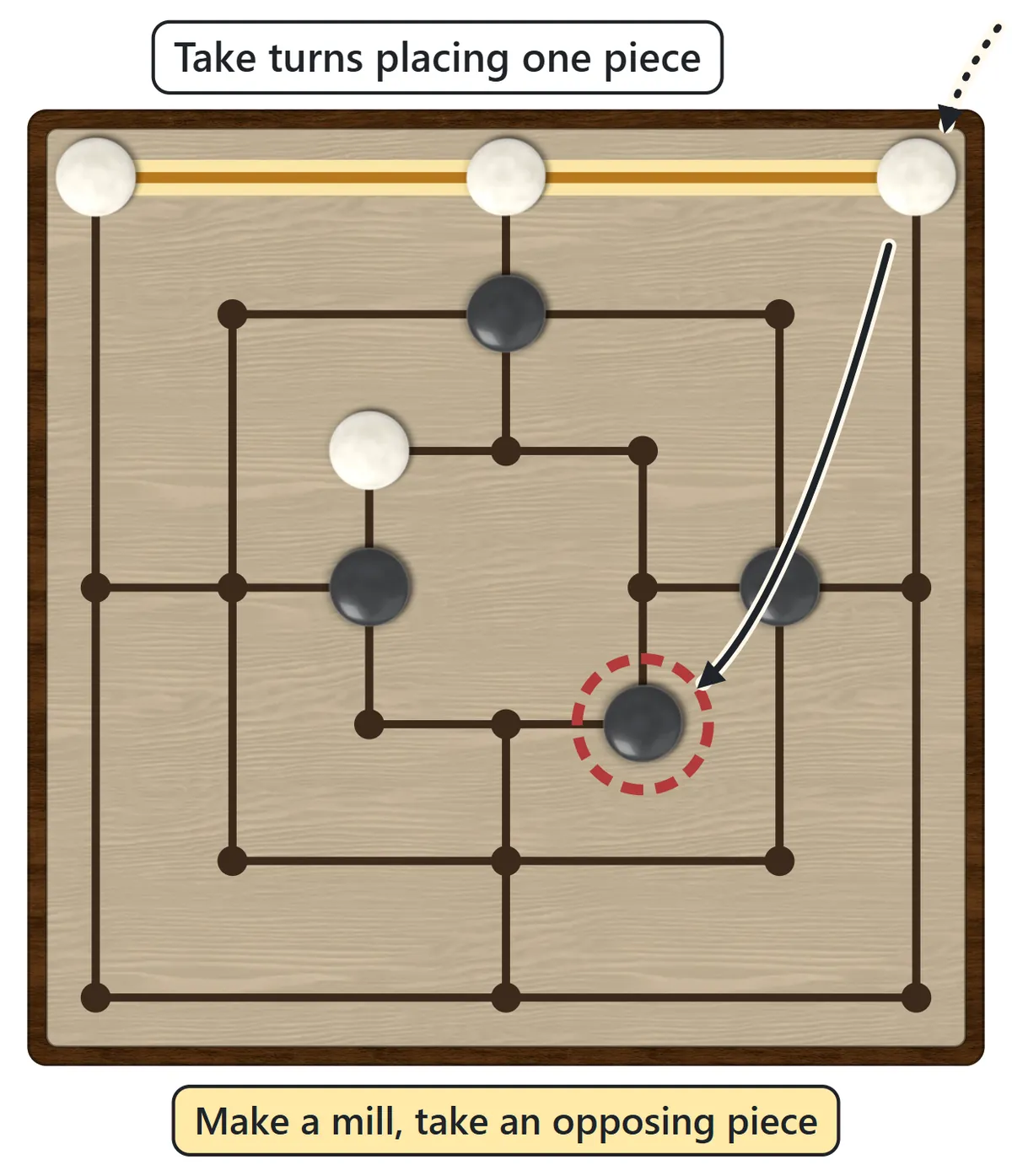
White moves first. The players take turns placing one piece at a time on any empty point. If a placement completes a mill, you take one of your opponent’s pieces off the board straight away, even in this opening phase. Captured pieces never come back. When both players have placed all nine pieces, the game moves on to the movement phase.
Pieces in a mill are protected
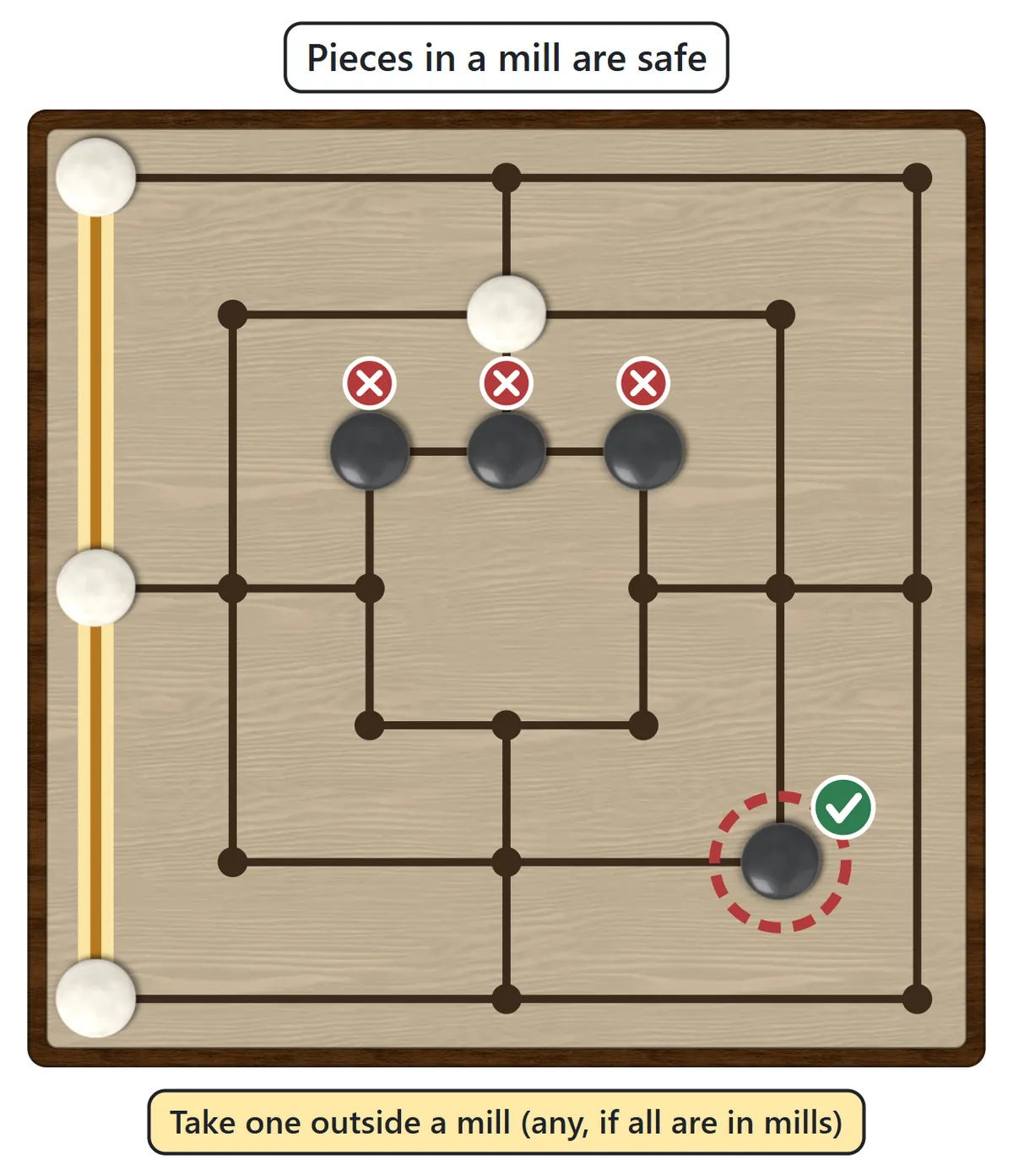
When you remove a piece, you must pick one that is not part of one of your opponent’s mills. The only exception is when every opposing piece is in a mill; then you may take any of them. (Under Custom rules you can choose a stricter version in which nothing is taken in that case.)
Phase 2: moving pieces
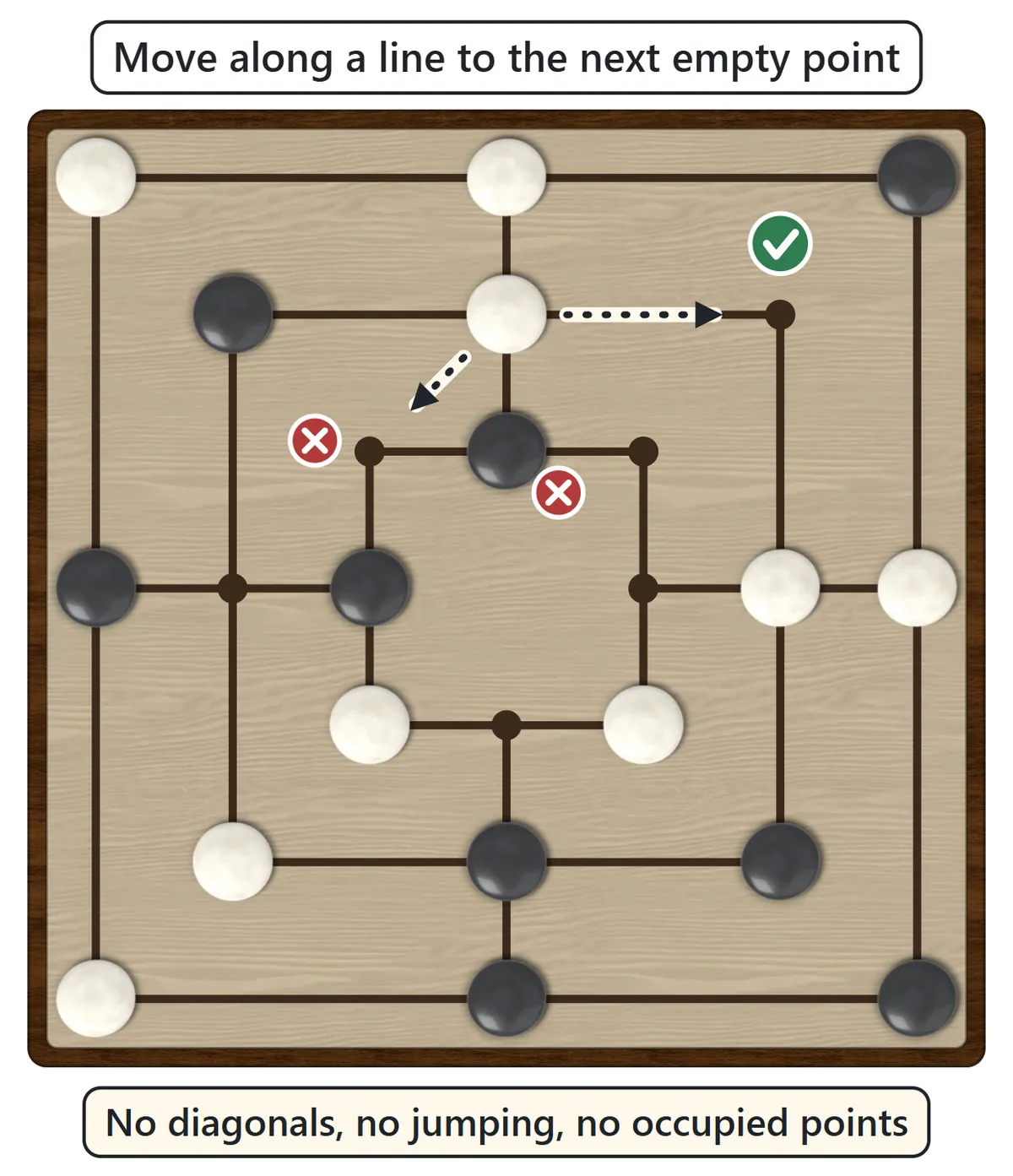
Once all pieces are on the board, players take turns moving one of their own pieces to an adjacent empty point along a line. You cannot move diagonally, jump over another piece or move onto an occupied point. Forming a mill by moving also lets you take a piece.
Opening and closing a mill
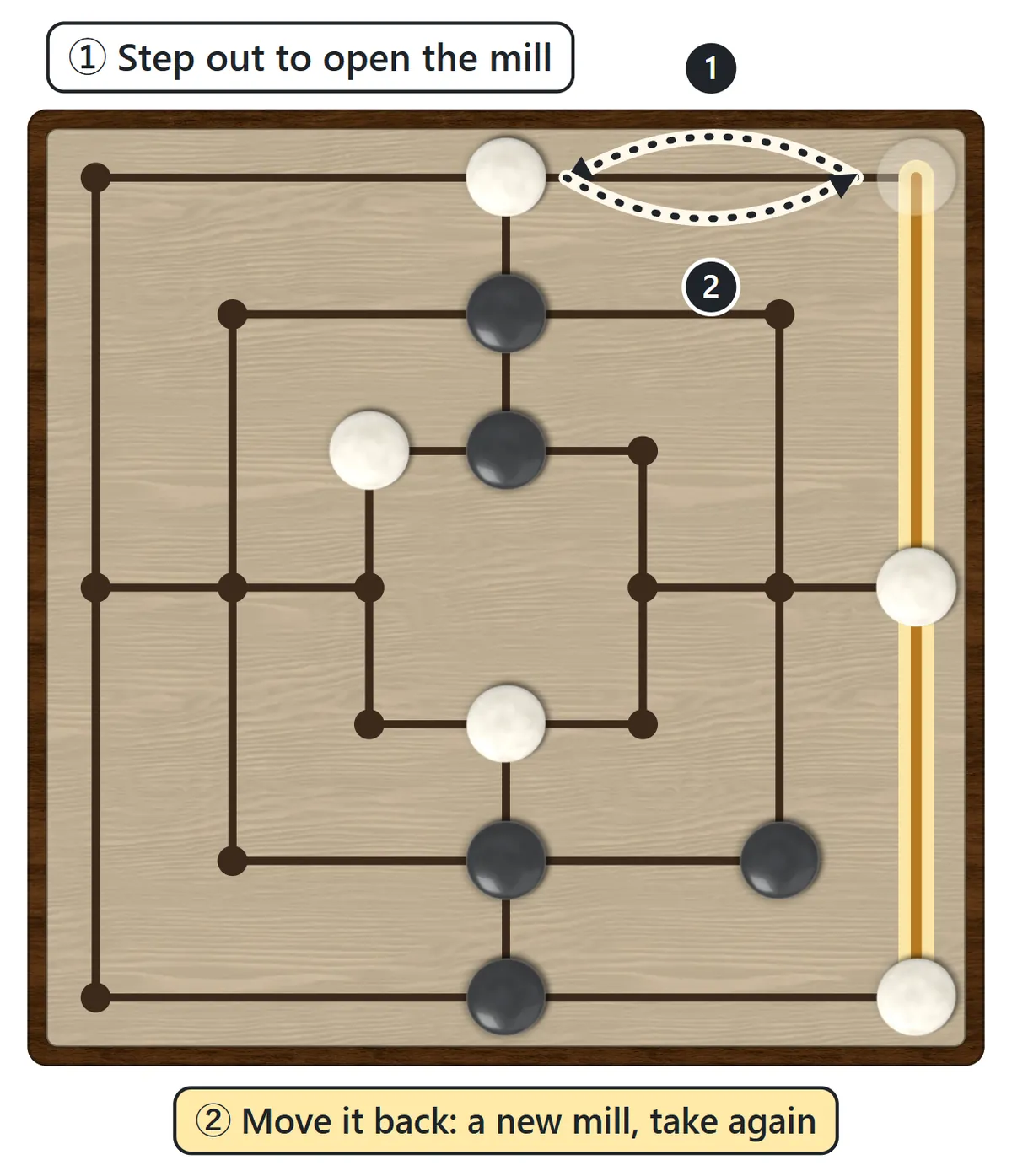
A mill only captures at the moment it is formed; leaving it standing does nothing more. But if you move one piece out of a mill and then move it back on your next turn, the mill is formed again and you get another capture. Your opponent will try to slip a piece into the gap in between, so this only works when the empty point is safe.
Phase 3: flying with three pieces
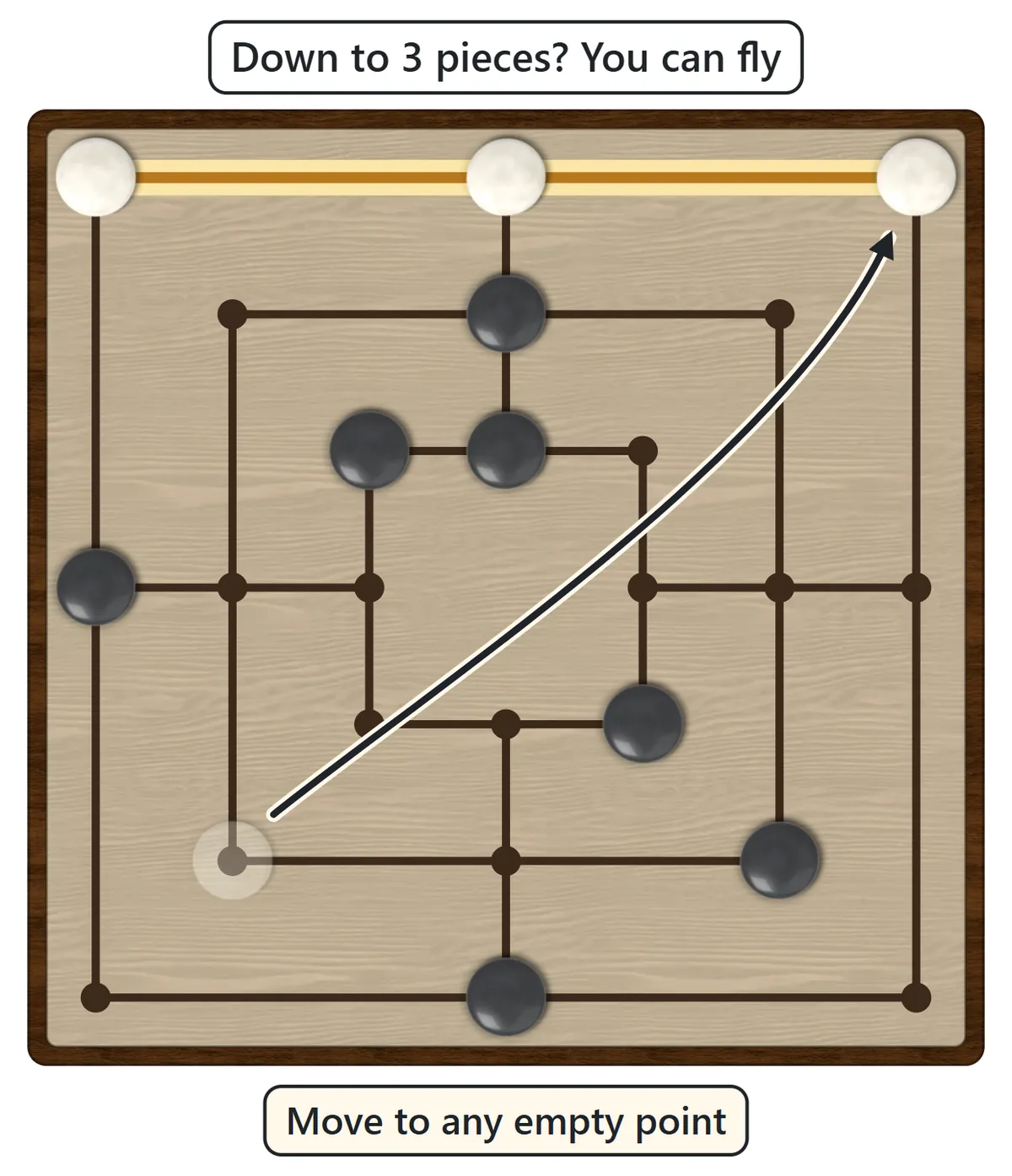
When a player is down to three pieces, their pieces may “fly”: they can move to any empty point on the board, not just a neighboring one. This gives the losing side a real chance to fight back. Some players leave this rule out, and you can play that way with the No flying setting.
Closing two mills at once
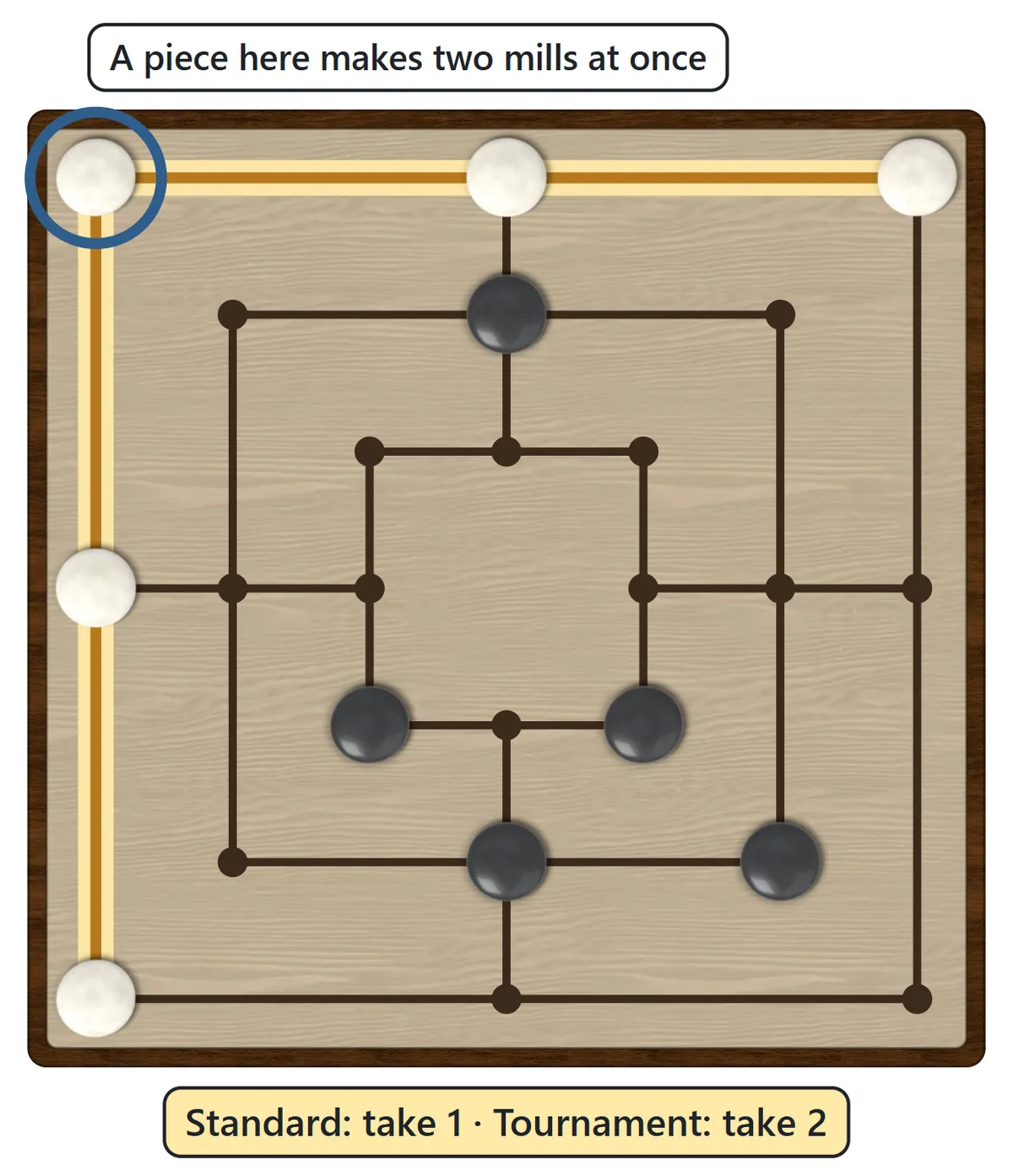
A piece placed or moved on a corner or crossing point can sometimes complete two mills at the same time. How many pieces that earns depends on the rules. In the standard game you still take only one; under the rules used in German Mühle tournaments you take two, which is what the Tournament setting does.
How you win, lose or draw
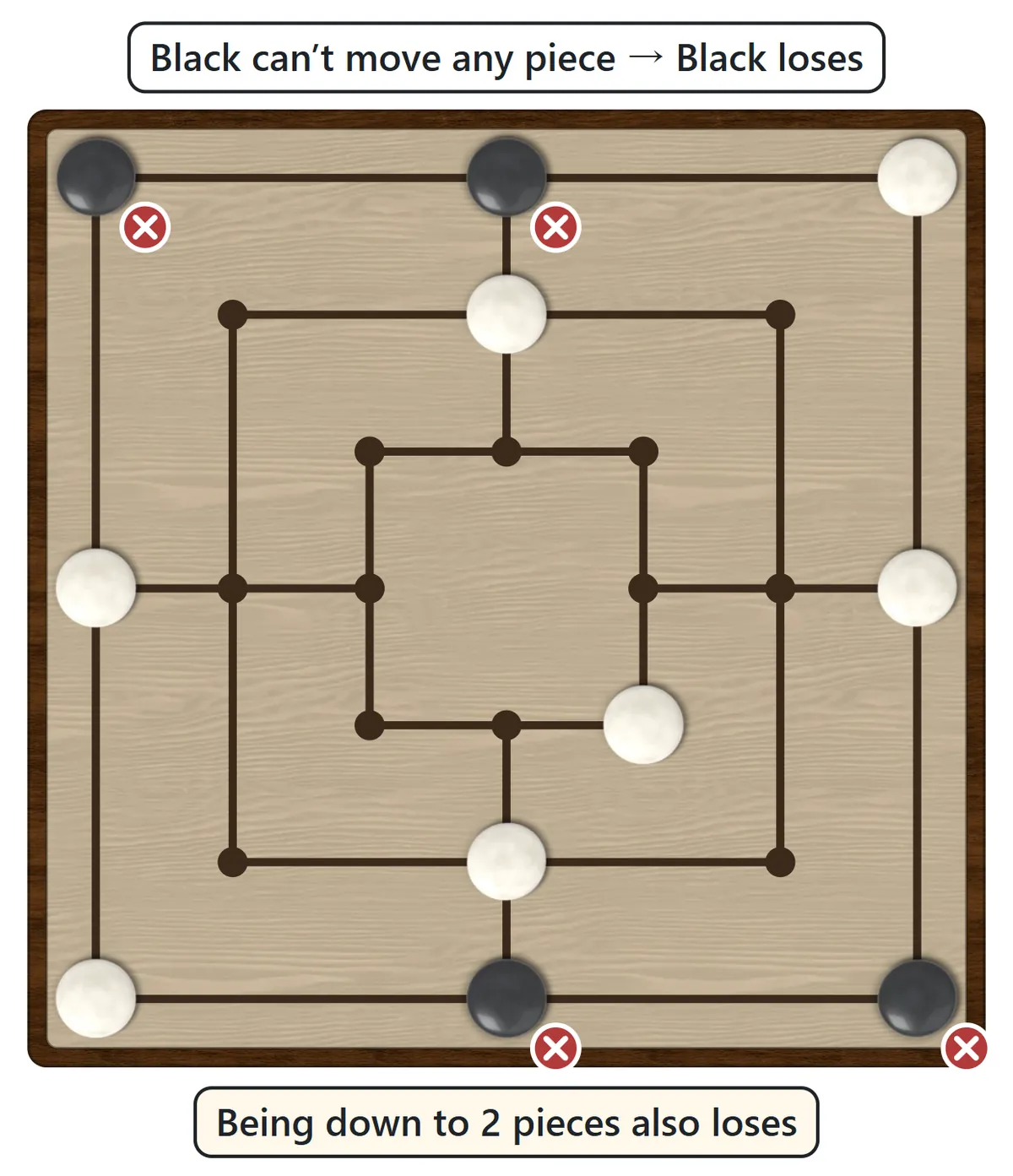
You lose the game if either of these happens:
- You are down to two pieces, so you can no longer form a mill.
- It is your turn and none of your pieces can move (you are blocked in).
In this game, the result is a draw if the same position (with the same player to move) comes up three times, or if both players make 30 moves each without any piece being taken. Both rules follow common Mühle tournament practice.
Nine Men’s Morris Rules: Standard, No Flying and Tournament
Because the game is so old, the details vary between countries and books. You can choose from these rule sets:
| Rule set | Flying at 3 pieces | Two mills at once |
|---|---|---|
| Standard | Yes | Take 1 |
| No flying | No | Take 1 |
| Tournament | Yes | Take 2 |
In all three, if every opposing piece is in a mill, you may take any of them. Custom lets you set each of these three rules yourself. Without flying, a player with three pieces stays slow, so games are more often won by blocking the opponent in.
Nine Men’s Morris Strategy: Tips to Win
1. Don’t rush for a mill in the placing phase
Crowding your pieces together in the opening to force a quick mill is tempting, but your opponent can usually block it, and your cluster will have trouble moving later. Spreading your pieces around the board and keeping them flexible pays off once the movement phase begins.
2. Take the crossing points
The midpoints of the middle square’s sides connect to four other points, which makes them the most mobile spots on the board. Corners connect to only two. With the movement phase in mind, prefer points with many connections.
3. Build two threats at once
If you set up two different “one more and it’s a mill” lines at the same time, your opponent can block only one of them. This double threat is especially strong while pieces are still being placed.
4. Make a running mill
The strongest formation in Nine Men’s Morris is a piece that can slide back and forth between two mills, closing one every time it moves. Each move captures a piece, so once you have it the game is almost won. Just as important is not letting your opponent build one.
5. Always block your opponent’s open two
When your opponent has two pieces on a line and the third point is empty, put (or move) a piece there. Captures add up quickly, and falling two or three pieces behind is hard to recover from.
6. Think about mobility and blocking
Even with fewer pieces you can win by taking away every move your opponent has. In the movement phase, compare how many moves you have with how many your opponent has, and look for chances to shut their pieces in.
Nine Men’s Morris FAQ
Is it better to go first or second?
Computer analysis has shown that with perfect play from both sides, Nine Men’s Morris ends in a draw. In practical games neither side has a clear edge, so if you play several games, alternate who goes first or pick Random.
Can you take a piece during the placing phase?
Yes. Whether you are placing or moving, forming a mill lets you remove one opposing piece immediately.
Does a mill keep capturing if you leave it in place?
No. A mill captures only at the moment it is formed. To capture again, move one piece out to open the mill and move it back on a later turn.
Which computer level should I choose?
If you are new to the game, start with Easy. It often forgets to block you when you are one piece away from a mill, and sometimes misses its own chances too. Normal thinks about your next move and usually blocks your mills, but it still overlooks things now and then. Hard rarely slips and also pays attention to mobility, so the best way to beat it is to build two mill threats at the same time.
Can two people play? Can I stop and continue later?
Set the opponent to “2 players” to take turns on the same screen; one player uses the bottom row of the board and the other the top. If you leave in the middle of a game, open it again in the same browser on the same device and press Continue. The game starts muted; press “Sound: off” to turn sound on.
History of Nine Men’s Morris
Nine Men’s Morris is one of the oldest board games still played. It was probably known in the Roman Empire, and it was hugely popular in medieval Europe. In England, morris boards have been found scratched into the stone seats of cathedral cloisters, and Shakespeare mentions the game in A Midsummer Night’s Dream, where the “nine men’s morris is filled up with mud.” Smaller and larger relatives exist too, such as Three Men’s Morris and Twelve Men’s Morris, which adds diagonal lines. Today the game is best known as Mühle in Germany and Switzerland, where tournaments are still held, and in 1993 it became one of the first classic board games to be solved by computer, which showed that perfect play leads to a draw.