 Yorimichi Games
How to play Napoleon, the Japanese card game
Napoleon is a trick-taking card game for five players that has been a favorite in Japan for more than a century. After the deal, players bid for the right to be Napoleon by announcing a trump suit and how many honor cards they expect to win, such as “13 in hearts”. The winner of the bidding names one card, and whoever holds that card secretly becomes Napoleon’s partner, the adjutant. The other three players are the allies. Nobody, not even Napoleon, knows who the adjutant is until the called card is played.
Despite the name, this is not the British game of Nap. The Japanese game grew its own rules over many years: a super card that beats everything, two special jacks, a hidden partner and plenty of house rules. Once you know the flow, the fun is in reading the table and working out who is on your side. Here you play with four computer players.
Cards and players
Napoleon uses a standard 52-card deck with no jokers. Each player gets ten cards and the last two are placed face down in the middle as the kitty. The cards that matter are the honors: the A, K, Q, J and 10 of each suit, twenty cards in all. Each honor is worth one point to the side that wins it. Every other card is worth nothing, however many you take.
1. Bidding to become Napoleon
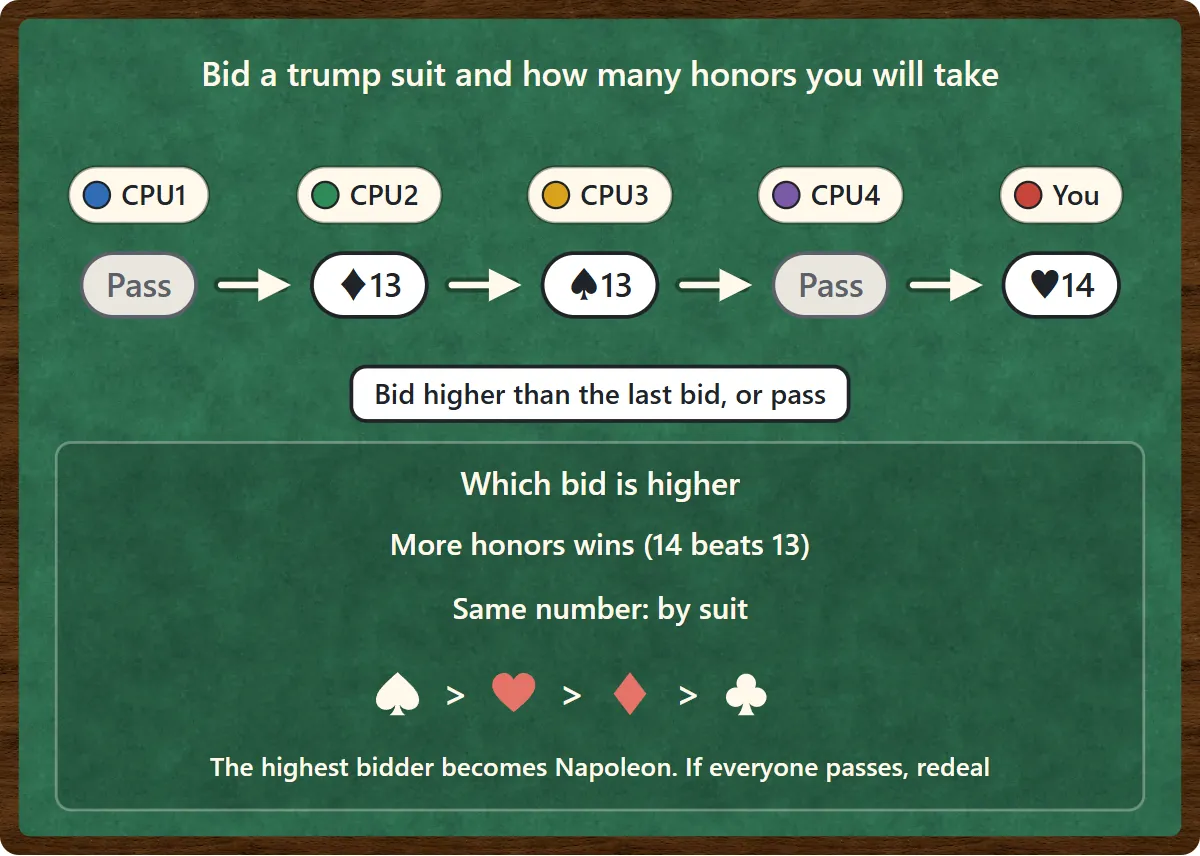
Starting with the player on the dealer’s left, each player either bids or passes. A bid names a trump suit and the number of honors Napoleon’s side will win. In the standard game the lowest bid is 13, and every bid must beat the one before: either a higher number, or the same number in a higher suit. So “13 in spades” beats “13 in hearts”, and “14 in clubs” beats both.
Once you pass, you are out of the bidding for that hand. When everyone else has passed, the last and highest bidder becomes Napoleon and the suit they named becomes trumps. If nobody bids at all, the same dealer deals again.
2. Calling the adjutant and taking the kitty
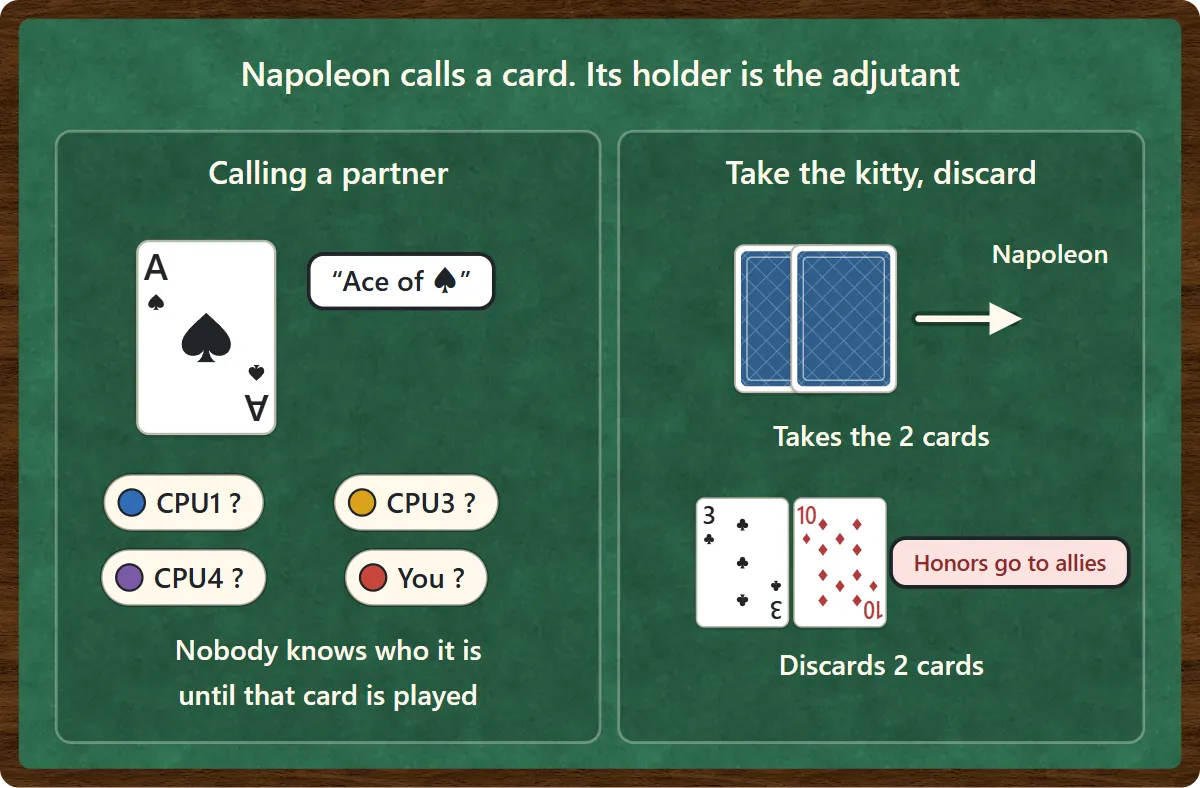
Napoleon now names any card, for example “the ace of spades”. The player holding that card is the adjutant and plays on Napoleon’s side, but keeps quiet about it. Only the adjutant knows. Napoleon then picks up the kitty and discards the same number of cards. Any honors among the discards are shown and count for the allies.
If the called card turns out to be in Napoleon’s own hand or in the kitty, Napoleon plays alone against the other four. Some players do this on purpose with a very strong hand, because a lone Napoleon scores double.
3. Card ranking: the Mighty and the two jacks
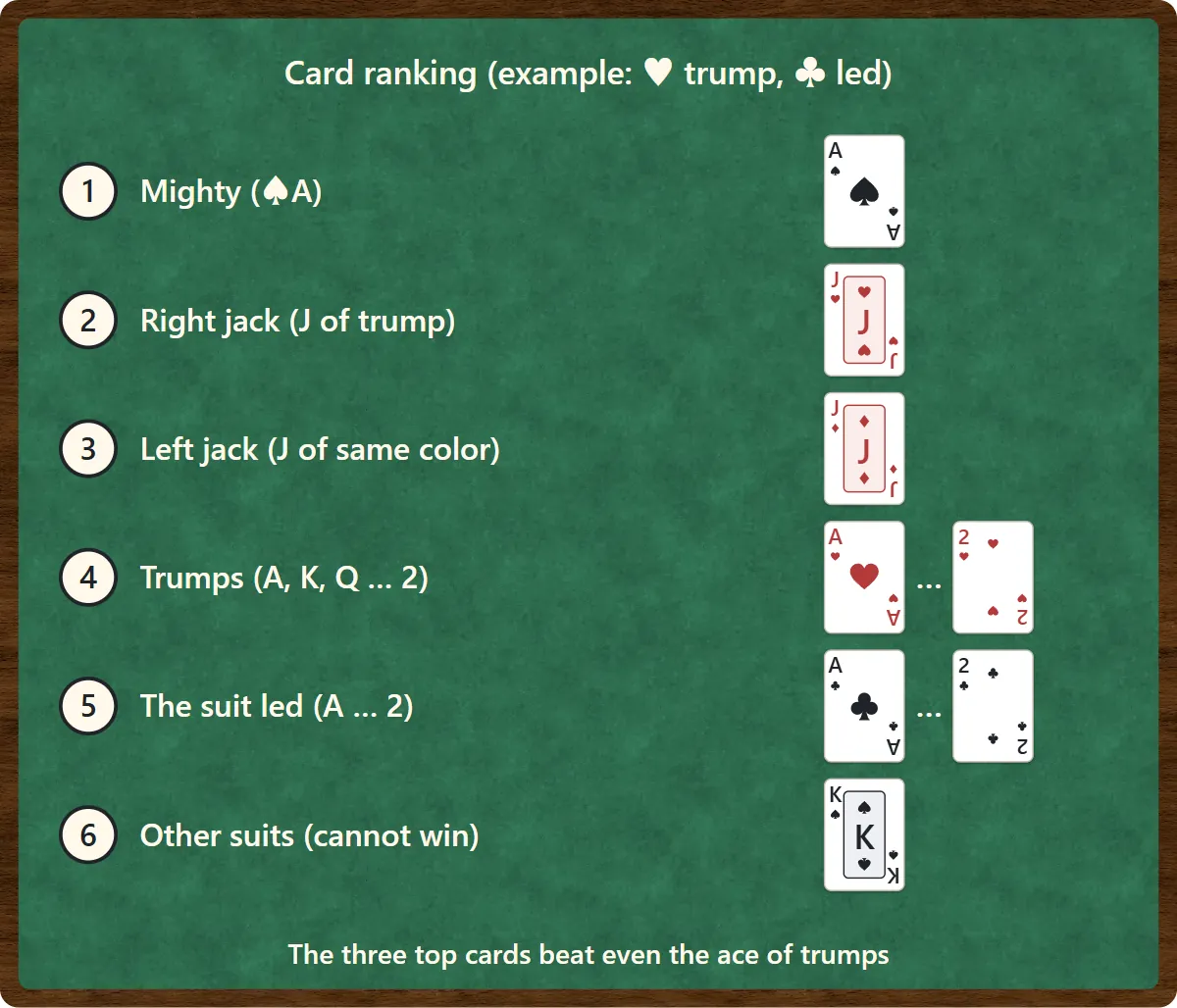
From strongest to weakest, cards rank like this:
- The Mighty (♠A). Always the highest card. Japanese players call it オールマイティ (all-mighty).
- The Right Jack, the jack of trumps (正ジャック).
- The Left Jack, the other jack of the same color (裏ジャック). With hearts as trumps it is the ♦J; with spades, the ♣J.
- Trumps, from A, K, Q, 10 down to 2. Even the 2 of trumps beats an ace of another suit.
- The suit led, from A, K, Q, J, 10 down to 2.
- Any other suit, which can never win the trick.
The three top cards keep their own suit. The ♠A is still a spade and the Left Jack still belongs to its printed suit, which matters for following suit. This is different from Euchre and 500, where the left bower joins the trump suit.
4. Playing the tricks
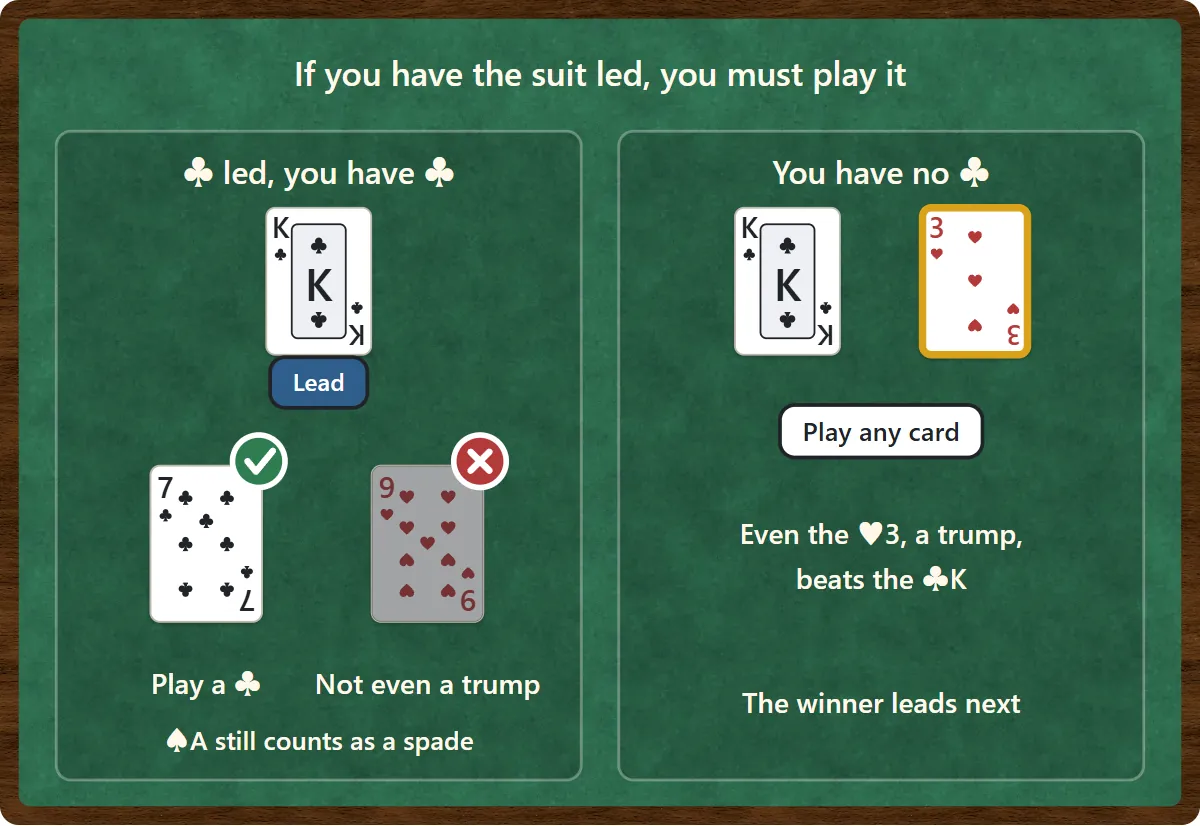
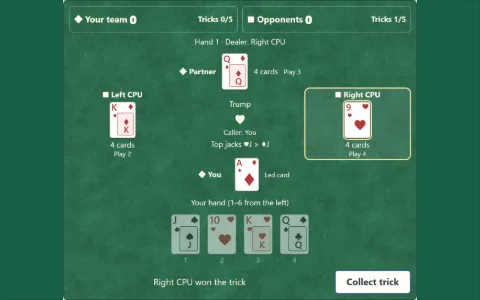
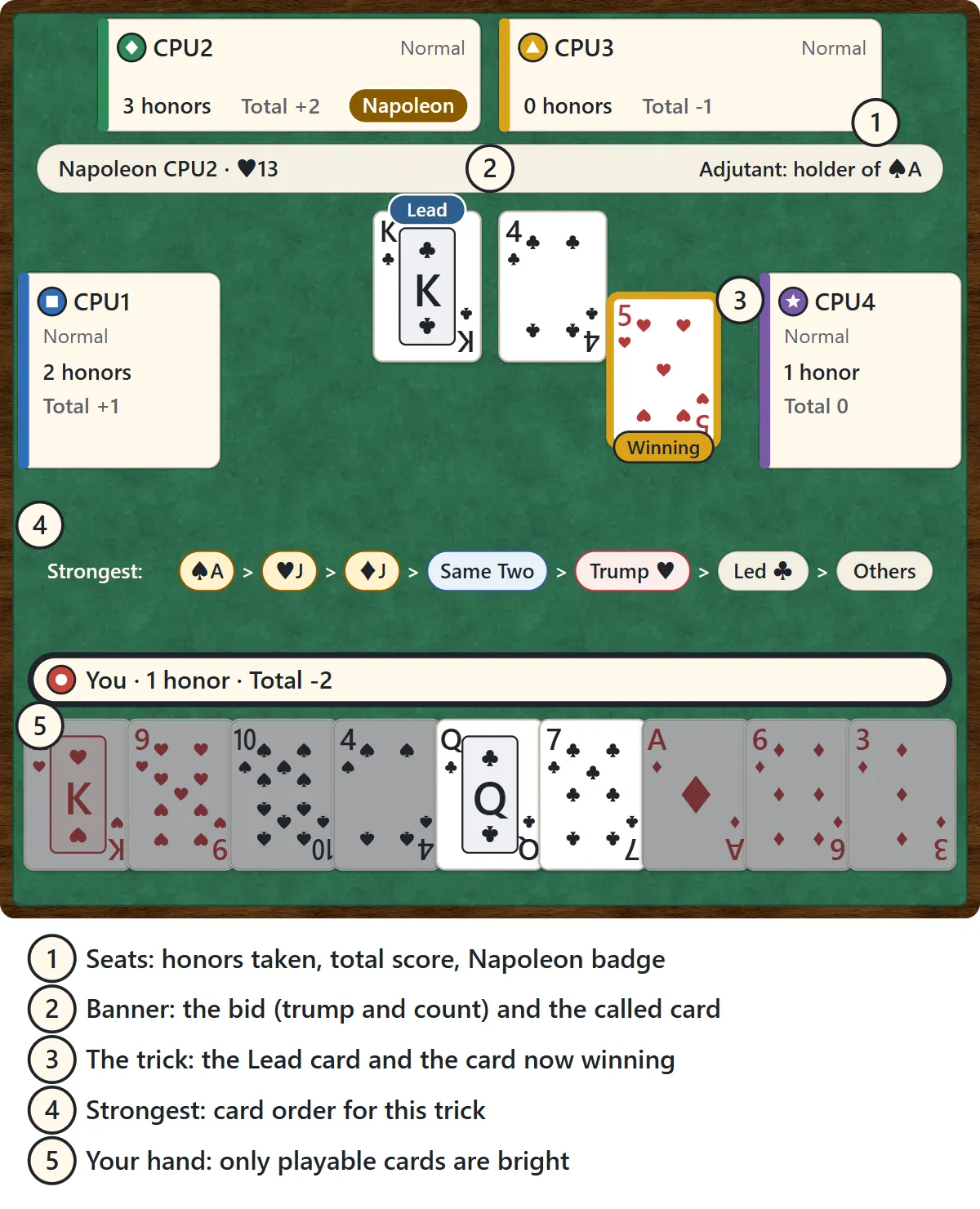
Napoleon leads to the first trick and play continues clockwise. You must follow the suit of the first card if you can. If you can’t, play anything you like, including a trump. When all five have played, the highest card by the ranking above wins the trick and all the honors in it. The winner leads to the next trick, and so on for ten tricks. In this game, the cards you may play are bright, a row under the table shows what beats what, and the card currently winning is marked.
5. Winning and scoring
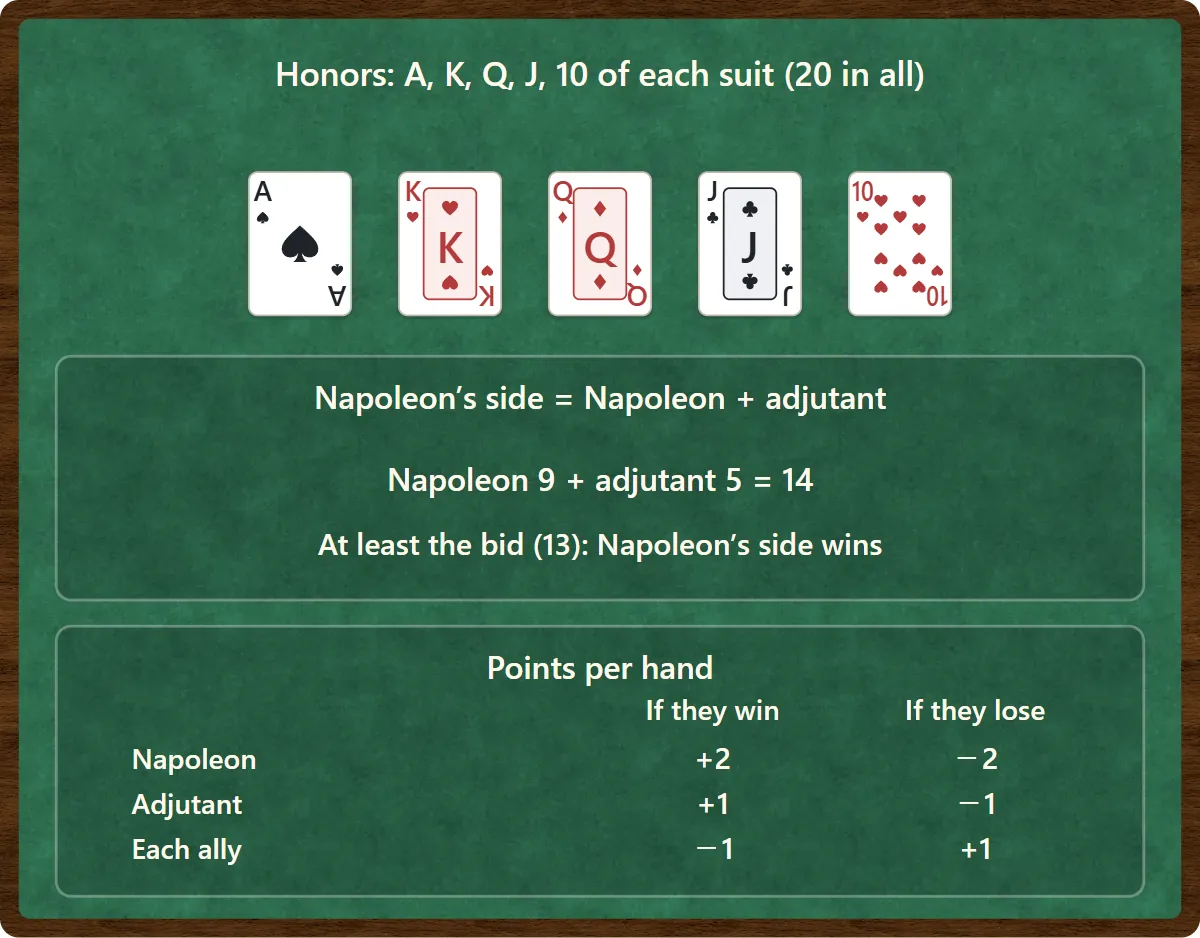
After ten tricks, count the honors won by Napoleon and the adjutant together. If they reach the bid, Napoleon’s side wins; one short and the allies win. If Napoleon’s side wins, Napoleon scores +2, the adjutant +1 and each ally −1. If they lose, it is the other way round. A lone Napoleon scores ±4, and if the allies take all twenty honors the scores are doubled. After the chosen number of hands (five by default), the highest total wins.
Napoleon card game rules: house rules and options
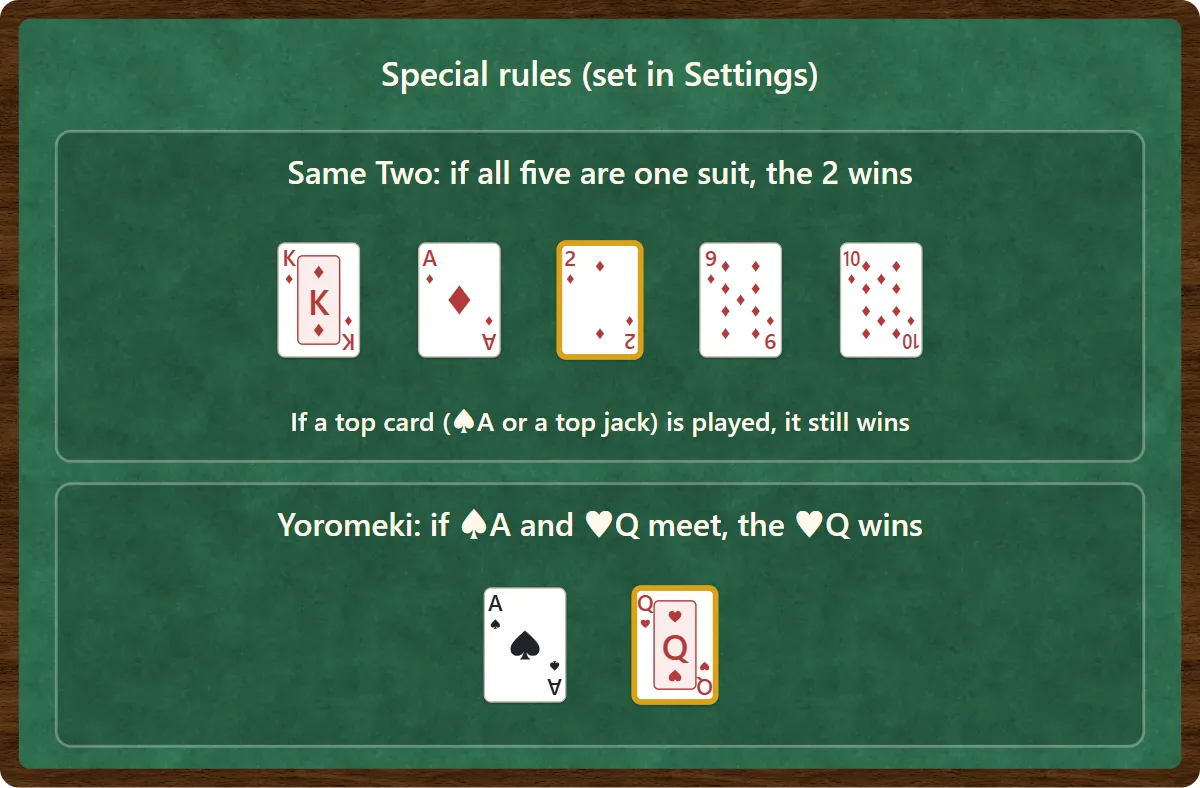
Napoleon is famous for its house rules, and every group seems to play a little differently. This game lets you choose the most common ones.
- Same Two: if all five cards in a trick are the same suit and one of them is the 2, the 2 wins. The Mighty and the two top jacks still beat it.
- Yoromeki (“stagger”): if the Mighty and the ♥Q are played to the same trick, the ♥Q wins. Even the strongest card has a weak spot.
- Joker: with 53 cards the kitty has three cards. The Joker may be played at any time, but it is the lowest card unless it is led. When it is led, everyone must play a trump if they can, and the Joker beats every trump except the three top cards. It cannot be led to the first trick.
- First trick: some groups play the first trick with no trumps and no special cards, or without Same Two.
- Minimum bid of 11, 12 or 13, and whether a player who passed may bid again later.
- Siberia: taking all twenty honors after bidding fewer counts as a loss.
| Rule | Standard | Options |
|---|---|---|
| Joker | No (52 cards) | Yes (53 cards) |
| Minimum bid | 13 | 12 or 11 |
| Same Two | On | Off |
| Yoromeki | Off | On |
| First trick | As usual | No Same Two, or no trumps |
Napoleon strategy: how many to bid
Good bidding starts with an honest count of what your hand can win. Look for these cards:
- Top cards: the Mighty and the two jacks of your chosen suit win a trick almost every time. Before picking trumps, check which suit would give you the Right Jack and the Left Jack.
- Length in trumps: five or more trumps let you keep winning after other players run out of a suit. With three trumps or fewer, bid that suit cautiously, if at all.
- Trump ace and king: once the top three cards are gone, these are the boss cards.
- Side aces: early in the hand they usually win when led.
Remember that your adjutant and the two kitty cards also help. You normally call the strongest card you don’t hold, so your partner starts with at least one big card. As a rough guide, five trumps and one top card are worth about 13, and six trumps with two top cards about 15. While bidding, this game shows an estimate for the suit you select, which is handy while you learn.
A higher bid makes you Napoleon more often, but the score for winning is the same whatever you bid. Stop at the number you can realistically make, and pass when no suit gets you to the minimum. Winning as one of the allies scores points too.
Napoleon tips: finding the adjutant
The heart of the game is guessing who the adjutant is. Until the called card appears, watch for these clues:
- A player who throws honors onto a trick Napoleon is winning is probably the adjutant. An ally would rarely hand Napoleon points.
- A player who beats Napoleon to grab a trick full of honors is probably an ally.
- A player who failed to follow the suit of the called card can’t be holding it, which narrows the field.
When you are the adjutant, there is no hurry to play the called card. Quietly feed honors to tricks Napoleon is winning, and step in to steal tricks the allies are about to take. While you stay hidden, the allies may even pass honors to you. When you are an ally, be careful about giving honors to someone you aren’t sure about; add them to tricks won by a player you know is on your side, or by yourself.
As Napoleon, take control early with your top cards and high trumps so you choose what is led. When discarding, throw away low non-honors, ideally emptying a short side suit so you can trump it later. As an ally, cash your side aces early, before Napoleon runs out of that suit and starts trumping. Whoever plays fifth can see the whole trick, so that seat can win cheaply when the trick is full of honors.
Napoleon card game FAQ
Can Napoleon be played with four or six players?
Yes, although five is the classic number and the one used here. With four players each person usually gets twelve cards and the kitty has four; with six, eight cards each and a kitty of four. Some groups remove a few low cards to keep the kitty small.
What if Napoleon holds the called card?
Then Napoleon plays alone against the other four, and the score is doubled. The same happens if the called card was in the kitty.
Does the adjutant have to announce themselves?
No. Everyone finds out when the called card is played. In this game, other players’ roles stay hidden until then; if you are the adjutant, only your own seat shows “Adjutant (secret)”.
Can the Mighty ever lose?
Not in the standard rules. With Yoromeki switched on, it loses to the ♥Q when both appear in the same trick.
Which difficulty should I choose?
Start with Easy. The computer players bid boldly, often fail as Napoleon, and play straightforwardly, so you can learn the rules. Normal bids sensibly and remembers which top cards have gone. Hard remembers every card, reads who the adjutant is, and makes life difficult for you.
Can I stop and continue later?
Yes. If you close the page in the middle of a game, press Continue next time. Progress is saved only in this browser on this device.
Where does Napoleon come from?
The name comes from the British game of Napoleon, or Nap, which is said to have reached Japan in the Meiji era, in the late nineteenth century. The game Japanese people play today is very different, though. Over time it seems to have borrowed ideas from many games: the special jacks resemble the bowers of Euchre and 500, and the all-powerful ace of spades recalls Spanish games such as Ombre. The result is a uniquely Japanese party game, passed down through families, schools and clubs, with house rules that still vary from table to table.