 Yorimichi Games
How to Play Sudoku
Sudoku is a number placement puzzle. You start with a grid in which some squares already contain numbers, and your job is to fill in the rest. Although the puzzle uses numbers, there is no math involved at all – you never add or multiply anything. All you need is logic: working out, step by step, which numbers can’t go in a square until only one possibility is left. Every puzzle on this page has exactly one solution, so you never have to guess. If you give each number a reason, you will always reach the end.
Sudoku rules
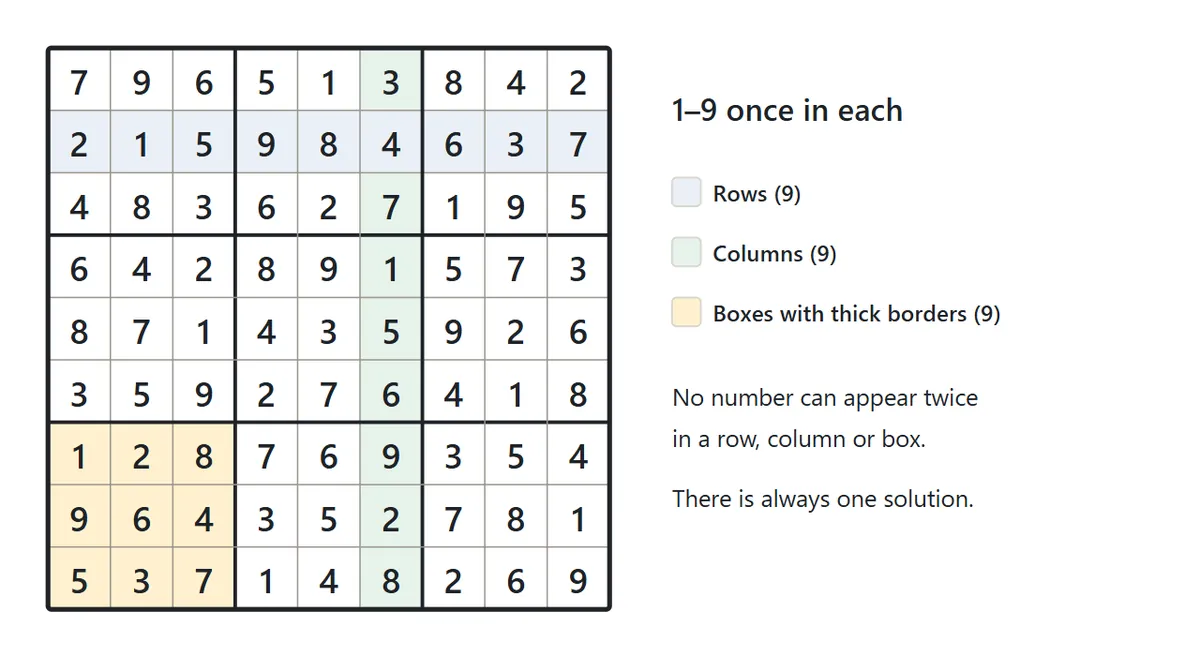
There is only one rule: each row, each column and each 3×3 box outlined with a thick border must contain the numbers 1 to 9 exactly once. In other words, the same number can never appear twice in the same row, column or box. Zero is not used. The numbers that are already in the grid when you start (the “givens”, shown in black) can’t be changed; the numbers you enter appear in blue. When every square is filled and every row, column and box is complete, the puzzle is solved.
Using the game screen
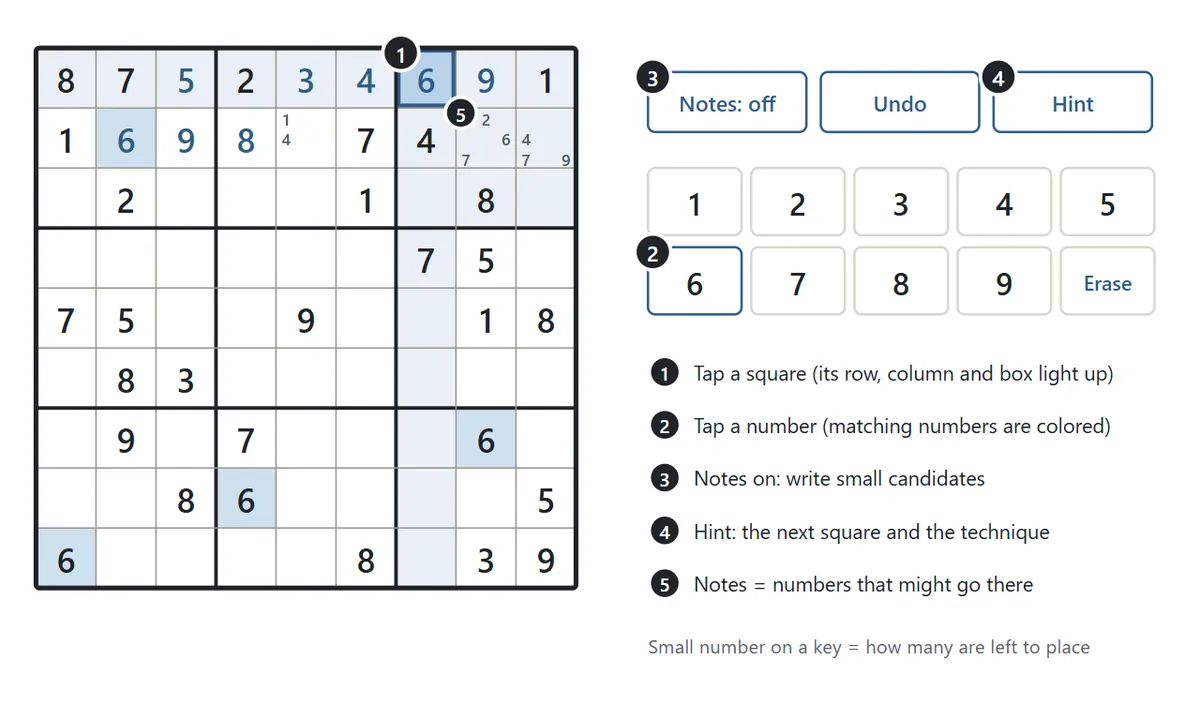
Tap or click an empty square to select it, then press a number below the grid to enter it. Press the same number again to remove it. When a square is selected, its row, column and box are lightly shaded, and every square containing the same number is highlighted, so you can see at a glance where that number already appears. The small figure in the corner of each number key tells you how many of that number are still missing; once all of them are placed, the key fades.
Turn on “Notes” to write small candidate numbers in a square – for example, “this could be a 2 or a 7”. When you place a number, it is automatically removed from the notes in the same row, column and box. “Fill in all notes” writes every possible candidate into every empty square at once (all the numbers not already in that square’s row, column or box). “Undo” steps back through your numbers and notes one change at a time.
You can also play with a keyboard: arrow keys move between squares, number keys enter numbers, and Backspace (or 0) erases. M switches Notes on and off, Z undoes and H asks for a hint. On a phone you can press the “Keyboard” button to type with your device’s number keyboard.
Hints and mistake check
Stuck? Press “Hint”. The first press marks the next square that can be solved from the current grid with a dotted frame and names the technique you need. The second press explains why, highlighting the squares involved. The third press fills in the number. If you only want a nudge, look at the first step and work out the rest yourself. If a number you entered is wrong, the hint shows that square in red first.
With “Mistake check” on, any number that doesn’t match the solution turns red as soon as you enter it. It is a gentle way to learn. With it off, the game stays quiet, so you can solve the puzzle entirely on your own. You can switch it at any time.
Sudoku for Beginners: Grid Sizes and 5 Levels
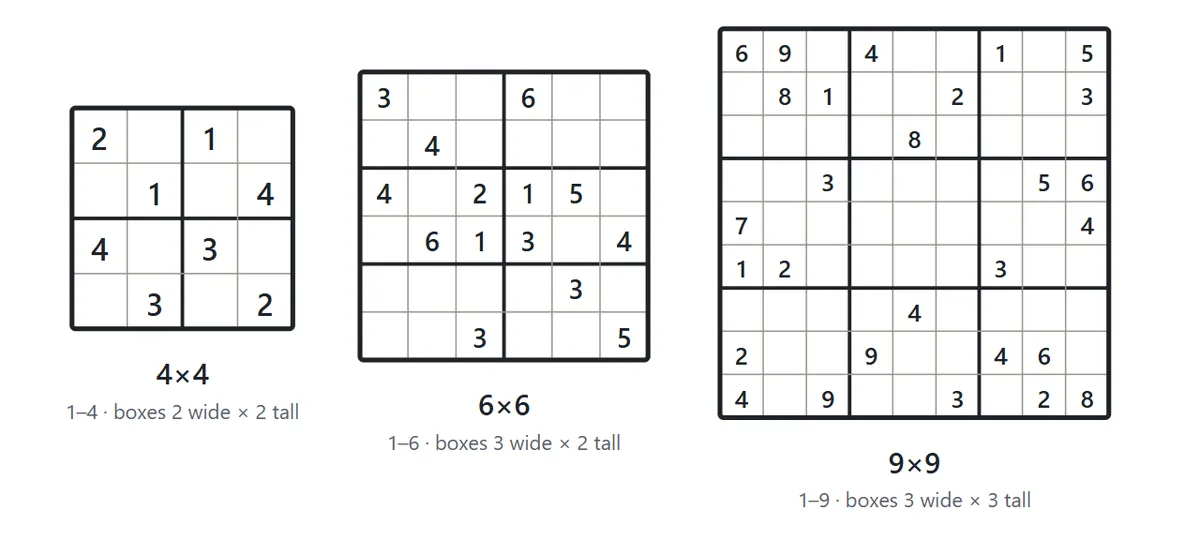
You can choose from three grid sizes. The 4×4 grid uses the numbers 1 to 4 and the 6×6 grid uses 1 to 6, with smaller boxes (on 6×6, each box is 3 squares wide and 2 tall). The rules are exactly the same as on 9×9, so if you are new to Sudoku, a few small puzzles are the fastest way to get the idea.
The level of a puzzle is not decided by how many numbers are given, but by which techniques you need to finish it. Every puzzle can be solved with the techniques of its level and can’t be solved with the techniques of the level below.
| Level | Techniques you need | Grid sizes |
|---|---|---|
| Beginner | Hidden singles in boxes | 4×4, 6×6, 9×9 |
| Easy | Hidden singles in rows and columns, naked singles | 4×4, 6×6, 9×9 |
| Medium | Pointing pairs, box/line reduction | 6×6, 9×9 |
| Hard | Naked and hidden pairs and triples | 9×9 |
| Expert | X-Wing, XY-Wing, Swordfish | 9×9 |
On 4×4 the techniques hardly differ, so Beginner (8 givens) and Easy (4–6 givens) are separated by the number of givens instead. A new puzzle is generated every time you play, so you will almost never see the same puzzle twice.
Sudoku Techniques and Strategy
1. Hidden single: find the only place in a box

This is the most basic Sudoku technique and the one you will use most. Pick one box and one number. Imagine drawing lines through every row and column that already contains that number; those lines cross out the squares where it can’t go. If only one square in the box is left, the number goes there. Go through the numbers 1 to 9 in every box and you can solve most Beginner and Easy puzzles with this alone. Doing the same inside a single row or column is called a hidden single in a row or column.
2. Naked single: count what a square can hold
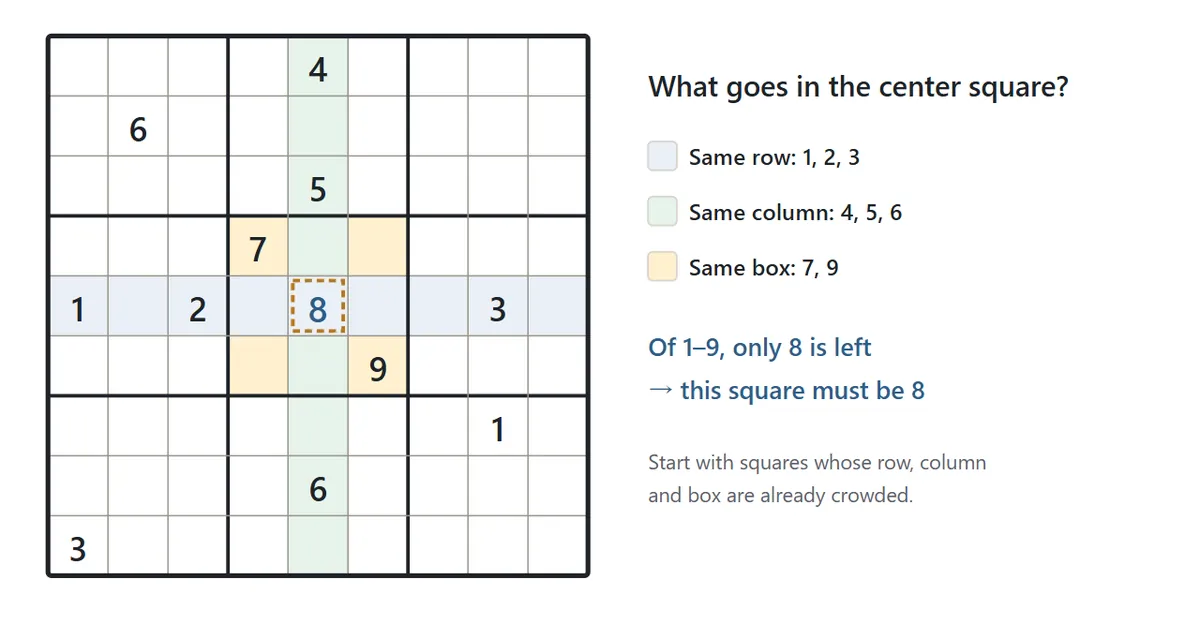
Now think from the square’s point of view. Choose a square and look at every number already in its row, column and box. If eight of the nine numbers are there, the missing one is the answer. Squares at the crossing of crowded rows and columns are the best places to look.
3. Use notes: pointing pairs and box/line reduction

From the Medium level you will reach points where singles alone won’t move you forward. This is where notes pay off. If, inside one box, all the candidates for a number lie in a single row (or column), that number must go in that row within the box – so it can’t go anywhere else in that row, and you can erase it from the other boxes. This is called a pointing pair. It also works the other way round: if all the candidates for a number in a row sit inside one box, you can remove that number from the box’s other squares (box/line reduction). Each note you erase can reveal a new single.
4. Spot naked pairs
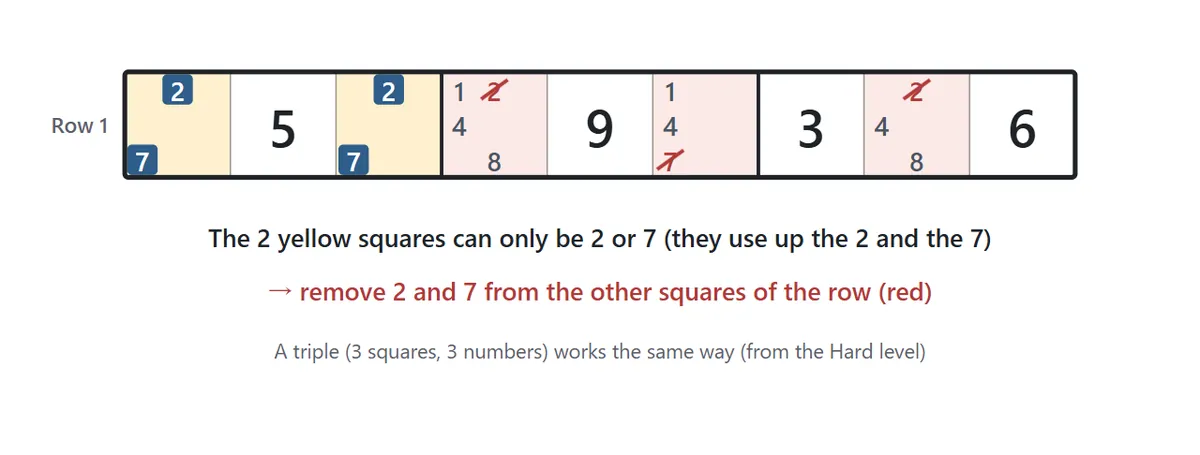
If two squares in the same row, column or box both have only the candidates 2 and 7, then one of them is 2 and the other is 7. You may not know which is which yet, but you know that the 2 and the 7 of that row are used up, so you can remove them from every other square in it. A naked triple (three squares sharing three numbers) and a hidden pair (two numbers that can only go in the same two squares) follow the same idea.
5. Link distant squares: the X-Wing
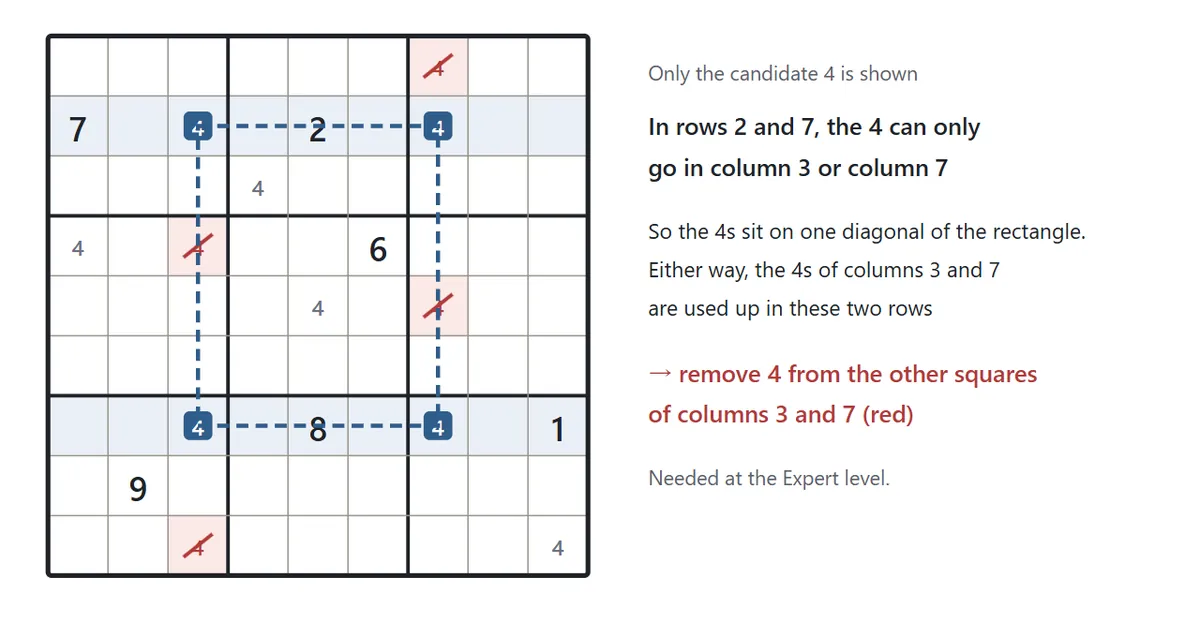
Expert puzzles need patterns that connect squares far apart. Suppose that in two rows a number has exactly two possible squares, and those squares are in the same two columns. The number must then sit on one of the two diagonals of that rectangle – either way, it uses up that number in both columns. So you can remove it from every other square of those columns. This pattern is called an X-Wing. A Swordfish does the same with three rows and three columns, and an XY-Wing links three squares that each have two candidates.
6. When you are stuck
Press “Fill in all notes” and look for squares with only two candidates – pairs and pointing patterns become much easier to see. If you still can’t find the next step, look at just the first hint and use the technique name to work out the reason yourself. After a few puzzles you will start spotting the patterns without help.
Daily Sudoku and Printable Puzzles
The “Daily puzzle” is one 9×9 Sudoku per date. Everyone gets the same puzzle on the same day, so you can compare times with friends and family. The level depends on the day of the week: Easy on Monday and Tuesday, Medium on Wednesday and Thursday, Hard on Friday and Sunday, and Expert on Saturday. Solve it on consecutive days to build a streak.
The “Printable” button opens the current puzzle on a clean black-and-white page. Choose the grid size, the level and how many puzzles to put on a page (1 to 6, or up to 12 for 4×4), add an answer page if you like, and print on US Letter or A4 paper with your browser’s print dialog – handy for a coffee break or a trip without a screen.
Sudoku FAQ
Does every puzzle really have only one solution?
Yes. Before a puzzle appears, a solver checks every possibility to confirm that it has exactly one solution. On top of that, only puzzles that can be finished with the techniques of the chosen level – without trial and error – are used.
How are best times recorded?
For each combination of grid size and level, the game records how many puzzles you solved, how many you solved without hints, your fastest time and your average time. Only puzzles solved without hints or “Show answer” count toward your best time; using Mistake check is fine. Records are stored in your browser on this device only.
Can I stop and continue later?
Yes. Open the page again on the same device and browser and press “Continue” in the settings to pick up with your numbers, notes and time intact. Your undo history is kept too, and the timer pauses while you are looking at another tab.
Are puzzles with fewer givens harder?
Not necessarily. Some puzzles with few givens can be solved with hidden singles alone, while others with many givens need advanced techniques. That is why levels here are based on the techniques required. For the record, a 9×9 Sudoku with a unique solution needs at least 17 givens.
Is there sound?
Sound is off at first. Press “Sound: off” to hear a soft click when you enter numbers and a chime when you solve a puzzle.
History of Sudoku
The puzzle is generally traced back to 1979, when an American puzzle magazine published it under the name “Number Place”; its creator is usually said to be Howard Garns, a retired architect. In the 1980s it was introduced in Japan, where it got the name Sudoku – short for a Japanese phrase meaning roughly “the digits must be single”. It became a worldwide craze in 2004 and 2005 after British newspapers began printing it daily. The rules could hardly be simpler, yet the techniques run deep, and new puzzles are published every day in newspapers, books and apps around the world.