 Yorimichi Games
How to play Quick Draw Duel
Quick Draw Duel is a reaction time game dressed up as an old-fashioned standoff. You and your opponent stand as black silhouettes against a sunset. Nothing happens for a few seconds – and then a white “!” flashes in the sky. The moment you see it, press the big Draw button or tap anywhere on the scene. If your reaction is faster than your opponent’s, you win the duel. If they are faster, you lose. Press before the “!” appears and it counts as a false start.
It takes about ten seconds to learn and a surprisingly long time to master. Every duel shows both reaction times in milliseconds, so it doubles as a simple reaction test you can come back to and track over time.
One duel, step by step
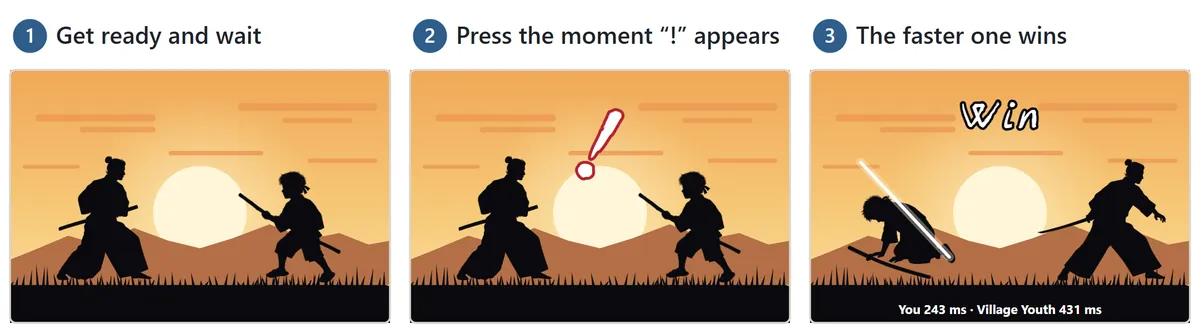
First your opponent’s name and a short line appear. When the word “Ready” fades out, the duel has begun, and from that point until the “!” you must not press anything. As soon as the “!” shows up, press. The screen flashes white, the two silhouettes dash past each other, and the slower one drops to one knee. Under the scene you will see how long each of you took from the “!” to the press.
False starts: pressing before the “!”
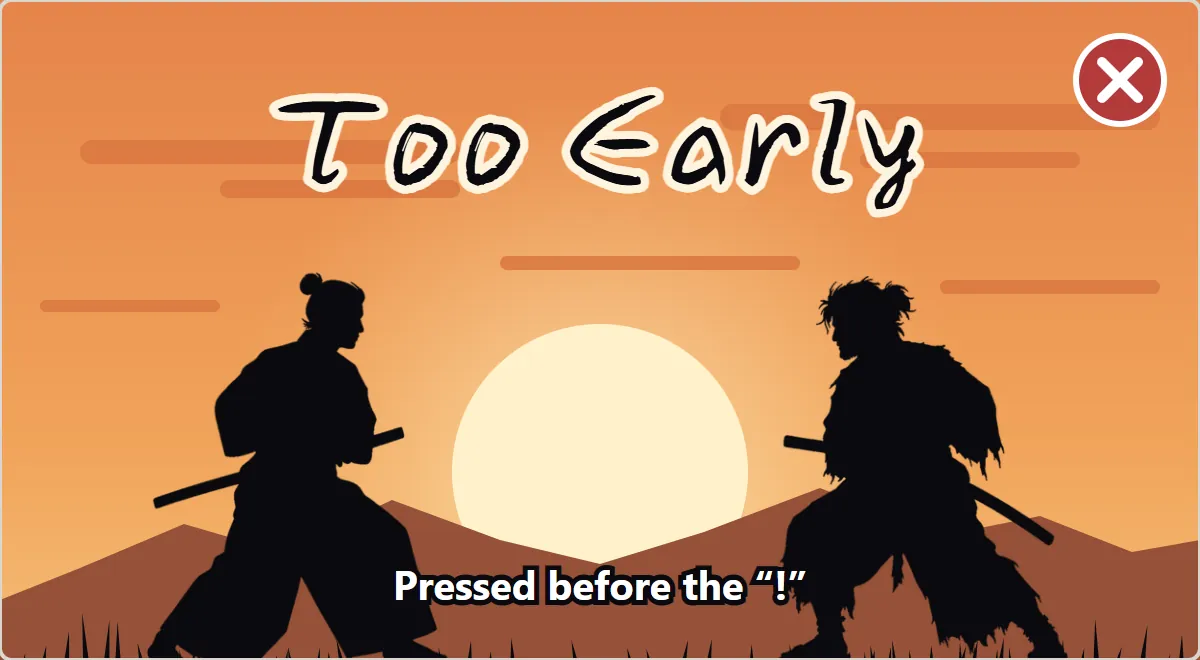
The wait before the signal changes every time. Sometimes the “!” comes after two seconds, sometimes you are kept waiting for more than six. If you try to guess the moment and press early, you lose that duel on the spot. A press that comes less than 0.1 seconds after the “!” also counts as a false start. Nobody can see a signal and move a finger that quickly, so such a press must have been a guess. Sprint races use the same idea to spot false starts at the starting blocks.

Watch out for fake-outs
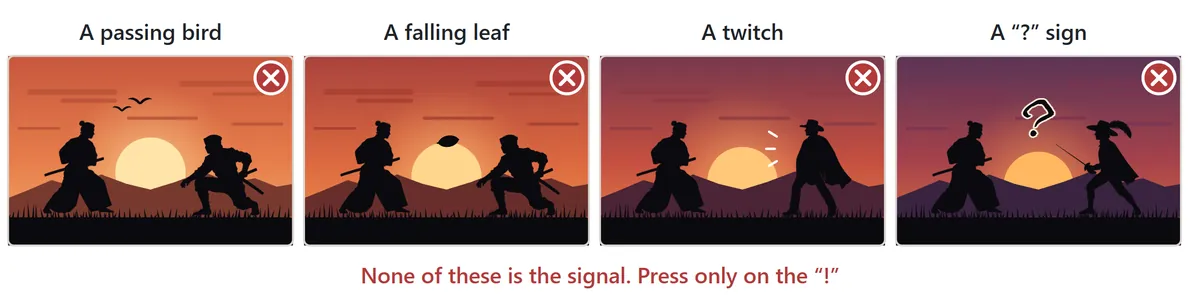
From the third opponent, the Ninja, things start trying to trick you. A pair of birds glides across the sky, a leaf flutters down, your opponent suddenly twitches, or a “?” pops up exactly where the “!” would be. Pressing on any of these is a false start. Only the white “!” counts. When you fall for one, the line under the scene tells you what fooled you.
The gauntlet: seven rivals
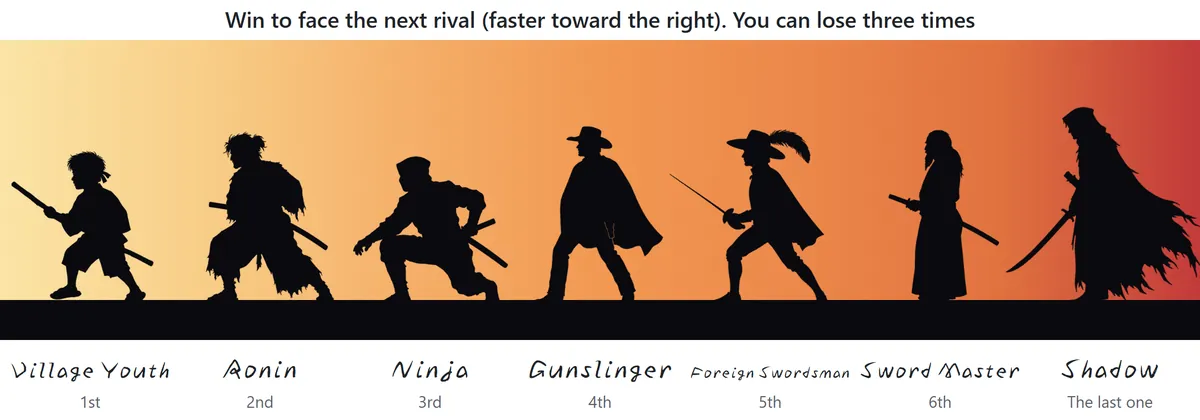
In the gauntlet you meet seven opponents in a row. Win a duel and you move on to the next one, and the sun sinks a little lower each time. Lose, or make a false start, and you face the same opponent again. You have three lives (the dots at the top of the game), and the run ends on your third loss. If both times are exactly the same, the duel is a tie and is replayed without costing a life. The early opponents are a little nervous and sometimes move before the signal – that is their false start, and you win that duel.
The seven are the Village Youth, a Ronin (a wandering samurai without a master), a Ninja, a Gunslinger, a Foreign Swordsman, a Sword Master and finally the Shadow, whose waiting times are the most unpredictable of all.
Normal, Expert and practice duels
| Normal | Expert | |
|---|---|---|
| Opponent speed | About 0.6 s for the Village Youth, about 0.47 s for the last two. Beatable on your first try, with a tougher finish | Much faster: the Village Youth is in the 0.4 s range and the Shadow is around 0.27 s |
| Fake-outs | From the Ninja (third) onward | Can appear from the very first duel, and more often |
| Lives | 3 | 3 |
In a practice duel you pick any opponent you have already met in the gauntlet and duel them as many times as you like. Losing does not end anything, so it is a good way to work on the rival who keeps beating you. Opponents you haven’t met yet are shown as “???”.
There are three ways to press: the big Draw button under the scene, a tap anywhere on the sunset scene, or the space bar on a keyboard (Enter, F and J work too). Use whichever lets you react fastest.
Reaction time: how fast is fast?
Reaction time is the delay between a signal and your response. For a simple visual signal, young adults typically respond in roughly 0.19 to 0.25 seconds in lab conditions. On a phone or computer the number you see is a little higher, because the screen takes time to light up and the device takes time to register your touch or key press. In this game, a reaction around 0.3 seconds is already very good, and anything under 0.25 seconds is excellent.
At the end of every run you get your average reaction time for that run. As a rough guide: if your average is around 0.45 seconds, you are a match for the last opponents on Normal. At around 0.3 seconds you can stand up to the second half of Expert, and once you can get under 0.25 seconds, clearing the whole Expert gauntlet is within reach.
Quick draw tips: how to win more duels
1. Keep your eyes on the spot where the “!” appears
The “!” always shows up in the same place: in the middle of the sky, just above the sun. If your eyes follow the silhouettes or a passing bird, you will notice the signal a split second later. Rest your gaze on the signal spot and take in the rest of the scene loosely.
2. Keep your finger ready
Moving your finger from far away adds time before you even touch the screen. On a phone, hover your finger just above the screen. On a computer, rest a finger lightly on the space bar. Tapping directly on the scene is often quicker than aiming for the button.
3. Don’t try to guess
The wait before the signal is random, and some opponents keep you waiting a long time on purpose. Pressing because “it must be coming now” usually ends in a false start. Against fast opponents it is tempting to gamble, but reacting to what you see wins more often in the end.
4. Decide in advance that only the “!” counts
Fake-outs work because we naturally react to anything that moves. Tell yourself before each duel: “white exclamation mark or nothing.” The “?” is the sneakiest, because it appears in exactly the same place and has a similar shape, so be especially careful against the last opponents.
5. Play when you are fresh
Reaction time gets slower when you are tired, sleepy or distracted. If you are chasing a record, try it when you are alert, sit comfortably, and use the same device each time so your numbers are comparable.
Quick Draw Duel FAQ
How accurate are the times?
The game measures from the moment it draws the “!” on screen to the moment your press arrives. That includes the small delay of your display and of your touch screen or keyboard, so phones and tablets may show slightly longer times than a computer. The number is best used to compare yourself over time on the same device.
Can I pause?
Yes. Pressing “Pause” cancels the current duel. When you press “Resume”, the duel with the same opponent starts again from the beginning, and you don’t lose a life. If you switch to another tab in the middle of a duel, that duel is replayed too.
Can I stop and continue later?
Yes. Open the game again in the same browser on the same device and press “Continue” to pick up with the same opponent and the same number of lives. Your records – best run, fastest win and best average – are kept on your device as well.
Is there sound?
Sound is off at the start. Press “Sound: off” to turn it on: you will hear a sharp wooden clap for the signal, the swish of the duel, and short koto and drum phrases for wins and losses. While you wait there is a soft wind and, now and then, a distant flute or the cry of a hawk. The hawk only calls when a bird crosses the sky, never right before the signal. Hearing the signal can make you react slightly faster than seeing it, so leave the sound off if you want a purely visual test.
Do I need to sign up or download anything?
No. The game runs in your browser on phones, tablets and computers, and it is free to play without an account.
About the quick draw
A duel decided in a single instant – two swordsmen facing each other, or two gunslingers waiting for the clock to strike – is a familiar scene in Japanese period dramas and in old Western films alike. Fast draw has even become a timed sport, where a machine measures how long it takes a competitor to react to a signal. Quick Draw Duel takes that moment and turns it into a gentle test of reflexes, with rivals from many times and places meeting as silhouettes at sunset. No one gets hurt: the loser simply kneels, and you can always try again.