 Yorimichi Games
How to Play the Maze Game
A maze is a puzzle made of paths and walls: somewhere among the corridors there is a route that leads from the entrance to the exit, and your job is to find it. In this online maze game you guide a hamster from the start square to the goal flag. A fresh maze is generated every time you play, and every one of them is a so-called perfect maze: there is exactly one path from the start to the goal. No corridor loops back on itself and no part of the maze is sealed off, so however big the maze is, you can always reach the goal if you keep going.
Trace the path to move
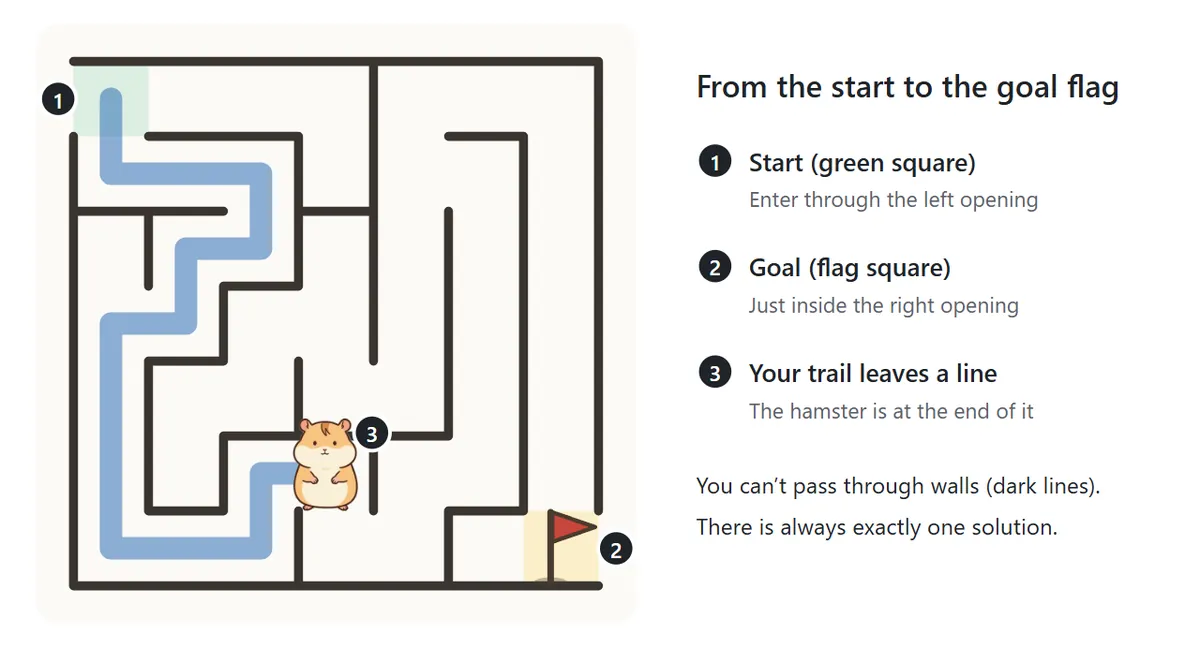
Put your finger or mouse on the hamster and trace along the corridor – the hamster follows. The dark lines are walls and you can’t pass through them. On a keyboard, the arrow keys or W, A, S and D move one square at a time. On a phone or tablet you can also swipe across the maze: the hamster runs in that direction until it reaches the next fork or dead end. That makes long straight corridors and winding one-way passages quick to cover.
Hit a dead end? Walk back the way you came
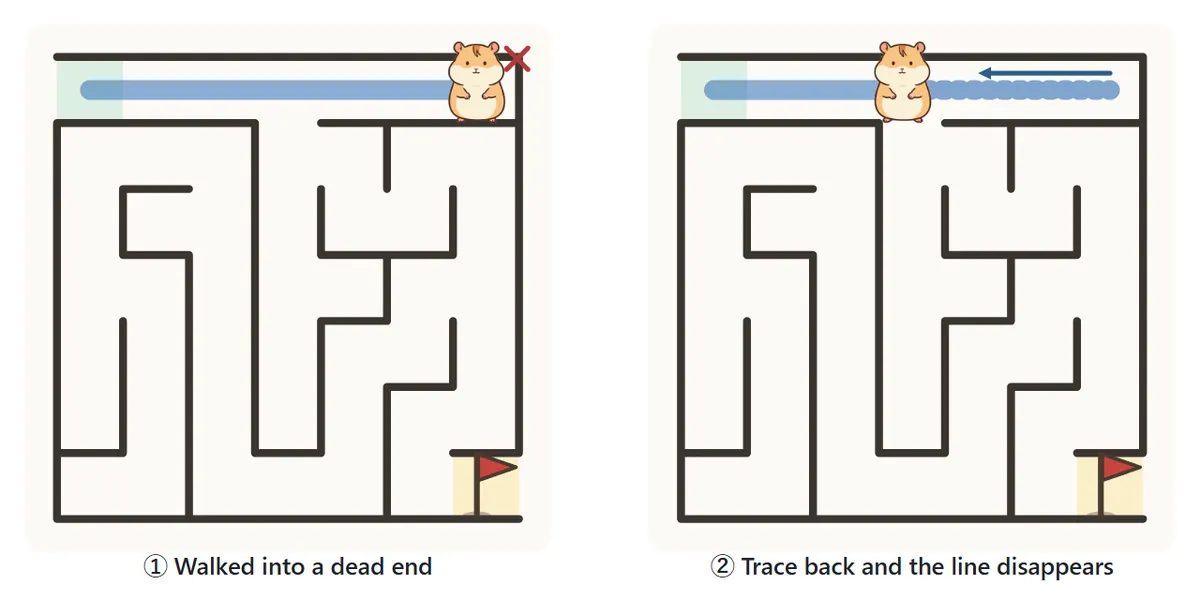
When you run into a dead end, simply trace back along the way you came. The line you walk back over is erased, so the board always shows just one thing: the route from the start to where you are now. You can also tap any point on your line to jump straight back there. The Undo button (or Backspace) steps back one square, and “To start” sends the hamster back to the beginning of the same maze.
Hints and the answer
If you’re not sure which way to go, press Hint. A few squares of the correct route appear as dots, starting from where you are – enough to get you moving without spoiling the rest of the maze. If the corridor you’re in doesn’t lead to the goal, the dots point back the way you came. Press “Show answer” twice in a row to see the whole solution path drawn in green. Mazes solved with a hint or the answer still count as goals, but not toward your best time.
Maze Shapes and Sizes

There are three shapes. Square is the familiar grid maze: you enter at the top left and leave at the bottom right. Circle is a round maze built from rings around a center point. You come in through the outermost ring and head for the flag in the middle. The outer rings are divided into more cells than the inner ones, so the paths thin out as you get closer to the center. Hexagon is a honeycomb of six-sided cells. Every cell can open in six directions, which creates many more forks and gives these mazes a very different feel from a square grid.
| Size | Square | Circle | Hexagon |
|---|---|---|---|
| Tiny | 7×7 | 3 rings | radius 3 |
| Small | 10×10 | 5 rings | radius 4 |
| Medium | 14×14 | 7 rings | radius 6 |
| Large | 20×20 | 10 rings | radius 8 |
| Huge | 27×27 | 14 rings | radius 11 |
For hexagon mazes, the radius is the number of cells from the center cell to the edge. Tiny and Small mazes are easy to trace with a finger and take well under a minute – perfect for a quick break or for someone trying mazes for the first time. Huge mazes have very fine corridors, so they are best on a large computer screen or printed out on paper.
How the Maze Generator Works: Three Styles
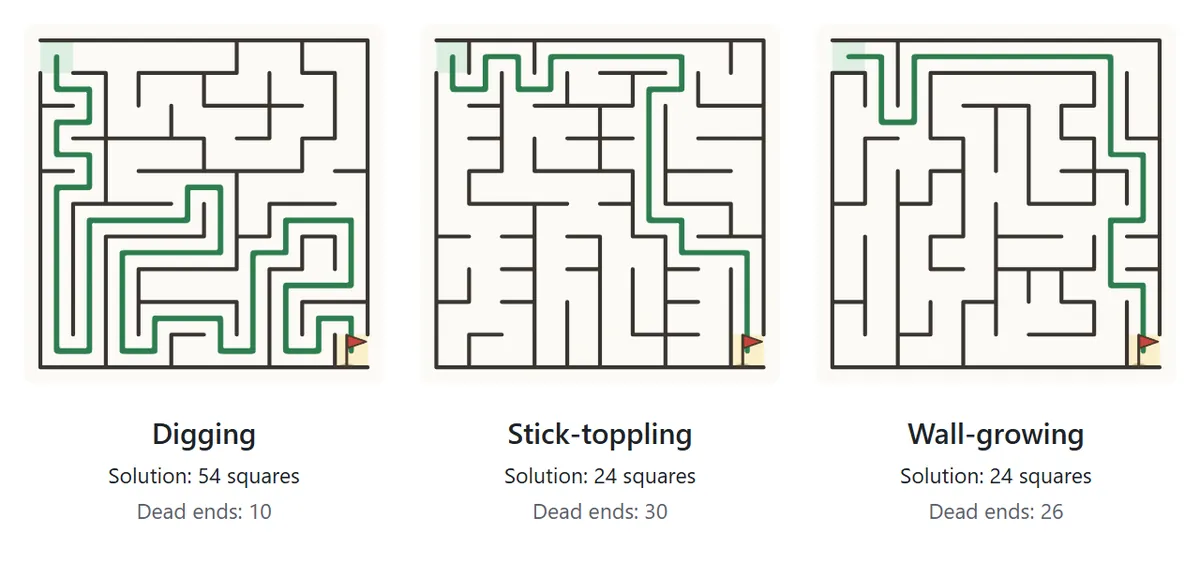
Every maze is built on the spot by a maze generator using well-known maze generation algorithms. All three styles produce perfect mazes with a single solution, but they differ in how long the paths are and how often they branch – so try them all and find your favorite.
Digging
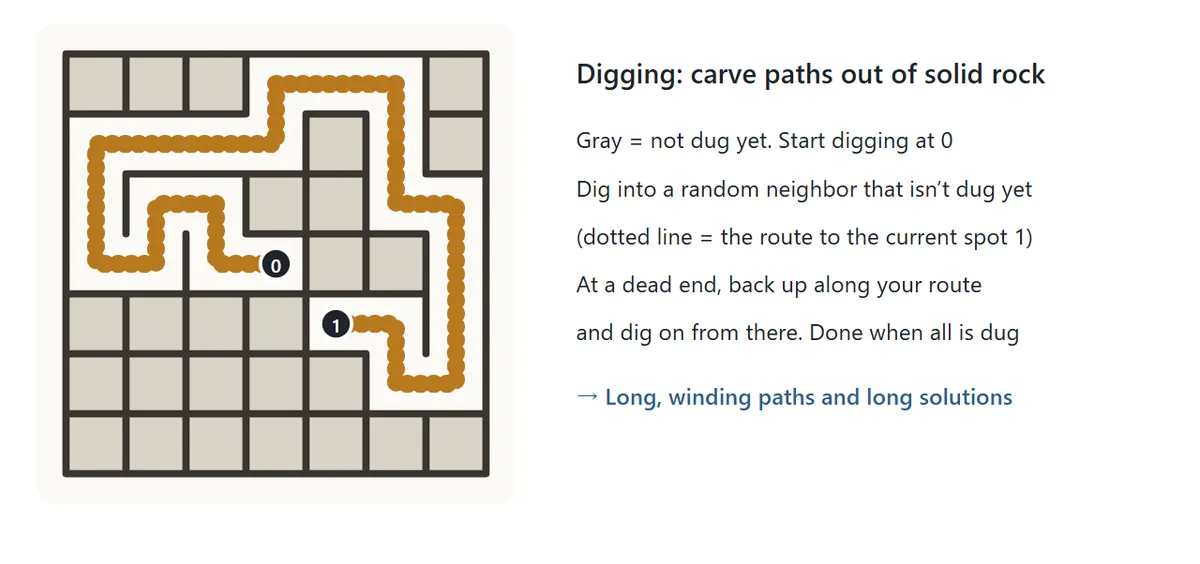
Imagine the whole maze filled with earth, and you are digging tunnels through it. From the current cell, you dig into a random neighbor that hasn’t been dug yet. When every neighbor has already been dug, you back up along your tunnel until you find a spot where you can dig again. Programmers know this as the recursive backtracker or randomized depth-first search. Because it digs each tunnel as far as it can, it creates long, winding corridors and a long solution path. There are fewer dead ends, but a wrong turn can take you a long way before you find out.
Stick-toppling

Inside the outer wall, posts stand on the grid points between cells. Going row by row from the top, each post knocks one stick over in a random direction, and that stick becomes a wall. Posts in the first row may fall up, down, left or right; posts in every later row may fall any way except up, and a stick never falls onto a spot that already has one. It is a remarkably simple recipe, yet it always produces a maze with a single solution. You get lots of short dead ends and a short solution, which makes this the easiest style. Because sticks can’t fall upward, the top two rows tend to be open from one side to the other. This style is available for square mazes only.
Wall-growing
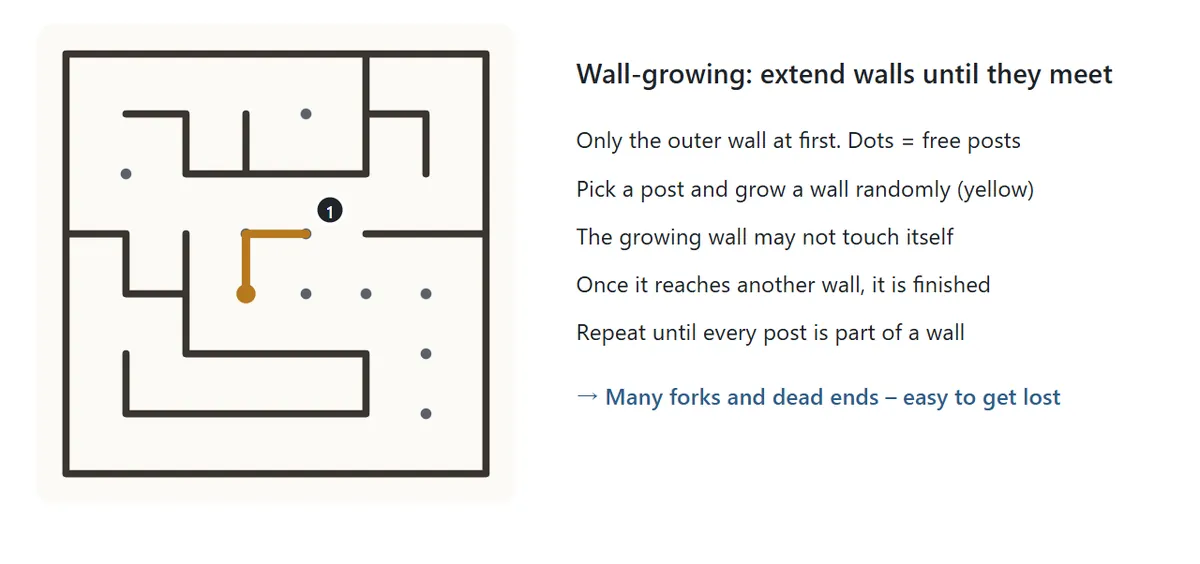
This one works the other way around: you start with only the outer wall and add walls a little at a time. Choose a post that isn’t part of a wall yet and extend a wall from it in random directions. The growing wall is never allowed to touch itself, so no closed rooms can form. As soon as it reaches an existing wall, that piece is finished. Repeat until every post belongs to a wall. The result has many forks and dead ends scattered everywhere – a maze that is easy to get lost in.
Maze Solving Strategy and Tips
1. Look ahead before you take a fork
When you reach a fork, don’t move right away. Follow each branch with your eyes first. If one of them obviously ends a few squares later, you can rule it out without walking it. On a small screen, scan ahead a little at a time.
2. Work backward from the goal
Tracing the route backward from the flag narrows things down quickly. Look from both ends and search for the place where the two routes meet. In circle mazes this is especially useful: the area around the goal in the center has only a few paths, so starting from the goal side is often the fastest way in.
3. On printable mazes, fill in the dead ends
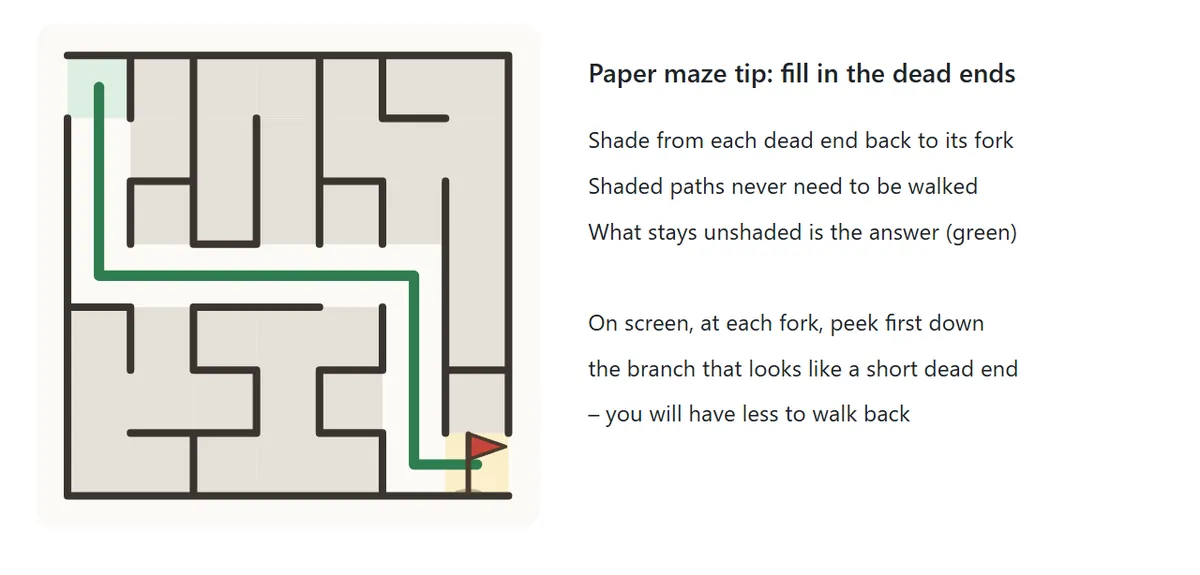
On a paper maze you can use the dead-end filling method: with a pencil, shade each dead end back to the fork where it branches off. A shaded corridor is one you never need to walk. Keep going, and the only corridor left unshaded is the solution.
4. Keep one hand on the wall
If you keep your right hand (or your left) on the wall and never let go, you will eventually reach the goal in any maze in this game. It may take a while, but it always works here because the paths have no loops and every wall is connected to the outer wall. That makes the wall follower rule a good last resort when you are truly stuck. In mazes that do have loops – for example when the goal sits inside a ring of corridors – following one wall can send you around the same circuit forever.
5. Learn each style’s habits
In Digging mazes the wrong branches are long, so choose carefully at every fork. In Stick-toppling and Wall-growing mazes the dead ends are short, so a wrong turn costs you little. There, the quickest approach is to try a branch and turn back the moment it stops.
Daily Maze and Printable Mazes
The daily maze is a fixed maze for each date. Everyone who plays on the same day gets the same maze, so you can compare times with family and friends. The shape rotates day by day between square, circle and hexagon, and the size is always Medium. Solve it on consecutive days to build up a streak.
Press Print to open the maze you are playing on a clean black-and-white page. Choose the shape, size, style and how many mazes to put on a page (1, 2 or 4), pick US Letter or A4 paper, and print from your browser. You can add an answer page too, which makes these free printable mazes handy for a rainy afternoon, a long car ride or a quiet moment with a pencil.
Maze FAQ
Is there really only one solution?
Yes. Every style is built so that the corridors never form a loop and no area is left unreachable. In a maze like that, there is exactly one route between any two points – including the start and the goal.
How are best times recorded?
The clock starts the first time you move the hamster. For each combination of shape and size, the game keeps the number of goals, the number of goals without hints, your best time and your average time. Only runs without hints or the answer count toward your best time. Records are stored only in the browser on your own device.
Can I stop and continue later?
Yes. Open the page again on the same device and browser and press Continue to pick up in the same maze at the same spot. The clock pauses while you are looking at another tab.
Tracing doesn’t work well on my phone. What can I do?
Start close to the end of your line (where the hamster is) and trace slowly without lifting your finger. Large and Huge mazes have small cells, so Tiny to Medium sizes are easier on a phone. Swiping to run to the next fork also helps.
Is there sound?
Sound is off at first. Press “Sound: off” below the maze to turn on the sound effects for moving and reaching the goal.
A Short History of Mazes
Mazes are ancient. Greek myth tells of a maze built to imprison the Minotaur, and maze-like patterns appear on coins, floors and rock carvings from many cultures. In Europe, hedge mazes became popular in the gardens of palaces and country houses in the 16th and 17th centuries; the hedge maze at Hampton Court Palace near London, planted in the 1690s, is still open to visitors today. In Japan, a maze garden opened in Yokohama in the 1870s is often cited as an early example, and in the 1980s giant wooden-walled mazes became a nationwide craze. Paper mazes remain a favorite in puzzle books to this day, and computer scientists have invented many ways to generate mazes automatically – the three styles in this game are among the classic ones.