 Yorimichi Games
How to play matchstick puzzles
A matchstick puzzle shows a short sum built from matchsticks, and the sum is wrong. Your job is to move a set number of matchsticks, usually just one, so that the equation becomes true. Take “5 + 7 = 2”: lift the upright stick out of the plus sign, drop it into the top-right corner of the 5, and the line now reads “9 − 7 = 2”. You never add or remove matchsticks; you only pick them up and put them somewhere else. Alongside the equation puzzles there is a set of square puzzles, where you rearrange matchsticks on a grid until you have a given number of squares. Everything runs in your browser, with nothing to install and no account.
Pick up a matchstick, then tap where it goes
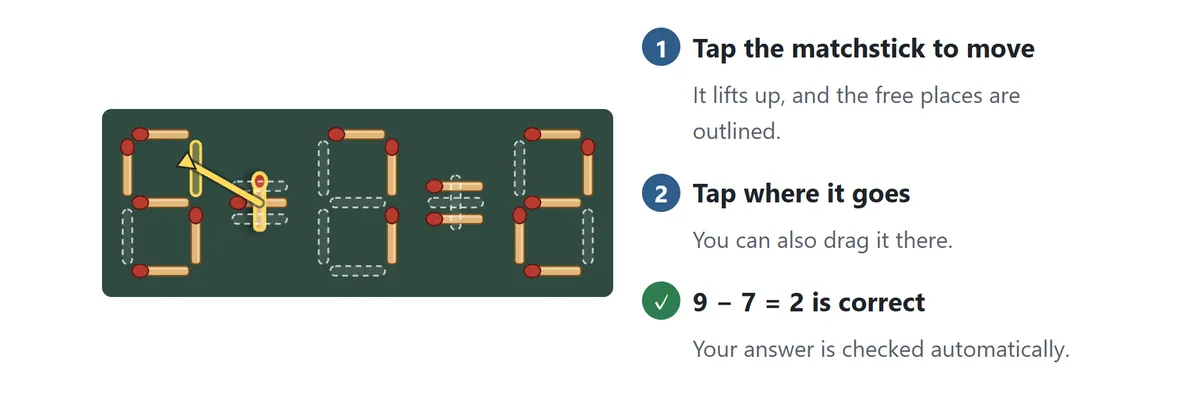
Tap (or click) the matchstick you want to move. It lifts up, turns yellow, and every empty place where a matchstick could sit appears as a dotted outline. Tap one of those outlines and the matchstick slides there. If you prefer, just drag the matchstick and let go over the spot you want; it snaps to the nearest place. Tapping the lifted matchstick a second time puts it back down without moving it. As soon as you have moved the required number of matchsticks, the game checks your answer for you.
Digits look like calculator digits
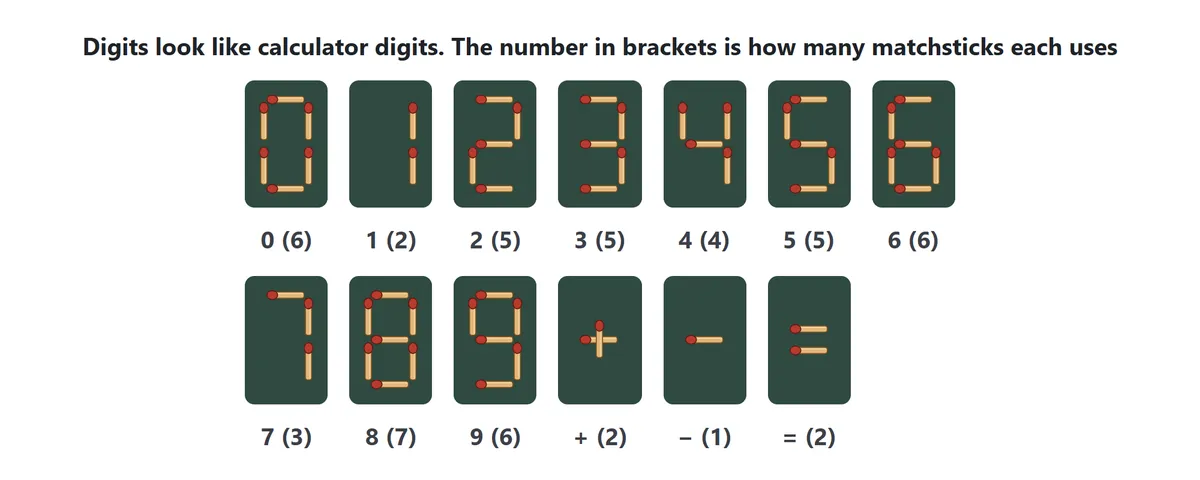
The numbers use the familiar seven-segment style you see on a calculator or a digital clock. An 8 uses all seven places, and every other digit leaves some of them empty. A 1 is the two sticks on the right, a 7 is the top bar plus those two sticks, and the 6 and 9 both have their “tails” (the top bar on the 6, the bottom bar on the 9). There are three signs: plus (two sticks), minus (one stick) and equals (two sticks). You can’t lay a stick across the equals sign to make “not equal”, and matchsticks always sit straight, either across or upright.
How moves are counted
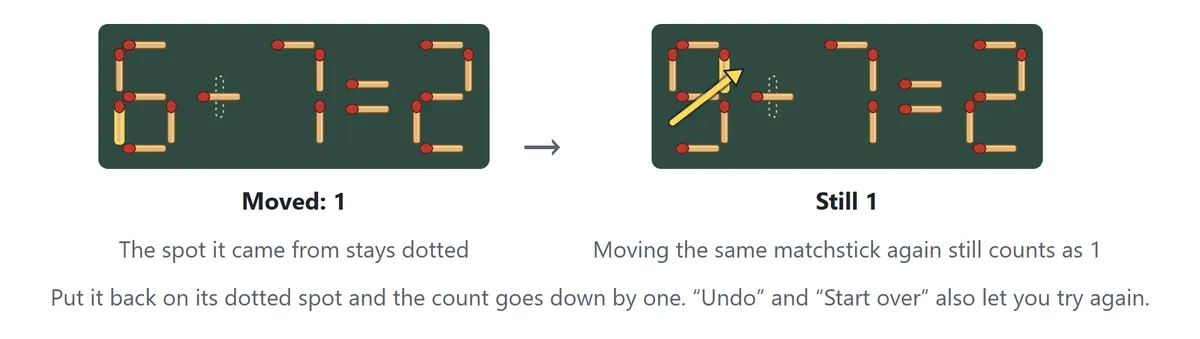
The counter above the board, such as “Moved 1 / 1”, tells you how many matchsticks you have moved so far. Moving the same matchstick again, to a different spot, still counts as one move, so you can adjust your idea freely. Put a matchstick back into its dotted starting place and the count goes down by one. The game won’t let you go over the limit, so when you want to try a different idea, use “Undo” to take back your last move or “Start over” to reset the board.
When the answer is wrong, you see why
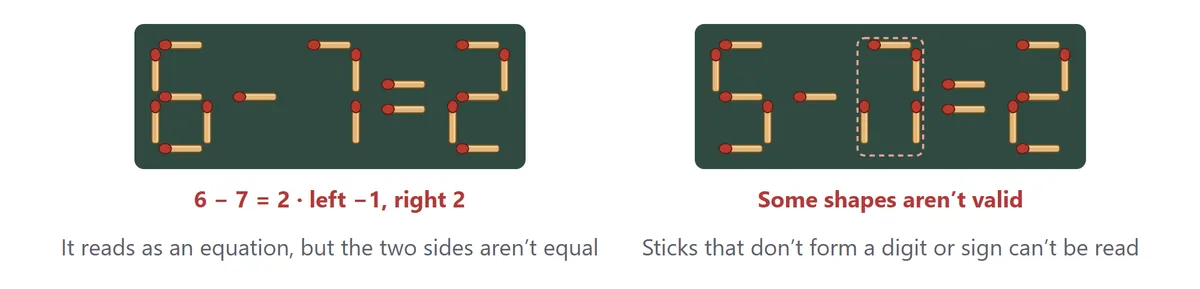
If you use up your moves and the equation still isn’t true, the game tells you what went wrong, for example “The left side is −1 and the right side is 2, so they aren’t equal”. If a group of sticks doesn’t form a digit or sign at all, that spot is outlined so you can see it. Wrong tries are not counted against you, so experiment as much as you like. When you solve a puzzle you see the corrected equation, what both sides add up to, and which characters changed (for example 5→9 and +→−).
Two-move puzzles
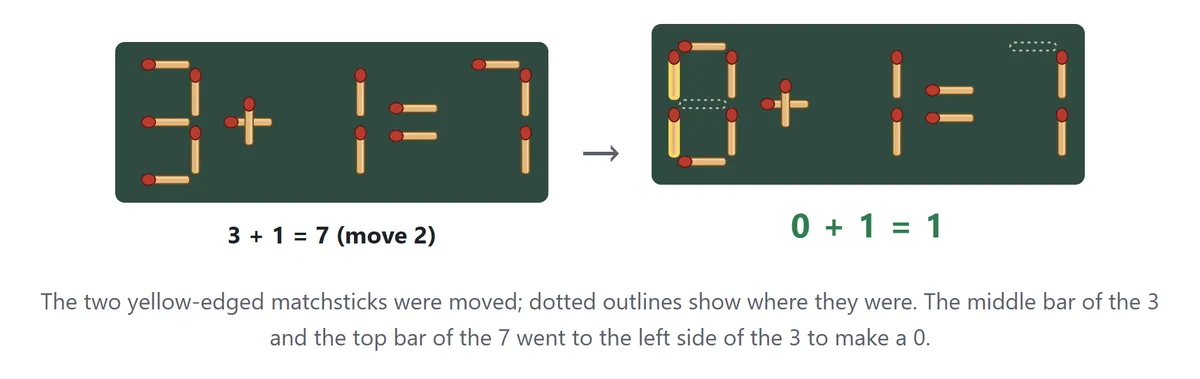
The Normal level asks you to move two matchsticks. These puzzles are chosen so that a single move is never enough; you really need both. Sometimes both sticks end up in the same digit, and sometimes they go to two different places. The Hard level mixes in two-digit numbers, sums with three numbers, and puzzles where the key is to turn a plus into a minus or the other way round.
Matchstick square puzzles
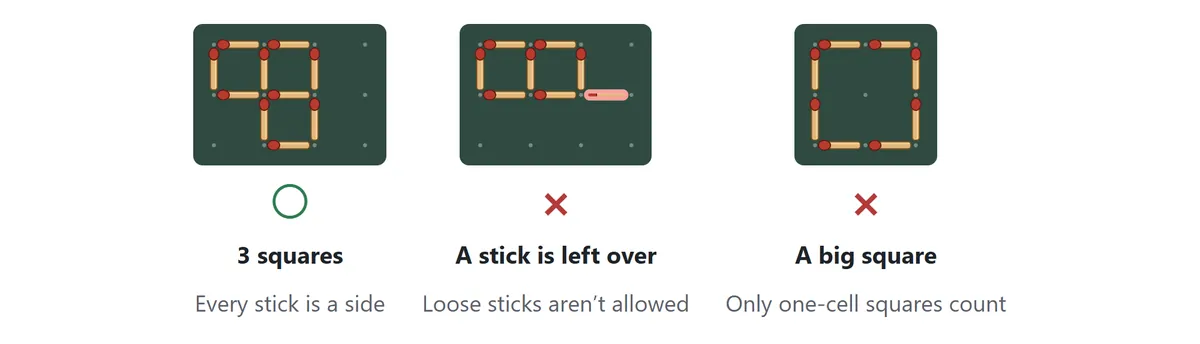
In the square puzzles the matchsticks lie on a dotted grid. Move the given number of them so that you end up with exactly the requested number of small, one-cell squares. Every matchstick has to be a side of at least one square; a loose stick left over means the answer doesn’t count. Bigger squares made from four cells are not counted. Some of these puzzles have more than one answer. Any correct arrangement is accepted, and after you solve one you can page through all the answers with “Other answer”.
Levels and modes
| Level | What you get |
|---|---|
| Easy | Move 1. Single-digit adding and subtracting (e.g. 3 − 1 = 4) |
| Normal | Move 2. Single digits, plus some answers with two digits |
| Hard | Move 1 or 2. Two-digit numbers, three-number sums, sign swaps |
| Squares | Move 1 to 3 to make a set number of squares |
| Mode | How it works |
|---|---|
| One at a time | Work through a level in numbered order, starting from the first puzzle you haven’t solved. “Previous puzzle” and “Next puzzle” let you jump around. The settings show how many you have solved. |
| 10-puzzle challenge | Ten random puzzles from one level, against the clock. Each hint adds 10 seconds. Your best score (most correct, then fastest) is saved for every level. |
| Daily 3 | Three puzzles picked by the date: one easy, one normal, one hard. Everyone gets the same set on the same day, and your streak of days is saved. |
In every mode you can close the page and pick up later with “Continue”; the same puzzle comes back with the matchsticks exactly where you left them. The first press of “Hint” makes the matchstick you should move glow, and the next press also outlines where it should go. If you have already moved a stick to a spot the answer doesn’t use, the hint points that out first. “Show answer” slides the matchsticks into the solution.
Printable matchstick puzzles
The “Print” button opens a printable page with eight puzzles per sheet for any level, on US Letter or A4 paper. You can add an answer page: moved matchsticks get a thick outline and their old places are dotted, so the answers are clear even on a black-and-white printer. Solving on paper is fun, and so is laying out real matchsticks, toothpicks or cut drinking straws on a table and moving them by hand.
Matchstick math puzzle tips and tricks
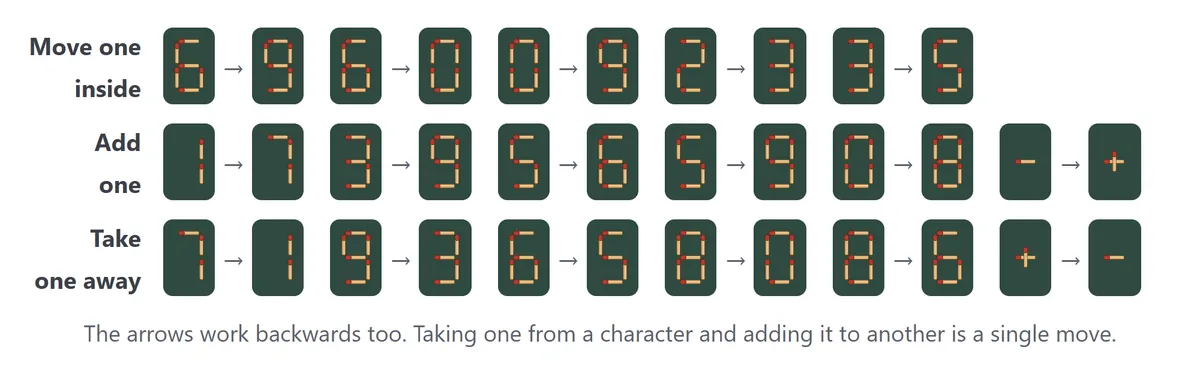
1. Learn the one-stick changes
Some digits turn into each other by shifting a single stick inside them: 6, 9 and 0 form one family, and 2, 3 and 5 form another. Other changes need one stick added or taken away: a 1 plus a stick is a 7, a 5 plus a stick is a 6 or a 9, and an 8 minus a stick can be a 0, 6 or 9. Once the chart above is in your head, you can scan an equation and immediately see which characters are “soft” and can be changed.
2. Measure how far off the equation is
Work out both sides before you touch anything. In “9 + 1 = 2” the left side is 10 and the right side is 2, a gap of 8. No single stick can raise the answer by 8, so the fix must shrink the left side instead, for instance by turning the plus into a minus. The size of the gap is a strong clue about where the change has to happen.
3. Don’t forget the signs
It is easy to stare at the numbers and ignore the plus and minus. Yet a plus sign is a spare matchstick waiting to be used: pull out its upright stick and you get a minus, plus a free stick to put into a digit. It works the other way too, since a stick taken from a digit can turn a minus into a plus. When no change to the digits works, the answer almost always involves a sign.
4. Look for digits with the same stick count
Moving a stick within one digit keeps its total the same, so the digit can only become another digit with the same number of sticks. The five-stick digits (2, 3, 5) and the six-stick digits (0, 6, 9) are the ones to watch. Checking these families narrows down the possibilities fast.
5. In two-move puzzles, start with what can be removed
Two-move puzzles have many more combinations, so begin by asking where a stick can be taken away and still leave a proper digit or sign. An 8 can give up a stick to become 0, 6 or 9; a 9 can become 3 or 5; a 7 can become a 1. There aren’t many such spots, and once you know where sticks can come from, the places they can go become obvious.
6. For squares, watch the shared sides
Two squares that touch share one side. To lose a square, take a stick from a shared side or from an edge that belongs to only one square; to gain one, put sticks where they can become sides of two squares at once. At the end, check that no stick is left hanging on its own.
Matchstick puzzle FAQ
Who are these puzzles for?
Anyone who can add and subtract single digits can start with Easy. The puzzles are more about seeing shapes than about arithmetic, so you don’t need to be good at math to enjoy them. Hard includes two-digit sums and sign swaps that make experienced puzzlers stop and think.
Can a puzzle have more than one answer?
Every equation puzzle here has exactly one way to make it true with the given number of moves, so there is no arguing about the answer. Square puzzles can have several answers, and any of them counts as correct. After solving, use “Other answer” to see the rest.
Can I make a “not equal” sign or break a matchstick?
No. Matchsticks can’t be broken, stacked or laid at an angle, and each one must sit in one of the fixed places, across or upright. Laying a stick across the equals sign to make “not equal” doesn’t count, and neither does any arrangement that doesn’t read as proper digits and signs.
What happens when I use a hint?
The puzzle still counts as solved. In the 10-puzzle challenge and the Daily 3, puzzles solved with a hint get a triangle in the results and each hint adds 10 seconds to your time. A puzzle where you pressed “Show answer” gets a cross.
Can I play with a keyboard?
Yes. Use the left and right arrow keys to choose a matchstick and press Enter to pick it up. Then use the arrow keys again to choose where it goes and press Enter to put it down. Esc cancels, Backspace (or Z) undoes a move, and H gives a hint.
When does the Daily 3 change?
A new set appears when the date changes on your device. Because everyone gets the same three puzzles on the same day, it’s easy to compare times with family and friends.
Where matchstick puzzles come from
Puzzles made by laying out matchsticks and moving or removing a few to make a new shape have been a popular pastime for a long time, largely because the only equipment you need is a box of matches. They have appeared in puzzle books, newspaper corners and quiz shows around the world, with the numbers written as calculator-style digits or as Roman numerals. Psychologists have also used matchstick arithmetic to study insight: people tend to focus on changing the numbers and are slow to notice that the answer lies in changing a sign. That “aha” moment, when you finally drop an assumption and see the move, is what makes these little puzzles so satisfying.