 Yorimichi Games
What is a match 3 game?
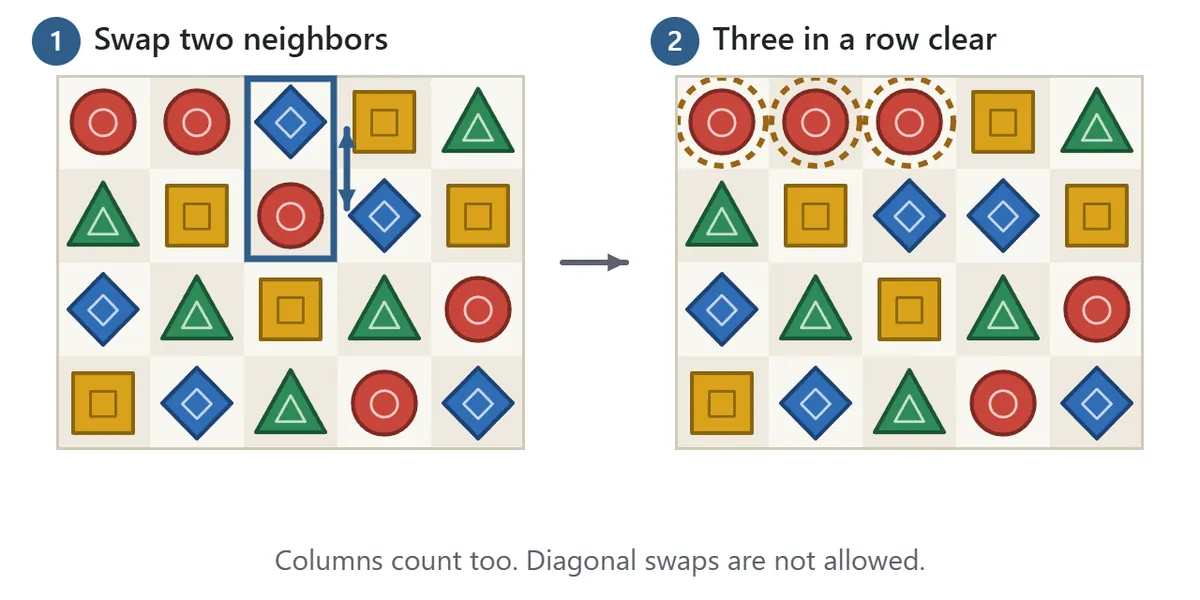
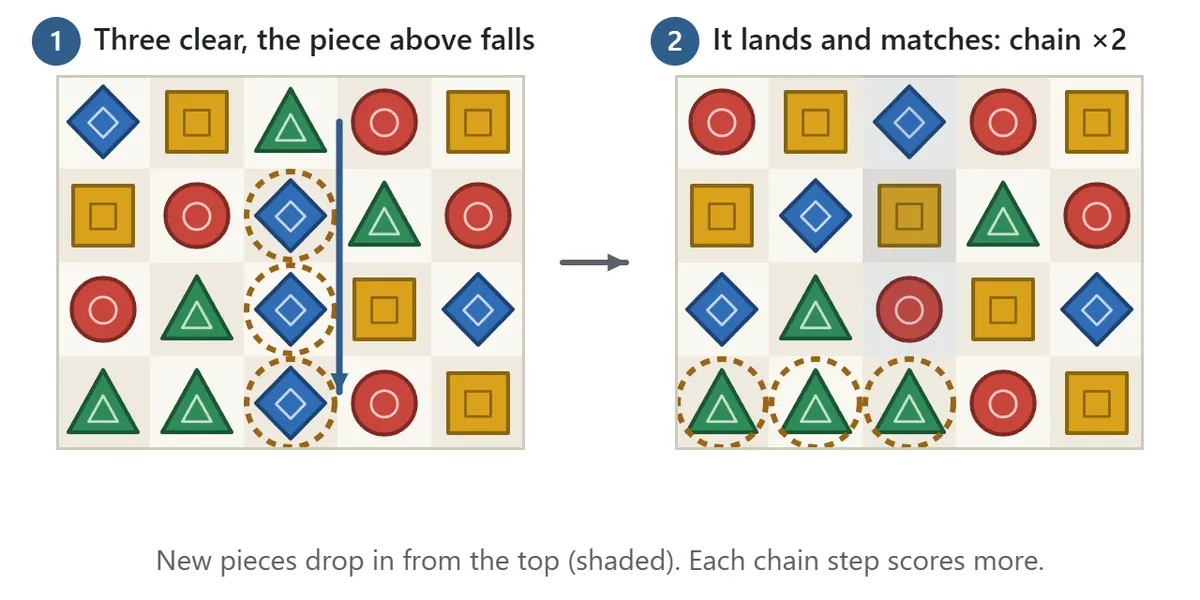
A match 3 game is a puzzle played on a grid packed with colored pieces. You swap two pieces that sit side by side, and whenever three or more of the same color line up in a row or a column, they disappear. The pieces above slide down to fill the gap, new pieces drop in from the top, and sometimes the falling pieces line up again on their own. That knock-on effect is called a cascade or chain reaction, and it is what makes the genre so satisfying.
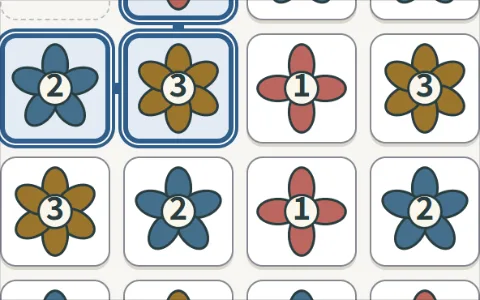
The idea is simple enough to learn in ten seconds, yet there is plenty of room to get better: spotting the swap that makes four or five in a row, saving special pieces for the right moment, and planning around a tight move limit. In this version every color also has its own shape, so you never have to rely on color alone: red circles, blue diamonds, green triangles, yellow squares, purple flowers and teal hexagons.
How to play Match 3
Basic rules
- The board is 8 × 8. You may swap any two pieces that touch horizontally or vertically. Diagonal swaps are not allowed.
- A swap only counts if it creates a line of at least three matching pieces. Otherwise the two pieces slide back and you keep your move.
- Matched pieces are removed. Everything above falls down, and new pieces enter from the top of the board.
- If the falling pieces form new lines, they clear too. The second step of a chain scores double, the third step triple, and so on.
- If there is no possible swap anywhere, the board reshuffles automatically. Reshuffling never costs a move.
Match 3 rules for special pieces
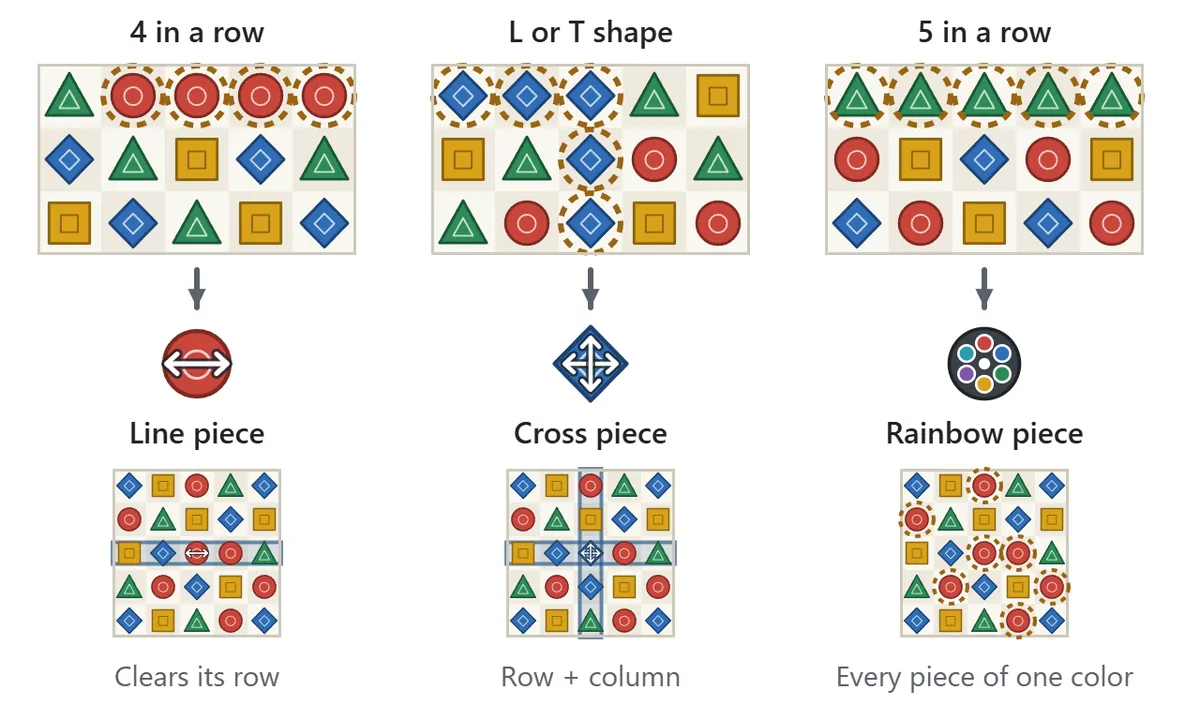
Whenever you clear four or more pieces in one match, one of them turns into a special piece instead of disappearing. A special piece still behaves like a normal piece of its color: line it up with two more of the same color and it clears, unleashing a bigger effect.
| Match | Special piece | What it clears |
|---|---|---|
| 4 in a row or column | Line piece (white arrow) | Its whole row, or its whole column |
| L, T or plus shape | Cross piece | Its row and its column |
| 5 or more in a line | Rainbow piece | Every piece of the color you swap it with |
A horizontal four makes a piece that clears its row; a vertical four makes one that clears its column. The special piece appears where the piece you moved landed (or near the middle of the line when it came from a chain). The rainbow piece has no color, so you cannot line it up, but you can swap it with any neighbor at any time. When a special piece is caught in another piece's blast, it goes off as well, so one good swap can set off several at once.
Combining two special pieces
Two special pieces next to each other can always be swapped, even if their colors differ. Two line pieces clear a full cross. Any combination with a cross piece clears a thick cross three rows and three columns wide. Swapping a rainbow piece with a line or cross piece turns every piece of that color into the same kind of special piece before they all go off together. Two rainbow pieces clear the entire board.
Stones and tiles
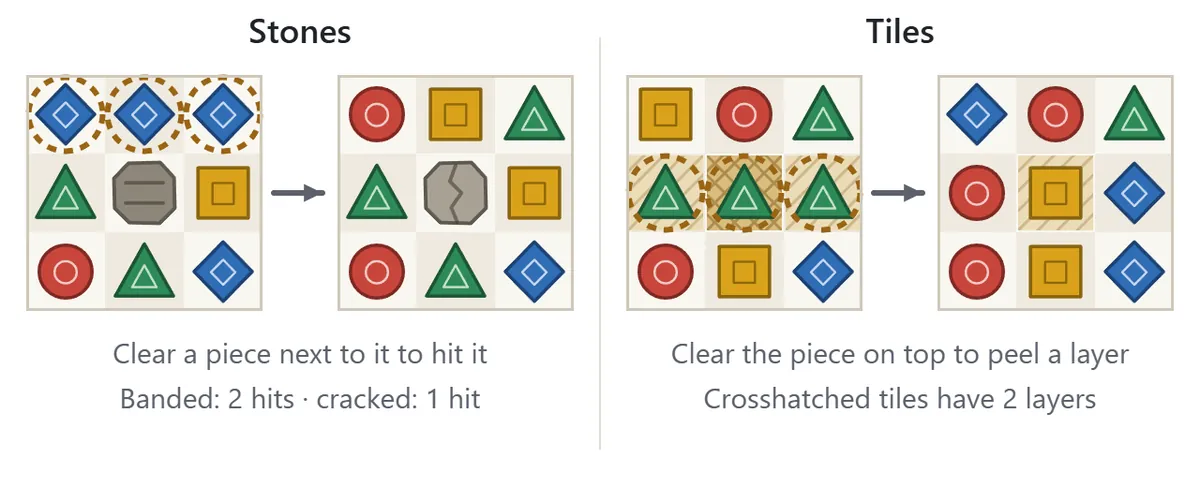
- Stones block a square. They cannot be swapped and pieces cannot fall through them. Clearing a piece directly next to a stone (up, down, left or right) hits it once, and so does catching it in a special piece's blast. Cracked stones break after one hit; banded stones need two. Squares under a stone refill from just below it.
- Tiles sit underneath pieces. Clearing the piece on top peels one layer away. Plain striped tiles have one layer, crosshatched tiles have two.
Game modes and difficulty
| Mode | How it works |
|---|---|
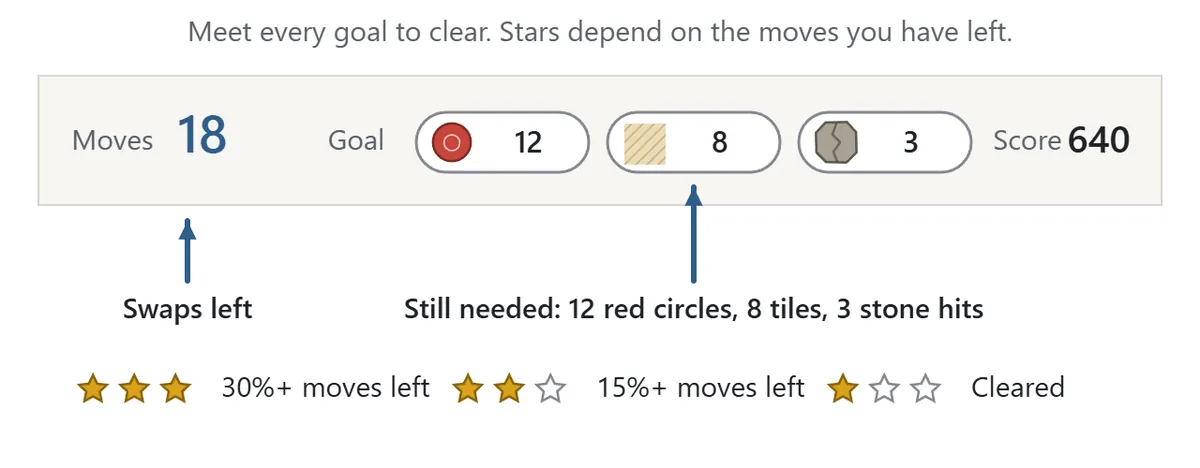
| Stages | 30 hand-made stages. Each one has goals such as a target score, a number of pieces of one color, clearing every tile or breaking every stone, plus a move limit. Meet all the goals to clear the stage. The more moves you have left, the more stars you earn, up to three. |
| Endless | No goals and no move limit. When you run out of swaps the board reshuffles, so you can play as long as you like. Press Finish to record your score. |
| Daily board | A new puzzle every day. On the same day and difficulty, everyone plays the same board, and the same swaps bring down the same pieces, so you can compare stars with friends. |
| Difficulty | Difference |
|---|---|
| Easy | 1.4 times as many moves as Normal. Most players can clear nearly every stage. |
| Normal | The move limit and number of colors (five or six) set for each stage. |
| Hard | One extra color (up to six), which makes matches harder to find, with a few extra moves to compensate. Stages that already use six colors get fewer moves instead. |
With hints turned on, the frames of two pieces you can swap start to glow if you wait a few seconds. You can also press the Hint button (or H on the keyboard) at any time.
Match 3 strategy tips
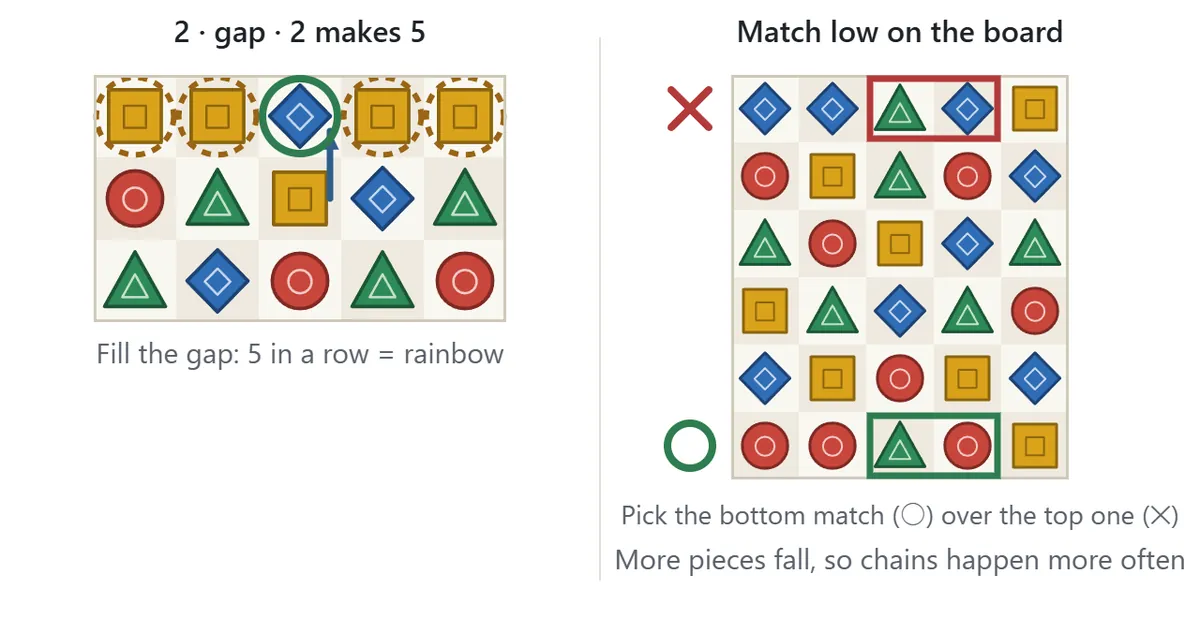
1. Work from the bottom
A match near the bottom of the board makes everything above it fall, which gives chain reactions a much better chance. A match at the very top only brings in fresh pieces. When two swaps look equally good, pick the lower one.
2. Look for four and five before you take three
When you spot an easy three, pause for a second and scan the area around it. The pattern "two, gap, two" in a line is especially valuable: dropping the right color into the gap makes five in a row and a rainbow piece. A pair in a row with a single matching piece around the corner is often an L or T in disguise.
3. Save special pieces for combos
A fresh special piece is tempting to use right away, but it is usually worth more next to another special piece. Swapping two of them together clears far more than using them one at a time. Rainbow plus line piece is the classic board-wrecker: every piece of one color becomes a line piece and they all fire at once.
4. Aim for the goal, not just the score
On tile stages, only matches on top of tiles make progress, and tiles in corners and along the edges are the last to go. Use vertical line pieces and cross pieces on those columns while you still have moves to spare. On stone stages, prioritize matches right next to the stones, and remember that banded stones need two hits.
5. Count backwards from your remaining moves
When the move counter gets low, compare it with what the goals still need and work out how much each move has to achieve. If the math does not add up with plain threes, spending a move or two to build a special piece is often the faster way to finish.
6. Use hints as a starting point
The hint shows one swap that makes an immediate match. It is not always the best move, so treat it as a place to start looking: there may be a four or an L hiding right next to it.
Match 3 FAQ
Why do my pieces slide back after a swap?
A swap only goes through if it creates a line of three or more for at least one of the two pieces. Diagonal swaps are not allowed. A swap that slides back does not use up a move, so feel free to experiment.
Can I play on a phone or tablet?
Yes. Swipe a piece up, down, left or right to swap it with its neighbor, or tap one piece and then tap the piece next to it. On a computer you can drag with the mouse, or use the arrow keys to move the cursor, press Enter to select a piece and then press an arrow key to swap in that direction.
How are stars awarded?
Stars depend on how many moves you have left when you meet the last goal. Keep at least 30 percent of the starting moves for three stars, at least 15 percent for two stars, and any clear earns one star. The three-star target is shown when you pick a stage and on the results screen.
What happens when no moves are left?
If there is no swap that makes a match anywhere on the board, the pieces are shuffled into a new arrangement that has at least one possible match. Stones, tiles and special pieces stay as they are, and you do not lose a move.
Can I stop and continue later?
Your game is saved in this browser after every move. Next time, press Continue to pick up exactly where you left off. The daily board can only be continued on the same day.
A short history of match 3 puzzles
Games about lining up matching colors or symbols have been around for a long time, but the swap-two-neighbors formula is usually traced to computer puzzle games of the 1990s. It spread widely through browser games in the early 2000s, and later mobile games added levels, move limits and goals, which is the style most people picture today. By then "match 3" had become the everyday name for the whole genre.
This Match 3 Puzzle follows those familiar rules, with its own shapes, special pieces, stones, tiles, stages and star system. Start with Stage 1 on Easy, get a feel for chains and special pieces, and then see how many stars you can collect.