 Yorimichi Games
How to play mancala
Mancala is a two-player game of sowing stones. On your turn you scoop up every stone from one of your pits and drop them one by one into the pits that follow. Whoever ends the game with more stones in their store, the large pit at the end of the board, wins. There are no dice and no hidden cards, so every game is decided by how well you plan ahead. The rules take a couple of minutes to learn, which is why mancala is a favorite in classrooms and families.
“Mancala” is really the name of a whole family of sowing games, and hundreds of versions are played around the world. The version on this page is Kalah, the one sold as “Mancala” in most toy stores in the United States and Europe. If you learned mancala at school or with a wooden board at home, this is almost certainly the game you know.
The board
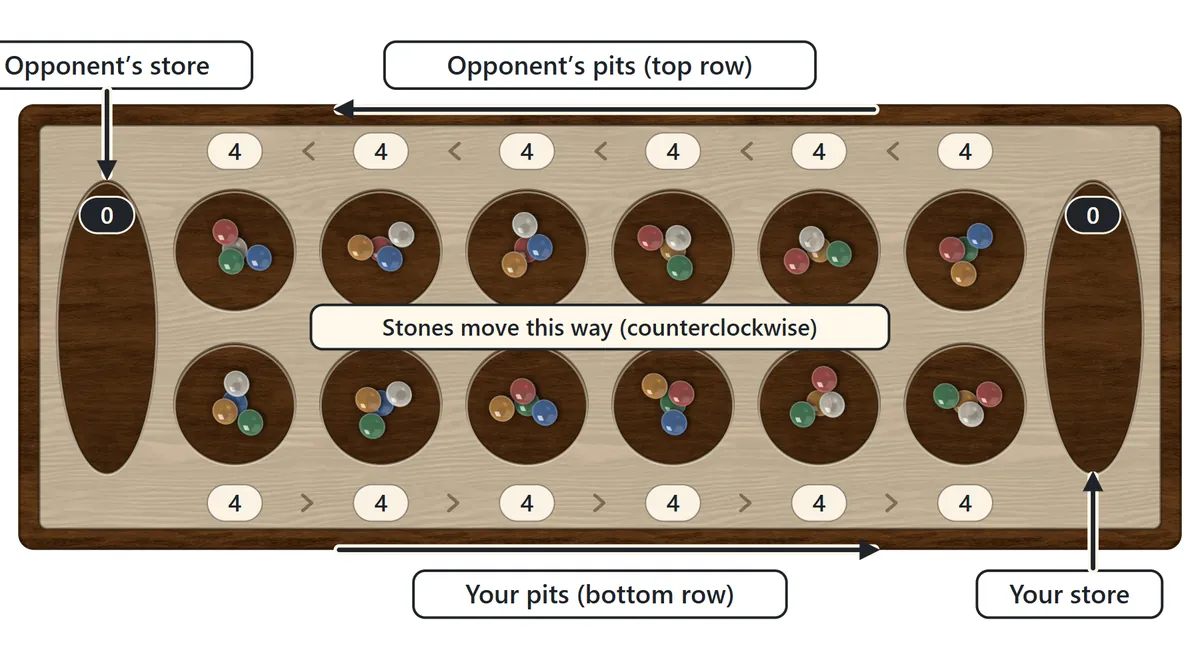
The board has two rows of six small pits and a large store at each end. The row nearest to you is your side, and the store on your right is yours. At the start, every small pit holds four stones and both stores are empty. The number next to each pit shows how many stones it holds, so you never have to count by hand.
Sowing the stones

On your turn, choose one of the pits on your side that has stones in it. Take all of the stones out and sow them: drop one stone into each following pit, moving counterclockwise. That means left to right along your row, into your store, and then right to left along your opponent’s row. If you have enough stones, some of them will land on your opponent’s side, which is perfectly normal.
Land in your store and go again
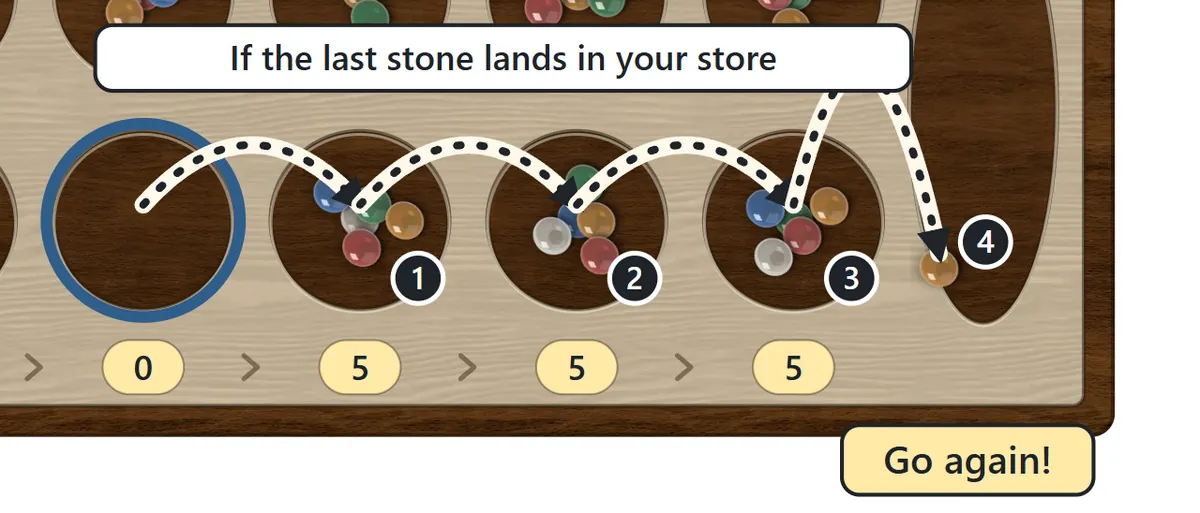
If the last stone you sow lands in your own store, you get another turn right away and can choose any pit again. There is no limit to how many extra turns you can chain together. A pit earns a free turn when the number of stones in it equals its distance from your store, so the pit right next to your store needs one stone, the one beside it needs two, and so on.
Capturing: land in an empty pit on your side
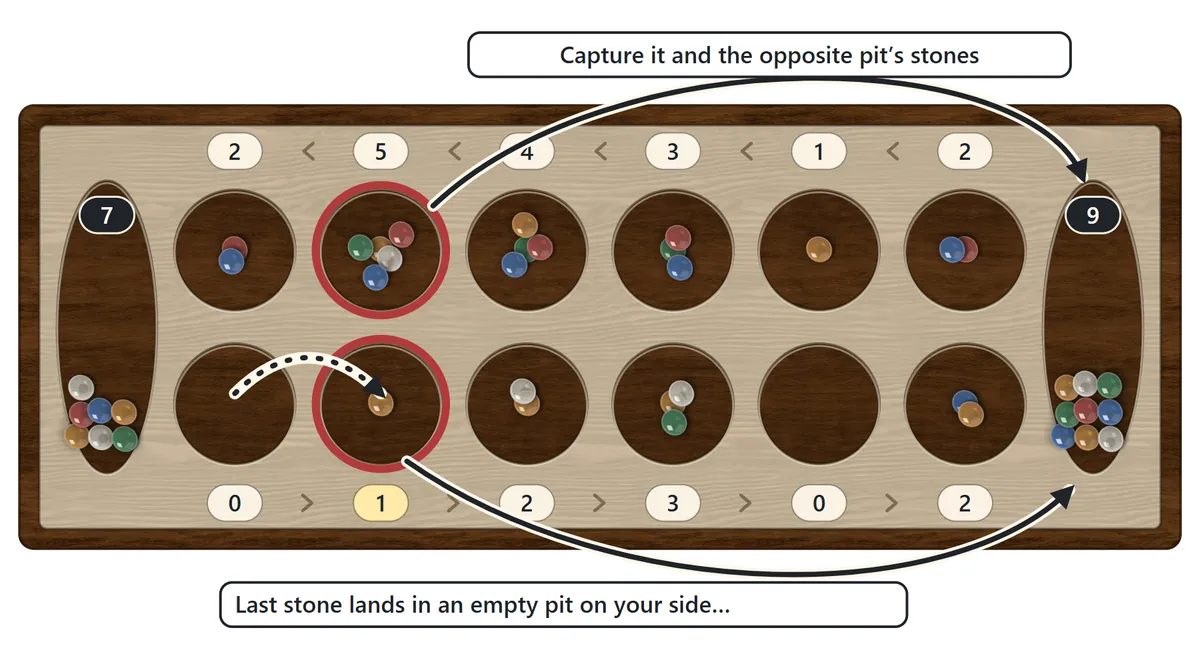
If your last stone lands in a pit on your own side that was empty, you capture: take that stone plus every stone in the opposite pit on your opponent’s side and put them all in your store. You cannot capture by ending on your opponent’s side, or by ending in a pit that already had stones. If the opposite pit is empty, nothing is captured and your last stone simply stays where it is. (Under Custom rules you can choose to move that single stone to your store anyway.)
Skip your opponent’s store
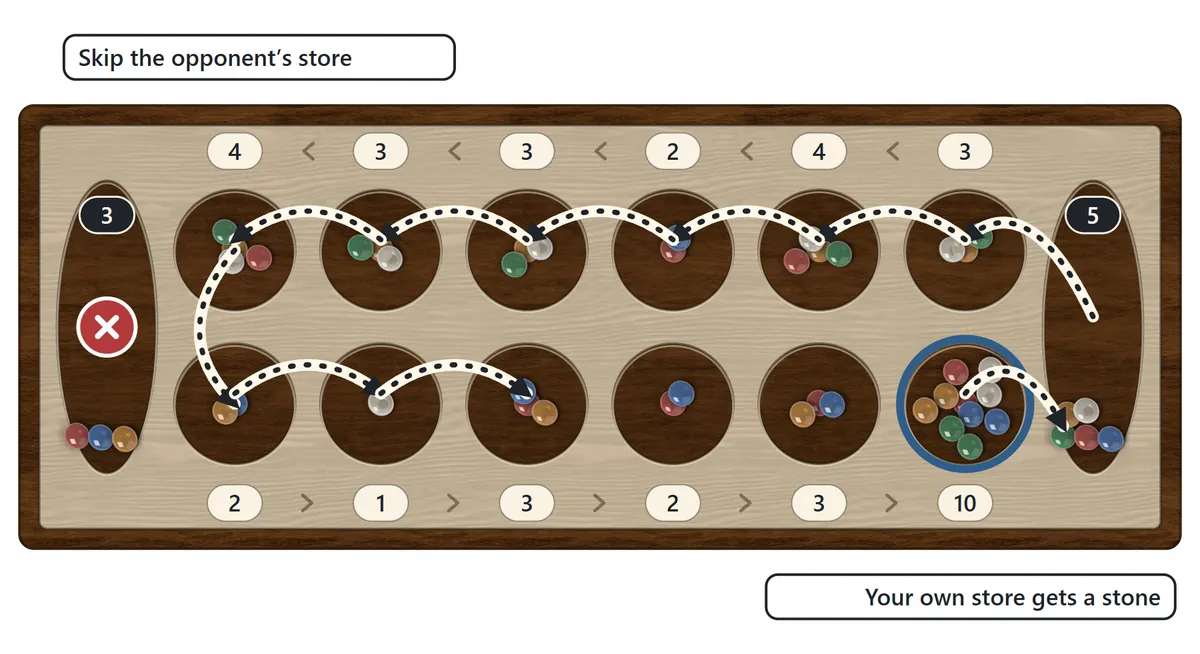
While sowing, you always drop a stone into your own store but you skip your opponent’s store. With 13 or more stones in one pit you travel all the way around the board, and a stone also drops back into the pit you started from.
How the game ends
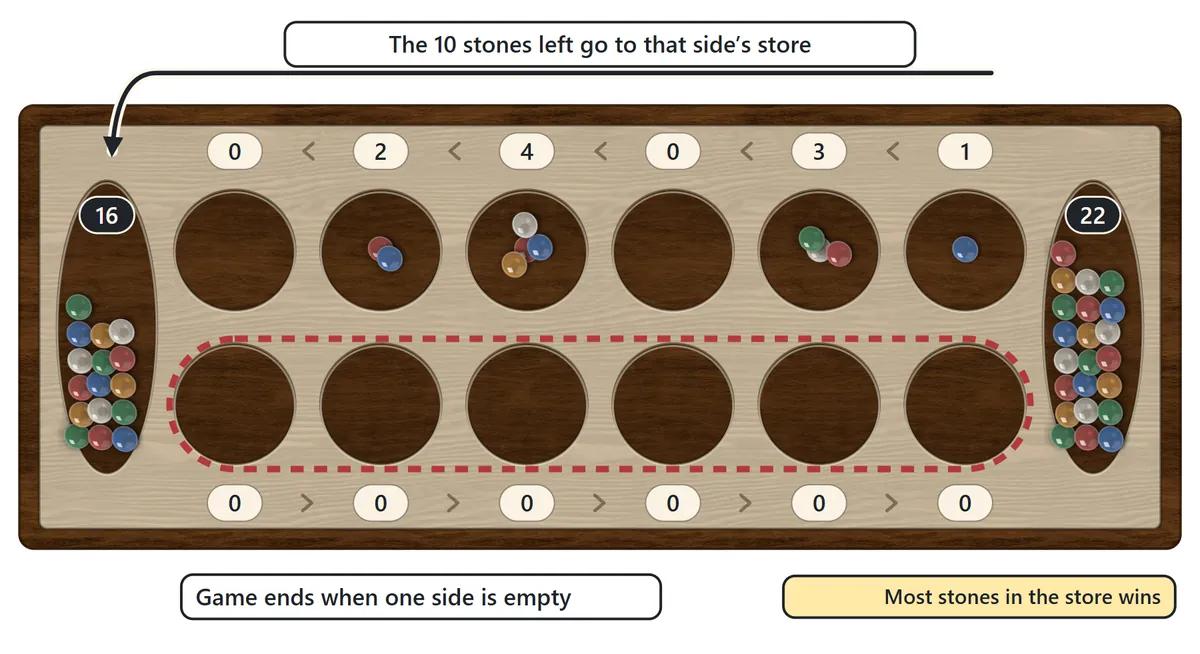
The game ends as soon as all six pits on one side are empty. Any stones still on the other side go into the store of the player whose side they are on. Count the stones in each store: the player with more stones wins, and equal stores are a draw.
Keep in mind that emptying your own side ends the game immediately, and every stone still on your opponent’s side becomes theirs. If you are behind, running out of stones is usually a bad idea.
Mancala rules at a glance
Families and schools often play slightly different mancala rules. In the settings you can choose between these:
| Rule | Standard | Short | Custom |
|---|---|---|---|
| Stones per pit at the start | 4 | 3 | 3 to 6 |
| Last stone in your store | Go again | Go again | Go again |
| Capture when the opposite pit is empty | No capture | No capture | Option: last stone goes to your store |
| Equal stores at the end | Draw | Draw | Option: whoever emptied their side first wins |
Three stones per pit makes a quicker game that is easier to see at a glance, which is nice for beginners. Five or six stones make longer games with more big, board-circling moves.
Mancala strategy: how to win
1. Use your free-turn pits first
Any pit whose stone count matches its distance to your store gives you another turn. Pits close to your store line up most often, so check them first. Playing them in the right order can give you two or three moves in a single turn. In the standard opening, the third pit from the left holds four stones and lands exactly in your store.
2. Keep the pit next to your store light
The pit right beside your store earns a free turn with just one stone. Rather than letting stones pile up there, send them into your store often. A single stone in that pit is a free move waiting to happen.
3. Watch for your opponent’s captures
Before you end your turn, look for empty pits on your opponent’s side and check whether one of their pits can land exactly there. If it can, the stones in your pit across from it are in danger. A big pile of stones sitting opposite an empty pit is an easy target.
4. Set up captures of your own
Leave an empty pit on your side and let your opponent’s stones build up across from it. Then sow a pit that ends exactly in that empty pit. The simplest capture is a single stone moving into an empty pit right next to it.
5. Save a big pit for later
A pit with exactly 13 stones goes all the way around the board and finishes in the pit it started from, which is now empty, so it captures whatever is across from it. Holding on to a large pit until the moment is right can turn the game around.
6. Count the stones near the end
In the endgame, the stones on each side are effectively points. Compare the stores and the stones left on both sides, then decide whether you want to end the game quickly by emptying your side, or keep your opponent from running out.
Mancala FAQ
Is it better to go first or second?
With four stones per pit, going first is an advantage, because the opening move can use a free turn straight away. If you play several games, take turns going first or set “Who goes first” to Random.
Can I sow from my opponent’s pits?
No. You can only choose a pit on your own side, and it must have at least one stone in it.
Which CPU level should I choose?
Easy often misses your captures and sometimes makes careless moves, which makes it a good match for someone who has just learned the rules or for young players. Normal uses captures and free turns well but still slips up from time to time. Hard looks many moves ahead and sets traps for you. It rarely makes mistakes, so beating it is a real achievement.
Can two people play on one device?
Yes. Choose “A friend” as the opponent and take turns on the same screen. When it is the top player’s turn, the pit buttons move to the top of the board.
Can I stop and come back later?
Yes. Open the page again on the same device and browser and press “Continue” to pick up where you left off. The sound is off at first; press “Sound: off” to hear the stones.
Is this the same as Oware or Bao?
No. Oware (also called Awale) and Bao are other members of the mancala family. They do not use stores in the same way, capture on the opponent’s side, and in Bao’s case use a four-row board. This page plays Kalah, the version most people mean when they say “mancala”.
A short history of mancala
Games of sowing seeds or stones into pits are thought to be among the oldest board games still played, with a long history across Africa, the Middle East and Asia and countless local variations. The name “mancala” is used for the whole family. Kalah, the version on this page, is said to have been standardized in the United States in the mid-twentieth century, and its short, easy-to-teach rules made it the mancala most people know today.