 Yorimichi Games
How to Play the Lights Off Puzzle
The Lights Off Puzzle is a single-player logic puzzle played on a square grid of lights. Your goal is simple: turn every light off. The catch is that pressing a light doesn’t just switch that one light – it also switches the lights directly above, below, to the left and to the right of it. Lights that were on go off, and lights that were off come on. So every time you put out one light, you may switch on its neighbors. Working out which lights to press, and which to leave alone, is what makes this light switch puzzle so absorbing. There is only one rule to learn, so anyone can start playing in seconds, but the larger boards can keep you thinking for a long time.
Each press switches a plus-shaped group
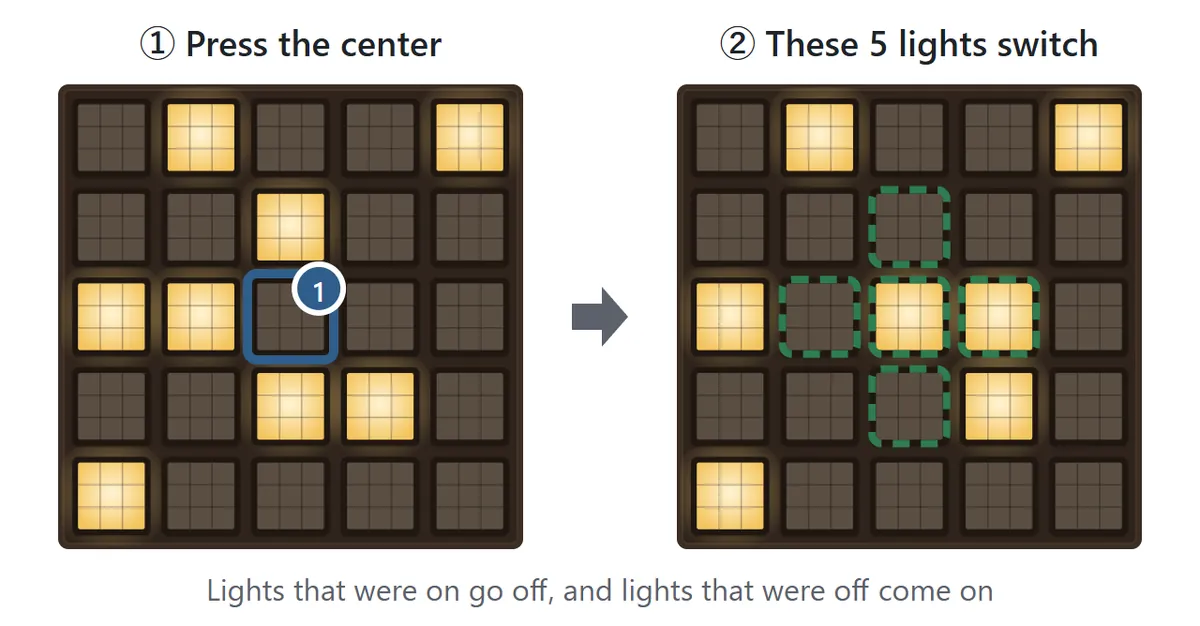
When you press a light in the middle of the board, five lights switch: the one you pressed plus the four around it, in a plus-sign pattern. Lights on the edge or in a corner have fewer neighbors, because there are no lights outside the board, so pressing them switches only four or three lights. If you are using a mouse, hover over a light to see a dotted outline around every light that will switch when you press it.
Turn off every light to win
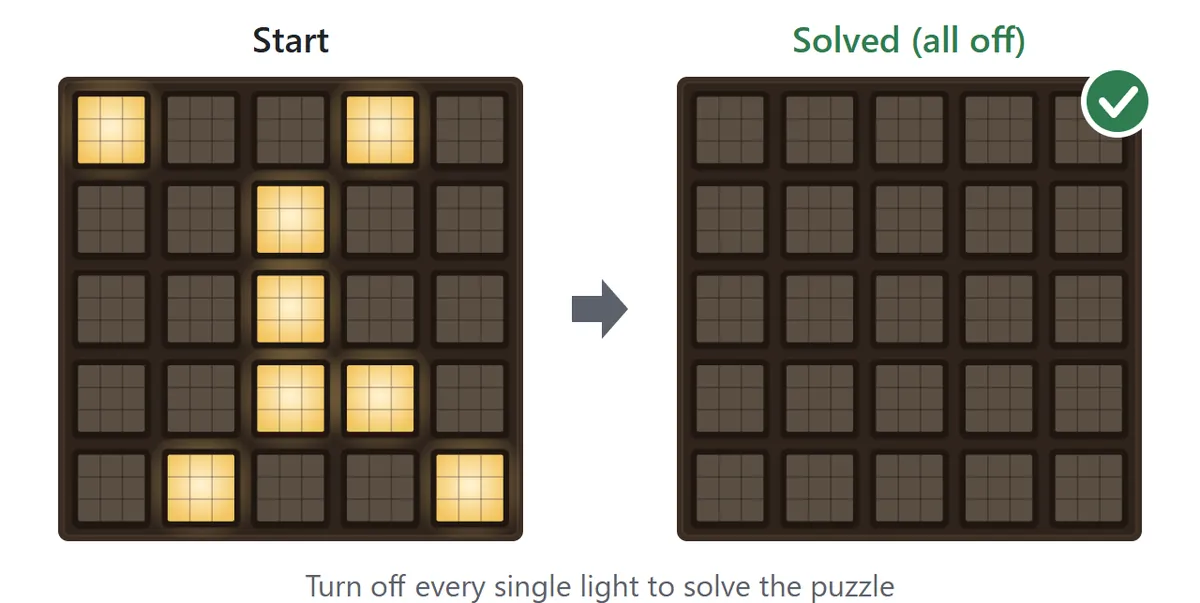
Each puzzle starts with some of the lights switched on. When every light is off, you have solved it. The bar above the board shows how many presses you have made (moves), the minimum number of presses that can solve this particular puzzle, and a timer. The timer only starts with your first press, so feel free to study the board and plan before you begin. If you press the wrong light, use “Undo” to take it back.
Board Sizes, Puzzle Types and Variant Rules
| Size | Lights | Good for |
|---|---|---|
| 3×3 | 9 | First-timers learning the idea |
| 4×4 | 16 | Practicing on a slightly larger board |
| 5×5 | 25 | The classic size |
| 6×6 | 36 | A challenge once you’re comfortable |
| 7×7 | 49 | Long, thoughtful solving sessions |
There are three kinds of puzzle. Random picks a puzzle at random from all the patterns that can be solved. Quick starts from a dark board on which only a few lights were pressed, so it can always be cleared in just a handful of moves – a gentle way to learn how the lights react. The Daily puzzle changes every day, and everyone who plays on the same date gets the same board for each size, so you can compare your moves and time with friends and family.
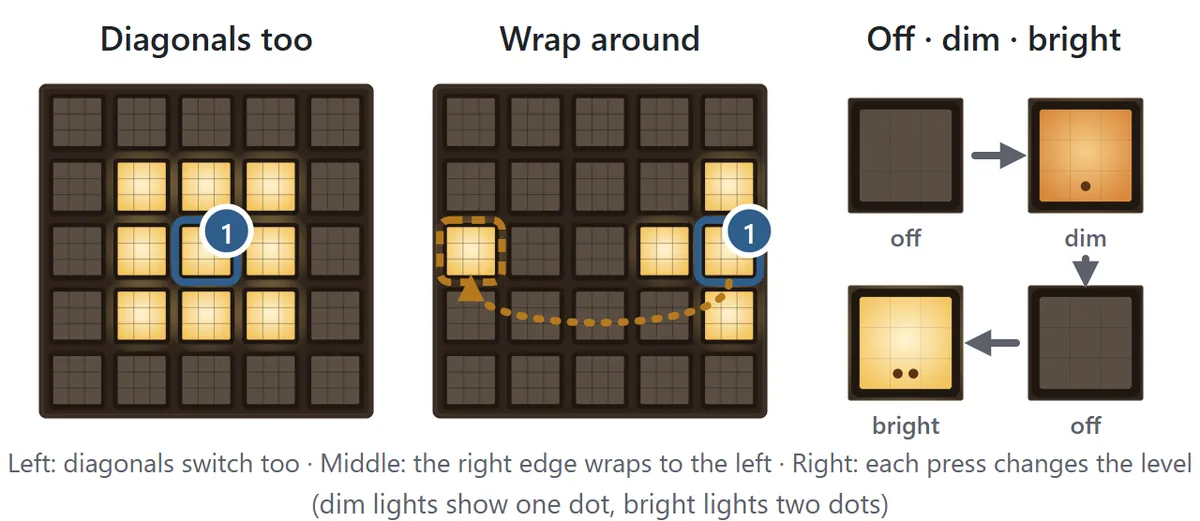
Choose Custom under Rules to try the variants. With Diagonals too, the four diagonal neighbors switch as well, so a press in the middle affects a 3×3 block of nine lights. With Wrap around, the left and right edges are joined, and so are the top and bottom, so pressing a light on one edge also switches a light on the opposite edge (available on 4×4 and larger). With Off · dim · bright, lights have three levels and each press moves them one step: off → dim → bright → off. Dim lights carry one dot and bright lights two dots, so you can tell them apart even if the colors are hard to distinguish. Every variant still gives you only solvable puzzles, along with the minimum-move counter and hints.
Are Some Patterns Impossible to Solve?
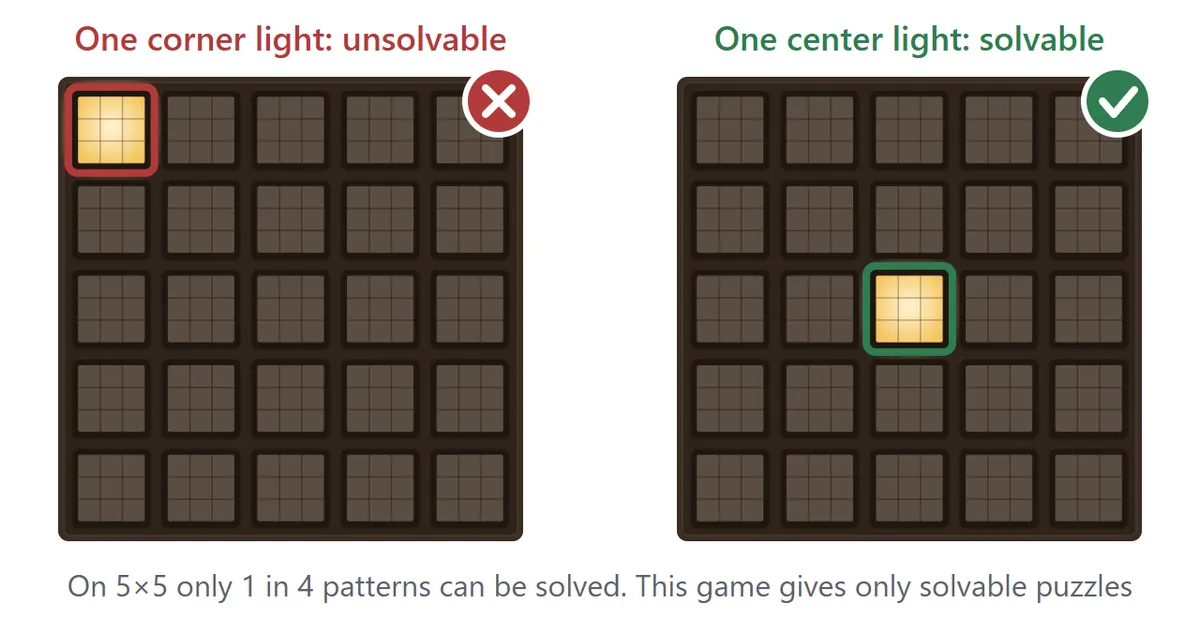
Yes. If you switch lights on at random, some patterns can never be cleared no matter what you press. On a 5×5 board with only the top-left corner light on, for example, there is no solution at all. In fact, exactly one quarter of all possible 5×5 patterns are solvable. On 4×4 only one pattern in sixteen can be solved, while on 3×3, 6×6 and 7×7 every pattern has a solution.
How to Solve the Lights Off Puzzle: Strategy and Tips
1. The order of your presses doesn’t matter
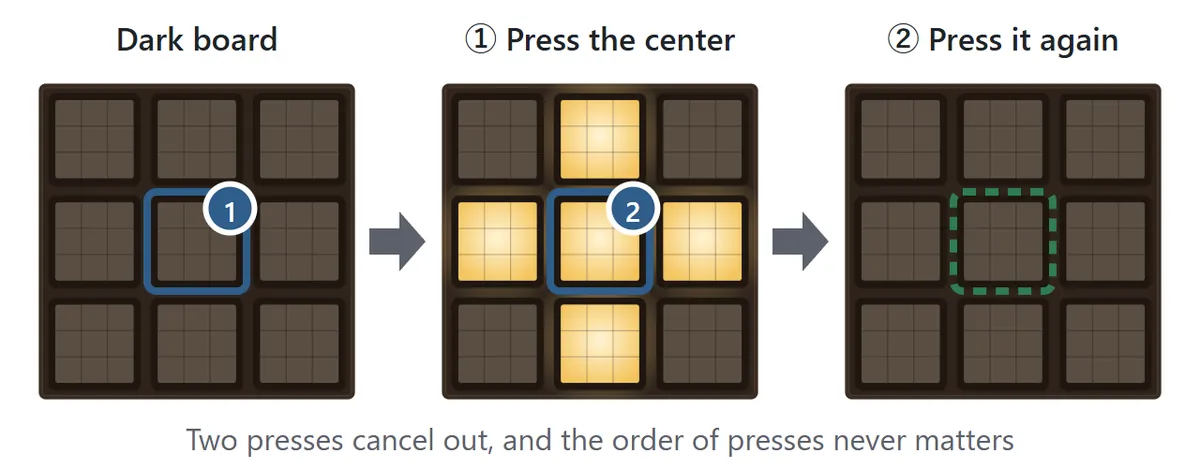
The most useful fact about this puzzle is that only which lights you press matters – not the order in which you press them. Pressing A and then B gives exactly the same board as pressing B and then A. Pressing the same light twice puts everything back where it was. That means a solution is really just a set of lights to press, each pressed once or not at all. Once you see the puzzle this way, you can stop worrying about sequences and think about combinations.
2. Chase the lights down from the top
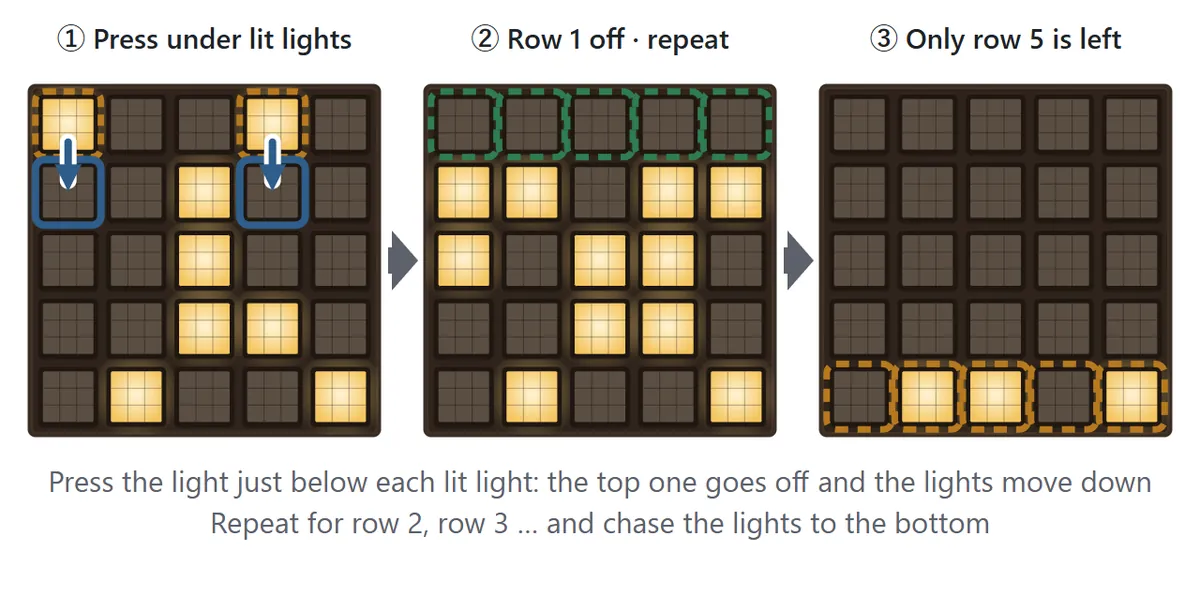
This method, often called chasing the lights, works on any board size. Look at the top row. For every light that is on in that row, press the light directly below it in the second row. That switches the top light off (and changes some lights in the rows below). When the top row is completely dark, do the same for the second row: press the light under each lit light in row two. Keep going row by row. Each step clears one row and pushes the remaining lights further down, until only the bottom row can still have lights on. Sometimes you get lucky and the whole board is already dark at this point.
3. Use the bottom-row table to finish
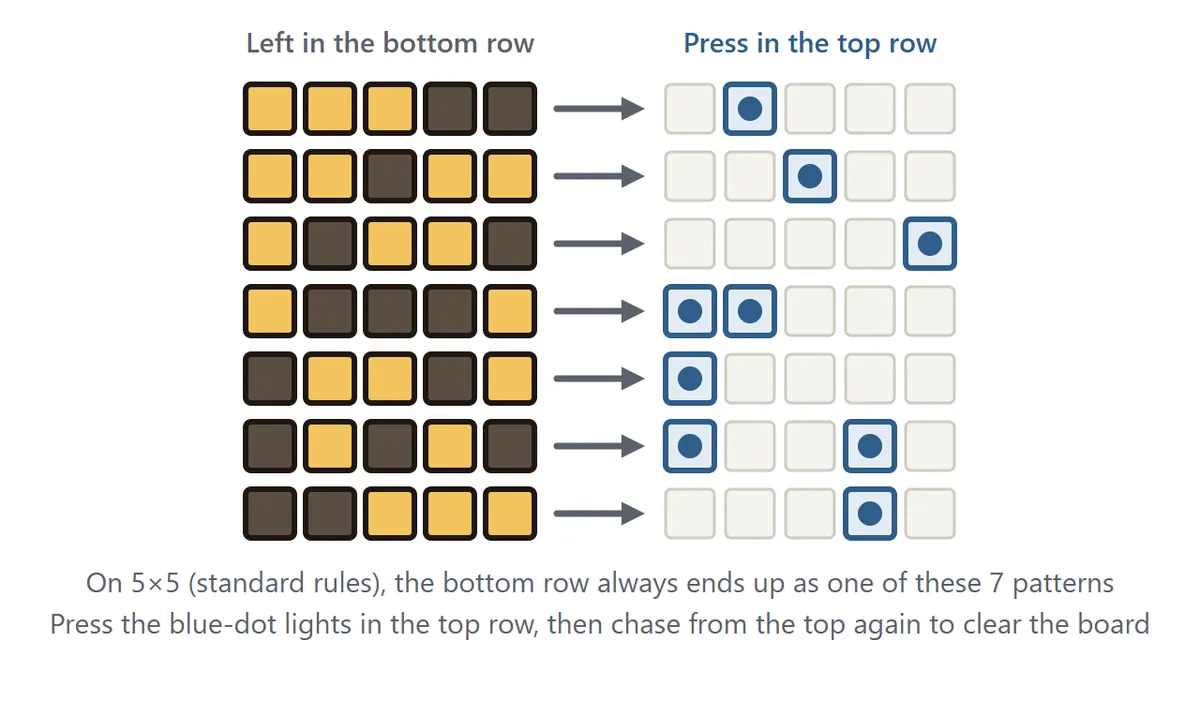
If some lights remain in the bottom row, look up that pattern in the table and press the matching lights in the top row. Then chase the lights down from the top again. This time the board will be completely clear. With the standard rules on 5×5, the leftover pattern is always one of the seven shown in the table. Solving with the table is a perfectly good method, and after a while you will remember it and solve boards smoothly. The chasing method usually takes more moves than necessary, though, so if you are aiming for the minimum, add the next tip.
4. Going for the minimum: look for efficient presses
To match the minimum number of moves, you need to know which lights to press before you start pressing. Scan the board for groups that one press can clear at once: a plus shape of five lit lights disappears when you press its center, and three lit lights along an edge disappear when you press the middle one. Since pressing the same light twice is wasted effort, if you ever find yourself wanting to press a light you already pressed, stop and look for a different combination instead.
5. Practice on small boards
The 3×3 board has only nine lights, which makes it easy to try combinations in your head and really understand how the puzzle works. Quick puzzles can be solved in a few presses, so you can calmly check what each press does. When you feel ready, move up to 5×5, and then to 6×6 and 7×7.
6. Stuck? Use a hint
Press “Hint” and the next light to press is outlined with a dashed frame, together with the minimum number of presses still needed from the current position. Press “Hint” again and the game presses that light for you. If you follow the hints, you will always finish in the minimum number of moves. Games where you used hints or undo don’t count toward your personal bests.
Lights Off Puzzle FAQ
What is the minimum number of moves?
It depends on the puzzle. The “Min” number in the bar above the board shows the fewest presses that can solve the puzzle in front of you. With the standard rules on 5×5, it is known that every solvable pattern can be cleared in 15 presses or fewer. Solve a puzzle in exactly the minimum and the result screen will tell you so.
What if I get stuck?
Use a hint to see your next move.
Does everyone get the same daily puzzle?
Yes – on the same date, everyone gets the same board for each size. The daily puzzle always uses the standard rules, and the date comes from your own device. Your first attempt each day is saved as your record for the day, and solving the daily puzzle on consecutive days builds a streak.
Can I play with a keyboard?
Yes. Use the arrow keys to move the frame to a light and press Space or Enter to press it. Z (or Backspace) undoes a move and H shows a hint.
Can I stop and continue later?
If you come back on the same device and browser, “Continue” in the settings resumes your board, moves and time where you left off. Your personal bests for each size and puzzle type are also saved on this device. Sound is off at first; press “Sound: off” to hear a click when you press a light and a chime when you solve a puzzle.
History and Math Behind the Puzzle
Puzzles in which pressing a button also switches the buttons around it are said to go back to handheld electronic games of the 1970s. The idea became widely popular in 1995, when the American toy maker Tiger Electronics released a handheld game with a 5×5 grid of light-up buttons that you had to switch off – exactly the puzzle you play here. Many variations followed, with more colors, bigger boards and differently shaped grids. The puzzle also caught the attention of mathematicians: it turns out that every board can be described as a system of linear equations in which 1 + 1 = 0, and solving that system tells you exactly which patterns can be cleared and in how few moves. In 1998 Marlow Anderson and Todd Feil used this approach to show that only a quarter of 5×5 patterns are solvable and that each solvable one has exactly four different solutions (sets of lights to press), which is why the puzzle is still a favorite example in linear algebra and programming courses.