 Yorimichi Games
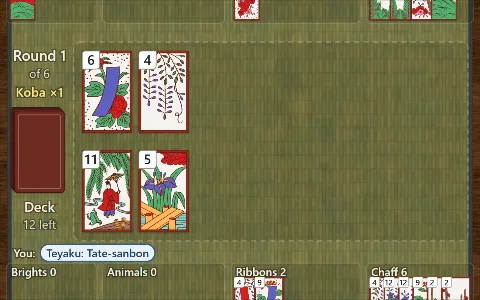
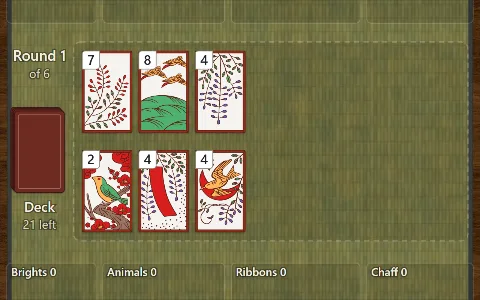
How to play koi-koi
Koi-koi is a two-player card game played with hanafuda, the Japanese “flower cards”. You play a card from your hand onto a card of the same month on the table to capture both, and the cards you collect form scoring combinations called yaku. The moment you complete a yaku, you face the question that gives the game its name: stop now and bank your points, or call koi-koi (“come on!”) and keep playing for a bigger score. Keep going too long and your opponent may finish a yaku first, leaving you with nothing. That push-your-luck decision is what makes koi-koi so much fun.
You do not need to read Japanese or know the cards to play here. Every card shows its month number in the top-left corner, the game highlights the cards you can capture, and it tells you which yaku are one card away.
The table
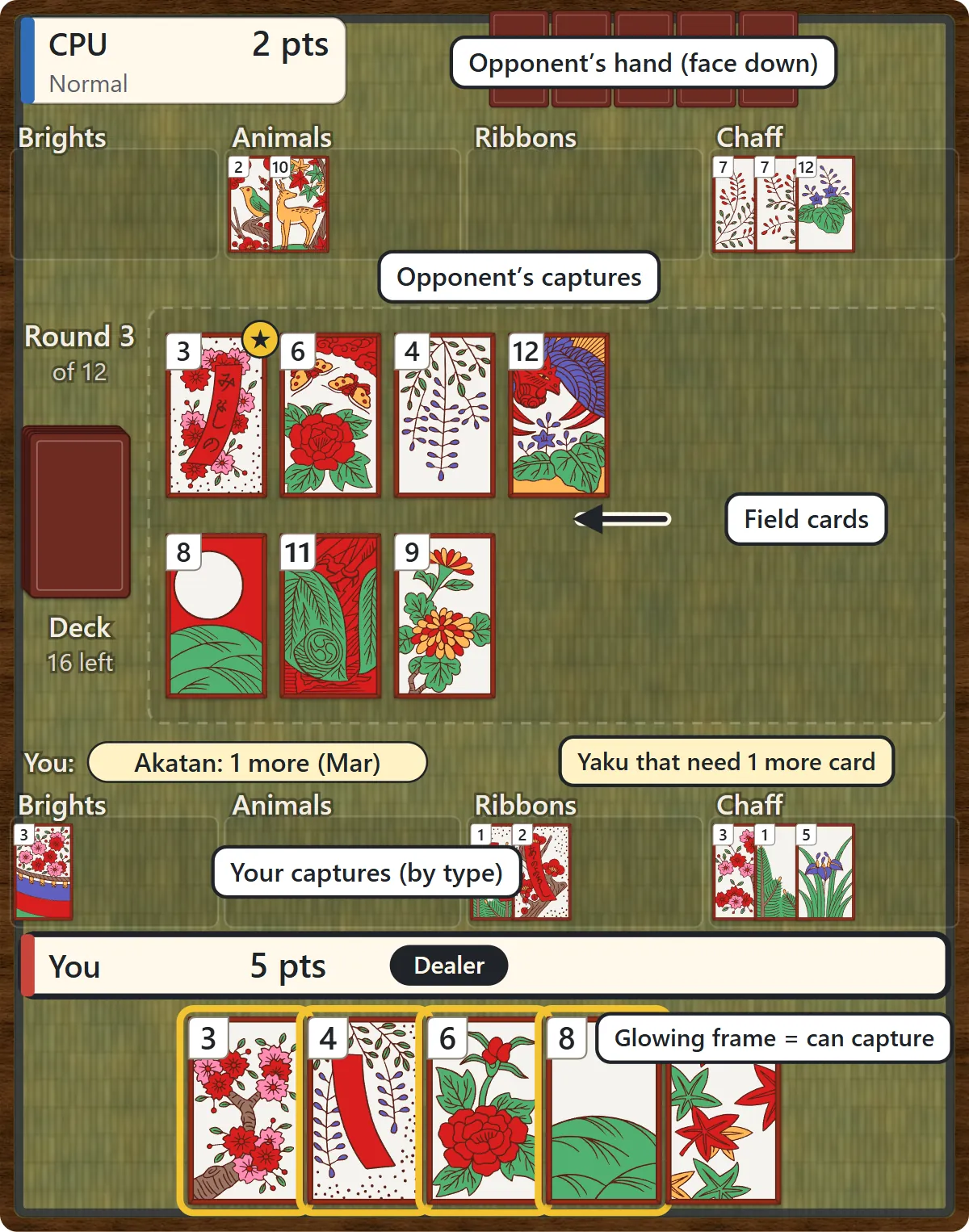
At the start of each round, eight cards are dealt face up to the field and each player gets a hand of eight cards. The rest form a face-down deck. Cards you capture are laid out in front of you by type: Brights, Animals, Ribbons and Chaff. When you are one card away from a yaku, a note such as “Akatan: 1 more (Mar)” appears above your captures. The same notes appear for your opponent, so you can always see what they are going for.
Capturing: match the month

A hanafuda deck has 48 cards: four for each month of the year. Instead of numbers, each month is shown by a plant, such as pine for January, plum blossom for February and cherry blossom for March. Here, the small number in the corner of every card tells you the month, so you can play right away.
When you play a card and the field has a card of the same month, you capture both. If there is no match, your card stays on the field. You are always free to play a card that does not match, even if you could capture with another one. If the field holds two cards of that month, you choose which one to take; if it holds three, you take all four.
A turn, step by step
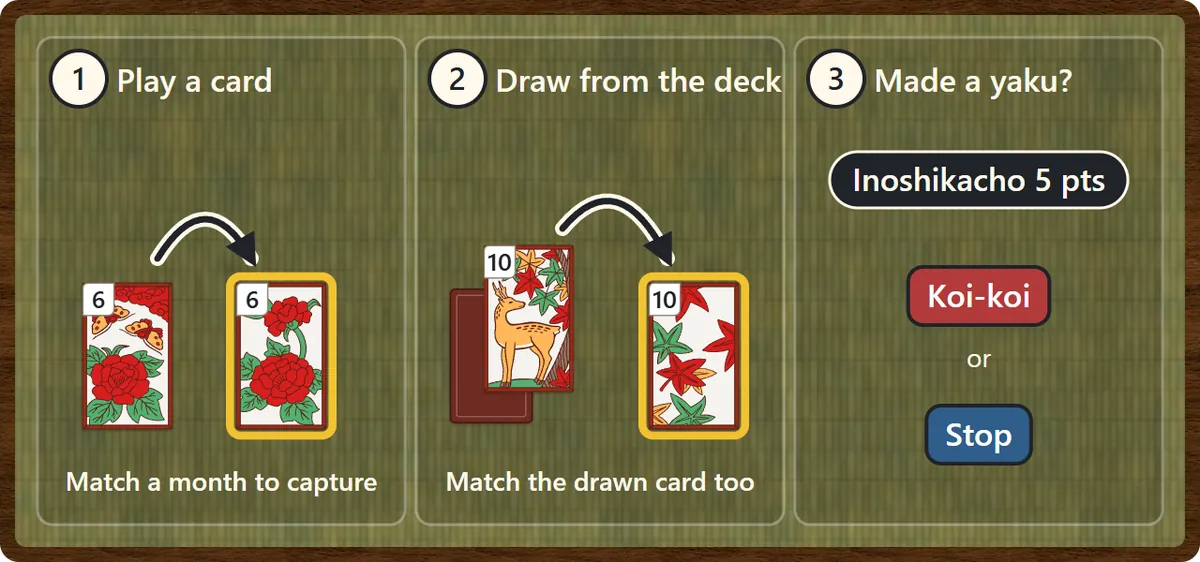
- Play one card from your hand and capture a field card of the same month (or leave your card on the field).
- Flip the top card of the deck and match it in the same way. A drawn card must capture if the field has a card of its month.
- If you completed a yaku this turn, choose Koi-koi or Stop. Otherwise it is your opponent’s turn.
The first player in each round is the dealer (親, oya). In the first round, each player draws a card and the one with the earlier month deals. After that, the winner of the previous round deals.
Hanafuda cards: the 12 months
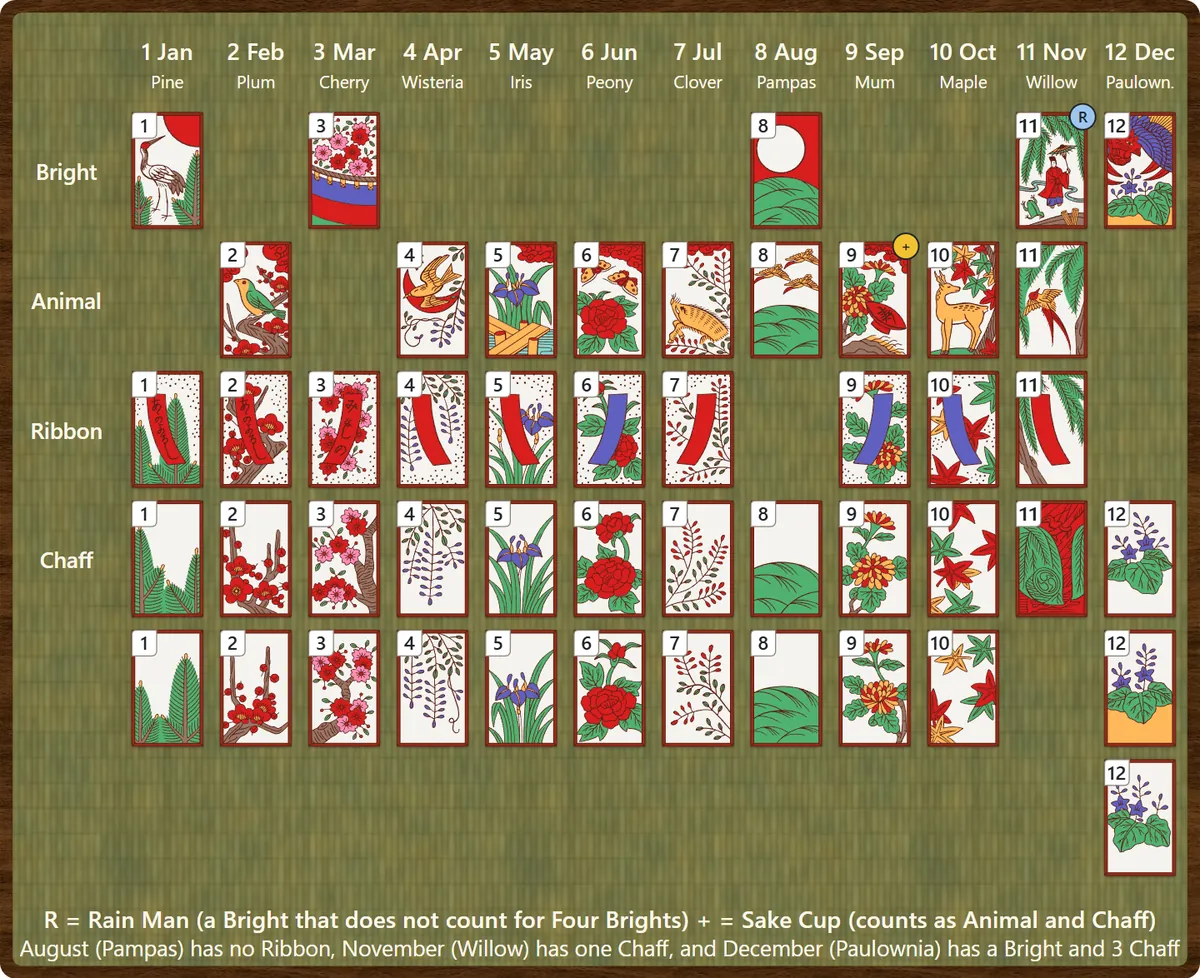
Every month has four cards, and each card belongs to one of four types:
- Brights (hikari, 5 cards): Crane (January, Pine), Curtain (March, Cherry), Moon (August, Pampas), Rain Man (November, Willow) and Phoenix (December, Paulownia).
- Animals (tane, 9 cards): the cards with birds, animals or objects, such as the Bush Warbler, the Boar, the Deer and the Sake Cup.
- Ribbons (tanzaku, 10 cards): the cards with a long paper strip. Three red ribbons carry a poem (Pine, Plum, Cherry) and three are blue (Peony, Chrysanthemum, Maple).
- Chaff (kasu, 24 cards): plain cards showing only the plant.
The months are not all alike. August (Pampas) has no ribbon, December (Paulownia) has one Bright and three Chaff, and November (Willow) has one card of each type. Its Bright, the Rain Man (Ono no Michikaze with an umbrella), is special: it does not count toward Three or Four Brights. The September Sake Cup is an Animal, but under most rules it also counts as a Chaff card.
Koi-koi yaku (scoring combinations)
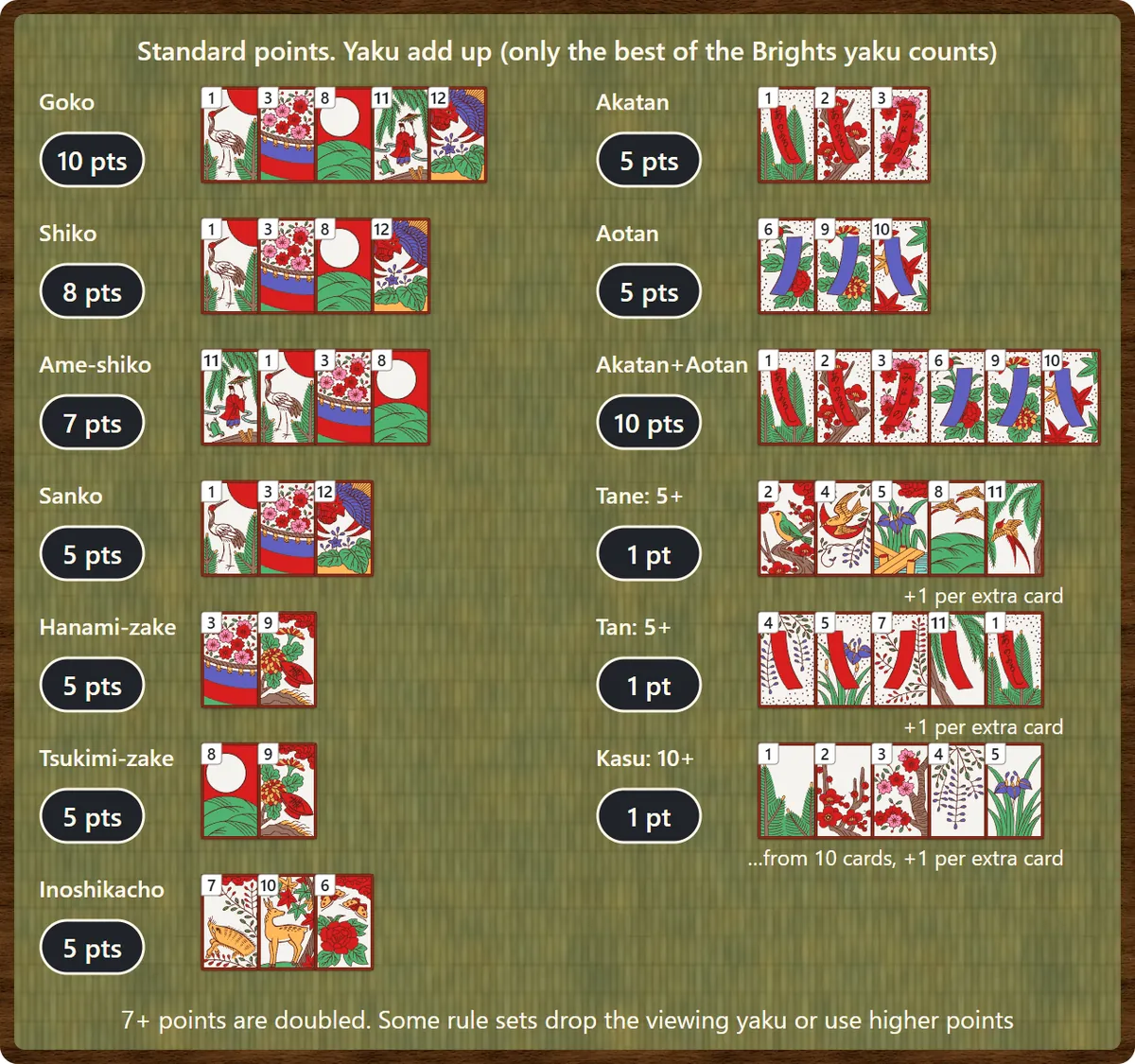
| Yaku | Cards needed | Points (standard) |
|---|---|---|
| Goko (Five Brights) | All 5 Brights | 10 |
| Shiko (Four Brights) | 4 Brights, not the Rain Man | 8 |
| Ame-shiko (Rainy Four Brights) | 4 Brights including the Rain Man | 7 |
| Sanko (Three Brights) | 3 Brights, not the Rain Man | 5 |
| Hanami-zake (Flower Viewing) | Cherry Curtain + Sake Cup | 5 |
| Tsukimi-zake (Moon Viewing) | Pampas Moon + Sake Cup | 5 |
| Inoshikacho (Boar, Deer & Butterflies) | Bush Clover Boar, Maple Deer, Peony Butterflies | 5 |
| Akatan (Red Poetry Ribbons) | The 3 red poem ribbons | 5 |
| Aotan (Blue Ribbons) | The 3 blue ribbons | 5 |
| Akatan & Aotan | All 6 of the above ribbons | 10 |
| Tane (Animals) | 5 Animals | 1, +1 per extra |
| Tan (Ribbons) | 5 Ribbons | 1, +1 per extra |
| Kasu (Chaff) | 10 Chaff | 1, +1 per extra |
Only the highest of the Brights yaku counts. Everything else adds up, so a hand with Inoshikacho and Akatan scores 10. Under the Standard rules, a total of 7 points or more is doubled.
Koi-koi rules and scoring
Koi-koi or stop?
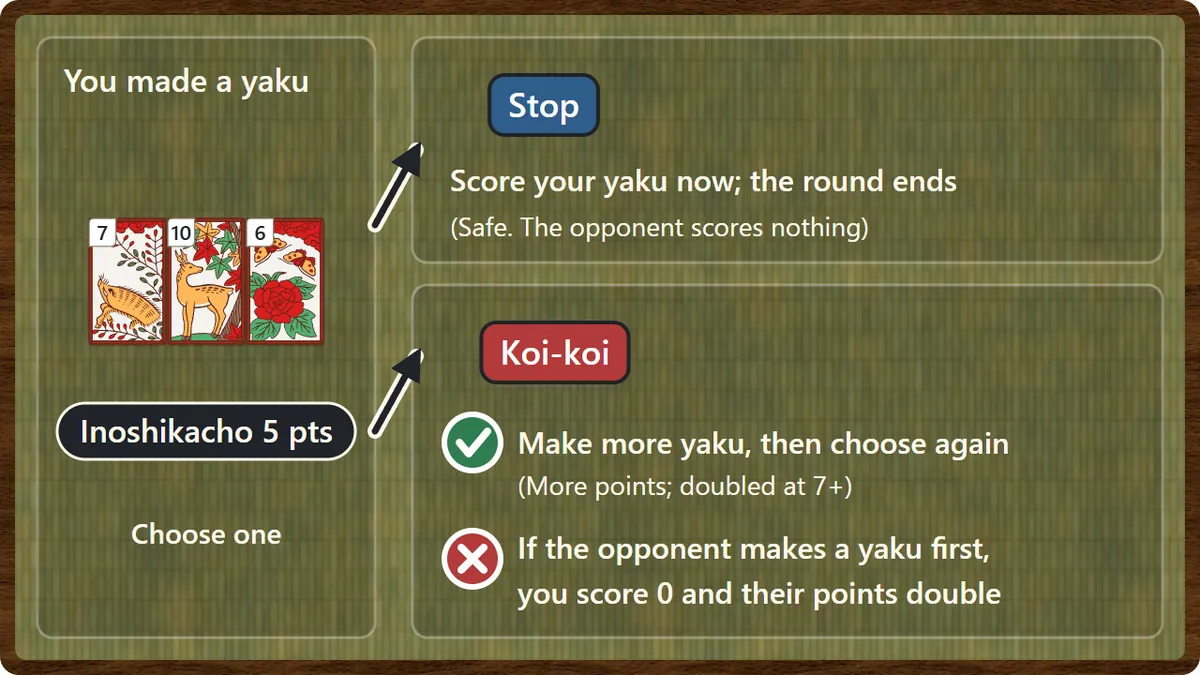
At the end of a turn in which you completed a yaku, choosing Stop scores all your yaku and ends the round. Choosing Koi-koi keeps the round going. Whenever you make a new yaku, or an existing Tane, Tan or Kasu yaku grows by another card, you may choose again.
The risk: while you are in koi-koi, your opponent may complete a yaku and stop. Then your yaku score zero, and under the Standard rules their score is doubled. Watch the “1 more” notes above your opponent’s captures before you call koi-koi.
How a round ends
A round ends when someone stops, or when both hands run out. If you complete a yaku on the very last turn, you stop automatically. If the hands run out and nobody has scored (including after a koi-koi that never added anything), the round is a draw and no points change hands. After the chosen number of rounds (3, 6 or 12), the player with the higher total wins. Twelve rounds, one for each month, is the traditional length: a full “year” of hanafuda.
Hand yaku: Teshi and Kuttsuki
If your eight dealt cards contain all four cards of one month, that is Teshi (“four of a month”). If they form four pairs of months, that is Kuttsuki (“four pairs”). Either one scores 6 points immediately and ends the round. If four cards of the same month are dealt to the field, the cards are redealt.
Rule sets: Standard, No viewing yaku and Classic
Koi-koi scoring varies a lot from region to region and family to family. You can pick one of three common rule sets, or choose Custom to switch individual rules such as rain cancelling the viewing yaku, a koi-koi multiplier, a one-koi-koi limit, koi-doku and the dealer’s privilege.
| Rule | Standard | No viewing | Classic |
|---|---|---|---|
| Brights yaku (5, 4, rainy 4, 3 cards) | 10, 8, 7, 5 | 10, 8, 7, 5 | 15, 10, 8, 6 |
| Akatan, Aotan | 5 each, 10 for both | 5 each, 10 for both | 6 each |
| Flower and Moon Viewing | 5 each | Not used | 5 each |
| Double at 7+ points | Yes | Yes | No |
| Double after the other player calls koi-koi | Yes | Yes | No |
| Sake Cup also counts as Chaff | Yes | Yes | Yes |
| Hand yaku (Teshi or Kuttsuki) | 6 | 6 | 6 |
The viewing yaku need only two cards, so many players leave them out: without them the Sake Cup is less of a must-have, and the other yaku become more important.
Koi-koi strategy
1. Grab the Sake Cup
With the viewing yaku in play, the Sake Cup pairs with both the Cherry Curtain and the Pampas Moon, and it counts as an Animal and a Chaff card too. When it shows up on the field, taking it is usually your top priority, especially if your opponent could take it next.
2. Don’t feed your opponent’s yaku
If a note like “Inoshikacho: 1 more (Oct)” appears above your opponent’s captures, avoid leaving an October card on the field. If one is already there and you can match it, take it yourself. Field cards your opponent needs are marked with “!”, and cards you need are marked with a star.
3. When you can’t capture, give away Chaff
Sometimes you have to put a card on the field. Chaff is the safest choice; Brights and Animals are the riskiest. Even better, drop a card whose month you still hold, so you can take it back on your next turn.
4. Read the table before you call koi-koi
If your opponent has several yaku one card away, or only a few cards are left in the hands, stopping is usually the safer play. If their captures are thin and you are close to another yaku, koi-koi is a good chance to grow your score.
5. Seven points is the magic number
Under the Standard rules, 7 points or more is doubled. With 5 points on the board and another point or two within reach, koi-koi to aim for the double. Already past 7? Take the points.
6. Count the cards you haven’t seen
Any card that is not in your hand, on the field or in either pile of captures is in your opponent’s hand or the deck. If most cards of the month you need are still unseen, there is a good chance of drawing one.
Koi-koi FAQ
Can I play a card that doesn’t capture when I could capture?
Yes. You choose which card to play, so you may put a non-matching card on the field instead. But if the card you play matches a field card, it must capture, and so must a card drawn from the deck.
After a koi-koi, when can I stop again?
When you make a new yaku, or when your Tane, Tan or Kasu yaku gains a card and your score goes up. You cannot stop on a turn that did not increase your score.
Which CPU level should I choose?
If you are new to hanafuda, start with Easy. It likes to grab flashy cards such as Brights and Animals and tends to call koi-koi even with a small score. Normal thinks about which cards build its yaku and which cards spoil yours, and it checks your captures before calling koi-koi. Hard looks further ahead before choosing a card and weighs koi-koi carefully. The deck always adds some luck, so every level can win or lose.
I can’t tell the months apart
Use the number in the top-left corner of each card, and the chart in “Hanafuda cards: the 12 months” above. After a few games you will start to recognize the pine, plum and cherry pictures without looking.
Can I stop and continue later?
Yes. Open the page again on the same device and browser and press Continue to resume from the start of the turn you were on. The sound is off at first; press “Sound: off” to hear the cards being dealt and captured.
Is this the same game as in hanafuda video games?
Koi-koi is the best-known hanafuda game, so it is the one most apps and video games feature. Point values and optional rules vary between versions, which is why you can choose the rule set here.
What is hanafuda?
Hanafuda are Japanese playing cards that became popular in the Edo period. The 48 cards follow the seasons, with a flower or plant for each month, from pine in January to paulownia in December. Koi-koi is said to have spread in the early twentieth century (some trace it to the Aizu region), and it is now the most widely played hanafuda game in Japan. Playing twelve rounds as a full year reflects the seasonal spirit of the cards. The name comes from the call itself: koi means “come”, as in “come on, let’s keep going”.