 Yorimichi Games
How to play Hachi-Hachi
Hachi-Hachi (“eighty-eight”) is a three-player game played with hanafuda, the Japanese flower cards. Like the better-known Koi-Koi, it is a fishing game: you capture cards from the field by matching months. What makes Hachi-Hachi special is how many ways there are to score. Some points come from the shape of the seven cards you are dealt (teyaku), some come from sets you capture during play (dekiyaku), and if nobody completes a set, every card you took is worth points measured against a par of 88. On top of that, certain cards in the opening field double or quadruple the whole round. Japanese card players have long called it the most complete of the flower card games, and it was the standard “serious” hanafuda game from the late nineteenth century onward.
The name comes from the arithmetic of the deck. The 48 cards are worth 264 points in total, and 264 divided by three players is 88. Anyone who ends a round above 88 has won points; anyone below has lost them.
Reading the table
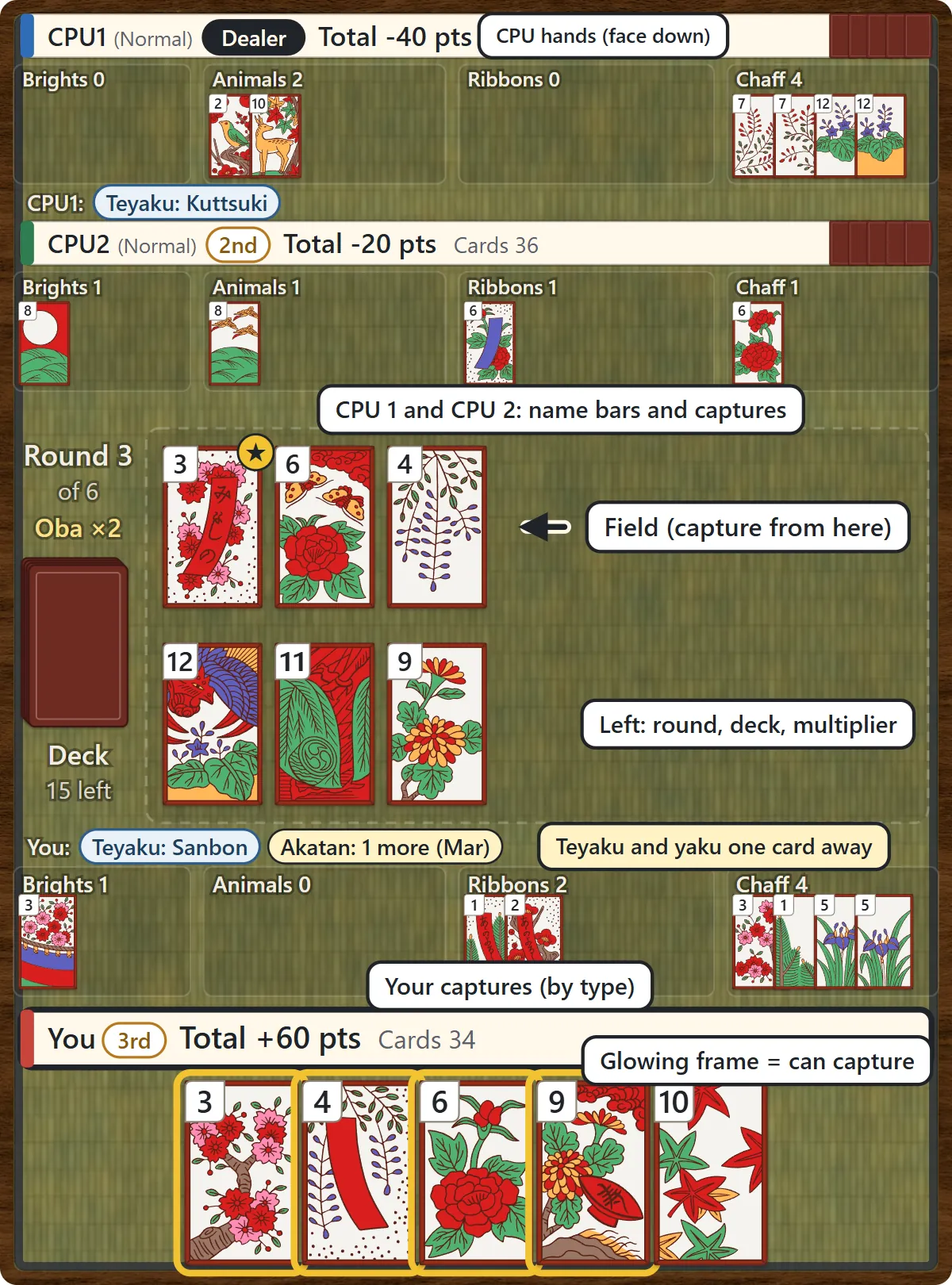
Each player is dealt seven cards and six cards are laid face up in the field. The remaining 21 cards form the deck. Play goes in a fixed order: the Dealer first, then the second player, then the third. For the first round, everyone draws a card and the earliest month deals. After that, the winner of each round deals the next one.
Hanafuda has twelve suits, one for each month, and each month has four cards. The cards are recognized by their plants: pine for January, plum blossom for February, cherry blossom for March, and so on. In this game each card carries a small month number in its corner, so you can play without knowing the plants. If you already know the deck, you can turn the numbers off in the settings.
Step 1: check the field for Oba and Zeppa
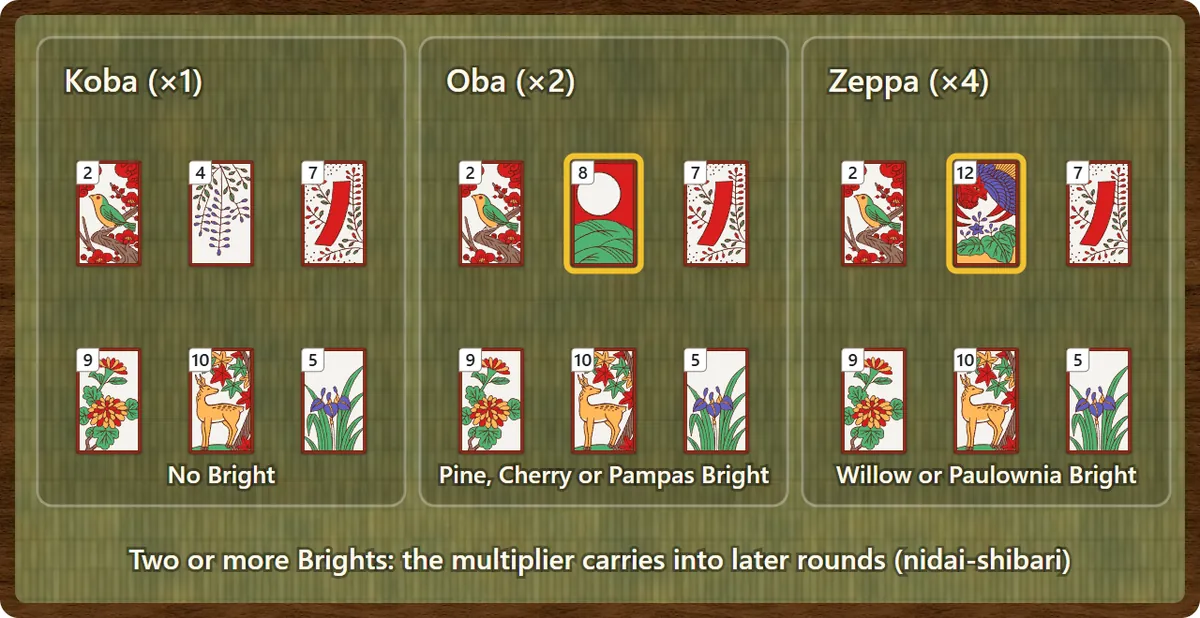
Before anyone plays, look at the Brights (the 20-point cards) in the opening field. With none, the round is Koba and scores normally. If the Crane (Pine), the Curtain (Cherry) or the Moon (Pampas) is there, the round is Oba and every score is doubled. If the Rain Man (Willow) or the Phoenix (Paulownia) is there, the round is Zeppa and every score is multiplied by four. When two or more Brights appear together, the extra ones carry the multiplier into the following rounds, a rule called nidai-shibari.
Step 2: show your teyaku (hand yaku)
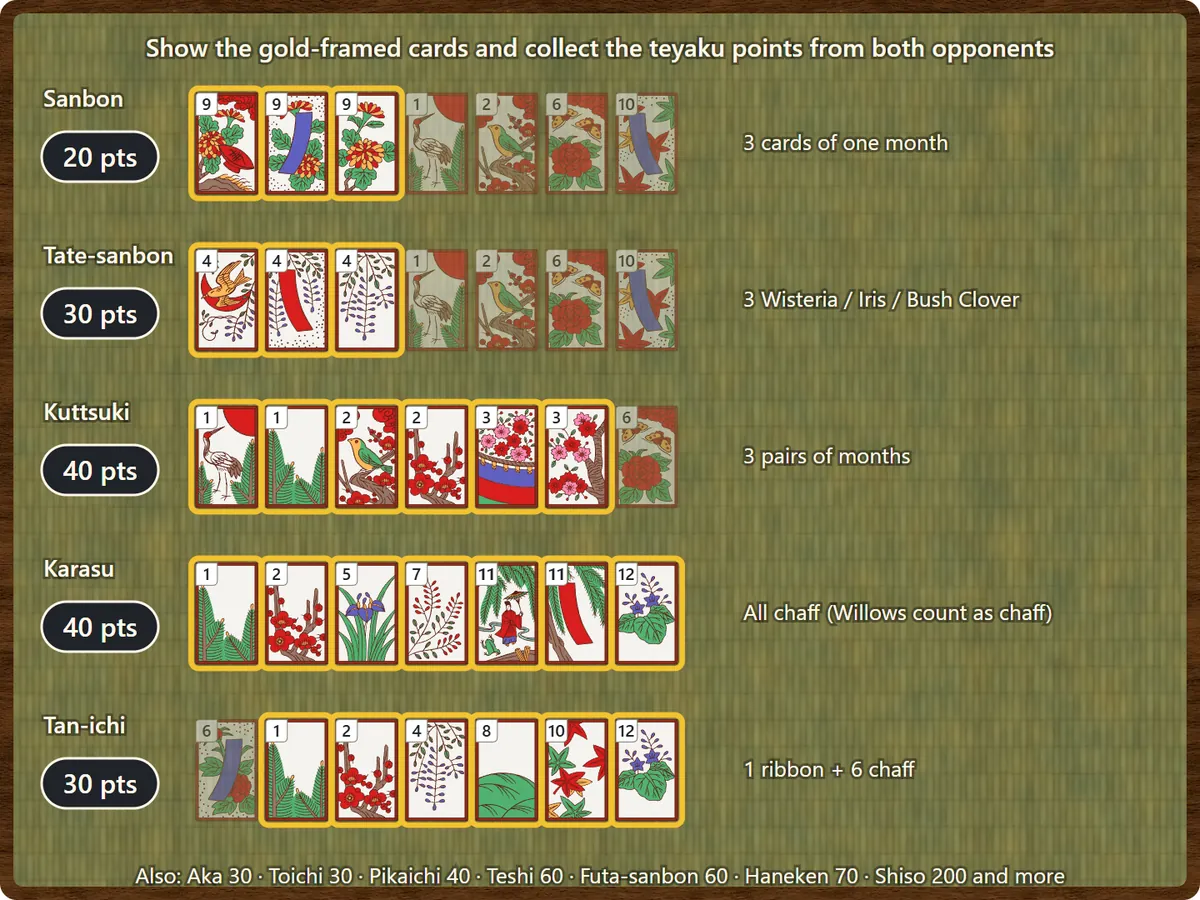
Right after the deal, the game checks every hand for teyaku. Some are based on shape: three cards of one month (Sanbon), three pairs (Kuttsuki), four of a month (Teshi) and larger combinations up to Shiso, four plus three. Others reward a poor hand: all chaff (Karasu), one ribbon with six chaff (Tan-ichi), or a single Bright with six chaff (Pikaichi). This is one of the clever ideas in Hachi-Hachi: a hand full of worthless cards still earns something. The cards that make the teyaku are shown to everyone, and the owner collects the value from each of the other two players. One yaku from the “chaff” group can combine with one from the “shape” group, and their points are added together.
Step 3: match cards to capture them
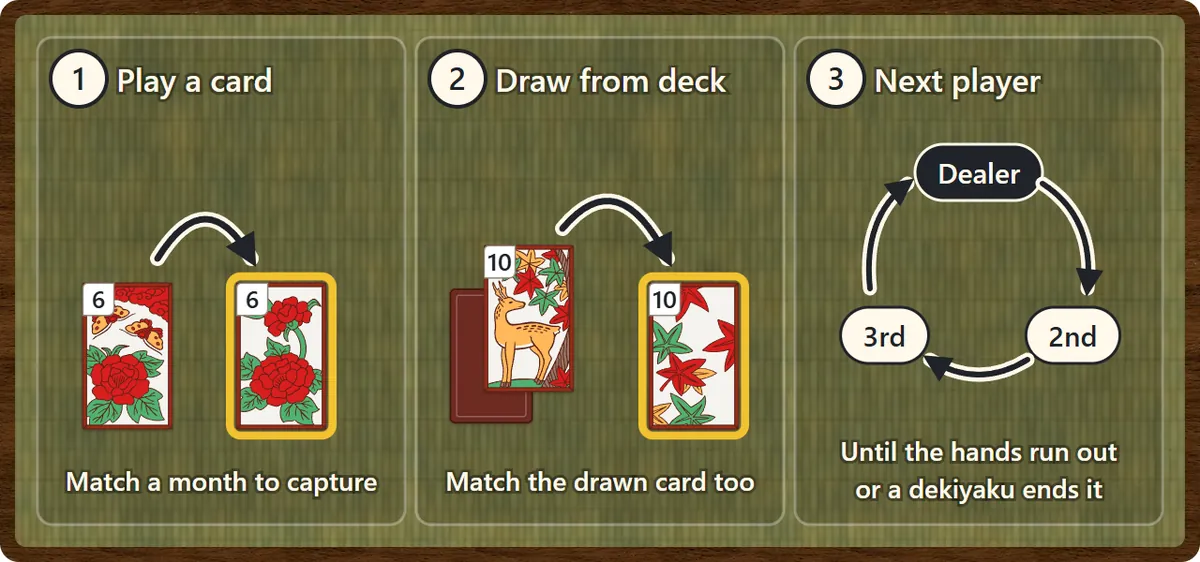
On your turn, play one card from your hand. If a field card shows the same month, you capture both. If not, your card stays in the field. Then turn over the top card of the deck and do the same with it. When two field cards match, you choose which one to take; when three match, you take all four. In this game, cards in your hand that can capture something have a glowing frame, so you always see your options.
Step 4: make a dekiyaku, then stop or sage
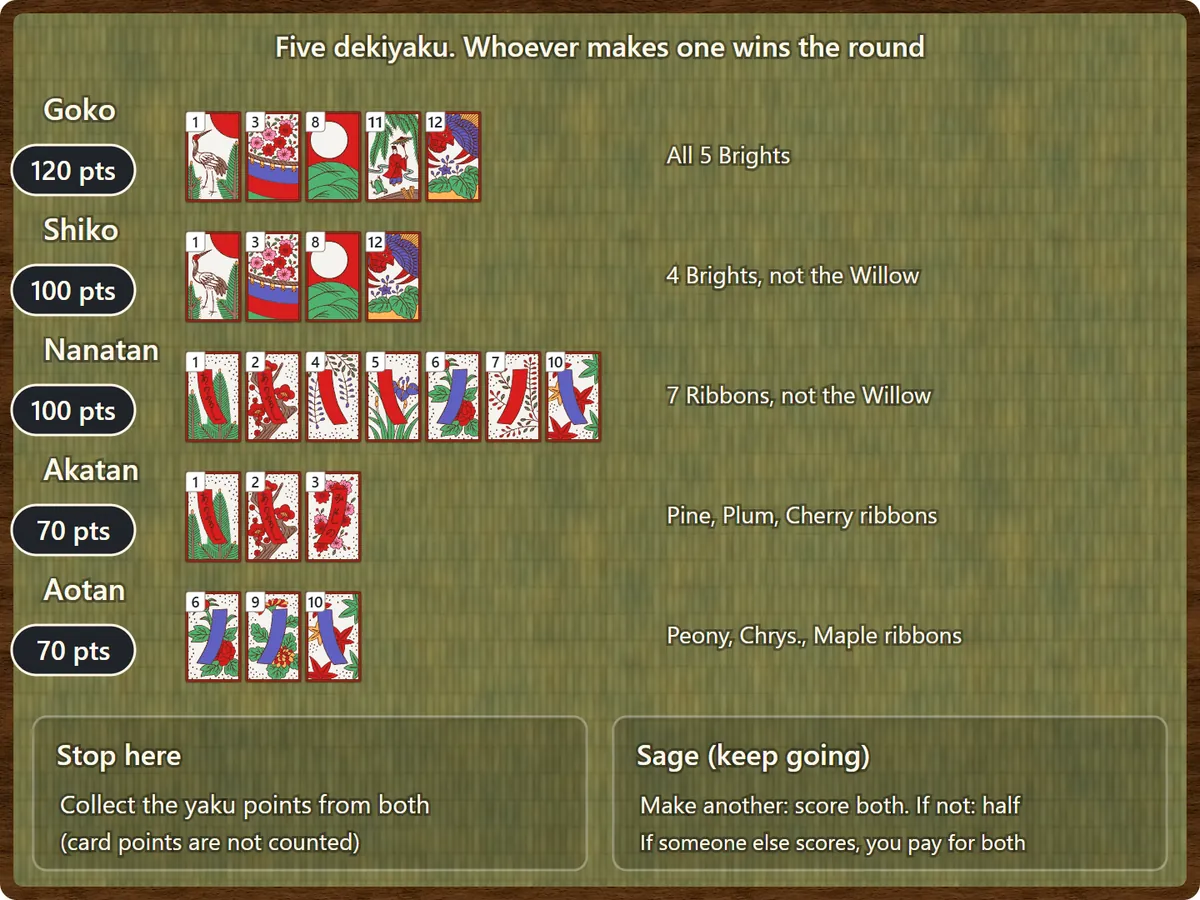
The capture yaku in Hachi-Hachi are few but valuable: Goko (all five Brights), Shiko (four Brights without the Willow), Nanatan (seven ribbons, not counting the Willow ribbon), Akatan (the three red poetry ribbons of Pine, Plum and Cherry) and Aotan (the three blue ribbons of Peony, Chrysanthemum and Maple). As soon as you complete one, you choose. Stop here ends the round and you collect the yaku value from both opponents; card points are not counted. Sage (“lowering”) means you keep playing in the hope of a second yaku, which would pay both. The risk is real: if the hands run out with nothing new, you get only half, and if an opponent completes a yaku first, you pay that player on behalf of both opponents. The Japanese term for this is sekinin-barai, “responsibility payment”.
Step 5: no dekiyaku? Compare card points with 88
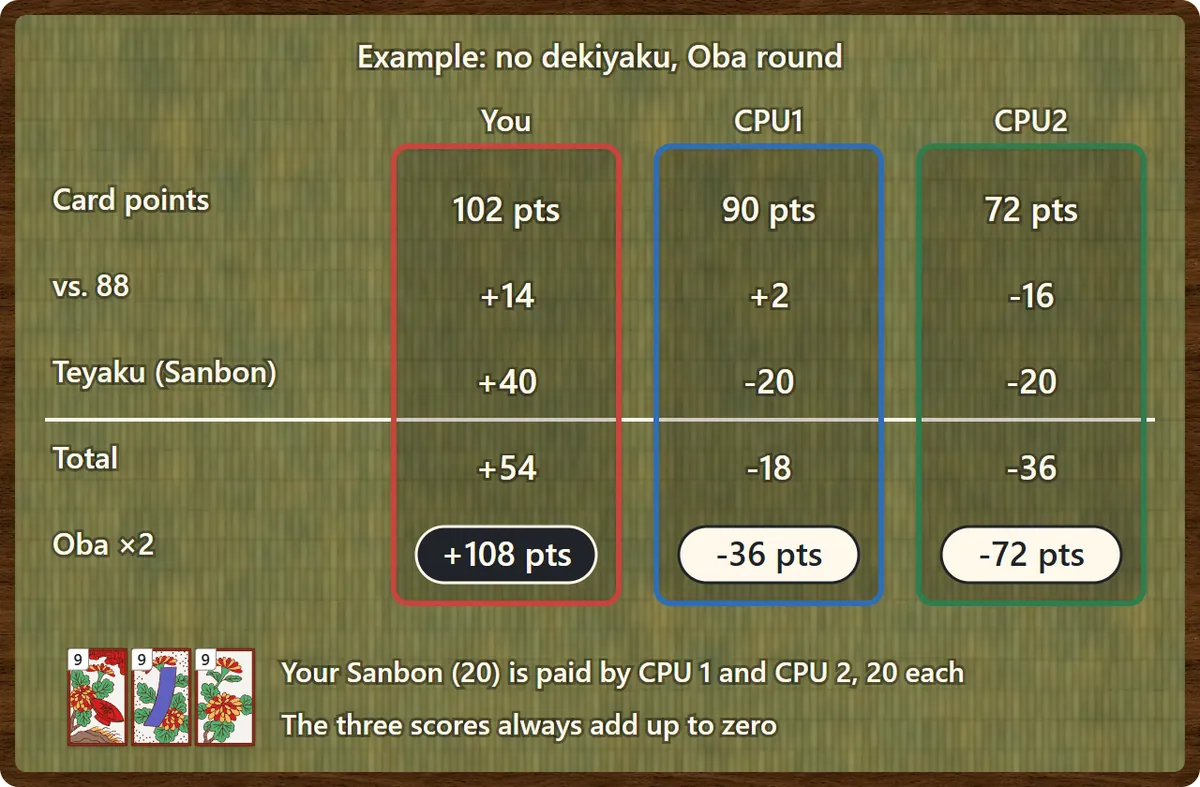
If nobody completes a dekiyaku before the hands are empty, everyone adds up their captured cards: Brights 20, Animals 10, Ribbons 5 and Chaff 1. Your score for the round is the difference from 88, so the three results always add up to zero. Teyaku are added, and then the Oba or Zeppa multiplier is applied. The game keeps a running total and, after the chosen number of rounds (3, 6 or 12), the player with the highest total finishes first.
Hachi-Hachi rules and yaku list
These are the point values for the Standard (Kanto) rules. Points are always collected from each of the other two players.
| Type | Yaku and points |
|---|---|
| Dekiyaku | Goko 120 · Shiko 100 · Nanatan 100 · Akatan 70 · Aotan 70 |
| Teyaku (chaff) | Aka 30 (two or more ribbons, the rest chaff) · Tan-ichi 30 · Toichi 30 (one animal and six chaff) · Pikaichi 40 · Karasu 40 (all chaff) |
| Teyaku (shape) | Sanbon 20 · Tate-sanbon 30 · Kuttsuki 40 · Teshi 60 · Futa-sanbon 60 · Futa-tate-sanbon 80 · Haneken 70 · Ichi-ni-shi 80 · Shiso 200 |
| Special | Sujuroku 120 (16 chaff) · Nihachi 100 (168+ card points) · Sohachi 100 (all three at exactly 88, dealer only) |
| Bonuses | Nuke 10 (a chaff-group teyaku holder who still takes 89+ card points) · Tobikomi 10 (a Sanbon or Tate-sanbon holder who also captures the fourth card of that month) |
A special yaku can only happen when a round is played to the end without a dekiyaku. If one is made, every teyaku that round is cancelled, a rule called fukikeshi (“blowing out”). During play, open the Yaku list under the table to see how close each player is to every dekiyaku.
Kanto, Kansai and Simple rules
Hachi-Hachi was played differently from region to region, and the point tables vary a lot between sources. You can pick one of these sets or switch individual rules under Custom.
| Rule | Kanto / Kansai | Simple |
|---|---|---|
| Five, Four Brights, Seven Ribbons | 120, 100, 100 / 150, 120, 120 | 120, 100, 100 |
| Red and blue ribbons | 70 each / 100 each | 70 each |
| Sage | Kanto: half if nothing more · Kansai: lost if nothing more | No sage |
| Carry-over, special yaku, bonuses | Yes | No |
In Simple, a round ends the moment anyone completes a dekiyaku. It is a good way to learn the teyaku and dekiyaku before adding the push-your-luck decision of the sage.
Hachi-Hachi strategy tips
1. Blocking a dekiyaku matters most
A single dekiyaku is worth 70 to 120 points from each opponent, and double that in an Oba round. Card points rarely swing by more than a few dozen. That means stopping an opponent’s yaku is often worth more than improving your own card total. When a pill under a computer player says something like “Akatan: 1 more (Mar)”, do not leave a Cherry card in the field, and take one if you can.
2. Watch the Brights and the ribbons
Only the five Brights and nine of the ribbons ever take part in a dekiyaku. Capture them while you can. The animals of Wisteria, Iris and Bush Clover and most chaff never complete a dekiyaku, so they are your safest cards to discard.
3. Sage only when the table looks quiet
If an opponent is one card away from a yaku, or the hands are almost empty, a sage is likely to cost you. Take the points and stop. The best time to sage is early in the round, when you are already close to a second yaku and nobody else is.
4. Be careful in Zeppa rounds
Everything counts four times in a Zeppa round, so one dekiyaku can decide the whole match. Defend even more carefully than usual.
5. Remember Nuke and Tobikomi
If you were dealt a chaff-group teyaku, finishing above 88 card points earns an extra 10. If you hold a Sanbon, capturing the fourth card of that month earns 10 as well, so it is worth chasing when it appears.
6. Count the unseen cards
Any card that is not in your hand, in the field, in someone’s captures or among the shown teyaku cards is either in an opponent’s hand or in the deck. Counting how many of the cards you need are still out there tells you whether to wait or to go for it.
Hachi-Hachi FAQ
How is Hachi-Hachi different from Koi-Koi?
Koi-Koi is a two-player game built around many yaku and the choice to call “koi-koi” and continue. Hachi-Hachi is for three players, has only five capture yaku, adds hand yaku and field multipliers, and falls back on card points against a par of 88 when nobody completes a yaku. The sage decision is a close cousin of calling koi-koi.
Why were my card points not counted when I made a yaku?
When a round ends with a dekiyaku, only the yaku is paid. Card points only matter in rounds where nobody makes a dekiyaku and the hands run out.
Isn’t Hachi-Hachi played with more than three people?
Traditionally, larger groups could join, and each player decided after looking at their hand whether to play or sit out until only three remained. This version is always three players, so everyone plays every round.
Which CPU level should I choose?
Start with Easy. It grabs high-value cards on sight, sometimes misses a capture, and gets greedy with the sage. Normal also pays attention to your yaku and to which cards it leaves in the field. Hard looks further ahead before choosing a card and thinks about whether a sage is worth it. The deck always adds some luck, so you can win or lose at any level.
Can I stop and continue later?
Yes. Open the page again on the same device and browser and press Continue to resume from the start of your turn. Sound is off at first; press “Sound: off” to hear the cards being dealt and captured.
The history of Hachi-Hachi
Hachi-Hachi is said to have become popular in Osaka and Yokohama in the Meiji era and then spread across Japan. Shops even sold dedicated scoring kits with counters for keeping track of the points. Scores were traditionally counted in kan, with one kan equal to ten points; the scores in this game follow that ten-point unit. The classic match lasted twelve rounds, one for each month of the year, with a halfway tally after six. Its layered scoring made it the game that serious hanafuda players measured themselves by, and it remains the best way to see how much depth a small deck of flower cards can hold.