 Yorimichi Games
How to play Hana-Awase
Hana-awase (literally “matching flowers”) is one of the oldest and most widely known games played with hanafuda, the 48-card Japanese flower deck. It is usually played by three people. On your turn you match a card from your hand with a card of the same month on the table and capture both. When every hand is empty, each player scores the printed value of the cards they captured plus any yaku, the special combinations that earn a bonus. Unlike koi-koi, nobody stops the round early: everyone plays to the last card, and the plain card points matter just as much as the yaku. That makes hana-awase a steadier, more strategic game than its famous two-player cousin, and it is the game many Japanese families brought out whenever relatives got together.
If you have never touched a hanafuda deck, don’t worry. Every card here shows its month number in the top-left corner, the table highlights every legal capture, and the scoring table at the end of each round explains exactly where the points came from.
The table

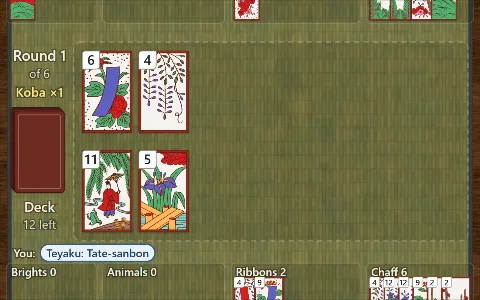
With three players, each person is dealt seven cards and six cards are laid face up in the middle as the field. The remaining 21 cards form the face-down deck. Captured cards are sorted in front of their owner into four groups: Brights, Animals, Ribbons and Chaff. Each seat bar shows the running total, the card points collected so far this round, any yaku points, and the seat’s role. The dealer plays first, then the second and third seats follow in order. In Japanese these three seats are called oya (dealer), dōni and biki.
Capturing cards: match the month
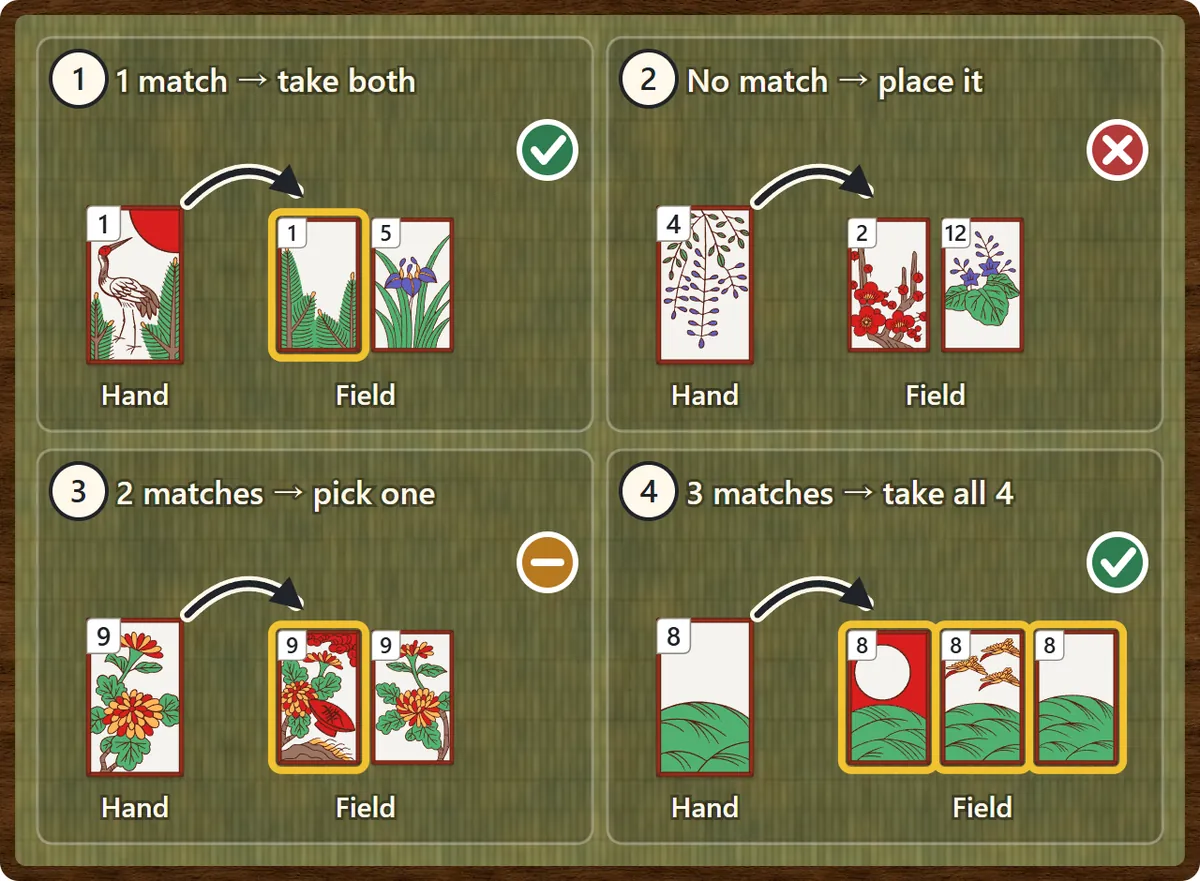
The deck has twelve suits, one for each month of the year, and each month is represented by a plant: pine for January, plum for February, cherry blossom for March, and so on to paulownia in December. There are four cards per month. To capture, play a card from your hand that shows the same month as a card on the field; both cards go to your pile. If nothing matches, your card stays on the field and becomes a target for the other players. You are always allowed to discard a card instead of capturing, which is sometimes the smart move.
A turn, step by step
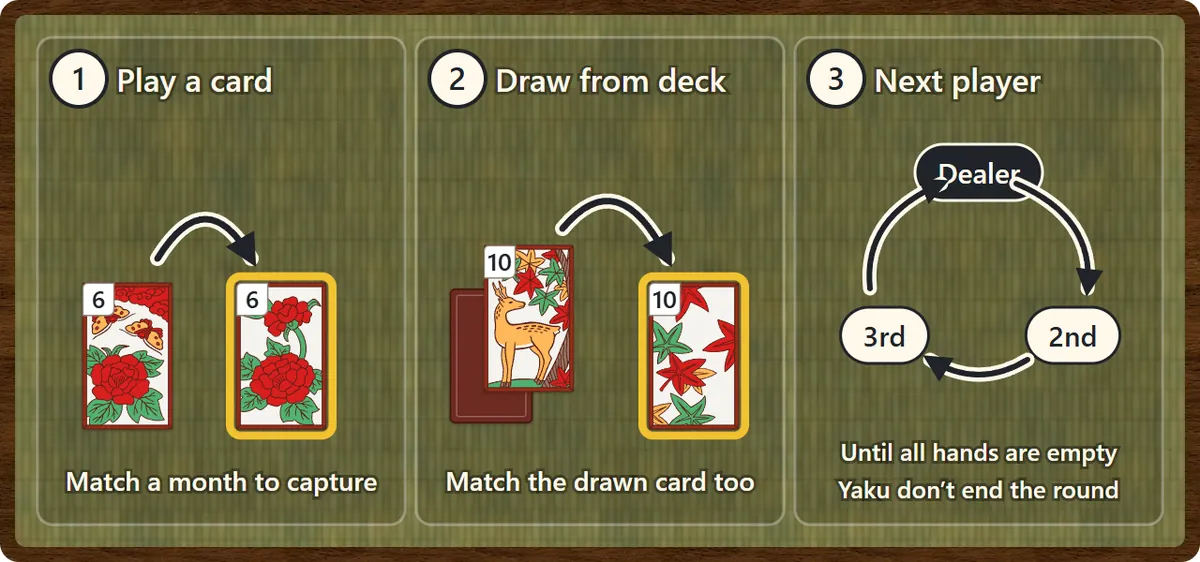
- Play one card from your hand. Capture a field card of the same month, or leave your card on the field.
- Turn over the top card of the deck and match it in the same way. If the drawn card matches something, you must take it.
- The next seat plays. Dealer, second, third, and around again until all hands are empty. By then the field and deck are empty too.
For the first round, every player draws one card and the earliest month deals (on a tie, the higher-value card wins). After that, whoever scored the most in the previous round becomes the next dealer.
Hanafuda card values
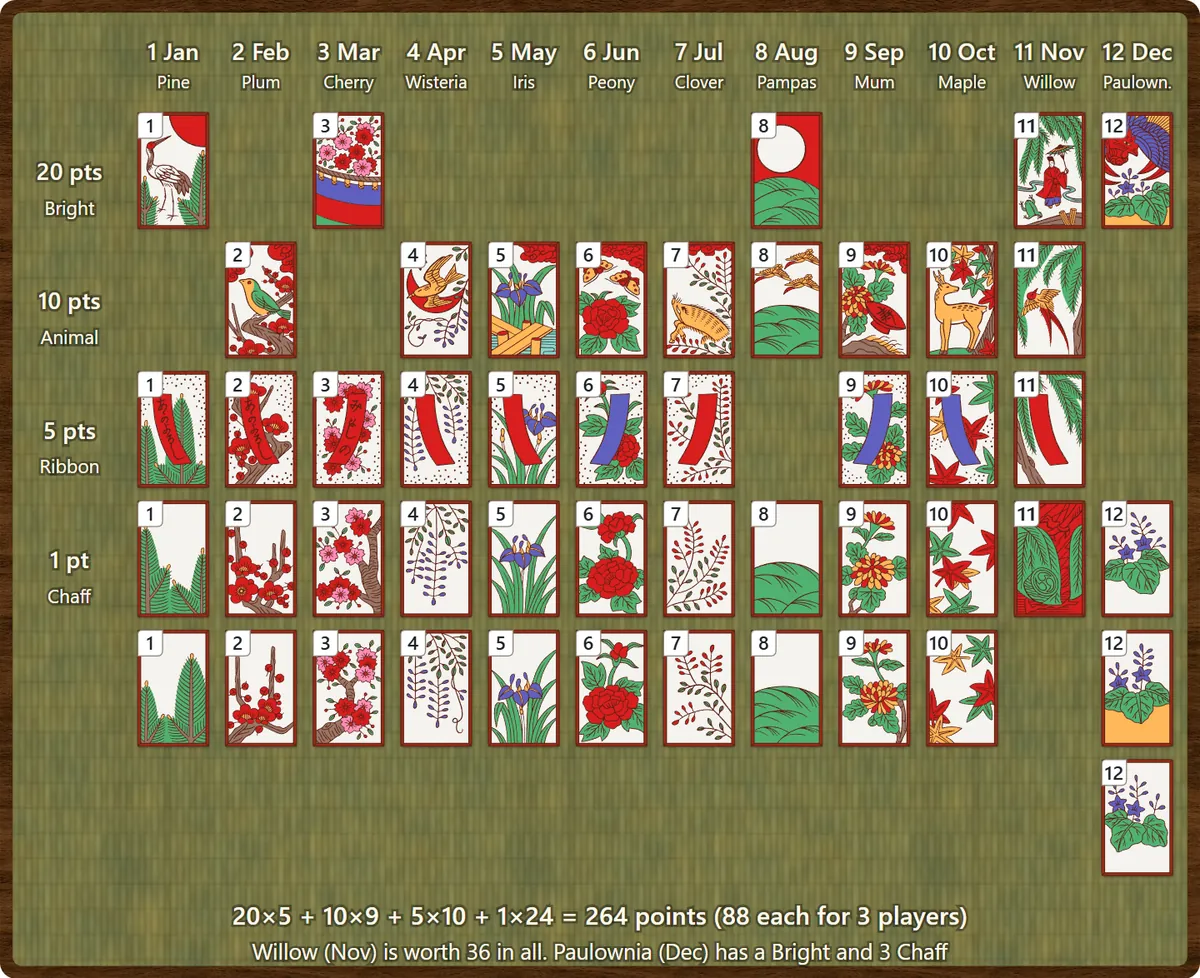
In hana-awase every card has a face value. The five Brights are the Crane (January), the Curtain (March), the Moon (August), the Rain Man (November) and the Phoenix (December), and each is worth 20 points. The nine Animal cards, which include the boar, the deer, the butterflies and the sake cup, are worth 10. The ten Ribbon cards are worth 5, and the 24 plain Chaff cards are worth 1 each. Add them all up and the deck totals 264 points. Split three ways that is 88 points per player, and 88 is the par score: anything you capture above 88 is profit, and anything below is a loss.
Willow (November) is an unusual month. It holds a Bright, an Animal, a Ribbon and a single Chaff card with a lightning drum, so collecting all four is worth 36 points on its own. Paulownia (December), by contrast, has one Bright and three Chaff.
Hana-Awase yaku (scoring combinations)

Yaku keep their traditional Japanese names. Here is what each one means:
- Brights: all five Brights make Goko (Five Brights, 200 points). The four Brights other than the Rain Man make Shiko (Four Brights, 60). The Crane, the Moon and the Phoenix together make Matsukiri-bozu (20).
- Ribbons: the three red poetry ribbons of pine, plum and cherry make Akatan (40). The three blue ribbons of peony, chrysanthemum and maple make Aotan (40). The plain red ribbons of wisteria, iris and bush clover make Kusa (20). Any seven ribbons except the willow ribbon make Nanatan (40), and any six make Rokutan (30).
- Picture sets: Crane, Bush Warbler and Curtain make Omote-sugawara (30). Curtain plus Sake Cup is Hanami-zake (Flower Viewing, 20), and Moon plus Sake Cup is Tsukimi-zake (Moon Viewing, 20). All three together form Nomi, the drinking party (30). Boar, Deer and Butterflies make the famous Inoshikacho (20).
- All four of a month: capture every card of wisteria, paulownia or willow for Fuji-shima, Kiri-shima or Ame-shima (20 each).
Overlaps are handled like this: Goko replaces Shiko, Nanatan replaces Rokutan, Omote-sugawara is not counted when you already have Goko or Shiko, and Nomi replaces the two viewing yaku. When a yaku is completed during play, a banner announces it, but the round simply carries on.
Hanafuda scoring for 3 players
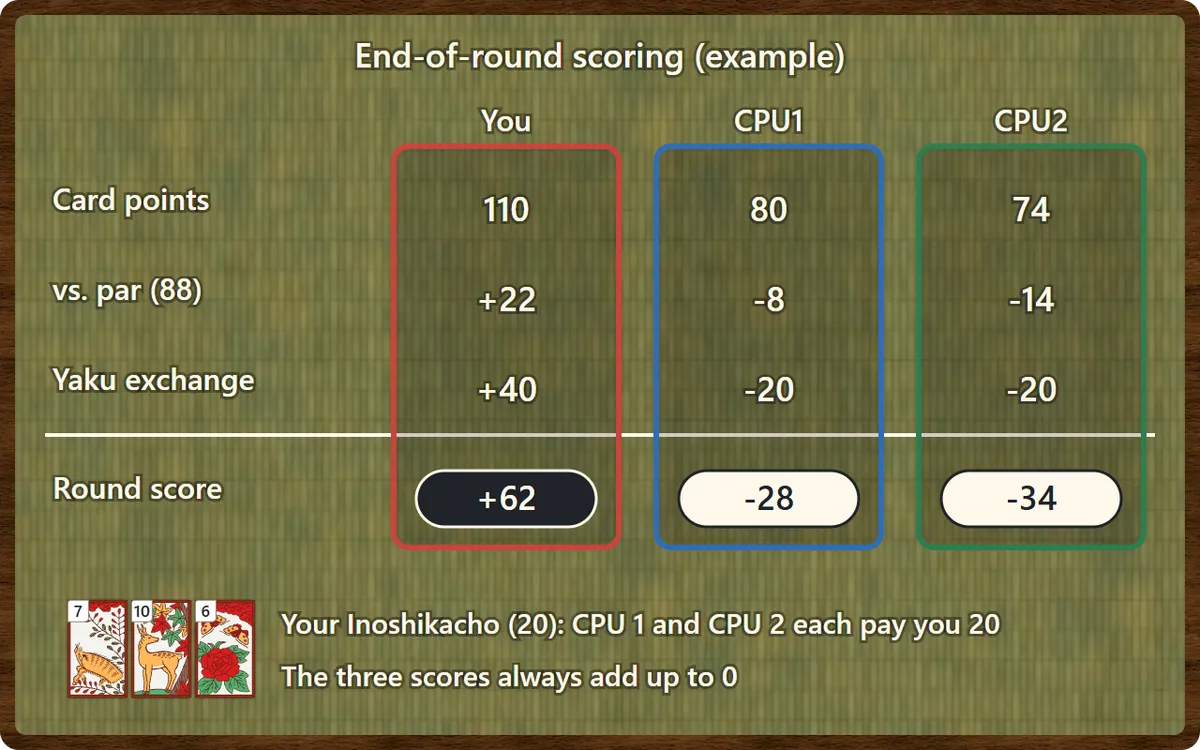
When the last card has been played, each player’s score for the round is worked out in three steps:
- Total your card points and subtract par (88 with three players).
- Collect the value of each of your yaku from every other player. With three players that means you receive your yaku points twice.
- Pay the value of every opponent’s yaku to that opponent.
The game shows this as a small table after every round, so you can check each line. Because every point you win comes from someone else, the three round scores always sum to zero. After the chosen number of rounds (3, 6 or the traditional 12, one for each month) the player with the highest total finishes first.
Hanafuda rules for 2 players
Hana-awase is designed for three, but it also works as a duel. With two players each person gets ten cards and eight go to the field. Par becomes 132 (half of 264), and yaku are paid by your single opponent. Two-player games are more tactical, because you can often work out exactly which cards your opponent is holding.
Rule sets: Standard, Classic and Few yaku
Hana-awase has always varied from region to region and from family to family, so the game offers three common versions. Custom lets you mix and match, and adds optional rules such as Oba and Zeppa (a Bright on the opening field doubles or triples the round) and Oya-naka (a bonus for a player who captured very few cards).
| Rule | Standard | Classic | Few yaku |
|---|---|---|---|
| Five / Four Brights | 200 / 60 | 100 / 60 | 100 / 70 |
| Red / blue ribbons | 40 each | 40 each | 50 each |
| Other yaku | Yes | Yes (Nomi 40) | None |
| All four of a month | 20 each | 10 each | None |
| Rain cancels yaku | No | Yes | No |
| Fuke (void round) | No | Yes | No |
| Chaff value / par | 1 / 88 | 1 / 88 | 0 / 80 |
In the Classic rules, anyone who collects all four willow cards cancels every yaku that round, and if any player ends with 20 card points or fewer the round is declared fuke and no points change hands. Few yaku keeps only four combinations and makes Chaff worthless, turning the game into a pure fight over high-value cards. Standard, with its big 200-point Goko, is the liveliest.
Hana-Awase strategy and tips
1. Take Brights and willow cards first
A single Bright is worth as much as twenty Chaff cards and feeds several yaku. Willow is also valuable: even though its Bright does not count toward Four Brights, the four willow cards add up to 36 points.
2. Throw away wisteria and iris when you must discard
When nothing in your hand can capture, you have to leave a card on the field. Pick a month that matters little. Wisteria (April) and iris (May) only feed Kusa and Fuji-shima, so they are the safest cards to give away.
3. Watch your opponents’ “1 more” warnings
Under each player’s captures the game lists any yaku that is one card away, such as “Inoshikacho: 1 more (Oct)”. Never leave that month on the field if you can help it, and if the card is already there (it carries a “!” marker), grab it when you can. Blocking is worth a lot, because a completed yaku is paid by both of the other players.
4. Leave safe captures for later
If you hold two cards of a month and the other two are already on the field, nobody else can take them. Capture something that is actually at risk first and collect the safe pair later.
5. Think about the next player
Whatever you leave on the field is first available to the very next player. Discarding a Chaff card next to a Bright of the same month is an open invitation for them to scoop up both.
6. Count what you haven’t seen
Every card that is not in your hand, on the field or in someone’s captures is either in an opponent’s hand or still in the deck. Knowing how many cards of a month are left tells you whether it is worth waiting for one.
Hana-Awase FAQ
Does the round end when someone makes a yaku?
No. That is the big difference from koi-koi. In hana-awase every round is played to the last card, and all yaku are settled together at the end.
Why is my score negative?
You captured fewer card points than par, or an opponent completed a yaku that you had to pay for. Since the three scores always balance to zero, somebody has to be below the line in every round.
How is this different from koi-koi?
Koi-koi is a two-player game scored by yaku alone, and when you complete one you decide whether to stop or call “koi-koi” and keep going. Hana-awase is normally for three, counts the value of every captured card, and has no stopping decision.
I can’t tell the months apart. What can I do?
Use the small number in the top-left corner of each card: 1 is January (pine), 12 is December (paulownia). It is switched on by default, and you can turn it off under Settings once you know the pictures. The card chart above is also handy while you learn.
Which CPU level should I choose?
Start with Easy. Those opponents grab whatever valuable card they see and often overlook captures. Normal players look for yaku, block your combinations and are careful about what they leave on the field. Hard players think several turns ahead before choosing a card. The deck still decides a lot, so you can win or lose at any level.
Can I stop and continue later?
Yes. Open the page again on the same device and browser and press Continue to resume from the start of your current turn. Sound is off at first; press “Sound: off” to hear the cards being dealt and captured.
Where does Hana-Awase come from?
The phrase hana-awase is old. It was once used for the flower cards themselves and for card games in general, long before “hanafuda” became the usual word. After card games were officially tolerated again in the Meiji era, books began to describe scoring games played with the flower deck, and the three-player version with a par of 88 points became the best known of them. A simpler ancestor with no yaku at all was later extended with combinations, which produced the game you can play here. The traditional match of twelve rounds, one for each month, echoes the seasonal calendar painted on the cards.