 Yorimichi Games
How to play the territory game
This territory game is a two-player strategy game played on a square grid. Each player starts with a single square in a corner and takes turns claiming empty squares next to their own land. Close off an empty area so that your opponent can no longer reach it, and every square inside becomes yours at once. When there is nothing left to fight over, the player who owns more squares wins.
There are no dice and no cards, so luck plays no part. The rules take a minute to learn, yet the game quickly turns into a race: who reaches the middle first, who blocks whose path, and who manages to fence in the biggest area. You can play against the computer at three levels or pass one device back and forth with a friend.
The board and your home square
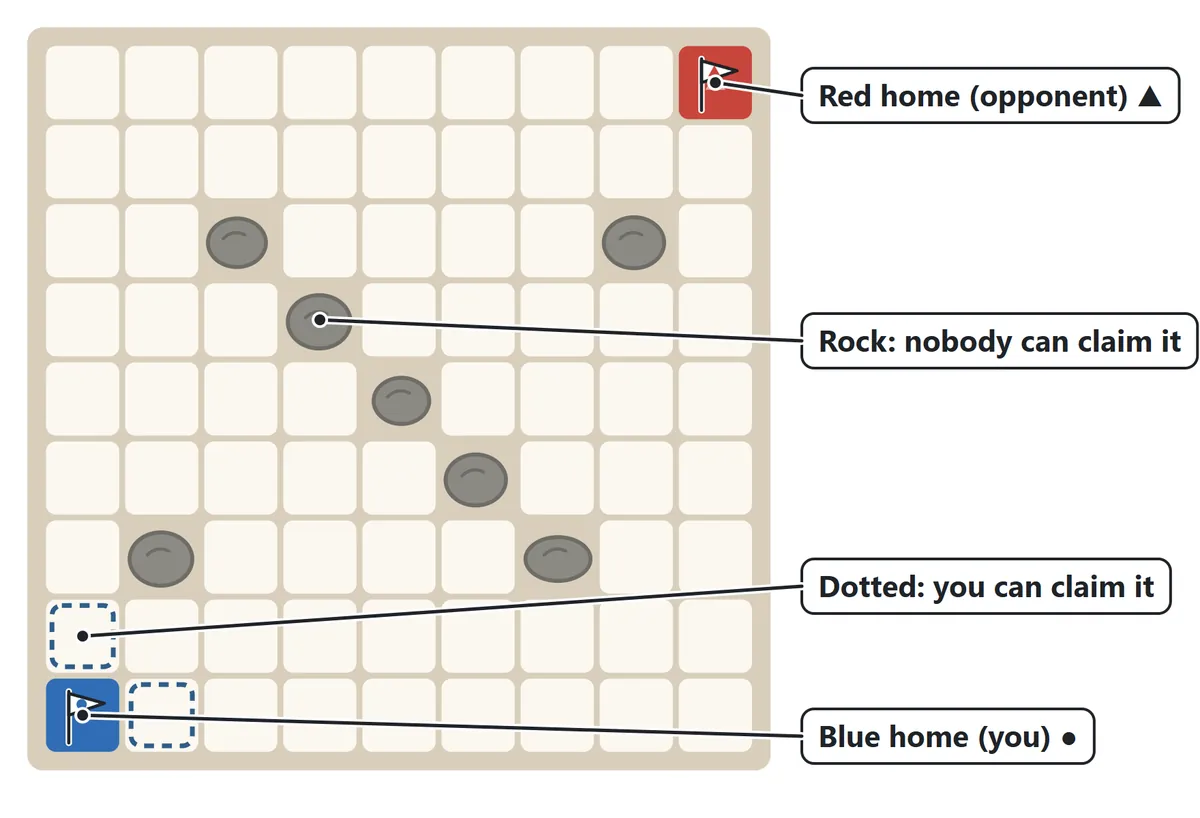
At the start, each side owns just one square in a corner, marked with a small flag. On this page you are Blue and start in the bottom-left corner; your opponent is Red and starts in the top-right. Blue squares carry a small dot and Red squares a small triangle, so you can tell them apart even if the colors are hard to see.
Most boards also have a few gray rocks. A rock can never be claimed and nothing passes through it. Rocks are always placed symmetrically: turn the board 180 degrees around its center and the layout looks the same, so neither color gets a better starting position.
Territory game rules: which squares can you claim?
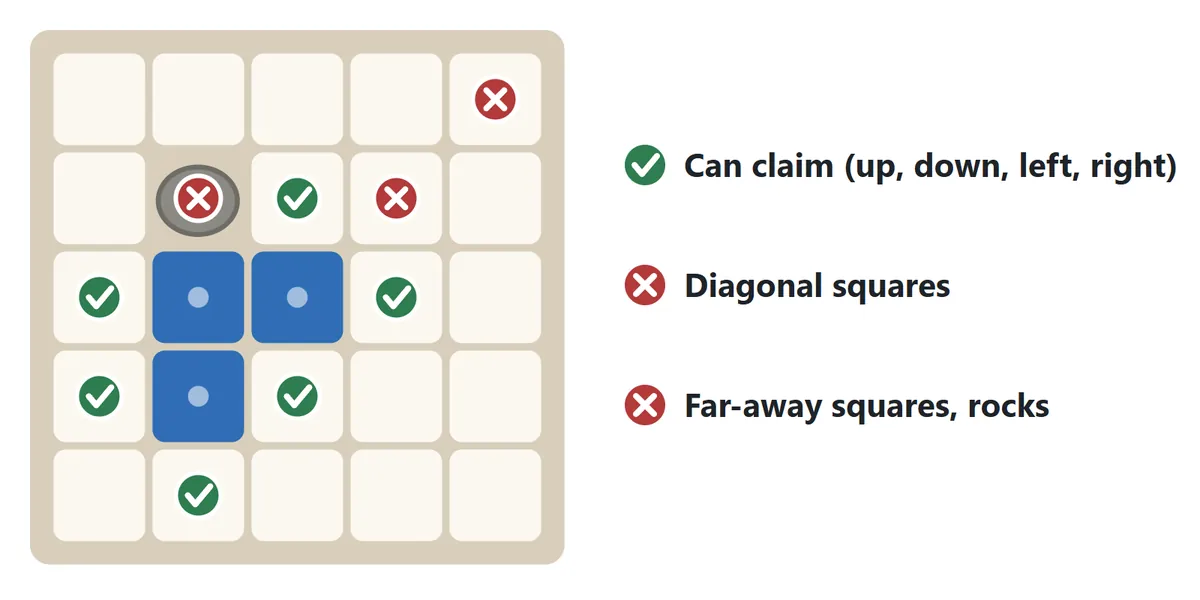
On your turn you pick one empty square and color it. The square must share an edge with a square you already own, meaning it sits directly above, below, left or right of your land. You cannot jump to a distant square, claim an opponent's square or claim a rock. The squares you are allowed to take are shown with a dotted outline, so you never have to guess.
Once a square is yours, it stays yours for the rest of the game. There are no captures and no flipping, which makes every move permanent and every mistake a lesson.
Wall off an area to claim it all
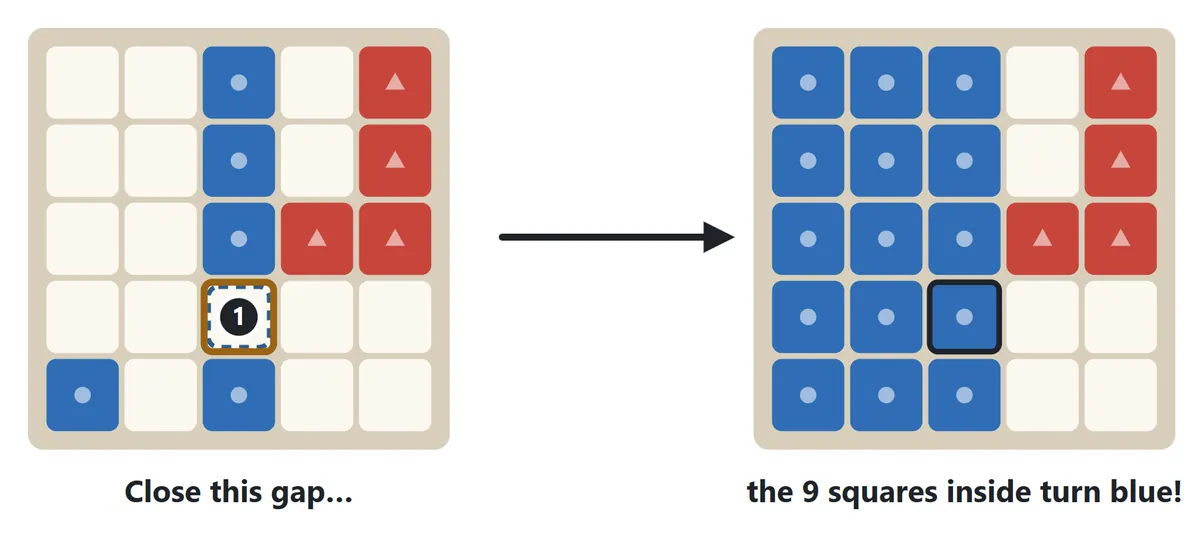
If you surround a group of empty squares with your own squares, the edge of the board and rocks, so that the group no longer touches any of your opponent's squares, the whole group becomes yours immediately. Your opponent could never reach those squares anyway, so the game hands them over at once and you can watch them fill with your color.
Empty squares that still touch both colors are contested, and the race for them continues. The board edge and the rocks are free walls: use them and you can fence in a large area with only a few squares.
How the game ends and who wins

The game ends as soon as Blue and Red have divided the board completely, so that no empty area touches both colors. Any remaining empty squares go to the player who enclosed them. Count your squares: more squares wins, and an equal count is a draw.
In rare cases an empty square may be boxed in by rocks and the board edge alone. Such a square touches neither color, belongs to nobody and is not counted.
Rule variations
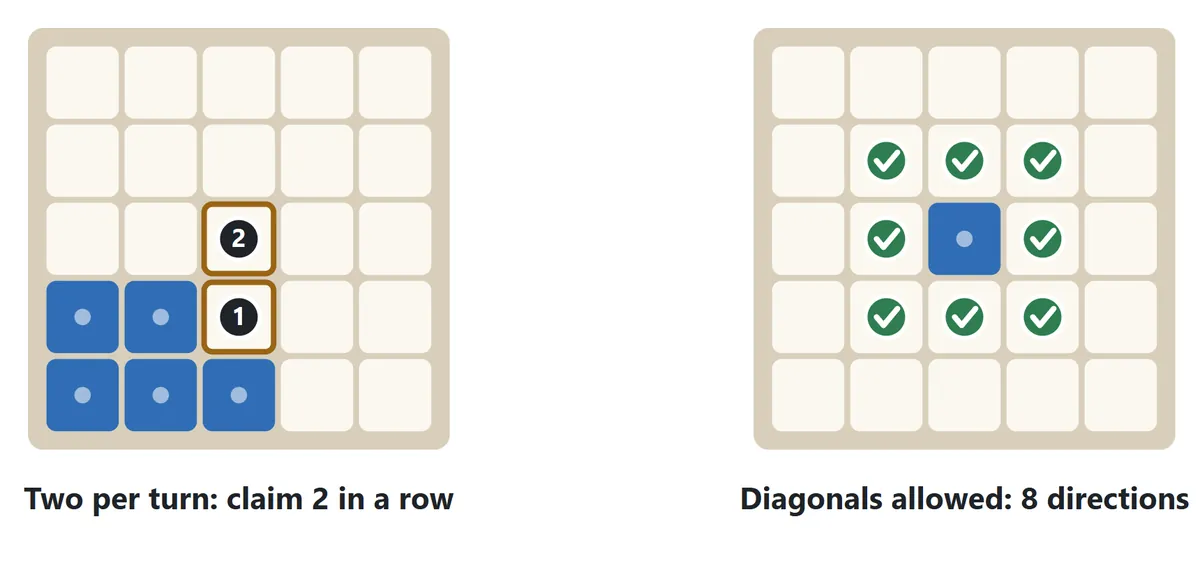
Territory games played with pencil and paper vary from group to group, so you can choose between three rule sets here:
| Rules | Squares per turn | Directions |
|---|---|---|
| Standard | 1 | 4 (no diagonals) |
| Two per turn | 2 (1 on the very first turn) | 4 (no diagonals) |
| Diagonals allowed | 1 | 8 |
With two per turn, you claim two squares in a row, and the second one may sit next to the first. To keep the first player from running away with the game, the very first turn of the game is only one square. Walls grow twice as fast, so the game becomes quicker and sharper. With diagonals allowed, both players can slip through diagonal gaps, so an enclosure only counts once the diagonal holes are plugged as well.
You can also pick the board size. A 7×7 board takes a few minutes and is a good place to learn; 11×11 leaves room for long walls and sneaky flanking moves. The daily board uses a rock layout fixed by the date, so everyone who plays on the same day gets the same board — a nice way to compare results with friends or family.
Territory game strategy: 6 tips
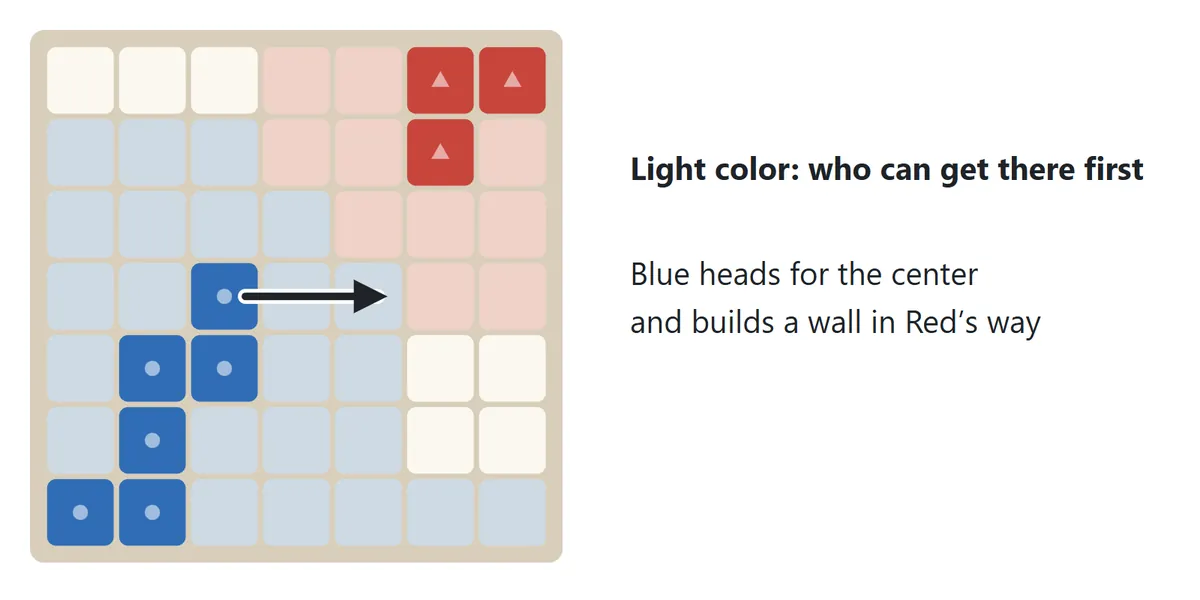
1. Race to the center
Early on, growing straight toward the middle of the board is worth far more than tidying up the squares around your corner. The area near your home is usually safe for later. Whoever reaches the center first gets to draw the line that splits the rest of the board.
2. Count the squares you reach first
For each empty square, ask who could get there sooner. If more squares are closer to you, you are ahead and simply need to seal the border. If fewer are, you need to get in front of your opponent and cut off their path before the border is fixed.
3. Block your opponent's path
A short wall placed right in front of your opponent's growing edge forces them to take the long way around. Making your opponent's paths narrow is just as valuable as widening your own.
4. Use the edge and the rocks as walls
An enclosure only needs to be closed by your squares, the board edge and rocks. Near the edge or next to a rock you can fence in a large region with very few moves. Gaps between rocks are natural choke points, so keep an eye on them from the start.
5. Never leave the last gap open
An area that is one square away from being enclosed is also your opponent's best way in. When the gap is down to a single square, close it before they slip through. And if your opponent leaves a gap in their wall, stepping into it can shrink their territory dramatically.
6. Build two-square walls in “Two per turn”
With two squares per turn, a gap two squares wide can be closed in a single turn, by you or by your opponent. Walls travel twice as fast, which makes the opening race to the center even more important.
Territory game FAQ
Can I take back my opponent's squares?
No. Once a square is claimed it belongs to that player until the end of the game. Only empty squares are ever fought over.
Is it better to go first?
Going first gives a small edge because you are always one square ahead in the race. When playing several games, alternate who starts or choose “Random”.
What happens if I have no square to claim?
That only happens once nothing is left to fight over, and at that moment the game is already over. Nobody ever has to skip a turn.
Which CPU level should I pick?
Easy often busies itself around its own corner and doesn't watch your moves very closely, which makes it a good first opponent. Normal heads for the center and tries to block you, but it slips up now and then. Hard reads a few moves ahead and goes after enclosures; beating it regularly means you have really understood the game.
Can I stop and continue later?
Yes. Open the page again on the same device and browser and press “Continue”. Sound is off by default; press “Sound: off” to hear a soft tap each time a square is claimed.
Where territory games come from
In Japan, “jintori” (literally “taking the camp”) is an old name for children's games about capturing territory. The oldest form is played outdoors: two teams each pick a tree or a post as their camp and try to seize the other side's camp, tagging opponents they meet along the way. In another playground version, players race along a winding path drawn in the dirt and play rock-paper-scissors whenever they meet; the winner keeps going and the first to reach the other team's camp wins.
There are pencil-and-paper versions too. In one, players draw dots on a sheet, take turns joining two dots with a line, and claim every triangle they close. The better-known cousin on a grid of dots, where you claim the little boxes you complete, is also played all over the world.
Today the word is also used for any game where the goal is to make your own territory as large as possible. The grid game on this page belongs to that family: grow, block and enclose. Go, the ancient board game of surrounding territory with stones, shares the same basic idea of counting the area you have fenced in.