 Yorimichi Games
How to Play Hex
Hex is a two-player connection game played on a diamond-shaped board made of hexagonal cells. One player is Red and the other is Blue. You take turns placing one stone of your color on any empty cell, and the first player to build an unbroken chain of stones between their two sides of the board wins. Nothing is ever captured or moved, and there are no special cases to memorize – the whole rulebook fits in a few sentences. Yet every stone you place does two jobs at once: it extends your own path and it gets in the way of your opponent’s. That tension is what makes Hex one of the most elegant abstract strategy games ever designed, and it is also why a game of Hex can never end in a draw.
The board and how to place stones
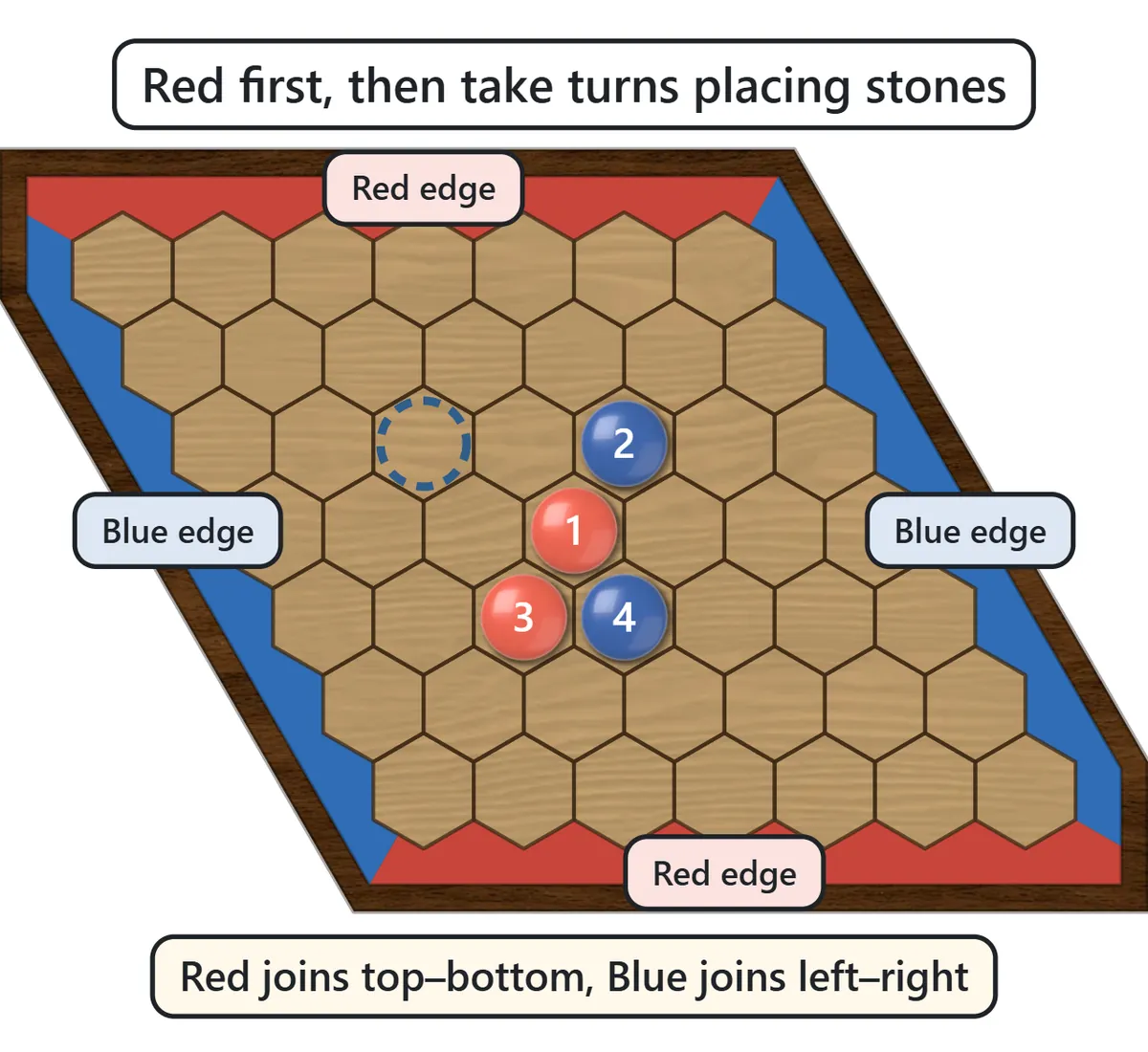
Each of the four edges of the board has a color. The top and bottom edges are red; the left and right edges are blue. Red’s goal is to join the top edge to the bottom edge, and Blue’s goal is to join the left edge to the right edge. The four corner cells belong to both a red edge and a blue edge, so either player can use them.
Red always moves first. On your turn, choose any empty cell and place one stone there. There are no restrictions on where you can play, and once a stone is on the board it stays there for the rest of the game – it is never moved, flipped or removed. You also cannot pass. In this game you can pick a board size of 7×7, 9×9, 11×11 or 13×13. If you are new to Hex, start with 7×7: a game takes only a few minutes and you will quickly get a feel for how paths form and how they get blocked.
Every cell has six neighbors
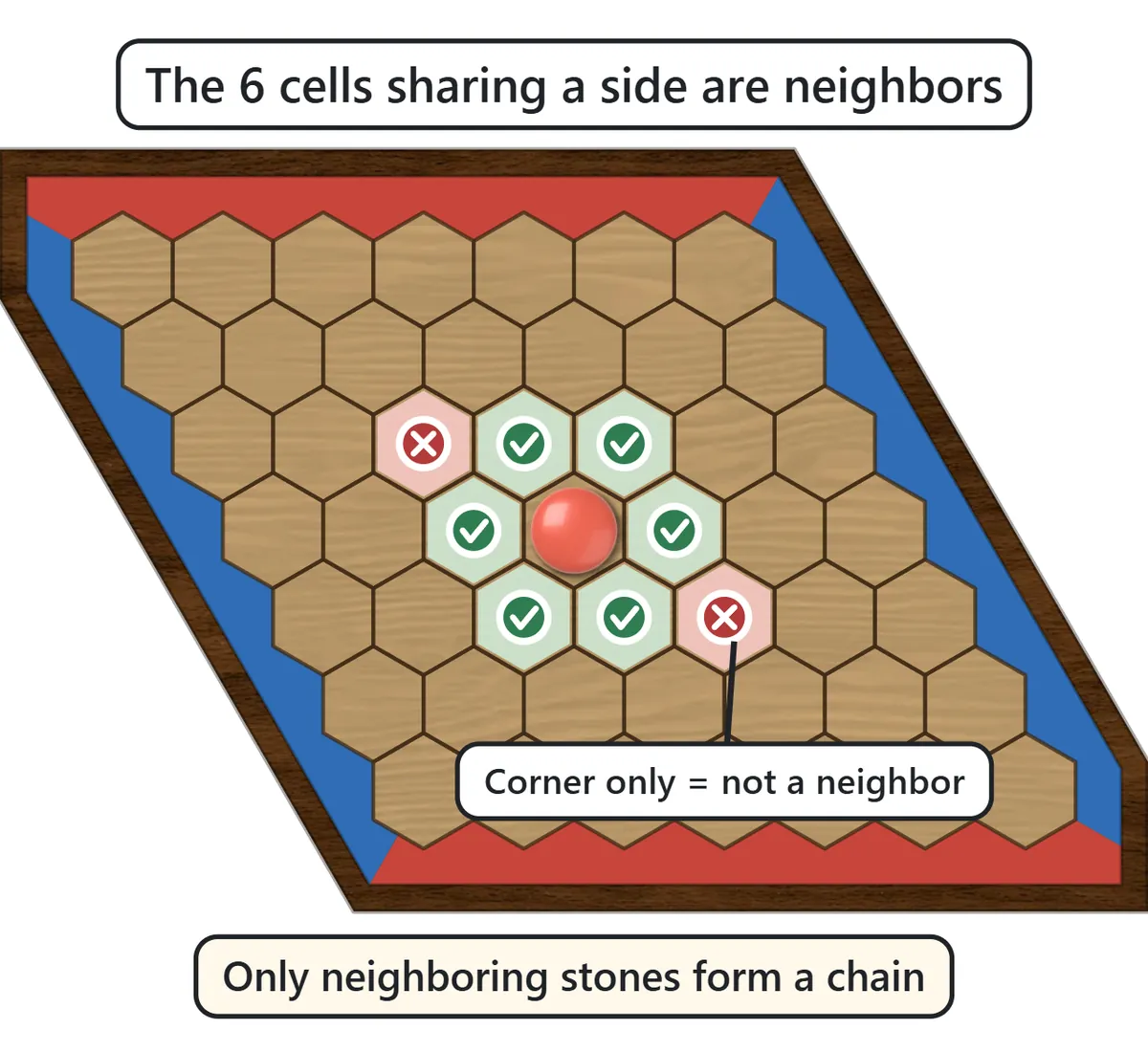
A hexagonal cell shares a side with six other cells. Stones on neighboring cells are connected, and a chain of connected stones is what forms your path. Unlike games played on a square grid, there is no such thing as a “diagonal” connection in Hex: two hexagons either share a whole side or they don’t touch at all. That makes it very easy to see whether two stones are linked. Cells along the edge of the board simply have fewer neighbors.
Connect your two sides to win
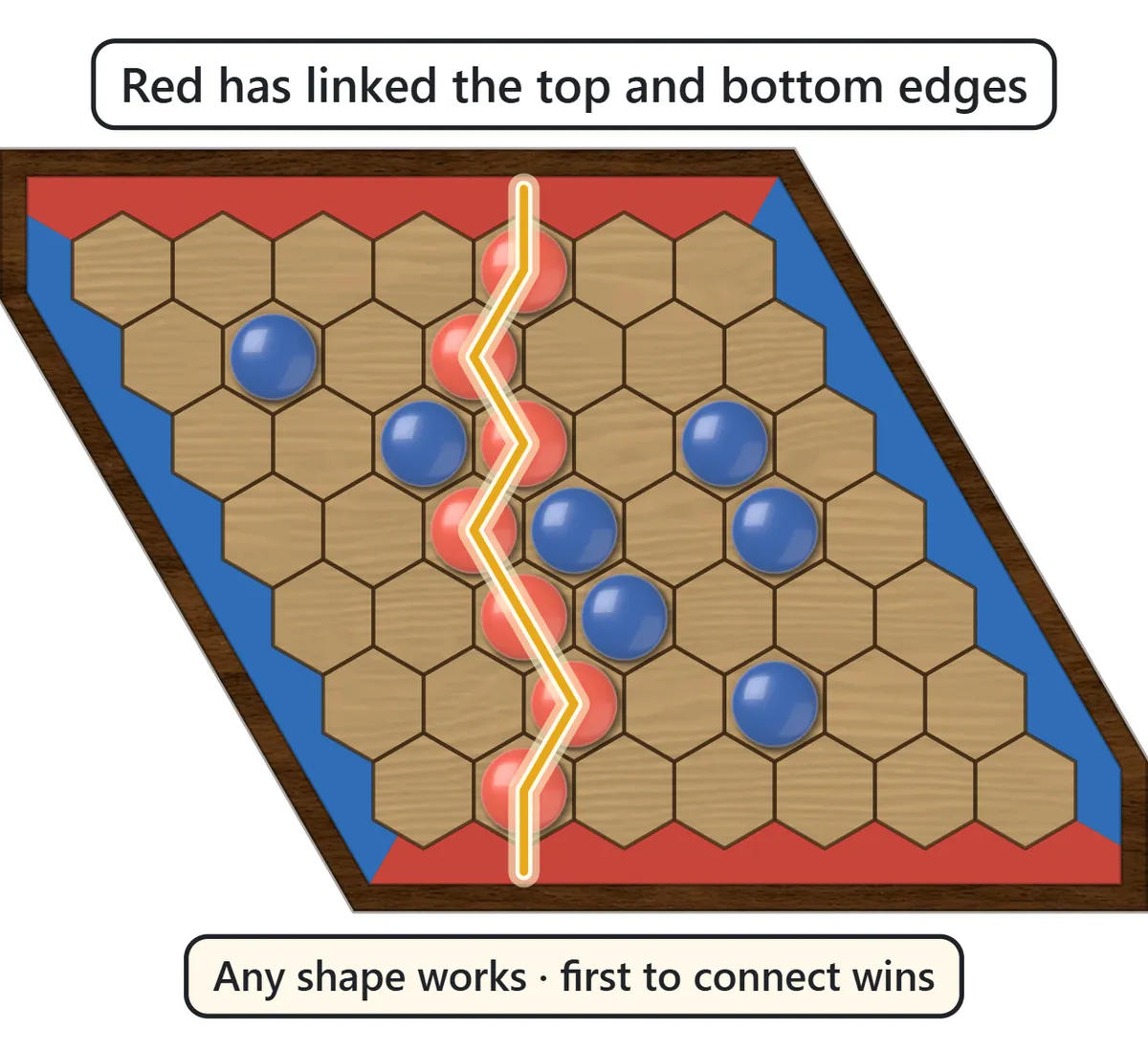
As soon as a chain of your stones touches both of your edges, you win on the spot. The path does not need to be straight; it can bend, zigzag and double back as much as you like. Extra stones that are not part of the winning chain do not matter. In this game the winning path lights up with a glowing line so you can see exactly how the connection was made.
Why Hex never ends in a draw
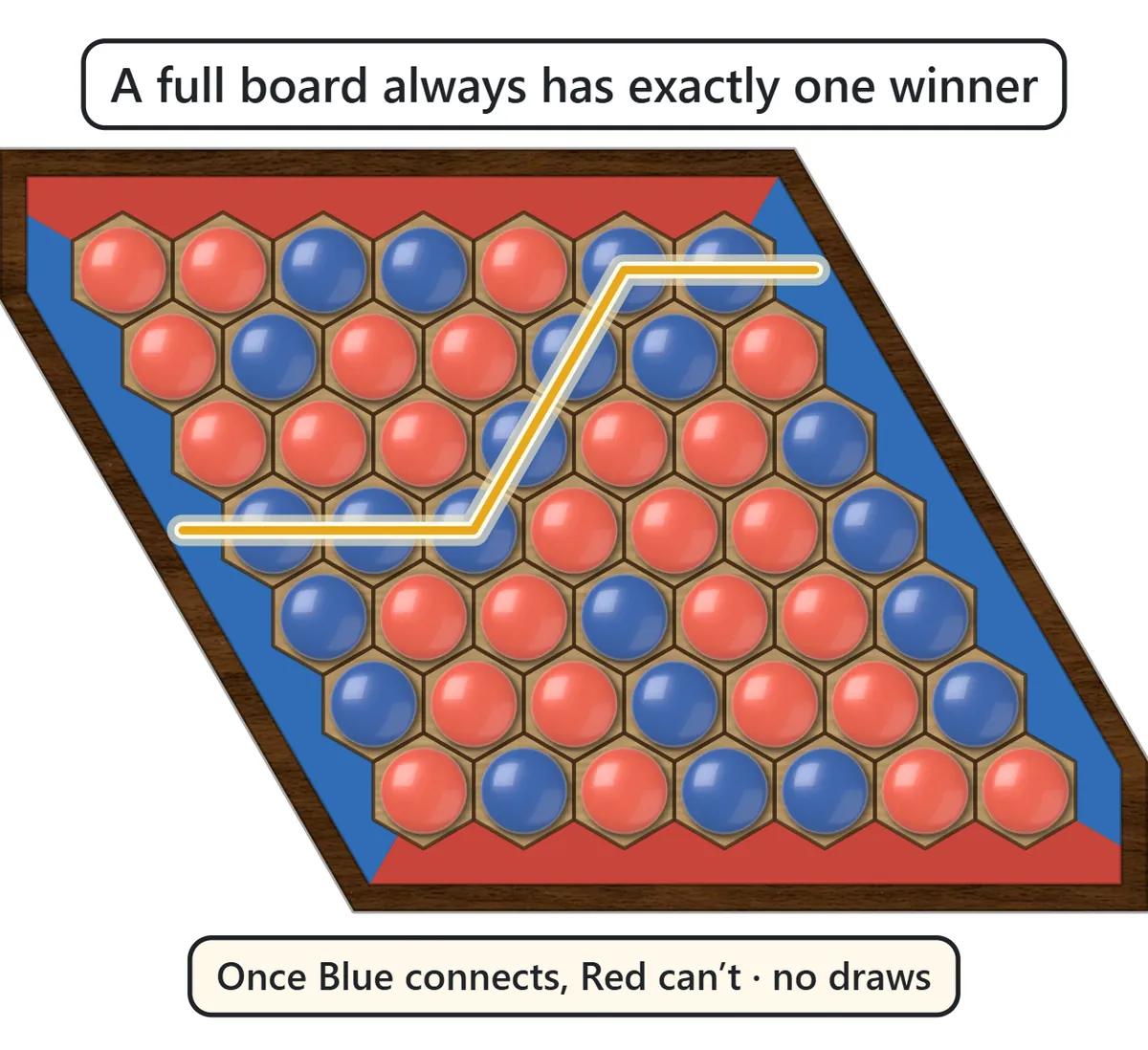
One of the most famous facts about Hex is that a draw is impossible. The only way for Blue to stop Red from joining top and bottom is to build a wall that stretches from the left edge to the right edge – and that wall is exactly a winning chain for Blue. So if you filled every cell on the board, one player (and only one) would always be connected. In practice you never get that far: games are decided long before the board is full.
The Swap Rule (Pie Rule) and Other Hex Rule Variations
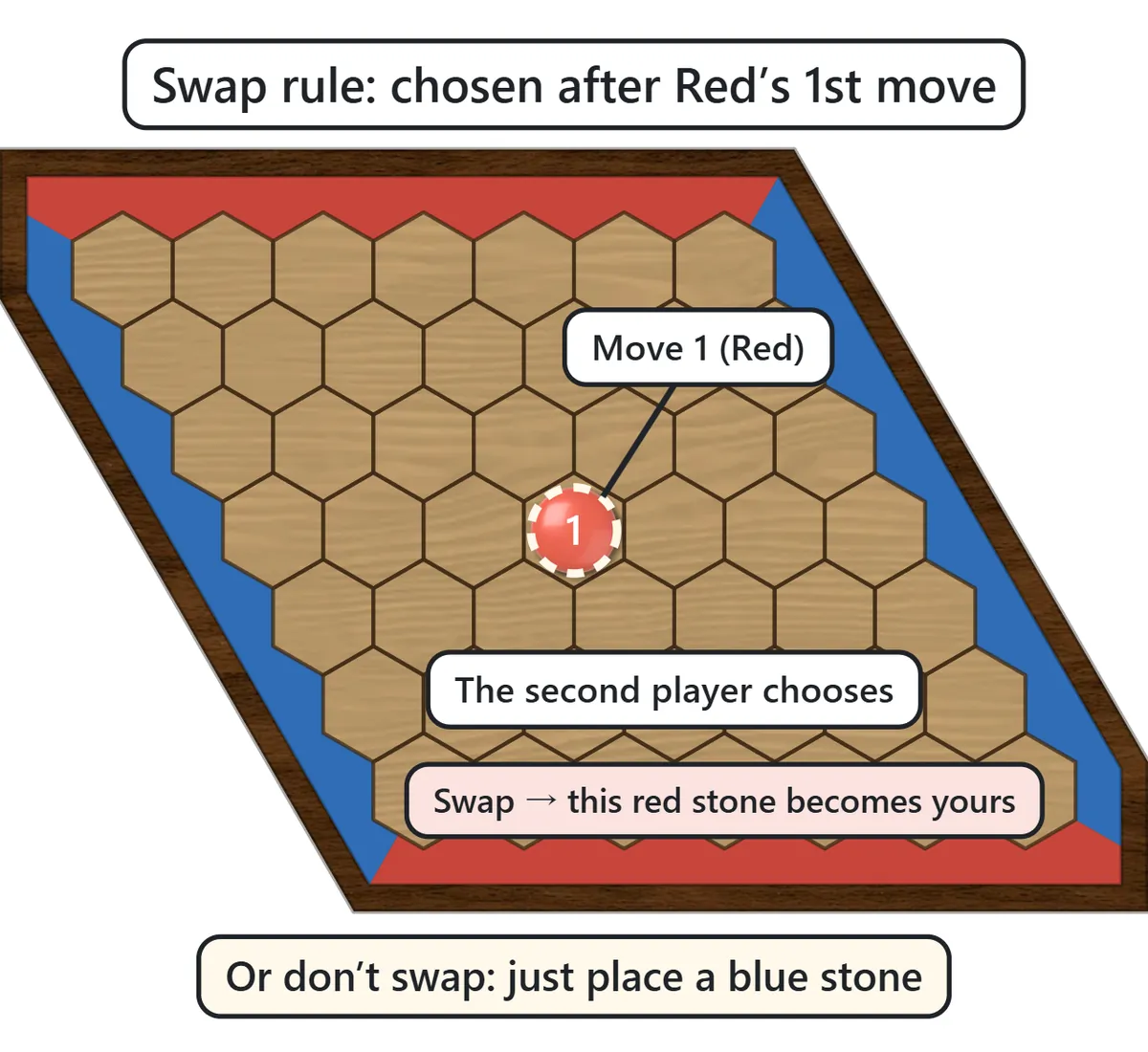
Moving first is a big advantage in Hex. A first stone in the middle of the board is so strong that a good player can often ride it all the way to victory. To balance this, most players use the swap rule, also called the pie rule. After Red places the very first stone, the second player chooses one of two options:
- Swap: the players trade colors. The first red stone now belongs to the player who was going second, and the original first player continues as Blue with the second move.
- Don’t swap: simply place a blue stone and carry on as normal.
Because a first move that is too strong will just be taken away, the first player has to look for an opening that is “fair” – good enough that it is not a disaster if it stays yours, but not so good that your opponent will grab it. It is the same idea as one person cutting a cake and the other choosing a slice, which is where the name “pie rule” comes from. In this game you can swap only on the second player’s first turn, using the “Swap” button.
| Option | Board · swap | Good for |
|---|---|---|
| Standard | 11×11 · swap | The most common way to play |
| No swap | 11×11 · no swap | Seeing how strong the first move is |
| Small board | 7×7 · swap | Beginners and quick games |
| Medium | 9×9 · swap | A slightly shorter game |
| Large board | 13×13 · swap | Long, deep games |
Choose “Custom” to combine any board size with the swap rule turned on or off. Competitive Hex is usually played on 11×11, 13×13 or even 19×19 boards; smaller boards are great for learning because every mistake shows up quickly.
Hex Strategy: 6 Tips to Win
1. Play near the center
The center of the board is the best place to reach in every direction, which makes it the strongest place to start. Without the swap rule, a center opening is the best first move. With the swap rule, though, a center stone will almost certainly be swapped, so experienced players open a little away from the middle – for example near an edge, or near one of the obtuse corners (top right and bottom left) – to make an opening that is harder to judge.
2. Use bridges to move two cells at a time
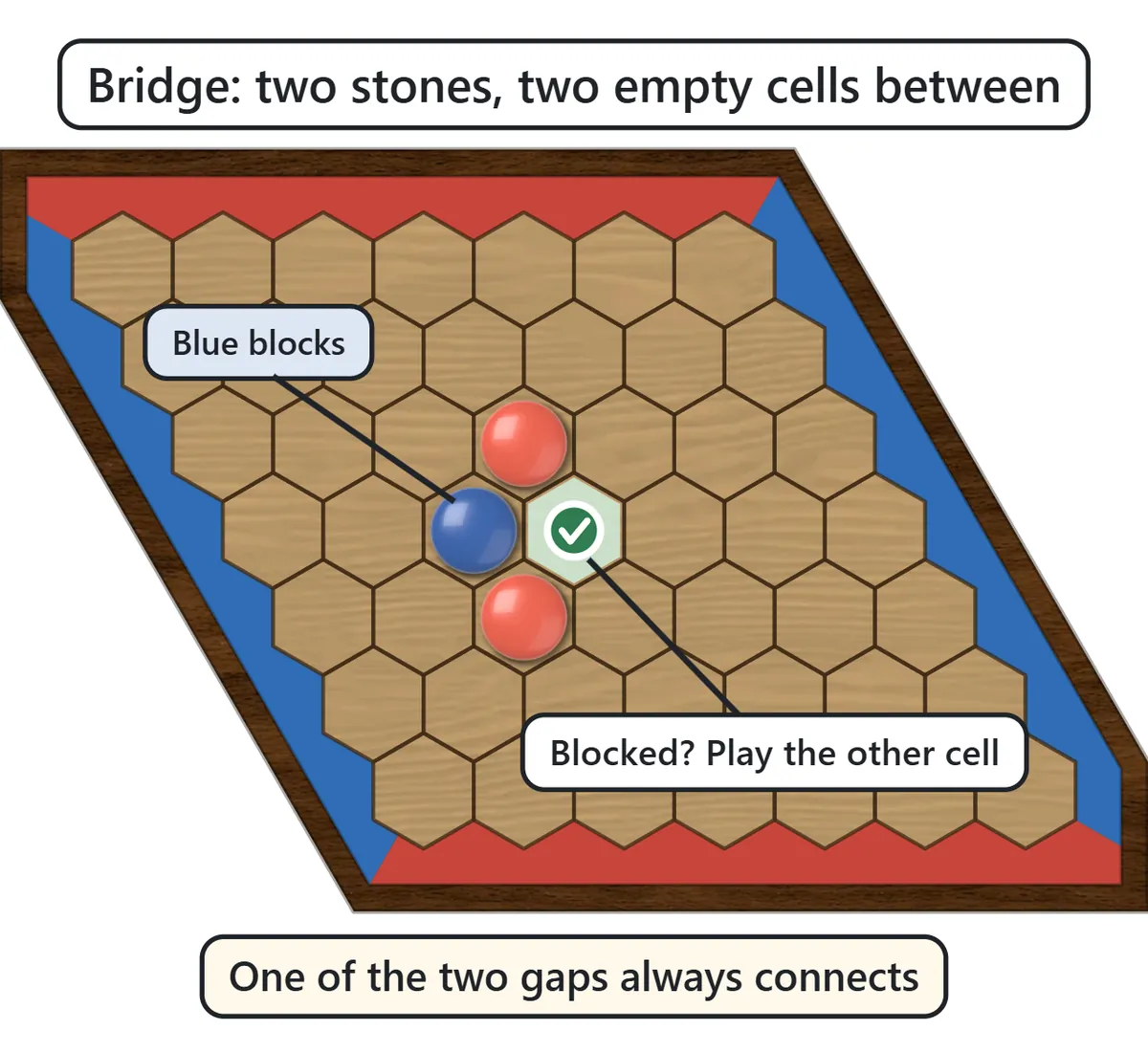
Placing stones right next to each other builds a path very slowly. The key shape in Hex is the bridge (also called the two-bridge): two of your stones with exactly two empty cells between them. If your opponent plays in one of those cells, you play in the other, and your stones are connected anyway. A bridge lets you advance two rows with a single move while staying safely linked, so strong Hex players build their paths almost entirely out of bridges.
3. You don’t have to touch the edge
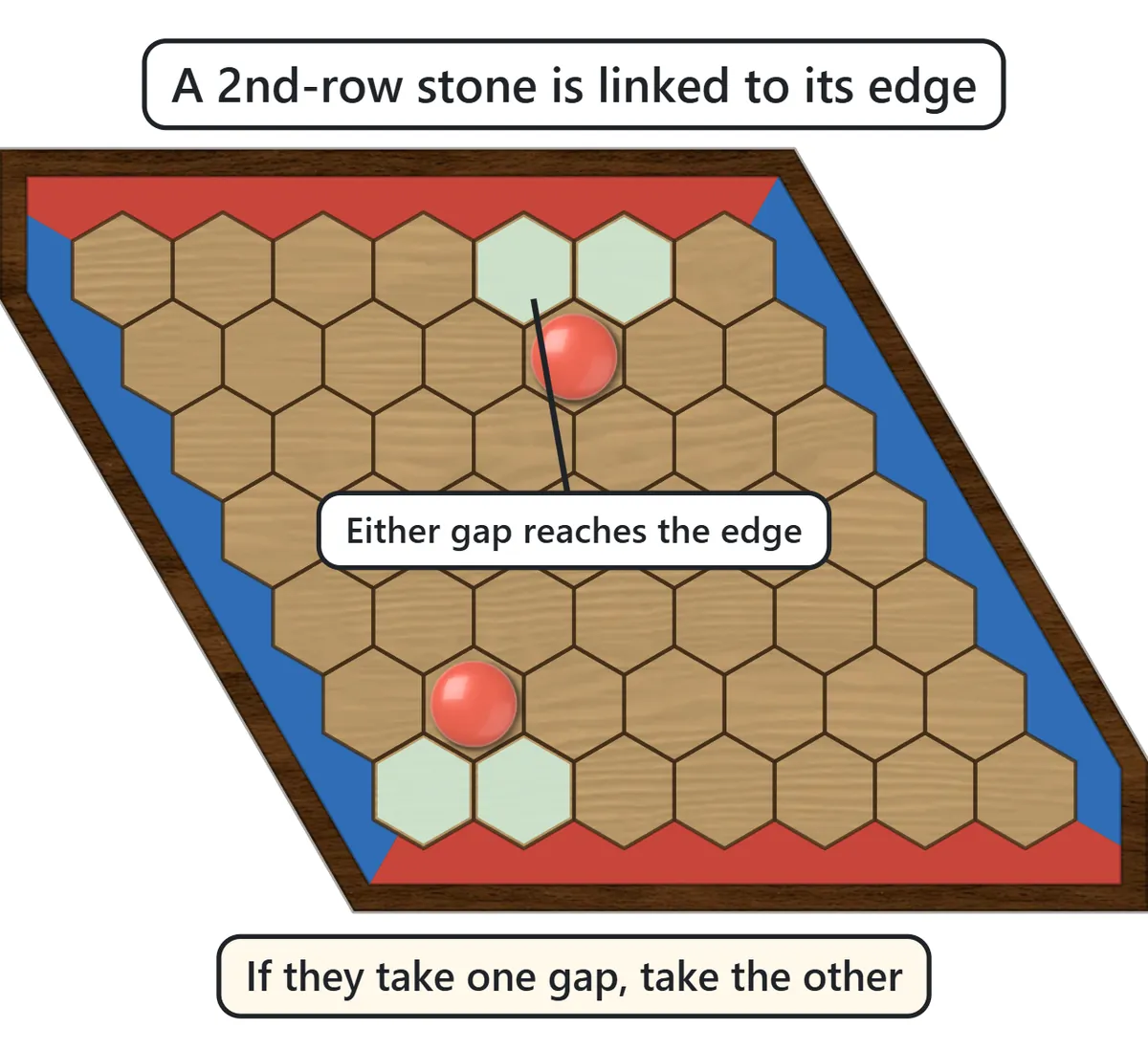
A stone on the second row from your edge has two empty cells between it and the edge, so it works just like a bridge: if your opponent takes one, you take the other. There is no need to rush and fill in that last row. Instead, spend your moves on the weak links in the middle of your path. Advanced players study larger “edge templates” that guarantee a connection from the third or fourth row as well.
4. Block from a distance
Playing right in front of your opponent’s stone rarely stops it – they simply step around your blocker. It is much more effective to block a little further ahead, leaving a gap in the direction your opponent wants to go. And remember the beauty of Hex: a wall that blocks your opponent is also a path for you. Look for moves that stop your opponent and extend your own chain at the same time.
5. Don’t play inside your opponent’s bridges
Placing a stone in the middle of your opponent’s bridge just invites them to play the other cell, and you have wasted a move. If you want to cut your opponent off, aim at the ends of their bridges or at links that are not yet protected by a bridge.
6. Knowing when to swap
When you are the second player and the swap rule is on, swap if the first stone is close to the center. On the other hand, a first stone right on Red’s own edge (the top or bottom row) is weak, so leave it and play your own move. If you are not sure, press “Hint” to see what the Hard CPU would do.
Hex Game FAQ
Does the first player have an advantage in Hex?
Yes. Without the swap rule, Red (the first player) has a large advantage. In fact, it has been proven mathematically that the first player can always win on a board of any size with perfect play – but nobody knows what that winning strategy actually is on large boards. With the swap rule turned on, the advantage almost disappears.
Can a game of Hex end in a draw?
No. If every cell were filled, exactly one player’s chain would be connected. A game can never get stuck either, since there is always an empty cell to play until someone wins, so every game of Hex has a winner.
Which CPU level should I choose?
If you are new to Hex, try Easy on the 7×7 board. The Easy CPU often doesn’t look closely at the board and may miss that you are one move away from connecting. Normal is better at joining and blocking paths and makes fewer mistakes. Hard only slips up occasionally, so use bridges to go around its stones and aim for positions where you can connect in two different ways. If you can beat the Hard CPU on 11×11, you are a strong player.
What happens when I press “Swap”?
You and your opponent trade colors. The first red stone becomes yours, and you are now Red, trying to connect top and bottom. Your opponent becomes Blue and plays the second move. The name tags and the turn display switch as well, so you can always check which color you are at the top of the game screen.
Can I undo a move or get a hint?
Yes. Set “Undo” to On and the Undo button takes back your last move (together with the CPU’s reply). Press “Hint” and a dashed blue ring shows where the game would play after thinking it over carefully. The number of hints and undos you used is shown on the result screen.
The cells are small on my phone. What can I do?
Turn on “Confirm before placing” (it is on by default on phones and tablets). Your first tap shows a faded stone; check that it is in the right place, then tap the same cell again or press “Place here”. The 7×7 and 9×9 boards also have bigger cells. If you stop in the middle of a game, you can pick it up again later with “Continue” on the same device and browser.
What board size is best?
7×7 is ideal for learning the rules and trying out bridges. 9×9 gives you room for real strategy while staying short. 11×11 is the classic size used by most players and in computer Hex tournaments, and 13×13 is for long, patient games where planning several bridges ahead really pays off.
History of Hex: Piet Hein, John Nash and the “Nash” Game
Hex was invented by the Danish mathematician and poet Piet Hein, who introduced it in a Danish newspaper in 1942 under the name “Polygon”. A few years later, around 1948, the mathematician John Nash – later the subject of the film A Beautiful Mind – came up with the same game independently at Princeton University, where students played it and called it “Nash”. In 1952 the game was sold commercially under the name “Hex”, and that name stuck. Because it is easy to prove that Hex cannot end in a draw and that the first player can always win with perfect play, Hex became a favorite of mathematicians and computer scientists, and it is still used today in research on game theory and artificial intelligence.