 Yorimichi Games
How to play Hearts
Hearts is a trick-taking card game for four players. Everyone plays one card in turn, and whoever plays the highest card of the suit that was led wins all four cards. In most card games you want to win tricks. In Hearts it’s the opposite: every heart you take counts 1 point against you, and the queen of spades (♠Q) counts 13. The game goes on for several hands, and when someone reaches 100 points, the player with the lowest score wins.
That upside-down goal is what makes Hearts so much fun. High cards are dangerous because they win tricks you don’t want; low cards are your escape routes. Here you play against three computer players, so you can start a game any time and learn at your own pace.
The table

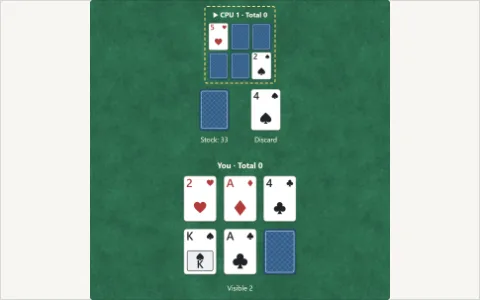
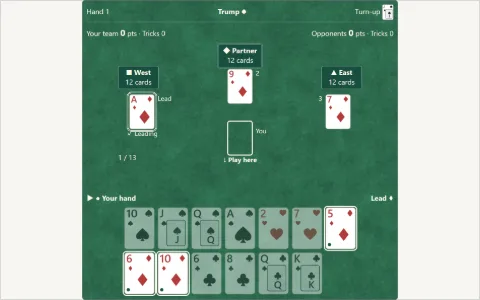
All 52 cards are dealt, 13 to each player; there are no jokers. Aces are high, followed by K, Q, J, 10 and so on down to 2. There is no trump suit: a card of another suit never beats the suit that was led.
Hearts rules
Pass three cards
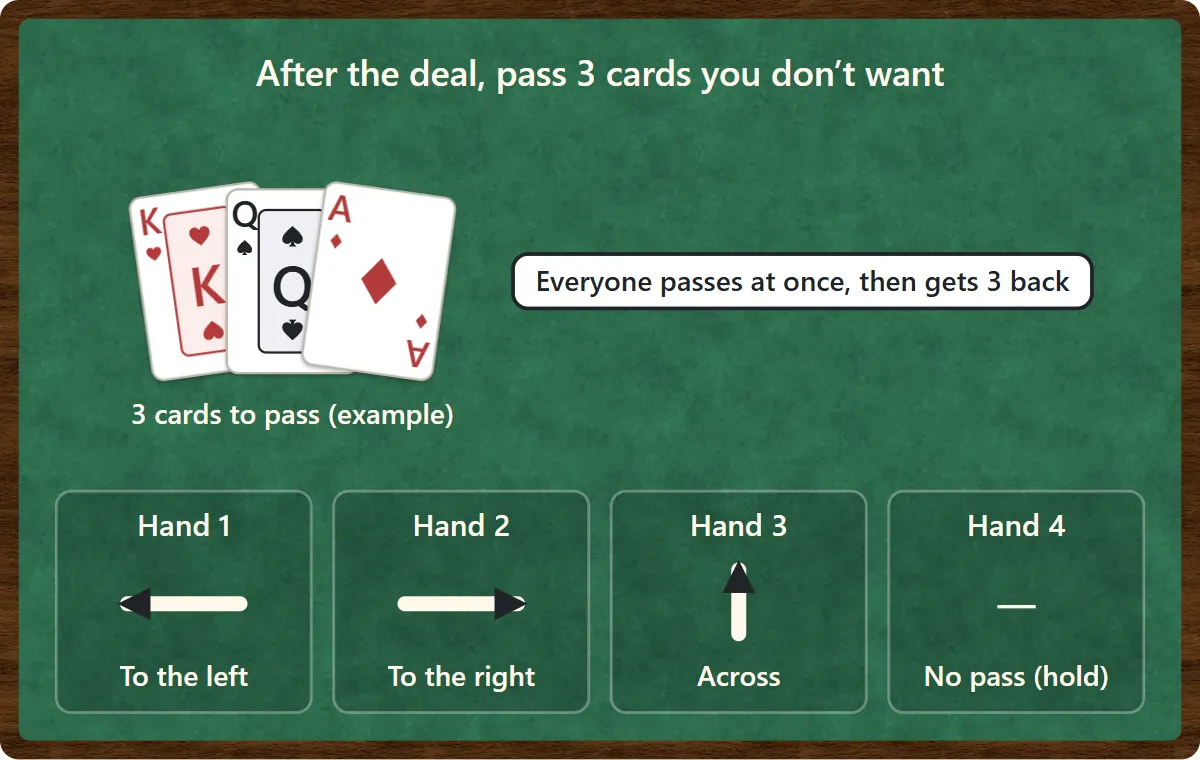
After the deal, each player chooses three cards to pass to another player. Everyone passes at the same time, so you also receive three cards from someone else. On the first hand you pass to the left, on the second to the right, and on the third across the table. The fourth hand is a “hold” hand with no passing, and then the cycle starts again. The cards you receive are shown with a blue frame so you can spot them.
Lead the ♣2 and follow suit
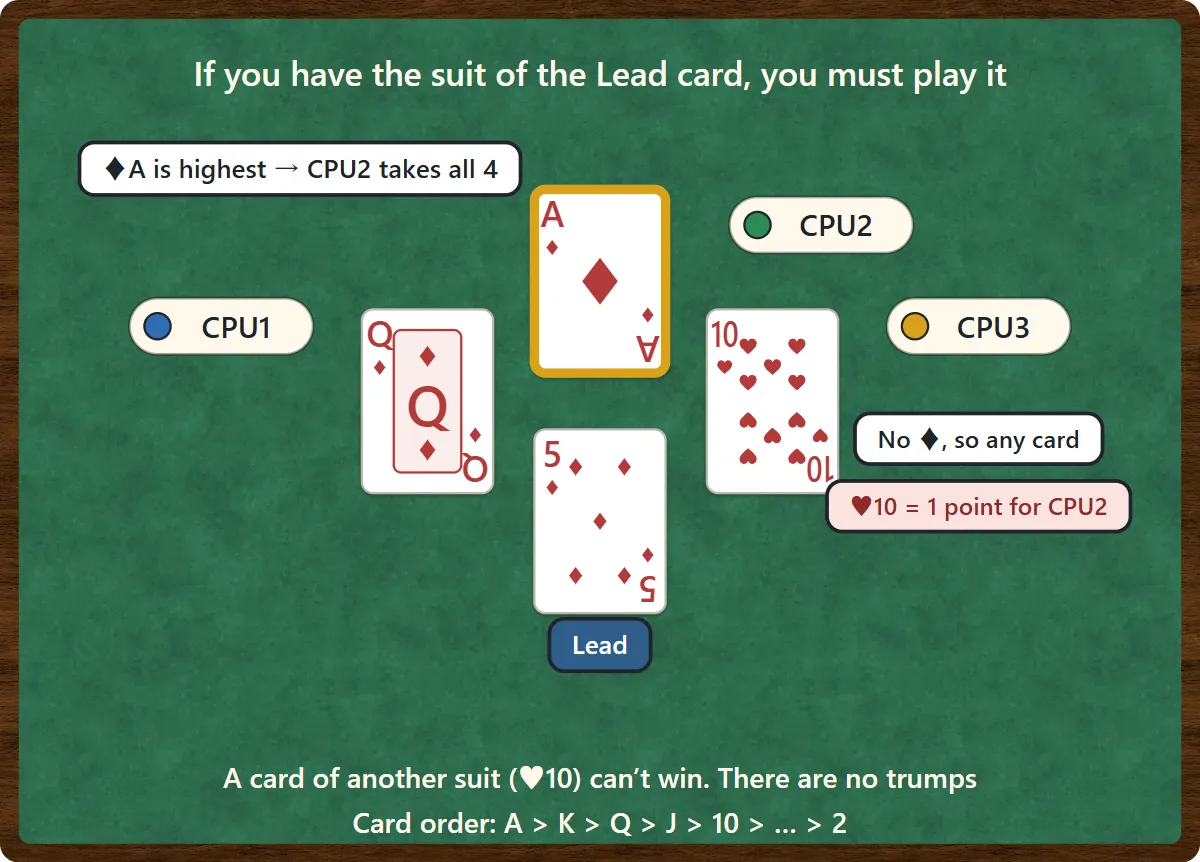
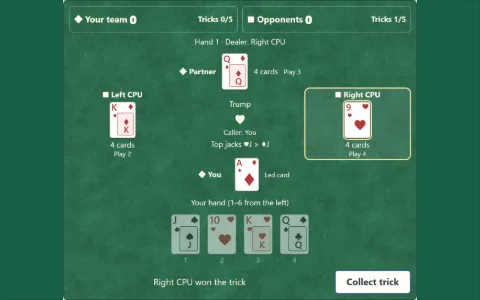
The player holding the two of clubs leads it to start the first trick. Play continues clockwise. If you have a card of the suit that was led (the “Lead” card), you must play that suit. Only when you have none of that suit may you play any other card. When all four cards are down, the highest card of the led suit wins the trick, and the winner leads the next one. A card of a different suit can never win, however high it is. After thirteen tricks, everyone counts the points in the cards they took.
Breaking hearts
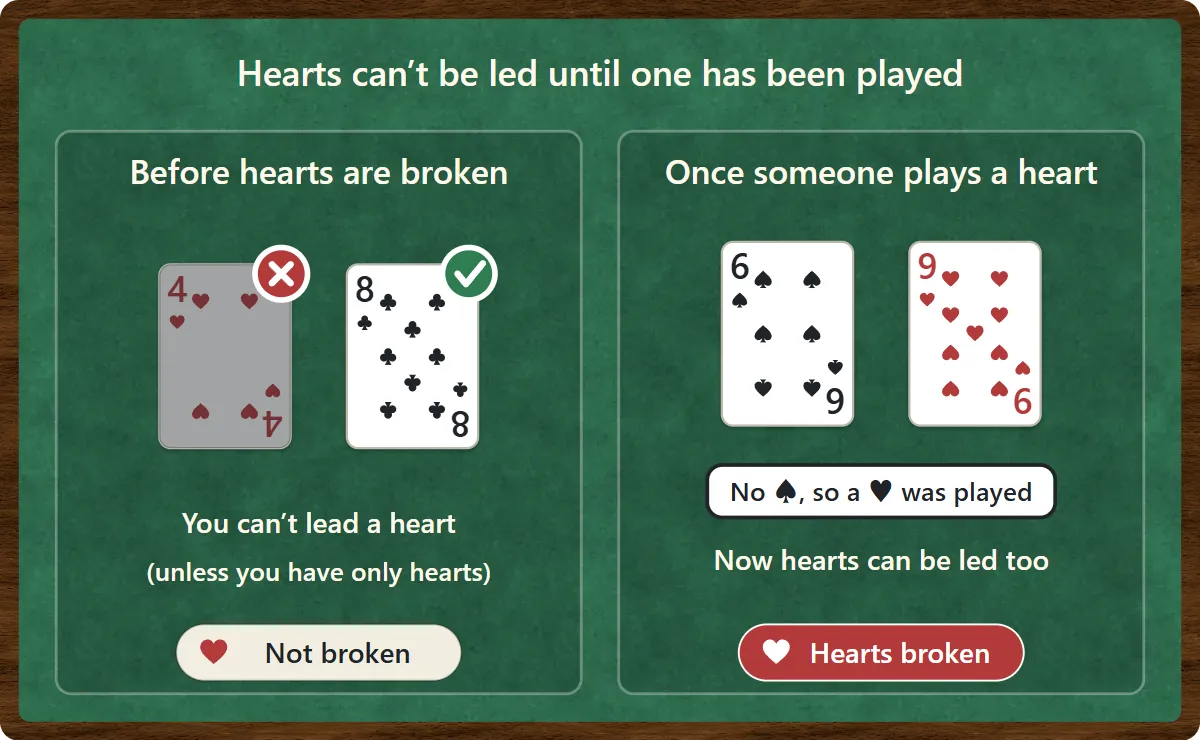
You can’t lead a heart until a heart has been played on an earlier trick. When someone who can’t follow suit discards a heart, hearts are broken, and from then on anyone may lead them. If your hand contains nothing but hearts, you may lead one even before they are broken. In the standard rules there is one more safeguard: no hearts and no queen of spades on the first trick, unless you hold nothing but point cards.
Hearts scoring and shooting the moon
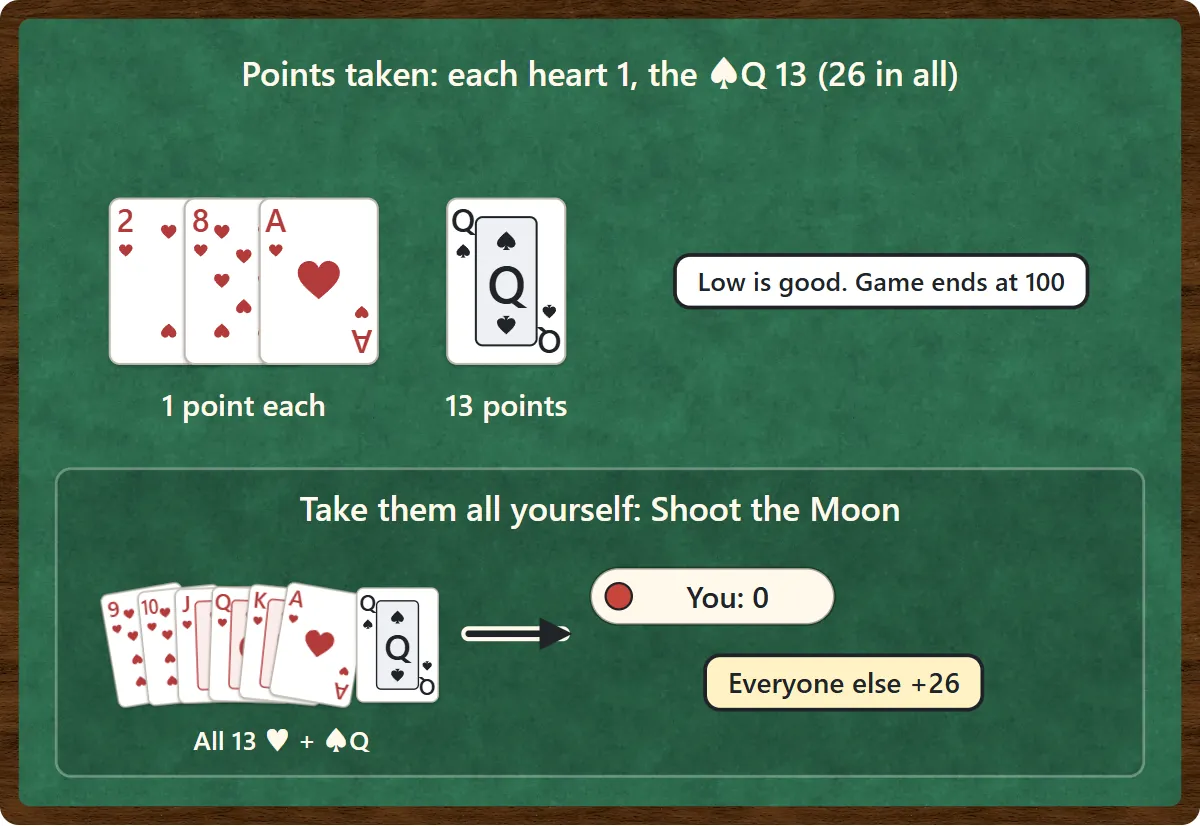
At the end of each hand, every heart you took is worth 1 point and the queen of spades is worth 13, so each hand has 26 points in play. But if one player takes all 13 hearts and the queen of spades, they have shot the moon: they score 0 and each of the other three players gets 26 points instead. It’s a big gamble, because a single heart taken by someone else turns the attempt into a disaster. Hands continue until someone reaches 100 points. The lowest score wins, and if the lowest scores are tied, one more hand is dealt to break the tie.
House rules you can choose
| Rule | Standard | Other options (Custom) |
|---|---|---|
| Passing | Left, right, across, hold | Left, right, across · always left · no passing |
| First lead | Holder of the ♣2 | Player left of the dealer, any card but a heart |
| Breaking hearts | On (no heart leads until broken) | Off · the ♠Q also breaks hearts |
| First trick | No hearts or ♠Q | Anything allowed |
| Shooting the moon | Others get 26 each | Subtract 26 from yourself · off |
| Game length | 100 points | 50 points |
Hearts has been played for a long time, and families and clubs often have their own house rules. If yours differ from the standard ones, switch to Custom and set them one by one.
Hearts strategy: tips to win more often
1. Pass the ♠Q, ♠A and ♠K when your spades are short
If you hold the queen, king or ace of spades with only one or two other spades, you’re likely to get stuck with the queen. Those cards are the first ones to think about passing. With plenty of low spades (jack and below), though, you can often keep the queen safely and wait for a chance to drop it.
2. Void a suit
If you have only one or two clubs or diamonds, consider passing them away. Once you have no cards of a suit, you can discard the queen of spades or high hearts whenever that suit is led. A void is one of the strongest weapons in Hearts.
3. Treasure your low cards
Twos, threes and fours rarely win a trick, which makes them safe exits. Save a few for the end of the hand, when you need to get out of the lead without taking points. Don’t burn them all early.
4. Duck just under the winning card
When you must follow suit, play the highest card that still loses. If a king is winning, play your queen; if a 10 is winning, play your 9. That gets rid of a dangerous high card without taking the trick.
5. Flush out the queen of spades
If you don’t hold the ♠Q, ♠K or ♠A, leading low spades forces the queen out sooner or later, and it won’t land on you. If you do hold the queen, wait for a trick where the ace or king of spades is already winning, or for a suit you are void in, and drop her there.
6. Watch for a moon shot
If one player has taken lots of hearts while everyone else has none, they may be trying to shoot the moon. Taking even one heart yourself stops them, and a single point is far better than 26.
Hearts FAQ
Can I play a different suit if I have the suit that was led?
No. If you can follow suit, you must. In this game, cards you can’t play are dimmed, and tapping one tells you why.
Why can’t I play a heart on the first trick?
The first trick starts with the two of clubs, and this rule stops a player who has no clubs from dumping hearts or the queen of spades straight away. If your hand is nothing but hearts and the queen, you may play them. Some house rules don’t use this restriction, and you can turn it off under Custom.
When should I try to shoot the moon?
Only when you hold a lot of high hearts plus aces and kings, and you are confident you can keep winning tricks until the end. If another player takes just one heart, the attempt fails and you’re left holding a pile of points. While you’re learning, it’s usually wiser not to try.
Which difficulty should I choose?
If you’re new to Hearts, start with Easy. The computer players often play low cards and don’t try hard to dodge, so you can learn the rules as you go. Normal players know the basics: they get rid of the queen of spades early and duck under winning cards. Hard players keep track of which cards are still out and choose the plays that cause you the most trouble.
Can I stop and continue later?
Yes. If you close the page in the middle of a game, press Continue next time you open it on the same device and browser. Your game and records are stored only in that browser. Sound is off to start with; press “Sound: off” to turn it on.
Where Hearts comes from
Hearts is usually traced back to Reversis, an old European game in which players tried to avoid taking tricks. A game close to modern Hearts took shape in the United States toward the end of the 19th century, and at first only the hearts counted as penalty cards. Later, the queen of spades was added as a 13-point card; that version was often called Black Lady, and it has since become the standard form of the game. Passing three cards and shooting the moon were added along the way. Many people first met Hearts as a game bundled with their computer, and it remains one of the best-loved card games for four players.