 Yorimichi Games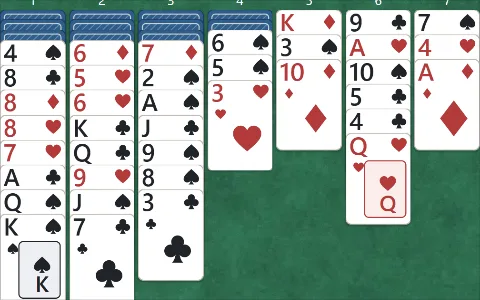
How to play Golf Solitaire
Golf Solitaire is a one-player card game played with a standard 52-card deck (no jokers). You deal 35 cards face up into seven columns and try to move every one of them onto a single pile, the foundation, by playing a card that is one higher or one lower than the top card. The rules fit in a sentence, yet the order in which you take the cards decides almost everything, which is what makes Golf such a satisfying puzzle.
The layout
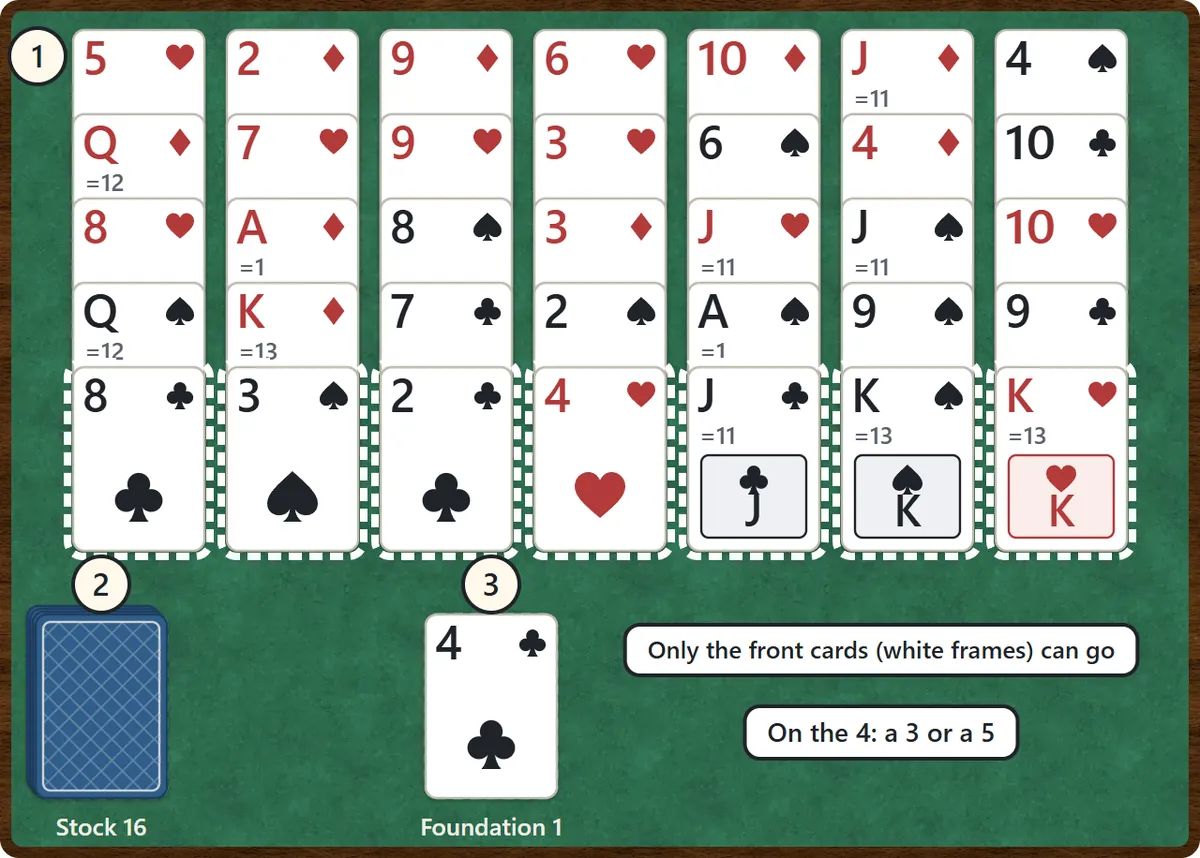
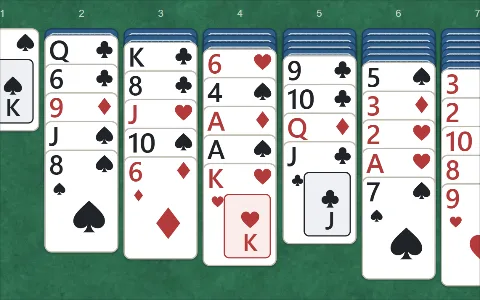
Shuffle the deck and deal seven columns of five cards each, all face up, overlapping so that you can see every card. That uses 35 cards. The remaining 17 cards form the face-down stock. Turn the top card of the stock face up to start the foundation, leaving 16 cards in the stock. Everything you do from here on is about moving column cards onto that foundation pile. Move all 35 and you win.
Golf Solitaire rules: one higher or one lower
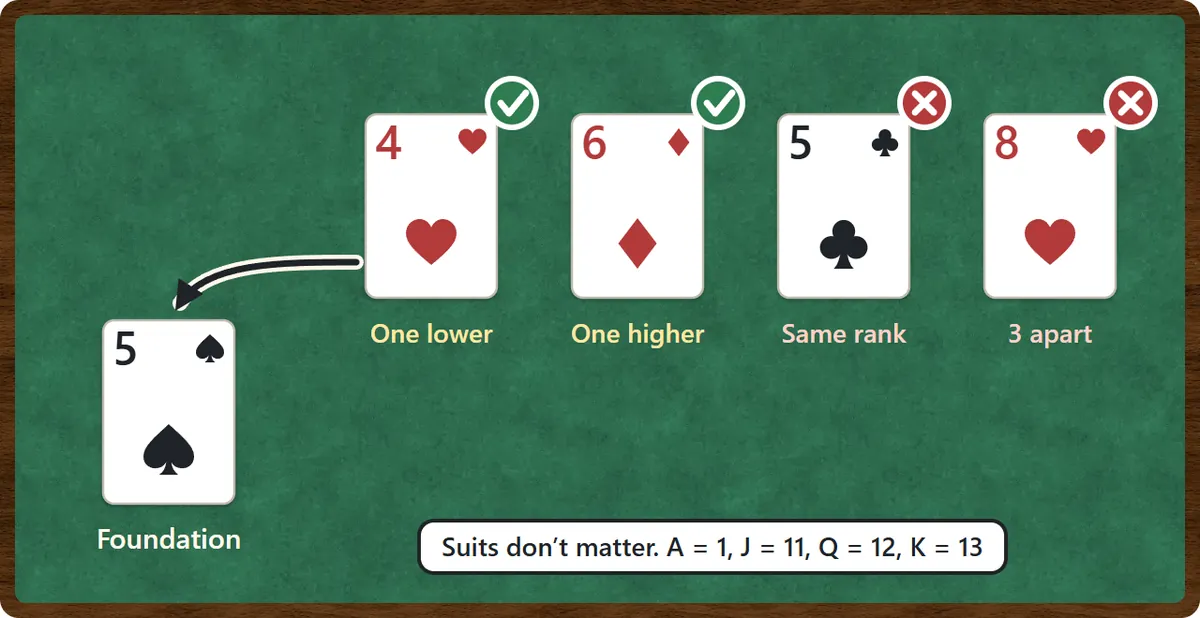
A card from a column can go on the foundation only if its rank is exactly one above or one below the foundation’s top card. On a 5 you can play a 4 or a 6; on a 10 you can play a 9 or a jack. Suits and colors are ignored completely. You can’t play a card of the same rank, and you can’t skip ranks. For counting, an ace is 1, a jack is 11, a queen is 12 and a king is 13.
Build long chains up and down
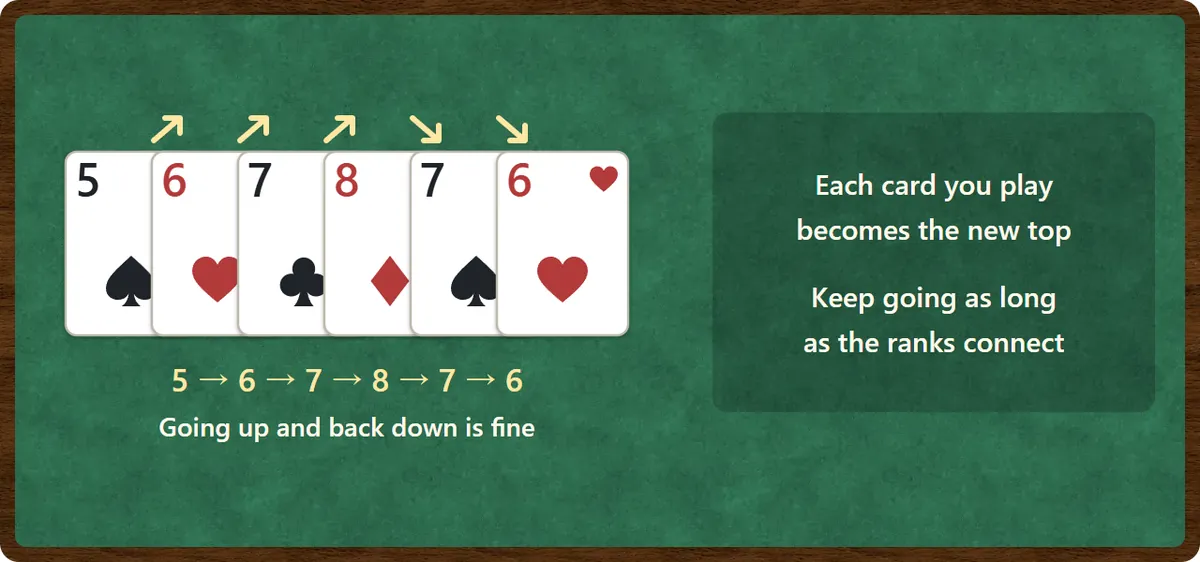
Every card you play becomes the new top of the foundation, so you immediately look for a card one step away from it. You are free to change direction whenever you like: 5, 6, 7, 8 and then 7, 6 is a perfectly legal run. The longer the chain, the more cards leave the columns in one go. A good game of Golf is really a handful of long chains separated by a few trips to the stock.
Only the front card of a column is available
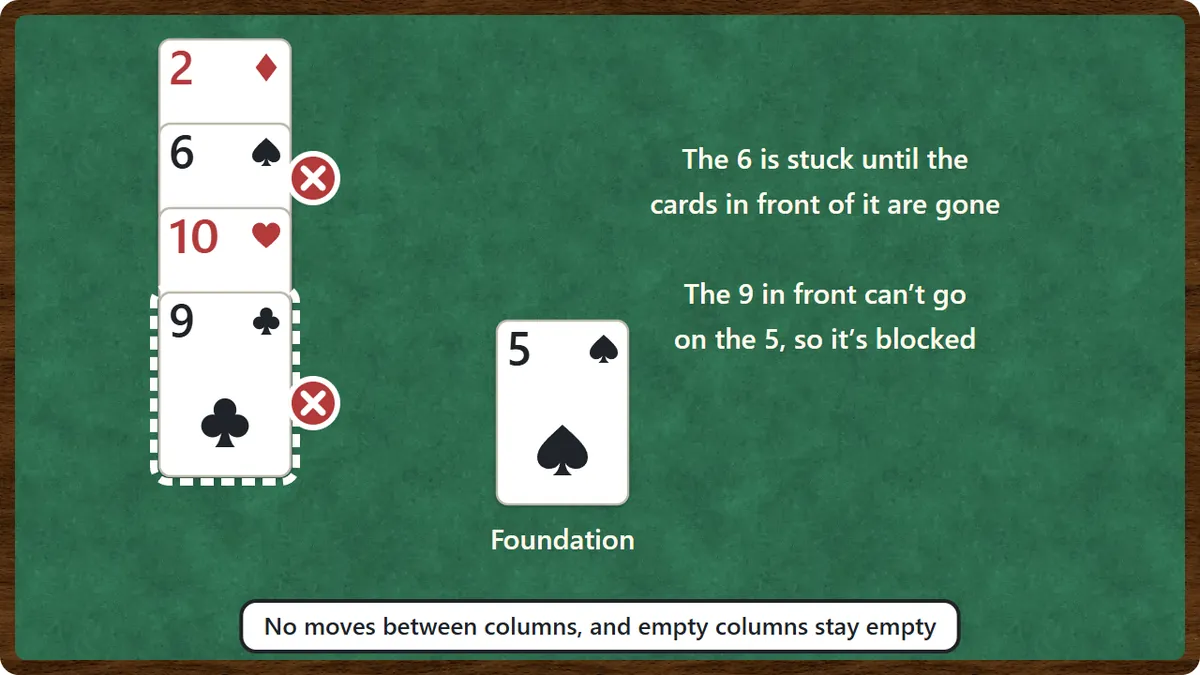
In each column, only the card at the front (the lowest card on the screen) can be played. A perfect card may be sitting one row back, but you can’t touch it until the card covering it has gone. There is no building on the columns: you never move cards from one column to another, and an empty column stays empty for the rest of the game. Because every card is face up from the start, you can see the whole problem and plan your route before you make a move.
Draw from the stock when you’re stuck

When no column card fits, turn up the next card of the stock and put it on the foundation. It can be any rank at all, and it becomes the new card to build from. You go through the stock only once; there is no redeal. When the stock is empty and no column card can be played, the game is over. You win if the columns are empty, even if stock cards are left over.
Kings, aces and the three rule sets
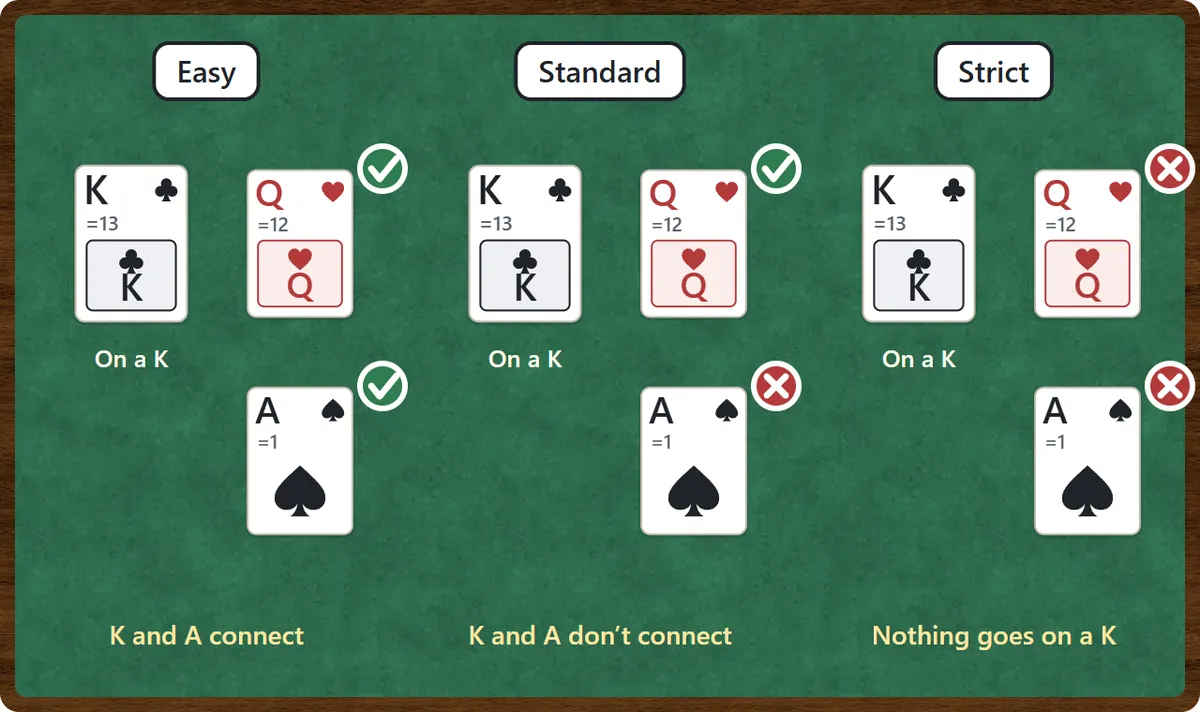
Card game books don’t agree on what happens at the ends of the ranks, so this game lets you choose. It starts on Easy, where the ranks loop around like a clock. Once you know the game, try Standard and Strict.
| Rules | Kings and aces | What it feels like |
|---|---|---|
| Easy | Connect: a queen or an ace on a king, a king or a 2 on an ace | Chains keep going around the corner. Good for first games and quick play |
| Standard | Don’t connect: only a queen on a king, only a 2 on an ace | You need to save 2s and queens for the moment an ace or king turns up |
| Strict | Don’t connect, and nothing at all on a king | The classic hard version. A king ends the chain and sends you to the stock |
Choose Custom to set the two rules separately (whether kings and aces connect, and whether anything can go on a king). With Winnable deals only turned on, you only get deals that have been confirmed clearable under the rules you picked. Turn it off to play fully random deals, including ones that can’t be cleared.
How to use this game
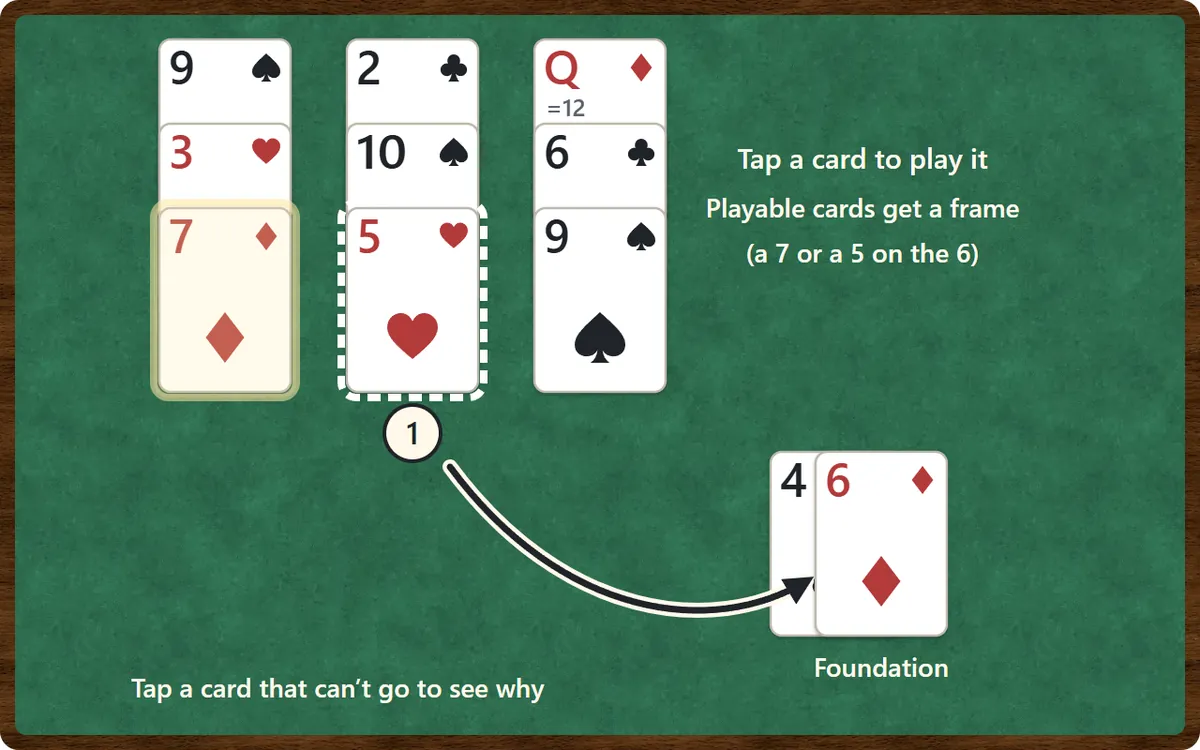
Tap or click anywhere on a column and its front card moves to the foundation. You can also drag the card onto the foundation. Cards you can play right now get a soft gold frame, and the right side of the table shows the ranks you can play next in large type (you can turn the frames off in Settings). If you tap a card that doesn’t fit, the game tells you why, for example “A 9 can’t go on a 5. You can play a 4 or a 6.” Tap the stock or press Draw to turn up a card.
Undo takes back as many moves as you like, even after you get stuck. Hint shows the next move with a white frame, and if you have already gone down a dead end, it tells you how many moves to undo to get back to a position that can still be cleared. On a keyboard, the number keys 1–7 play the front card of that column, Space draws, and Z undoes.
How Golf Solitaire scoring works: holes and par
The game is called Golf because of how it is scored. If you get stuck, your score for the deal is the number of cards left in the columns. If you clear all 35 cards, your score is minus the number of cards left in the stock, so winning with four stock cards to spare scores −4. As in real golf, the lower the better.
Each deal is one hole. Choose 9 holes to play nine deals in a row and add up the scores. The traditional target is par 45, an average of five cards left per hole. A total of zero or below is an excellent round. Scores from rounds played without hints are kept as your best round, so you can see yourself improve even on days when you don’t clear a single deal.
Golf Solitaire strategy: tips to clear more deals
1. Look past the first move
When two cards fit, say a 5 and a 7 on a 6, the choice matters. Check what each one uncovers and what you could play next: after the 5 you need a 4 or a 6, after the 7 a 6 or an 8. Every card is visible, so you can follow each path several moves ahead. Pick the one that leads to the longer chain.
2. Save the stock for when you really need it
As a rule, don’t draw while you still have a play. The stock can be used only once, and every card left in it at the end improves your score. The exception is when your only play would use up a card you’ll badly need later; then an early draw to change the rank can be the better move.
3. Dig into the longest columns
A column with five cards left takes a long time to empty, and the cards at the back stay locked away until then. When two plays look equally good, take the card from the fuller column. Deals are usually lost because one deep column still holds the cards you need.
4. On Standard and Strict, protect your 2s and queens
When kings and aces don’t connect, the only card that can follow an ace is a 2, and the only card that can follow a king is a queen. Try to keep a 2 and a queen available at the front of the columns for when an ace or king turns up. On Strict, a king ends the chain, so play kings as the last card of a run rather than in the middle.
5. Keep track of buried cards
A card near the back of a column still has to reach the foundation eventually, and it can only go on a card one rank away. If all four cards of the ranks next to it are gone before you dig it out, it will be stuck forever. Before you use up the last 7s, for example, check whether any 6s or 8s are still buried.
6. Use Undo to explore
Golf is a game of choices, and the effect of a choice often shows up ten moves later. When you get stuck, undo a few moves and try another order. Hint will tell you how many moves back you need to go to reach a position that can still be cleared.
Is every game of Golf Solitaire winnable?
No. Many deals can’t be cleared no matter how well you play, and how many depends a lot on the rules. When a computer tried every possible line of play on 10,000 deals, about 92% could be cleared on Easy, where kings and aces connect. With Standard rules the figure drops to about 46%, and on Strict only about 27% of deals can be cleared. That is why Golf has a reputation as one of the harder solitaire games to win with a random deal.
With Winnable deals only turned on, this game only gives you deals from the clearable group for your chosen rules, so the solution is always there to be found. It still takes planning: if you simply grab whichever card fits first, you will get stuck far more often than you win, even on Easy.
Golf Solitaire FAQ
Can I draw from the stock even when I have a play?
Yes. You can draw at any time. Just remember that every card you draw is one fewer card left in the stock at the end, which makes a winning score worse. Draw early only when playing the available card would ruin a later chain.
Can I move cards between columns or fill an empty column?
No. Cards only ever move from a column to the foundation, or from the stock to the foundation. Once a column is empty, it is finished.
Is Golf Solitaire the same as the Golf card game?
No. The name “Golf” is also used for a different game for two or more players, often played with six or nine cards per person, where you try to end with the lowest total in your own grid. Golf Solitaire is the one-player patience game described on this page. The two share only the golf idea of keeping your score low.
What is the Daily Deal?
The Daily Deal is one winnable deal chosen for each date and played with the Easy rules. Everyone who plays on the same day gets the same cards, so you can compare scores and times with friends and family. Win it on consecutive days to build a streak.
Can I stop and continue later?
Yes. Open the game again on the same device and browser and press Continue. Your undo history is saved too, and a 9-hole round picks up at the hole where you stopped. The game starts with the sound off; press “Sound: off” to hear sound effects when you play a card.
Does it work on a phone, tablet or Chromebook?
Yes. The game runs in any modern browser with a mouse, a keyboard or a touch screen, and all seven columns fit across a phone screen.
Where Golf Solitaire comes from
Golf is an old patience game, and nobody knows exactly when or where it was first played. Its name comes from the scoring: like a golfer, you try to finish with as few “strokes” as possible, and nine deals make a round of nine holes. Some card game writers call it One Foundation, since everything is played onto a single pile. It belongs to a family of solitaires built on the simple “one higher or one lower” rule, and it has appeared in books of card games and in computer solitaire collections for decades. The rules still vary from one source to the next, especially around kings and aces, which is why this version lets you choose. With every card in plain view, Golf rewards careful reading of the layout more than luck.