 Yorimichi Games
How to play gin rummy
Gin rummy is a card game for two players, played with a standard 52-card deck and no jokers. Each player holds ten cards. On every turn you take one card and throw one away, slowly turning your hand into melds: sets of the same rank and runs in the same suit. Whatever is left over is your deadwood. Once your deadwood adds up to 10 points or less you can knock and end the hand, and if you have no deadwood at all you have gin, which earns a bonus.
A single hand only takes a few minutes, so a game is played over several hands. Points carry over from hand to hand, and the first player to reach 100 (you can also choose 50 or 150) wins. On this page you play one-on-one against the computer. Your cards are grouped into melds automatically and your deadwood count is always on screen, which makes this a friendly way to learn gin rummy online before you play with friends.
The table
The deal and the first upcard
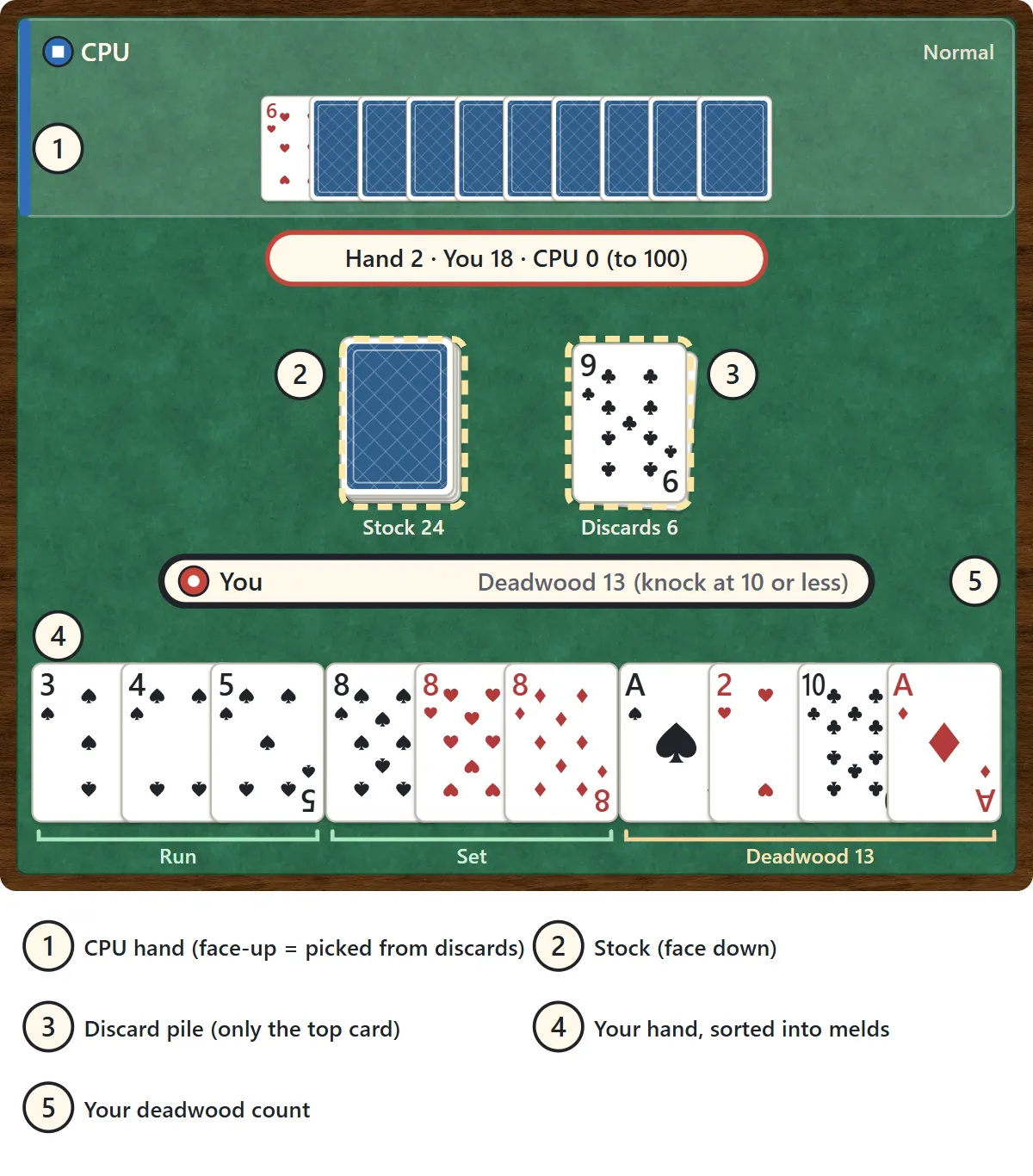
The dealer gives each player ten cards, one at a time, and turns the next card face up to start the discard pile. The rest of the deck goes face down beside it as the stock. In the Standard rules the deal alternates; in the Classic rules the winner of each hand deals the next one.
The first upcard is handled in a special way. The non-dealer decides first whether to take it. If they pass, the dealer may take it. If both players pass, the non-dealer draws the top card of the stock to begin. Whoever takes a card finishes the turn by discarding.
Gin rummy rules: sets and runs
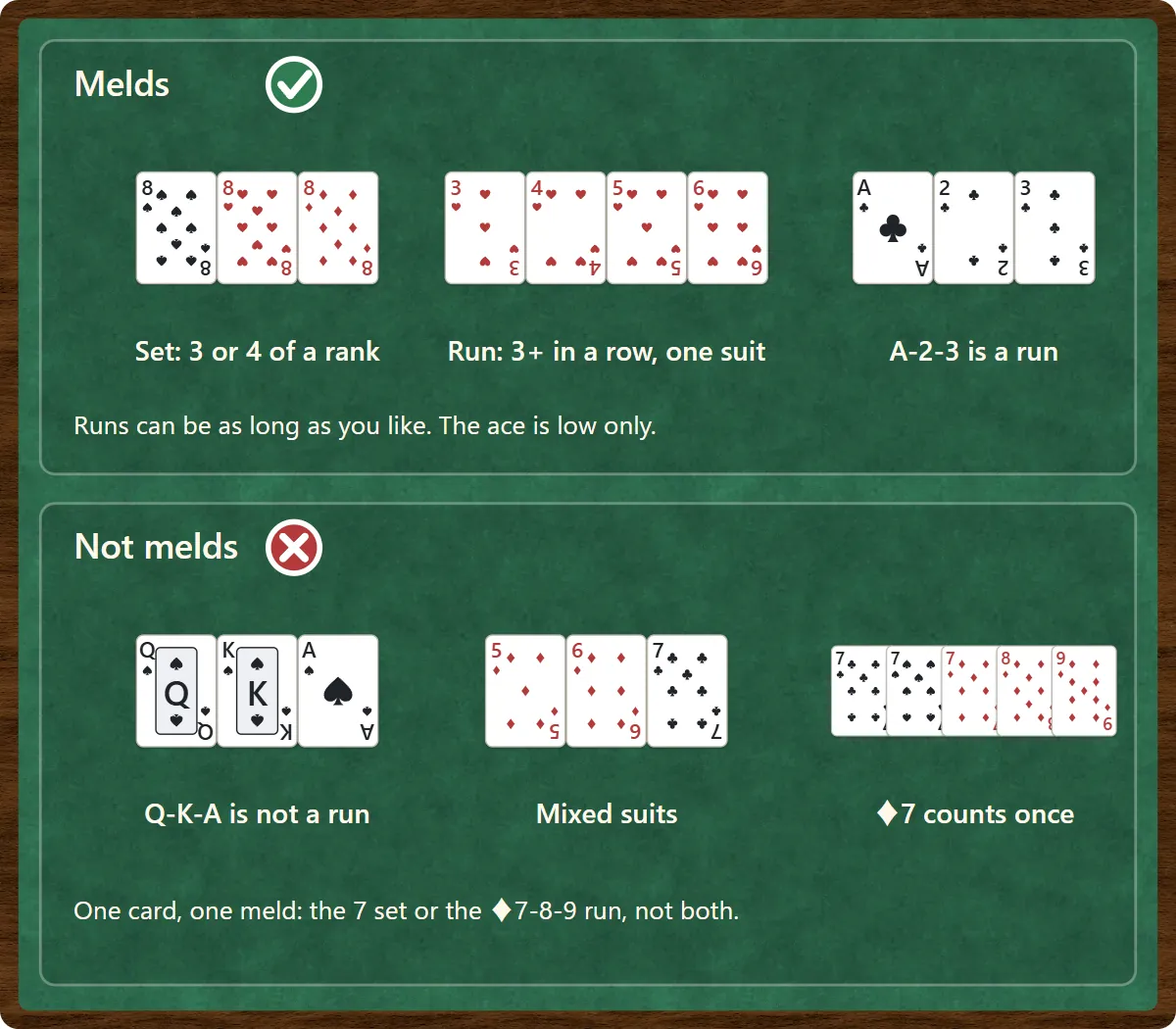
- Set (or group): three or four cards of the same rank, such as 8-8-8.
- Run (or sequence): three or more cards in a row in the same suit, such as ♥3-4-5-6.
Aces are always low. A-2-3 is a run, but Q-K-A and K-A-2 are not. Each card can only belong to one meld at a time, so if you hold three sevens plus ♦8 and ♦9, the seven of diamonds goes either into the set or into the run, not both.
Your turn: draw one, discard one
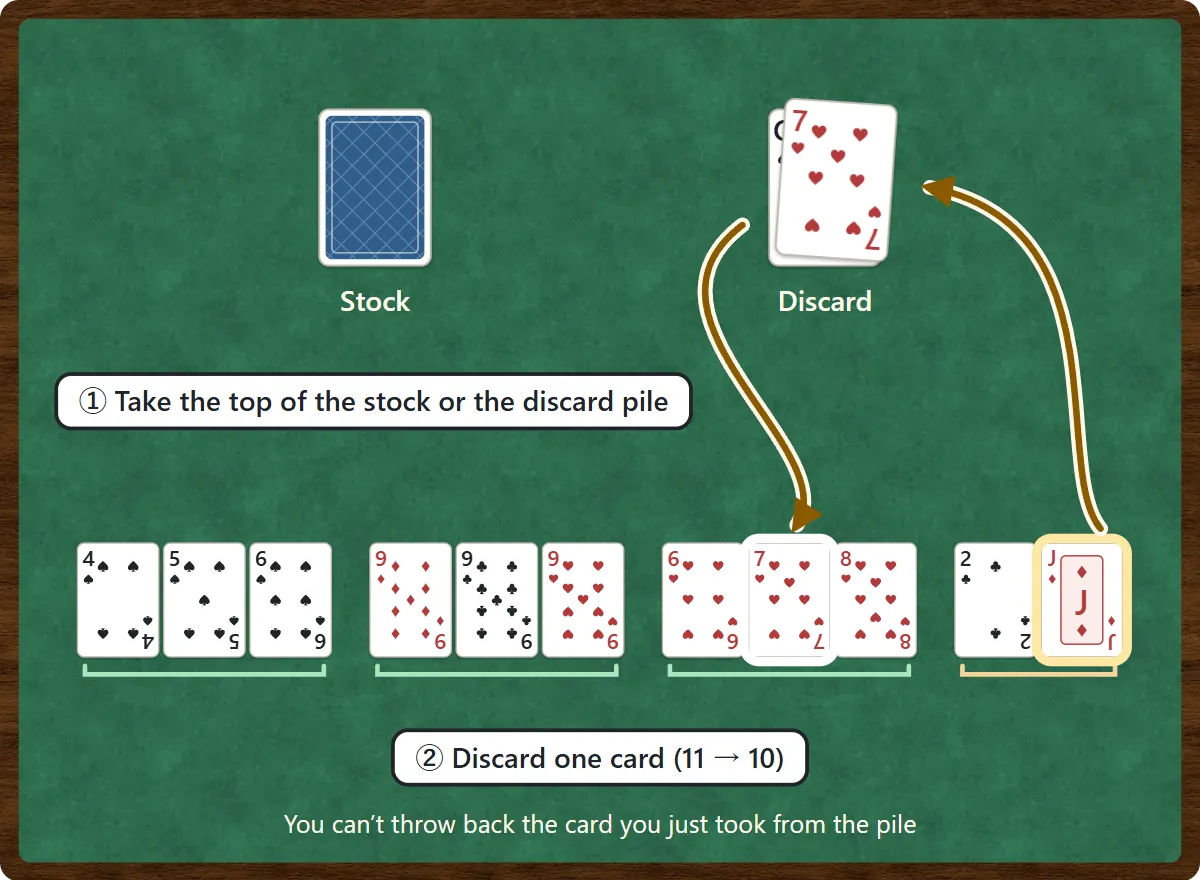
Start your turn by taking either the top card of the stock (unknown) or the top card of the discard pile (face up). You now hold eleven cards, so finish by placing one card face up on the discard pile. You may not throw back the card you just took from the discard pile on the same turn, although a card you picked up on an earlier turn is fine to discard.
Deadwood and knocking
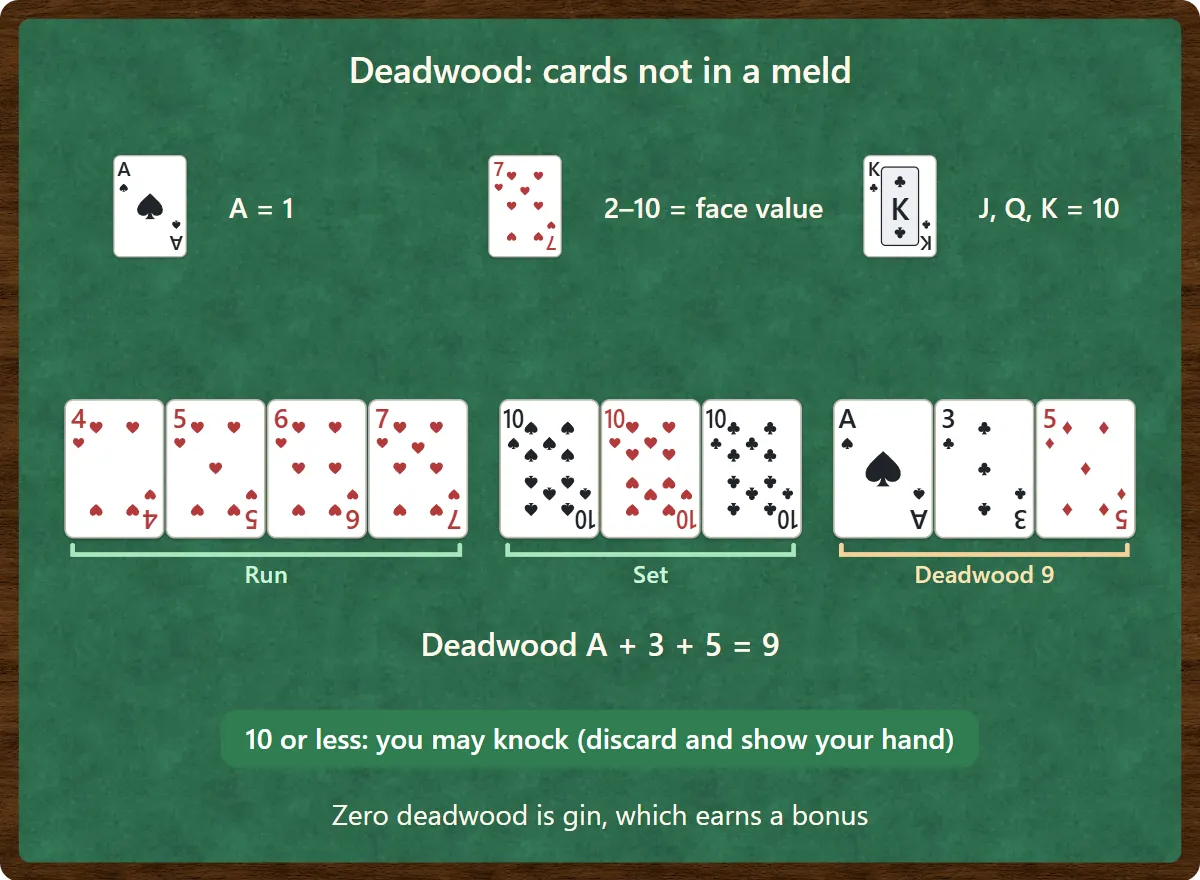
| Card | Deadwood value |
|---|---|
| Ace | 1 point |
| 2 to 10 | Face value |
| Jack, queen, king | 10 points |
If, after your discard, your deadwood totals 10 or less, you may knock. Both players then show their hands and compare deadwood. Knocking is never compulsory: you can keep playing to lower your count or to go for gin, at the risk of being caught first.
In this game, every card you could discard to knock gets a green dotted outline. Pick one and press Knock, or press Knock straight away to throw the card that leaves the least deadwood.
Laying off
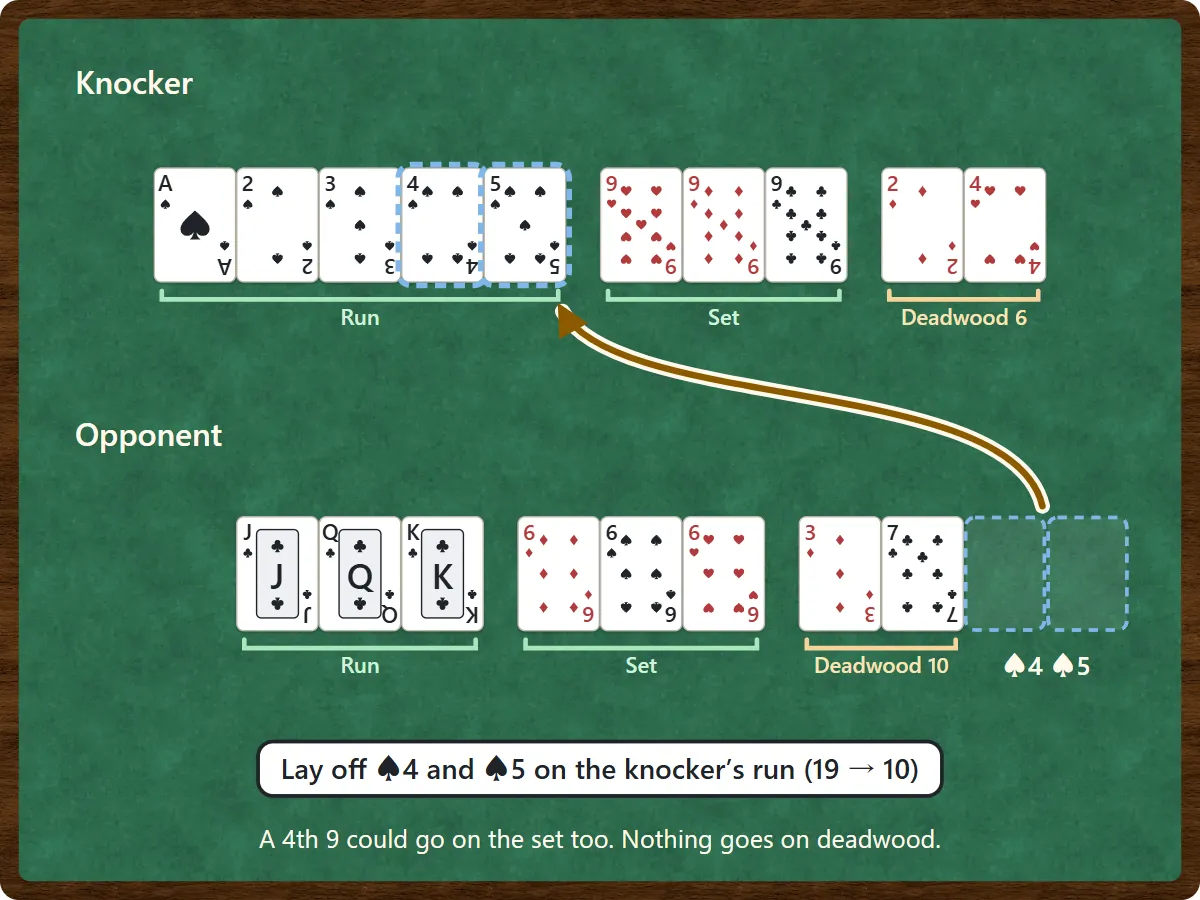
After a knock, the defending player may lay off deadwood cards onto the knocker's melds: a fourth card on a set of three, or cards that extend a run at either end (♠4 and then ♠5 on ♠A-2-3, for example). Laid-off cards no longer count against you. You can't lay off on the knocker's deadwood, the knocker never lays off on your melds, and nobody lays off against gin. Here, lay-offs are made for you in the way that leaves you the least deadwood.
Gin rummy scoring
- Knock wins: if the knocker has less deadwood, they score the difference.
- Undercut: if the defender's deadwood (after laying off) is equal to or lower than the knocker's, the defender scores the difference plus a 25-point undercut bonus.
- Gin: knocking with no deadwood scores 25 plus all of the opponent's deadwood. Gin can never be undercut, even if the opponent also has zero.
- Big gin: if all eleven cards form melds right after you draw, you go out without discarding and score 31 plus the opponent's deadwood.

If neither player has knocked by the time only two cards are left in the stock, the hand is dead: nobody scores and the same dealer deals again.
When someone's running total reaches the target, the game ends and the bonuses are added. The winner gets a game bonus of 100 (200 if the opponent never scored), and each player adds a line bonus, also called a box bonus, of 25 for every hand they won.
Gin rummy variations
Bonus values differ from book to book, so the game offers two common rule sets and a Custom option.
| Rule | Standard | Classic |
|---|---|---|
| Gin bonus | 25 | 20 |
| Undercut bonus | 25 | 10 |
| Big gin | 31 | Off |
| Line bonus | 25 a hand | 20 a hand |
| Next dealer | Alternate | Winner |
Under Custom you can also make a tie in deadwood a no-score tie instead of an undercut, set big gin to 50, and switch the game and line bonuses off so that only the points from each hand count. Shorter games to 50 are handy when you only have a few minutes.
Gin rummy strategy and tips
1. Throw high deadwood early
Kings and queens that are not in a meld cost you 10 points each if your opponent knocks. Unless they are already part of a pair or a near-run, let them go early. Low cards such as aces, twos and threes are cheap to keep.
2. Keep cards that are one away from a meld
A pair, or two suited cards in a row such as ♠5-♠6, needs only one more card to become a meld. When choosing a discard, protect these combinations, unless the cards they need have already been thrown away.
3. Watch what your opponent picks up
Cards taken from the discard pile stay face up in the computer's hand here, just as a sharp player would remember them. If it picked up ♥8, then ♥7, ♥9 and the other eights are likely to help it, so avoid throwing them.
4. Knock early
If you can knock in the first few turns, it is usually right to do it. Your opponent's hand is still messy, so the difference tends to be large. The longer you wait, the more likely you are to be undercut.
5. Mind the stock
With only a handful of cards left in the stock, chasing gin is risky because the hand ends in a dead hand at two cards. Take the safe knock when you have one.
6. Use the discard pile as information
Every card in the discard pile is gone for good. Before you wait on a run or a set, check whether the cards you need are already there.
Gin rummy FAQ
Can three or four people play?
Gin rummy is a two-player game. With three, the dealer often sits out each hand while the other two play. Four can play as two teams, each player facing one opponent and the team scores combined. This page is always you against the computer.
Do I have to knock when my deadwood is 10 or less?
No. Knocking is your choice. You can carry on and try for gin, but your opponent might knock first.
What happens if the deadwood counts are equal?
In the Standard and Classic rules the defender wins with an undercut. You can change this to a no-score tie in the Custom rules.
What is the difference between gin and big gin?
Gin means your ten cards are all melded after the discard. Big gin means all eleven cards are melded right after you draw, so you go out without discarding and score a bigger bonus.
Can I play with the keyboard?
Yes. Press S to draw from the stock, D to take the discard and P to pass on the first upcard. Use the left and right arrow keys to choose a card, Enter or Space to discard it, K to knock and B for big gin.
History of gin rummy
Gin rummy is usually said to have been created in New York around 1909 by Elwood T. Baker, with his son C. Graham Baker, as a faster form of rummy. Card game historians link it to the older Mexican game of conquian and to knock rummy. It became a Hollywood craze in the 1940s and spread around the world from there. The name is often said to be a pun on rum and gin, but nobody is quite sure.