 Yorimichi Games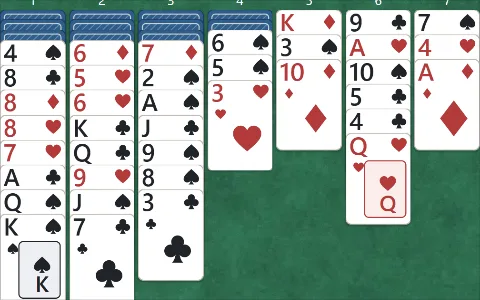
How to play Forty Thieves Solitaire
Forty Thieves is a solitaire (patience) game played with two standard decks, 104 cards in all, without jokers. It gets its name from the forty cards dealt to the table at the start. You rearrange those cards by building down in the same suit, and move every card up to the eight foundations, ace first and king last. Get all 104 cards onto the foundations and you win. The rules are short, but the original game is famous for being hard to win, so this version also offers easier rules for your first games.
The layout
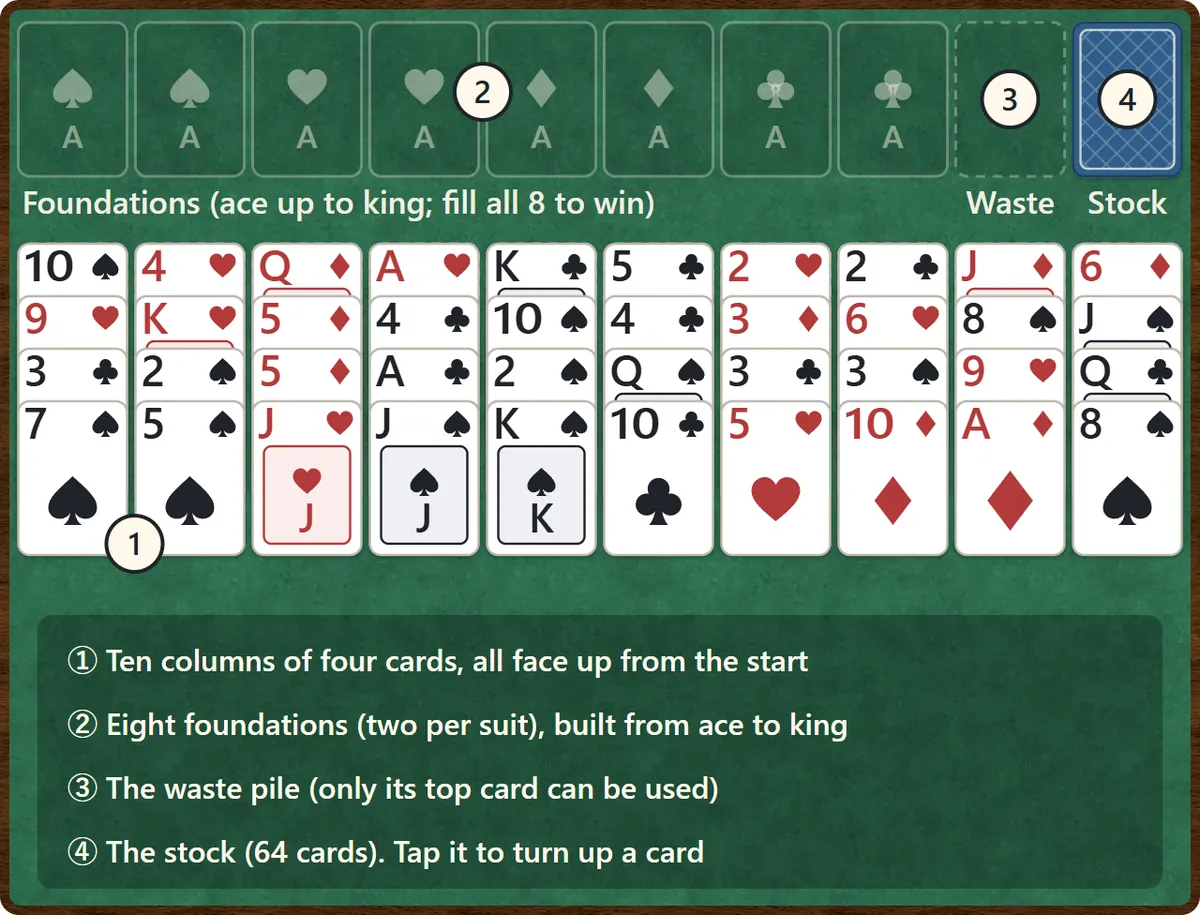
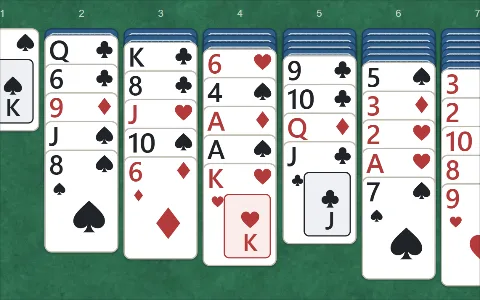
Deal ten columns of four cards each, forty cards in total. Unlike Klondike Solitaire or Spider Solitaire, every card in the columns is face up from the start, so you can see exactly where everything is and plan several moves ahead. The other 64 cards form the stock at the top right, and cards you turn up from it go on the waste pile next to it. The eight spaces at the top left are the foundations: two for each suit.
Forty Thieves rules: build down in the same suit
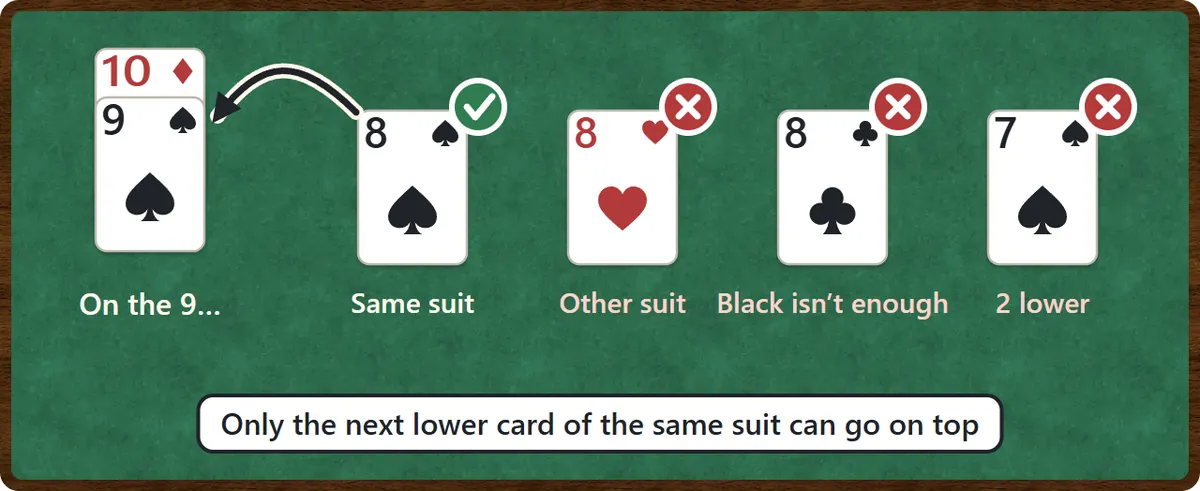
On the front card of a column you may place only the card one rank lower in the same suit. The 9 of spades takes the 8 of spades and nothing else: not the 8 of hearts, not the 8 of clubs (even though it is also black), and not the 7 of spades. Nothing can go on an ace. Having to match the suit, not just the color, is what makes Forty Thieves so much tighter than most solitaire games. The top card of the waste pile follows the same rule when you move it to a column.
Moving cards: one at a time in the original game
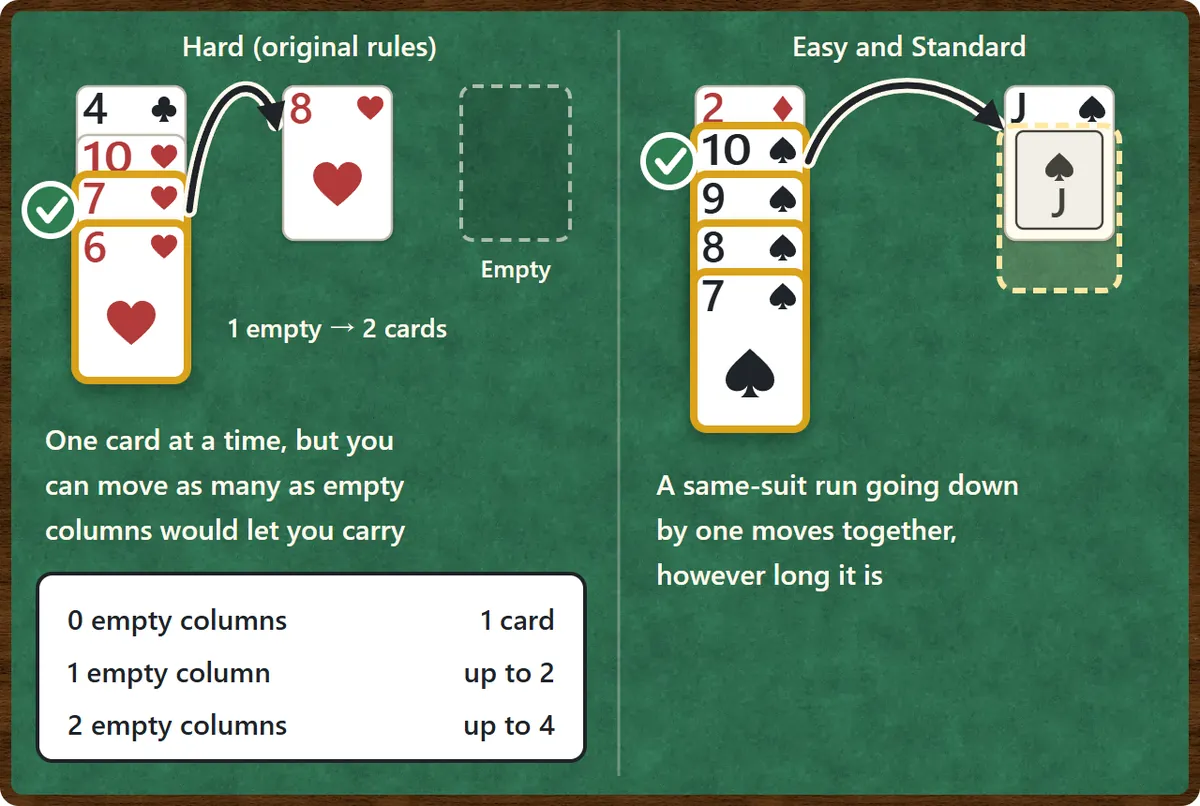
In the original game you can move only one card at a time, always the front card of a column. To shift a run of cards to another column, you have to carry it across one card at a time, using empty columns as temporary spaces. This game saves you that busywork: if the empty columns would let you carry a run, you can move it in one go (two cards with one empty column, four with two). With the Easy and Standard rules, any run that goes down by one in the same suit moves together, however long it is.
Empty columns take any card
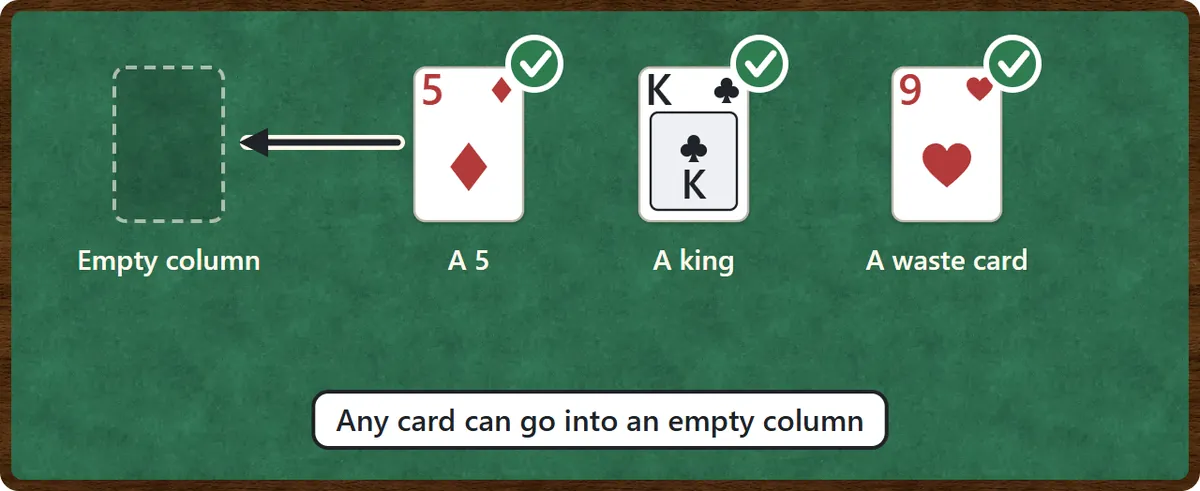
When you move every card out of a column, it becomes empty, and any card can go there. Unlike Klondike, where only a king can fill a space, you can use a middle card or a waste card. Empty columns are how you dig out buried cards and reorganize runs, so treat them as your most valuable resource.
The stock and the waste pile
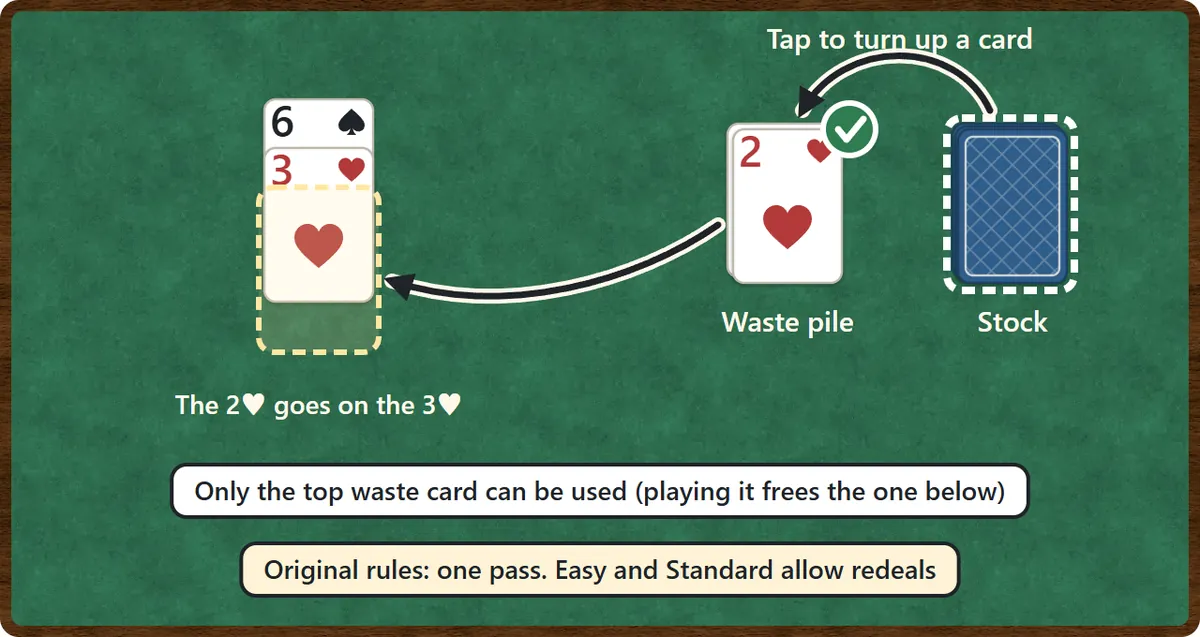
Tap the stock to turn up one card and place it face up on the waste pile. Only the top card of the waste pile can be played; once you use it, the card under it becomes available. In the original rules you go through the stock only once. Anything left buried in the waste pile at the end is lost for good, so think before you draw. With Easy and Standard rules, tapping the empty stock turns the waste pile back into a new stock so you can go through it again.
Building the foundations
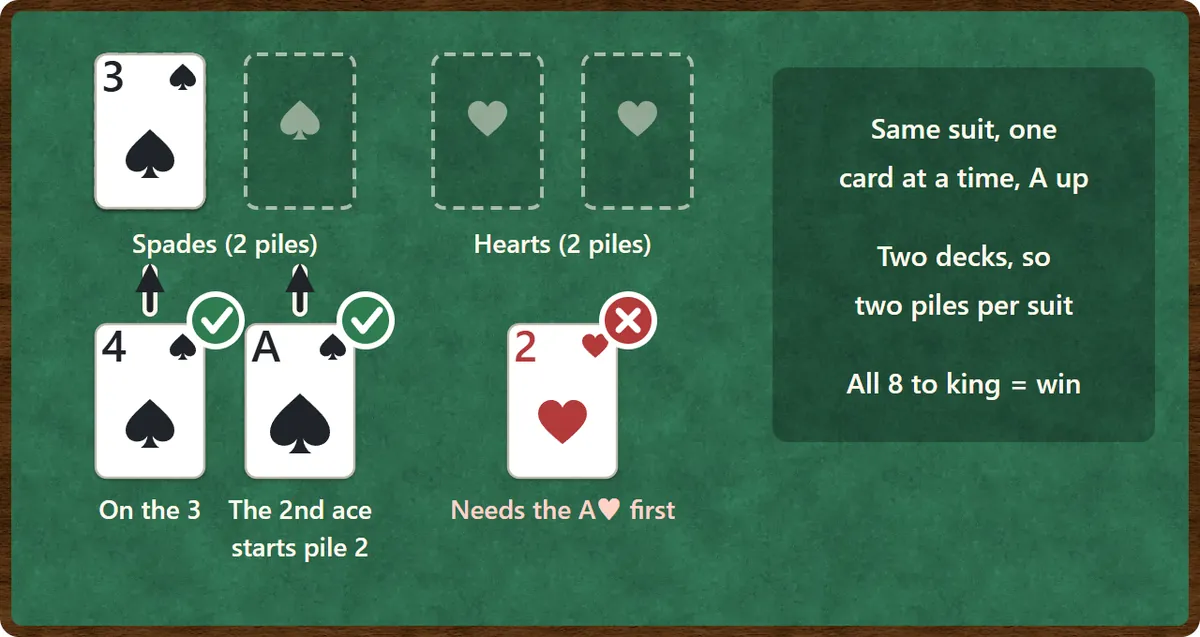
As soon as an ace appears, move it to a foundation. Each foundation is built up in one suit, one card at a time, from ace to king. Because you are playing with two decks, every suit has two foundations, and each of them needs its own ace-to-king sequence. Cards can go up from the front of a column or from the top of the waste pile. Once a card is on a foundation it stays there. Fill all eight foundations up to the king and you win.
How to use this game
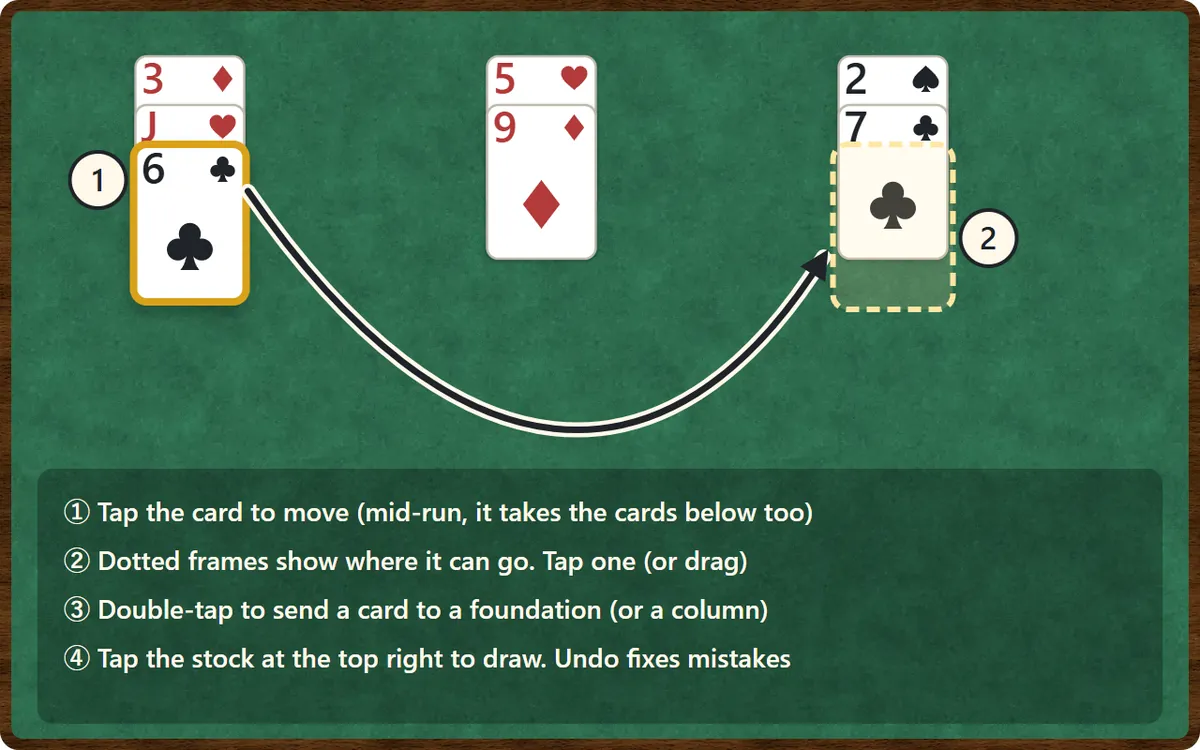
Tap or click a card to pick it up; dotted frames appear wherever it can go. Tap a framed spot to move it there, or drag the card instead. A quick double-tap sends a card to a foundation, or to a suitable column if it can’t go up yet. If a move isn’t allowed, the game tells you why, for example “Only the 8 of spades can go on the 9 of spades.”
Collect sends every card that is safe to move up (cards you will never need in the columns again) to the foundations. Turn on “Send safe cards to the foundations automatically” in Settings to have that happen after every move. Undo takes back as many moves as you like, and Hint shows the next move with an arrow. On a keyboard, 1–9 and 0 choose columns, W takes the waste card, F sends to a foundation, Space draws, Z undoes and H asks for a hint.
Choosing the rules: Easy, Standard or the original
The original Forty Thieves is so hard that players have been inventing gentler versions for well over a century. This game gives you three ready-made rule sets, plus a Custom option to mix and match.
| Rules | Moving cards · stock | What it feels like |
|---|---|---|
| Easy | Runs move together · unlimited passes | Every stock card will come round again, so you can build runs calmly. Best for your first games |
| Standard | Runs move together · up to 4 passes | You need to think about when to use the waste pile. For players who know the rules |
| Hard | One card at a time · 1 pass | The original rules. A real challenge that even strong players rarely beat |
| Custom | Either way · 1, 2, 4 or unlimited passes | Pick any combination you like |
| Game | What it does |
|---|---|
| Random deal | Deals one game with the rules you choose. With “Winnable deals only” on, every deal has a confirmed way to win |
| Daily Deal | One deal per date, played with the Standard rules. Everyone gets the same cards on the same day, so you can compare moves and times |
| Deal by number | Pick a deal by its number. The same number always gives the same cards, so you can replay a deal you liked |
Forty Thieves strategy: tips to win more games
1. Study the whole layout before you move
All forty table cards are face up, so you know from the start where the aces and 2s are. Before you touch anything, check how many cards are sitting on each ace and which columns look easiest to clear. Columns with low cards buried deep need to be broken up early.
2. Aim to empty a column
Because any card can go into an empty column, it is the strongest tool you have. Look for short columns, or columns whose cards can go straight to the foundations, and work toward clearing one. Once you have an empty column, don’t fill it right away; keep it until you really need it.
3. Put kings and queens in empty columns
If you must fill an empty column, a high card such as a king or queen is usually best, because you can build a long run of the same suit on it. A low card placed there quickly becomes a dead end that blocks the space.
4. Don’t let the waste pile grow too deep
If you draw carelessly, important cards end up buried deep in the waste pile. With a single pass through the stock, a buried card may never be playable again. Whenever a drawn card can go to a column or a foundation, play it and keep the waste pile thin.
5. Use the fact that every card appears twice
With two decks there are two copies of every card. An 8 of spades can go on either 9 of spades, and remembering this opens up more choices. The foundations work the same way: when both aces of a suit are out, you can build two piles of that suit at once.
6. When you’re stuck, go back
Undo a few moves and try a different order. Hint shows the next move, and if no way to win can be found from the current position, it tells you how many moves to go back.
Is Forty Thieves Solitaire winnable?
Not always, and with the original rules, not often. Card game writers estimate that even a skilled player wins only about one game in ten under the classic one-card, one-pass rules. Many deals simply can’t be won, however well you play. Even a computer that can see every card, including the order of the stock, finds a win in only about a quarter of original-rules deals.
That is why this game offers both easier rules and Winnable deals only. With that option on, every deal you get has already been solved under the rules you chose, so there is always a way through. Having a solution isn’t the same as finding it, though. On Hard you will still need patience, careful planning and plenty of Undo.
Forty Thieves FAQ
Why is Forty Thieves so hard?
Three rules combine against you: cards must match in suit, only one card moves at a time, and you get just one pass through the stock. Any one of these alone would be manageable, but together they leave very little room for error. Start with Easy to learn how the game flows, then move on to Standard and Hard.
What does “Winnable deals only” mean?
Before a deal is offered, a computer has already found a way to win it with your chosen rules. With the option on, every deal has at least one winning line. Finding it is still up to you, which on Hard is no small task.
Can I move cards back from a foundation?
Not in this game. In the traditional rules, cards stay on the foundations once they are there (a few variants allow taking them back). Only send a card up when you are sure you won’t need it in the columns. Collect only moves cards that are safe.
How is Forty Thieves different from Klondike and Spider?
Klondike Solitaire uses one deck, builds down in alternating colors, and only lets a king fill an empty column. Spider Solitaire also uses two decks, but completed runs of thirteen cards go to the foundations all at once. Forty Thieves builds down in the same suit, lets any card fill an empty column, and sends cards to the foundations one at a time. Its table cards are also all face up from the start.
Can I stop and continue later?
Yes. Open the game again on the same device and browser and press Continue. Your undo history is saved as well, so you can still go back to earlier moves. The game starts with the sound off; press “Sound: off” to hear sound effects when you move cards.
Does it work on a phone, tablet or Chromebook?
Yes. The game runs in any modern browser with a mouse, a keyboard or a touch screen, and all ten columns fit across a phone screen.
Where Forty Thieves comes from
Forty Thieves is also known as Napoleon at St Helena. The story goes that the French emperor played it during his final exile on the island of St Helena, though nobody knows whether that is true. The game was already described in a book of patience games in 1870, and from around the 1920s it became known in America as Forty Thieves, and also as Big Forty. The name fits the forty cards that start on the table, and it recalls the forty thieves of the old Ali Baba story. Many easier variants have grown out of it over the years, and it remains one of the most popular two-deck solitaire games.