 Yorimichi Games
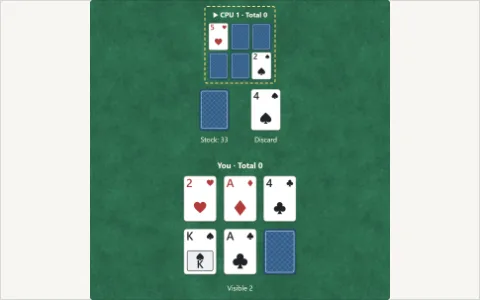
How to play Fifty-One
Fifty-One is a Japanese card game for two to five players. Everyone holds five cards, and five more lie face up in the middle of the table. On your turn you swap cards with the table, trying to make your whole hand one suit. A one-suit hand scores the total of its cards, and the best possible hand, the ace, king, queen, jack and ten of one suit, is worth exactly 51. That is where the name comes from. In Japan the game is simply called “51” (ごじゅういち, gojū-ichi).
If you know Thirty-One (also called Schwimmen), you will feel at home: Fifty-One is the same idea with five cards instead of three. You collect a suit by swapping with a shared row of face-up cards, and the real skill is deciding when to stop improving your hand and call. On this page you play against one to four computer players.
The table
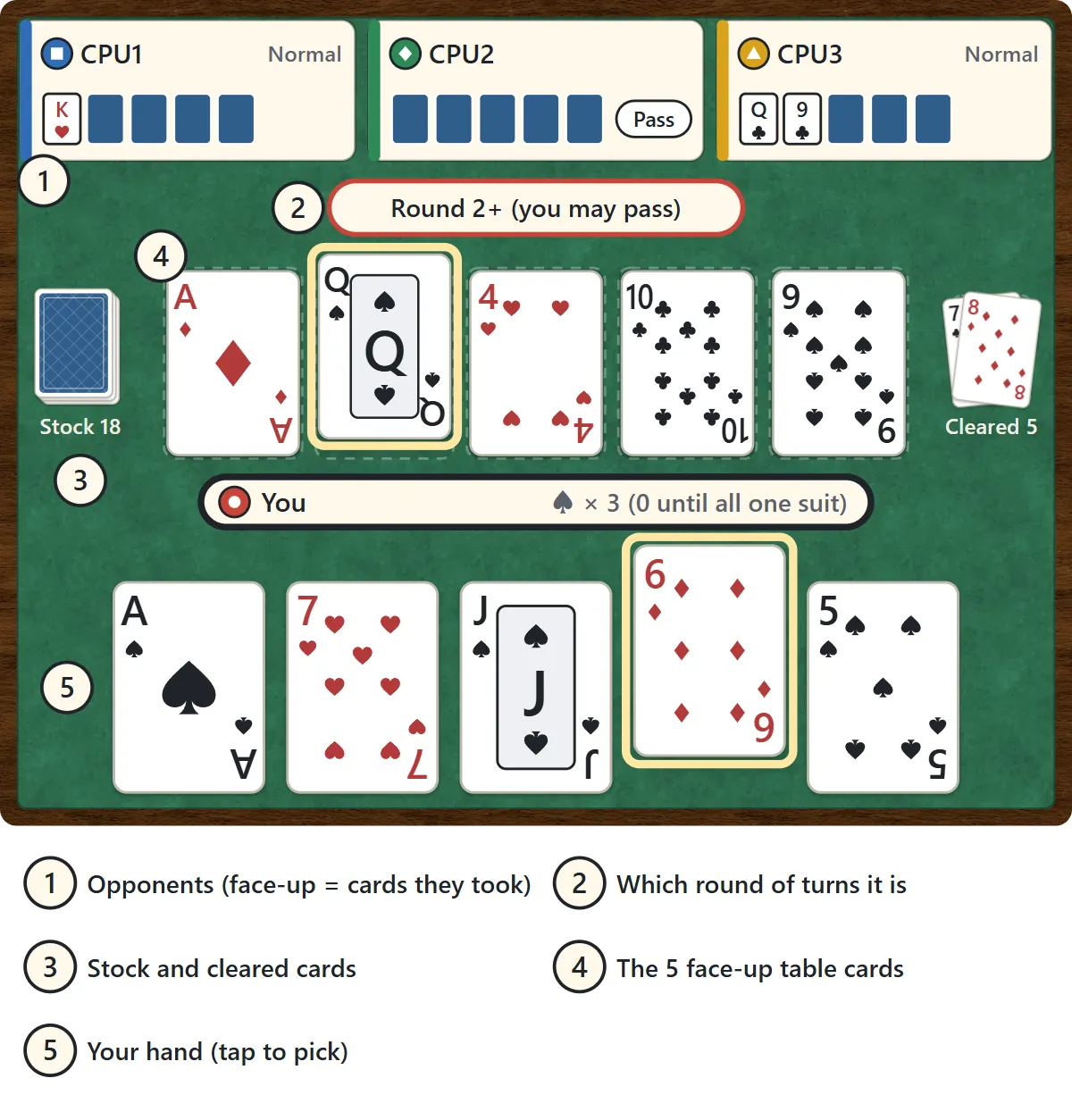
1. The deal
Use a standard 52-card deck plus one joker (53 cards). The dealer shuffles and gives each player five cards, which only they can see. Then five cards are turned face up in a row on the table; these are the table cards, open to everyone. The rest of the deck is the stock. Play starts with the player after the dealer and goes clockwise.
2. What you can do on your turn
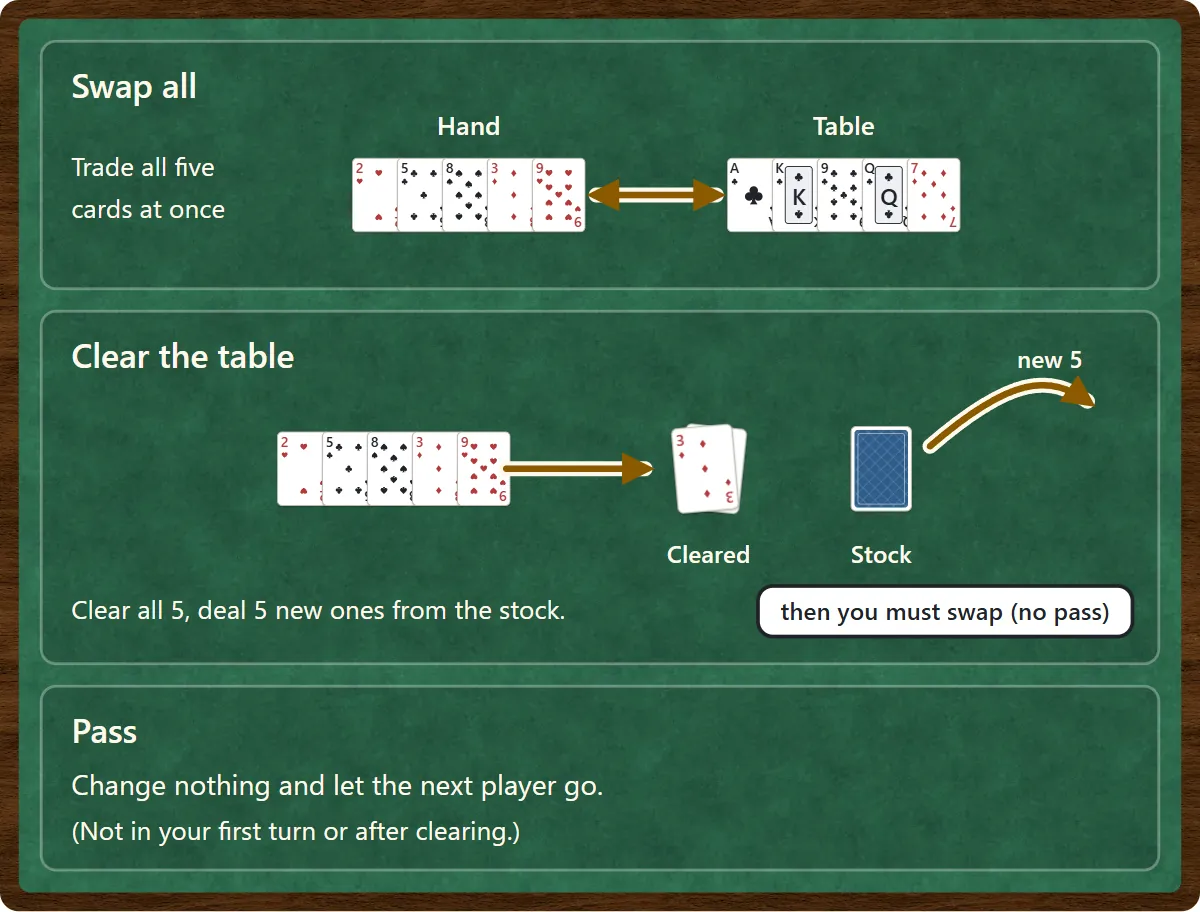
On each turn you do exactly one of these:
- Swap one: exchange one card from your hand for one table card. This is the move you will make most often.
- Swap all: exchange your whole hand for all five table cards. You can’t swap two, three or four cards; it is always one or all five.
- Clear the table: move the five table cards to the cleared pile and deal five new ones from the stock. After clearing you must immediately swap (one card or all five) with the new cards. You can’t pass or clear again on that turn.
- Pass: do nothing and let the next player go.
On your first turn you must swap one card. Passing, swapping all and clearing are only allowed from your second turn on. When the stock runs out, the cleared cards are shuffled to make a new stock.

Fifty-One card game rules: scoring
Only a hand where all five cards are the same suit scores. Add up the five cards. If even one card is a different suit, the hand is worth zero, however many aces and kings it holds.
| Card | Points |
|---|---|
| Ace | 11 |
| King, queen, jack, ten | 10 |
| 2 to 9 | Face value |
| Joker | Any suit; 11, or 10 if 11 would take the hand over 51 |
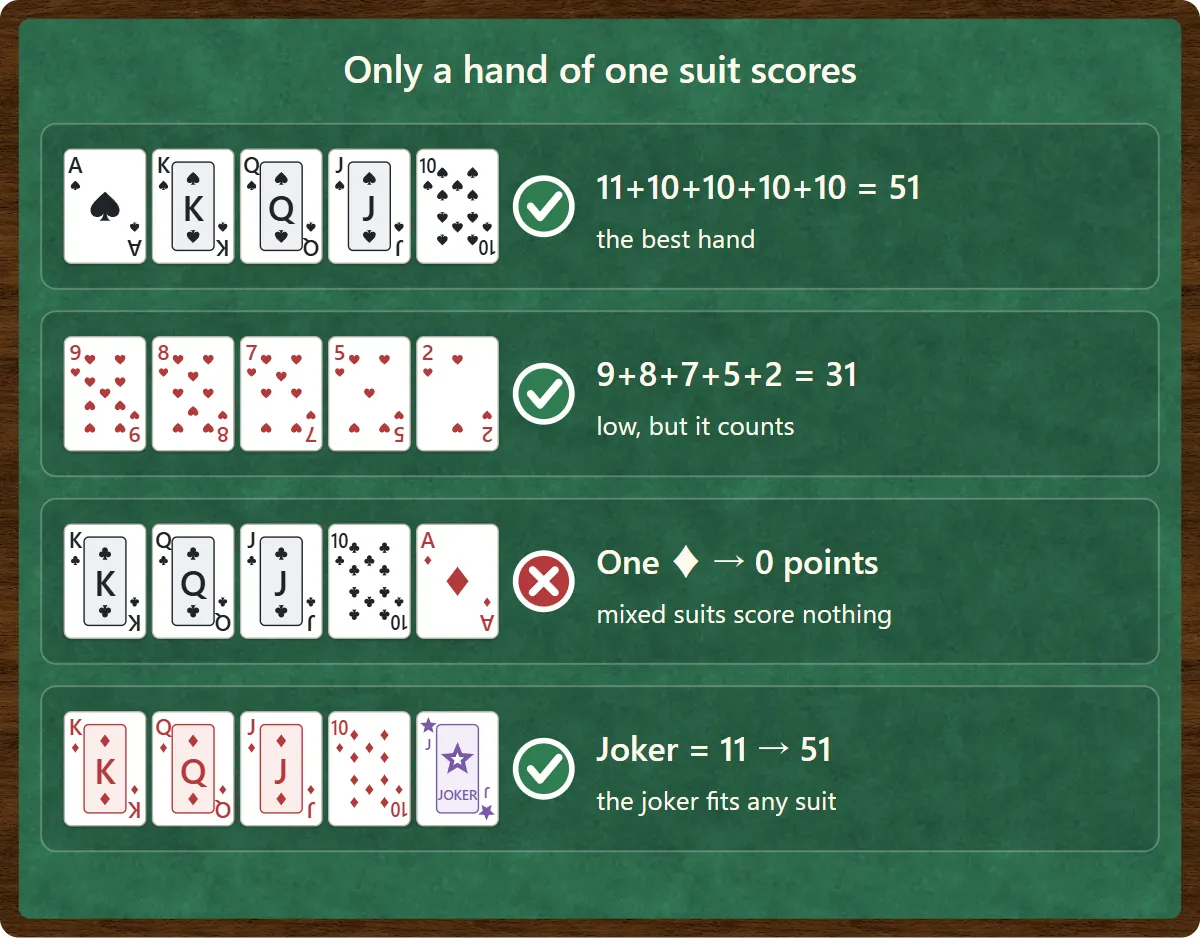
The joker fills in for whatever card your suit is missing. Without an ace in your hand it acts as the ace (11); with an ace it acts as a ten-point card, so the joker can never push a hand past 51.
Stop and Call
When your hand is one suit and totals exactly 51, that is a Stop: you win the hand straight away. (In this game Stop happens automatically the moment you reach 51.)
If your hand is one suit but below 51, you may Call after your swap. Everyone then shows their cards. If nobody has a higher score, the caller wins the hand. But if anyone has the same score or more, the call fails: the caller scores zero and drops to last place. Everyone else is ranked by points, and on equal points a hand without the joker ranks above a hand with it.
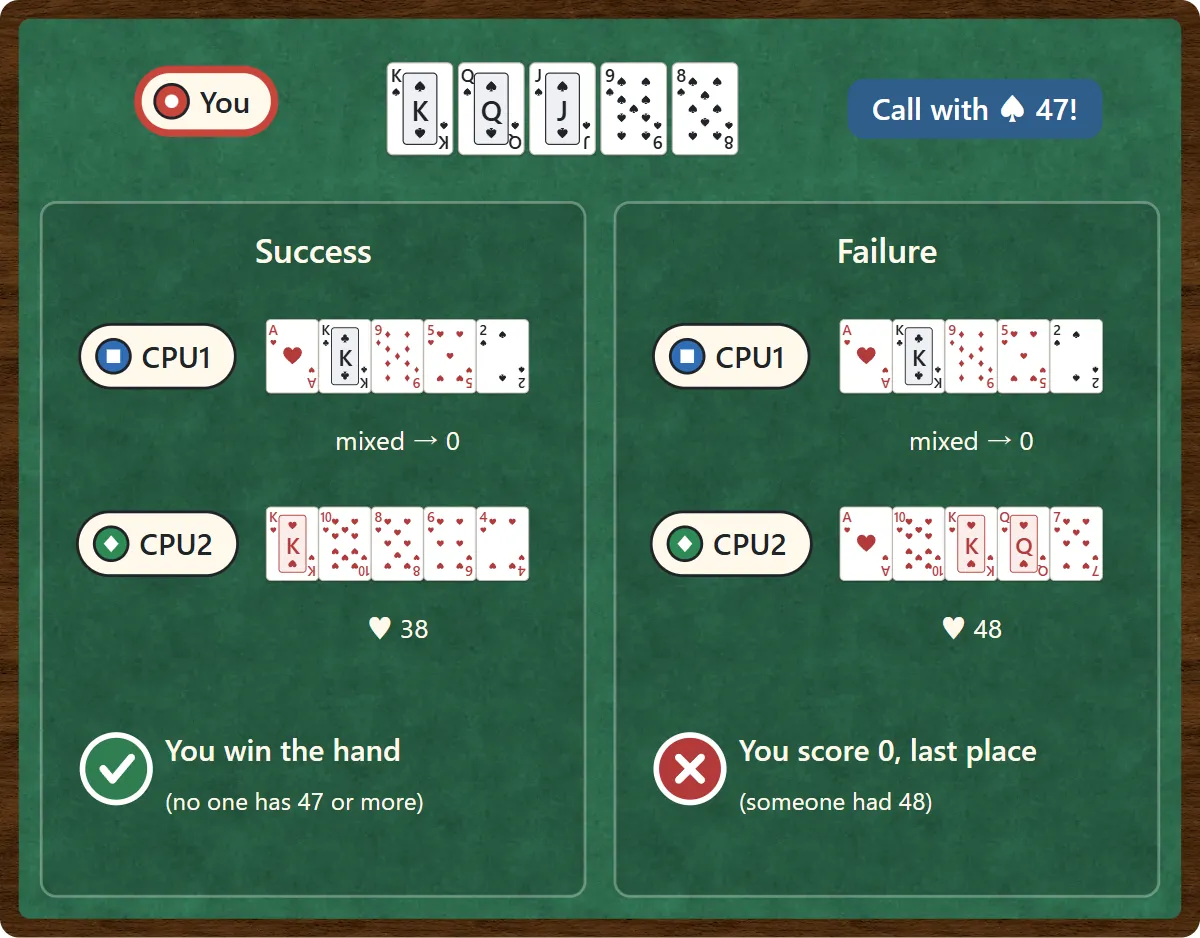
Whenever your hand becomes one suit after a swap, Call and Don’t call buttons appear. Choose Don’t call and play simply moves on.
Playing several hands
Choose 3 or 5 hands in the settings to play a longer game. Each hand’s score is added to your total (a mixed hand or a failed call adds nothing), and the highest total at the end wins. The dealer moves one seat clockwise every hand.
Fifty-One variations
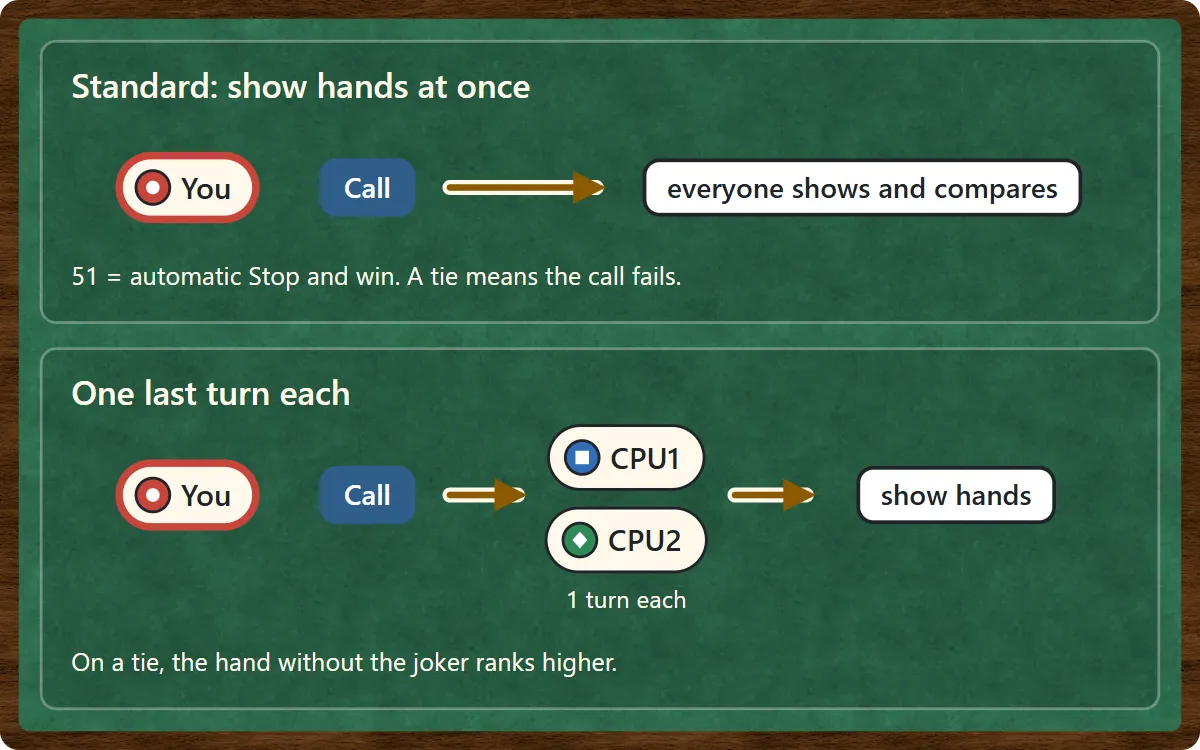
As with most family card games, the details of Fifty-One change from house to house. The biggest difference is what happens after someone stops or calls. You can pick either version here, or mix the rules yourself under Custom.
| Rules | After a call | Caller is tied |
|---|---|---|
| Standard | Show hands at once | Call fails |
| One last turn | Others play once more | No joker wins |
Custom rules
- On your first turn: swap one card only (standard), or anything but pass, which lets you swap all or clear the table right away.
- After a Stop or a Call: show hands at once (standard), or give everyone else one last turn. During that last turn a player may swap, swap all, clear or pass, but not call.
- If someone ties the caller: the call fails (standard), or the hand without the joker ranks higher. With the second rule, a caller without the joker still wins if someone ties using the joker, and a tie where both hands (or neither) hold the joker is a draw.
Fifty-One strategy and tips
1. Pick your suit early
Look at your first five cards and settle on the suit you hold the most of, or the suit where you already have an ace or a picture card. Then feed low cards of the other suits back to the table. Chasing two suits at once is the fastest way to be caught with a mixed hand when someone calls.
2. First make it one suit, then make it bigger
A mixed hand scores nothing, no matter how strong the individual cards are. Concentrate on getting all five cards into one suit first. Once you are there, keep an eye on the table: whenever a higher card of your suit shows up, trade your lowest card for it.
3. Time your call
Early in a hand, most players are still holding mixed cards, so a call in the thirties often goes through. The longer the hand runs, the more likely it is that someone else has completed a suit too. Above 40 you are usually safe, but if you can see that an opponent has taken several high cards of one suit, it may be worth waiting a turn or two.
4. Watch what others take
Every card taken from the table is taken in plain view, and this game keeps those cards face up in each opponent’s seat. If a player keeps picking up hearts, they are collecting hearts, so don’t hand them a high heart. A player holding cards of two different suits is clearly not ready yet.
5. Know when to swap all or clear
If four or five table cards share a suit, swapping all can complete your hand in one move. If there is nothing useful on the table at all, clear it and hope for better cards. Remember that clearing forces you to take something from the new row.
6. Hold on to the joker
The joker fits any suit, which makes collecting much easier. The one catch is ties: a hand with the joker ranks below an equal hand without it, so a joker hand can lose a close race.
Fifty-One FAQ
How many players can play?
Two to five here: you plus one to four computer players. With more players someone completes a suit sooner, so hands tend to be shorter and calls come earlier.
Can I swap two or three cards?
No. You can swap exactly one card, or all five.
How much is the joker worth?
The joker can be any suit and counts 11. If your hand already has an ace and 11 would take you past 51, it counts 10 instead. Reaching 51 with the joker is still a Stop.
Can I call with a mixed hand?
Not in this game. Calling is only offered when all five of your cards are one suit, because a mixed hand scores zero and could never win.
How is Fifty-One different from Thirty-One?
Thirty-One (Schwimmen) uses three-card hands and three table cards, and the best hand is 31. Fifty-One uses five cards on both sides and adds a joker. In this Japanese version you also have the Clear move to replace the whole row, and a hand only scores when all five cards are one suit.
Can I play with a keyboard?
Yes. Use ← → to move between cards, ↑ ↓ to switch between your hand and the table, and Enter or Space to pick. A swaps all, F clears the table, P passes, and when you are asked to call, C calls and N doesn’t.
Where Fifty-One comes from
Fifty-One is a long-time favorite in Japanese homes and appears in Japanese books of card games for families. Games where you trade cards with a face-up pool to collect one suit have been played in Europe for a long time; the three-card Thirty-One is the best known. Fifty-One looks like a five-card cousin of that family, but exactly when and how it reached Japan is not clear.